Enviar
 Compartir
 Detalles
 Guía
Guía

 Descargar
 Similares
 Presentación de diapositivas
 Estadísticas
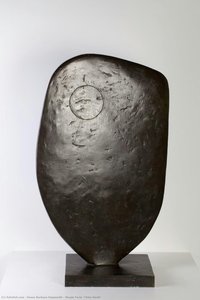
Shaft and Circle


Admire Barbara Hepworth's iconic 'Shaft and Circle' sculpture – a striking abstract form embodying balance & harmony through clean lines and organic shapes, reflecting modernist principles.
 Ver más
Descubre a Barbara Hepworth (1903-1975), pionera de la escultura moderna británica. Explora su legado abstracto y sus obras icónicas en el Hepworth Wakefield.
La obra de arte que se muestra en esta página está protegida por las leyes de propiedad intelectual, lo que significa que no podemos crear ni vender legalmente una reproducción idéntica. Esta protección se hace cumplir en virtud de acuerdos internacionales como el Convenio de Berna y por las leyes nacionales, incluidas aquellas establecidas por el Ley de derechos de autor de los EE. UU. - Título 17.
Este método cumple plenamente con las normativas de derechos de autor, ya que no implica la copia ni la duplicación de la obra protegida. En su lugar, se trata de una reinterpretación creativa: una nueva pintura influenciada por la original, pero que no es idéntica a ella.
Giclée / Impresión de arte
Impresiones giclée o en lienzo de calidad de museo con producción rápida y opciones de acabado flexibles. ( Comprar pintura hecha a mano Cambiar a imagen digital)




































Tamaño estándar
a medida
CM
INCH
Elija entre nuestros tamaños predefinidos que respetan las proporciones originales de la obra.
Loading sizes...

ancho
altura
Introduzca el ancho y el alto que necesite para adaptarse a su marco o pared. Una impresión solo puede recortarse, nunca hacerse más grande que la imagen original, por lo que un tamaño con una forma distinta perderá parte de la obra. Le enviaremos una maqueta digital para su aprobación antes de realizar cualquier impresión. La imagen que se muestra en esta página no refleja el recorte real; solo la maqueta lo hace.
Envío a todo el mundo () en 2 semanas en lugar de las 4/5 semanas estándar. (27 octubre)

Envío exprés gratuito a todo el mundo

Lienzo de lino de alta calidad

Seguro de envío total

Garantía de reembolso de aranceles aduaneros

Garantía de fidelidad cromática exacta

Política de devolución de 100 días (solo por defectos)

Garantía de devolución del 100% del dinero

Descuento por cantidad
 La opción de vidrio solo está disponible en tamaños inferiores a 110 cm.

Shaft and Circle
Giclée / Impresión de arte
Dimensiones de la reproducción
-


Precio total final
€ 61
A Vertical Echo: Barbara Hepworth’s “Shaft and Circle”
Barbara Hepworth's "Shaft and Circle," created in 1972, isn’t merely a sculpture; it’s an invitation to quiet contemplation. Standing before this arresting form – a towering shaft of polished concrete punctuated by a perfectly circular aperture – is akin to entering a sacred space. The piece immediately commands attention with its stark simplicity and the profound sense of upward movement it evokes. Hepworth, a pivotal figure in 20th-century British sculpture, masterfully distilled her signature style into this work: an exploration of form’s inherent qualities, divorced from representational concerns. It's a testament to her belief that sculpture could be experienced not just visually, but through touch and the subtle shifts in light and shadow.
The material itself – likely cast concrete, though Hepworth often worked with stone as well – is treated with an almost reverent attention. The surface is flawlessly smooth, reflecting the surrounding environment while simultaneously maintaining a sense of contained solidity. This deliberate contrast between smoothness and mass speaks to the core of Hepworth’s philosophy: she sought to capture the essence of materials themselves, revealing their inherent textures and geometries. The scale of the sculpture – approximately six feet tall – further amplifies this effect, drawing the viewer upwards into its embrace.
Roots in Epirus and Mycenaean Tradition
To fully appreciate “Shaft and Circle,” it’s crucial to understand Hepworth's artistic lineage. Her early influences stemmed from her travels through Italy and Greece, particularly a deep immersion in the archaeological sites of Mycenae. The shaft tomb tradition prevalent in Bronze Age Greece – elaborate burial chambers dug vertically into the earth, often containing grave goods – provided a foundational inspiration for her work. These tombs, built by elite societies, weren’t simply markers of death; they were statements of power and belief, reflecting a complex cosmology centered around ancestry and the afterlife. Hepworth's sculpture echoes this spirit, suggesting an upward journey towards something beyond the material world.
Interestingly, similar shaft tombs have been found in Bronze Age China, demonstrating a surprisingly widespread cultural practice across Eurasia. This shared heritage underscores the universal human impulse to create enduring monuments and explore questions of mortality and transcendence. Hepworth’s work can be seen as a contemporary reimagining of these ancient traditions, translated into the language of abstract form.
The Language of Form: Circularity and Verticality
The composition of “Shaft and Circle” is meticulously balanced between two fundamental principles: verticality and circularity. The shaft itself rises directly upwards, creating a powerful sense of momentum and aspiration. This upward thrust is counterbalanced by the perfectly formed circle cut into its midsection – an element that introduces ambiguity and invites interpretation. The circle can be seen as representing wholeness, continuity, or perhaps even a portal to another dimension. It’s a subtle yet potent symbol that adds layers of meaning to the sculpture's overall impact.
Hepworth was deeply interested in exploring the relationship between form and space. She believed that sculpture should not simply occupy physical space but also create an emotional resonance within the viewer. “Shaft and Circle” achieves this beautifully, prompting a sense of stillness and introspection. The negative space created by the circular aperture is just as important as the solid mass of the shaft itself, contributing to the sculpture’s dynamic balance.
A Legacy of Minimalism and Emotional Resonance
“Shaft and Circle” exemplifies Hepworth's commitment to minimalism and her profound understanding of materials. It’s a work that rewards careful observation and invites repeated contemplation. Her sculptures, often described as “non-objective,” are nonetheless deeply expressive, communicating complex ideas about form, space, and the human condition. Today, "Shaft and Circle" remains a powerful testament to Hepworth's artistic vision – a timeless exploration of fundamental geometric principles and their capacity to evoke profound emotional responses.
Preguntas y respuestas
¿Qué edad tenía Barbara Hepworth cuando creó "Shaft and Circle"?
Barbara Hepworth creó "Shaft and Circle" a la edad de 69. El artista nació en 1903 y la obra data de 1972.
¿De dónde provienen los visitantes de "Shaft and Circle" de Barbara Hepworth?
Existe una página de Estadísticas para "Shaft and Circle". En ella se detallan las visitas mensuales de la obra y de otras piezas del artista, con desgloses por país e idioma.
¿Es "Shaft and Circle" representativo de la temática habitual de Barbara Hepworth?
Los temas recurrentes de Barbara Hepworth incluyen abstraction, modernism, geometry, surrealist, exploration, balance, harmony, sculptural form; "Shaft and Circle" se centra en sculpture, abstraction, form, circle, geometric, modernism, balance.
Biografía del artista
Primeros años y educación
Dame Barbara Hepworth, una reconocida escultora e artista inglesa, nació el 10 de enero de 1903 en Wakefield, Yorkshire. Asistió a la Escuela de Arte de Leeds desde 1920 y posteriormente ganó una beca del condado para estudiar en el Royal College of Art (RCA) en Londres desde 1921 hasta que fue galardonada con el diploma en 1924.Carrera artística
- El trabajo de Dame Barbara Hepworth ejemplifica el modernismo, particularmente la escultura moderna. Fue una de las pocas artistas femeninas en lograr prominencia internacional.
- En 1933, cofundó el movimiento artístico Unit One con Ben Nicholson, Paul Nash y otros, buscando unir el surrealismo y la abstracción en el arte británico.
- El trabajo temprano de Hepworth se caracterizó por la abstracción y su participación con el movimiento artístico parisino, Abstraction-Création.
Obras notables y exposiciones
- Oval Form (Trezion), una escultura de bronce, forma parte de la colección del Museo Kimball de Arte en Fort Worth, Estados Unidos. (ver en TopImpressionists)
- Two Forms, una escultura, se exhibe en The Hepworth Wakefield en Wakefield, Reino Unido. (ver en TopImpressionists)
- Totem, una escultura de mármol, también forma parte de la colección de The Hepworth Wakefield. (ver en TopImpressionists)
Legado y colecciones de museos
Barbara Hepworth's work is widely recognized, with her sculptures and paintings forming part of various museum collections worldwide. The Hepworth Wakefield, named after the artist, houses numerous masterpieces from renowned artists, including Hepworth's own works. (descubra más sobre The Hepworth Wakefield en TopImpressionists)Conclusión
Dame Barbara Hepworth's pioneering work in modern British sculpture has left an indelible mark on the art world. Her legacy continues to inspire artists and art enthusiasts alike, with her works remaining a testament to her innovative spirit and artistic genius. más sobre Barbara Hepworth en Wikipedia
Barbara Hepworth
1903 - 1975 , Reino Unido
Datos clave
- Artistas Influyentes: ['Abstracción-Creación']
- Fecha De Nacimiento: 10 de enero de 1903
- Legado Artístico: Inspiró a artistas y entusiastas.
- Lugar De Nacimiento: Wakefield, Reino Unido
- Movimiento Artístico: Modernismo, Escultura moderna
- Nacionalidad: Británica
- Nombre Completo: Barbara Hepworth
- Nombres Alternativos: Dame Barbara Hepworth
- Obras Notables:
- Oval Form (Trezion)
- Two Forms
- Totem
Artículos relacionados

The Beauty of Less: A Sophisticated Guide to the Soul of Minimalist Art and Geometric Harmony
Discover the profound elegance of minimalist art. Explore how geometric abstraction and the beauty of reduction create serene, sophisticated spaces through our expert guide to finding soul and harmony in every line and shape.
Explore obras de arte organizadas por temas, estilos y características.