

Shown: · With its frame:
 Ver en contexto
 Enviar
 Compartir
 Detalles
 Guía
Guía

 Descargar
 Similares
 Radiografía
 Presentación de diapositivas
 Q&A
Q&A Estadísticas

€ 237
Reproducción al óleo hecha a mano
Óleo sobre lienzo pintado a mano en el tamaño y marco de su elección, realizado por encargo por nuestros artistas. ( Cambiar a impresiones Cambiar a imagen digital)
Size
·Tamaño estándar
a medida
CM
INCH
Elija entre nuestros tamaños predefinidos que respetan las proporciones originales de la obra.
Loading sizes...

ancho
altura
Indique el ancho y el alto que necesite para adaptarse a su marco o pared. Al tratarse de una obra pintada a mano, si requiere un tamaño con una proporción distinta, el artista puede pintar un poco más alrededor de la imagen o recortarla ligeramente; usted elige. Le enviaremos una maqueta digital para su aprobación antes de comenzar la pintura. La imagen que se muestra en esta página no refleja el resultado real; solo la maqueta lo hace.
 Leer más información
Finish
·
White €1

Blurside €1

Extended €1

P118B €10

P118H €10

P118W €10

P438Z €10

P508JH €12

P508YH €12

P805H €10

P805Z €10

P919BZ €10

P919G €10

P919XJ €10

P959ZH €10

P968JZ €12

W106C €8

W218G €10

W218JH €8

W218Y €10

W307PJ €10

W316G €10

W316PJ €8

W316Y €10

W398PJ €8

W4111J €10

W500HY €15

W500JH €15

W692G €12

W849H €8

W940BG €15

W953PJ €8

H24-GOLD €30

H24-SILVER €30

H36-GOLD €45

H36-SILVER €45
Shipped in a protective tube, ready for your own framer.
Above 105 cm the frame is shipped as a kit for a professional framer — read the details.
Extras
optionalWhat do the extras include?
Examples of what can be changed: Replace face with customer photo; Add pet (e.g., replace cat with dog); Include hidden message in background; Change background landscape or elements.
After order, TopImpressionists.com team will email client for instructions and provide a mockup preview
After order, TopImpressionists.com team will email client for instructions and provide a mockup preview
Envío a todo el mundo () en 3-4 semanas en lugar de las 5 semanas estándar. (29 octubre). Sin comprometer la calidad.
Barniz protector
Cartela
Detalles de la placa de bronce grabada
This elegant plaque features the artist's name and the title of the artwork, finely engraved for a timeless presentation.
It is made from bronze with a refined, elegant finish. The text is precisely laser-engraved for a sharp and permanent result. Measuring 9x2 cm, the plaque is compact yet easy to read. It's built to be durable and scratch-resistant, offering a professional, museum-quality look. Mounting is simple thanks to the included adhesive backing.
Detalles de la placa de acrílico transparente
The plaque includes essential engraved details such as the artist's name, the title of the artwork, the date it was created, the type of media used-like oil on canvas or watercolor-a brief description of the piece, and a QR code that links to the complete artwork information.
It is crafted from clear acrylic, offering a sleek, modern appearance. The text is UV-engraved in black to ensure strong visual contrast. With a size of 10x15 cm, it ensures optimal readability. It comes equipped with two metal hooks for secure wall mounting. The plaque is designed to be weather-resistant, making it suitable for various environments, and it includes interactive features that work seamlessly with smartphone scanning.
Detalles de la placa de acrílico negro
This elegant plaque includes engraved information such as the artist's name, the title of the artwork, the date it was created, the type of media used (like oil on canvas or watercolor), a short description of the artwork, and a QR code for quick access to more information.
The plaque itself is made from refined black acrylic with a premium finish. The text is laser-engraved in white for high contrast and readability. Its size is 10x15 cm, designed to be easy to read. It comes with two metal hooks for professional mounting. The design is sleek and fits any interior style. It is also weather-resistant and durable, with built-in digital integration for mobile compatibility.
La opción de vidrio solo está disponible en tamaños inferiores a 110 cm.
 La opción de vidrio solo está disponible en tamaños inferiores a 110 cm.
- Envío exprés gratuito a todo el mundo
- Lienzo de lino de alta calidad
- Seguro de envío total
- Garantía de reembolso de aranceles aduaneros
- Garantía de fidelidad cromática exacta
- Política de devolución de 100 días (solo por defectos)
- Garantía de devolución del 100% del dinero
- Descuento por cantidad


Descripción del objeto
Discover Camille Pissarro’s "untitled (2134)", an evocative Impressionist landscape of overgrown gardens & melancholic beauty. Explore its layered style & symbolic depth.
Biografía del artista
Explore la obra de Camille Pissarro: paisajes e escenas de la vida cotidiana impresionistas y neoimpresionistas. Una figura clave que influyó a Van Gogh, Cézanne y más.
About the painting
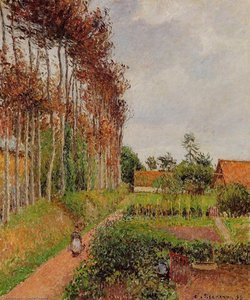
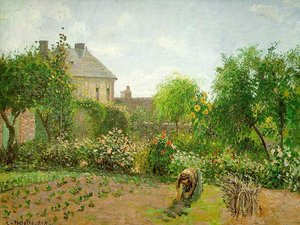
A Symphony of Light and Decay
In the quiet corners of the Impressionist movement, few works capture the delicate tension between nature’s vitality and the inevitable passage of time as poignantly as Camille Pissarro’s untitled (2134). This evocative landscape invites the viewer into a secluded, overgrown garden where the boundaries between the man-made and the organic begin to blur. At first glance, one is struck by the lush, dense vegetation that dominates the foreground, a vibrant tapestry of greens, deep browns, and soft blues that pulse with life. Yet, as the eye wanders deeper into the composition, it encounters a sense of melancholic beauty; a crumbling stone building stands partially obscured by encroaching foliage, serving as a silent witness to the slow reclamation of architecture by the earth. It is a scene that feels both intimate and vast, capturing a fleeting moment of stillness in an ever-changing world.
The technique employed here is a masterclass in the Impressionist spirit, characterized by Pissarro’s signature loose, expressive brushwork. Rather than relying on sharp, clinical outlines, the artist utilizes a layered application of oil paints to build texture and luminosity. These visible strokes do not merely represent leaves or stone; they convey movement and atmosphere, suggesting the gentle rustle of wind through the thicket and the diffused, soft light of an overcast day. This approach creates a shallow depth of field that pulls the observer into the immediate surroundings, making the viewer feel as though they are sitting amidst the wildflowers alongside the solitary figure nestled in the greenery. The interplay of light and shadow is subtle, avoiding harsh contrasts to instead favor a soft, atmospheric glow that lends the entire piece a dreamlike, almost ethereal quality.
Symbolism and the Impressionist Legacy
Beyond its aesthetic splendor, untitled (2134) carries a profound emotional weight, touching upon themes of memory, solitude, and the cyclical nature of life. The presence of the woman seated amidst the wild growth introduces a narrative element of quiet contemplation. She becomes a symbol of the human connection to the natural world—a figure of stillness within a landscape of constant growth and decay. The juxtaposition of the decaying stone structure with the flourishing flora serves as a powerful memento mori, reminding us that while human endeavors may fade, the rhythms of nature are eternal. For the collector or interior designer, this piece offers more than mere decoration; it provides a focal point for reflection, bringing a sense of historical depth and soulful tranquility to any curated space.
To possess a reproduction of such a work is to bring a fragment of art history into the modern home. Pissarro, a pivotal figure who mentored legends like Cézanne and Van Gogh, had an unparalleled ability to find the extraordinary within the ordinary. This painting stands as a testament to his devotion to observing the subtle shifts in light and the quiet dramas of the landscape. Whether placed in a sunlit gallery or a cozy study, this artwork radiates a timeless elegance, making it an ideal choice for those who appreciate art that speaks to the heart through its texture, color, and profound emotional resonance.
Preguntas y respuestas
¿Qué nivel de saturación e intensidad presenta "untitled (2134)" de Camille Pissarro?
"untitled (2134)" de Camille Pissarro presenta una saturación de Subtle Color y una intensidad de Balanced.
¿Para qué se recomienda una reproducción de "untitled (2134)" de Camille Pissarro?
Se recomienda una reproducción de "untitled (2134)" de Camille Pissarro para Mood, basándose en el tema, la atmósfera y los colores de la obra.
¿Dónde puedo ver una vista previa de "untitled (2134)"?
Puedes ver una vista previa de "untitled (2134)" de Camille Pissarro en la página de Vista previa de la obra de la obra.
Quick facts and art quiz
About Camille Pissarro

Camille Pissarro
1830 - 1903, Estados Unidos de América
Biografía del artista
Camille Pissarro: Una Vida en el Arte
Primeros Años y Formación
Jacob Abraham Camille Pissarro nació el 10 de julio de 1830, en Charlotte Amalie, San Tomás (entonces las Islas Vírgenes Occidentales danesas, ahora las Islas Vírgenes de EE. UU.). Su padre, Frederick Abraham Gabriel Pissarro, era de ascendencia judía portuguesa con nacionalidad francesa, y su madre, Rachel Manzano-Pomié, provenía de una familia judía francesa. Su crianza fue algo poco convencional debido a la herencia mixta y las circunstancias de sus padres. Recibió su formación artística temprana en la Academia Savary en Passy, cerca de París, donde desarrolló una apreciación por los maestros del arte francés y fue animado a dibujar de la naturaleza.
A los 17 años, Pissarro regresó a San Tomás y continuó dibujando durante sus descansos mientras trabajaba como empleado de carga. Este período le inculcó una aguda observación de la vida cotidiana y el mundo natural – temas que se convertirían en centrales en su arte.
Desarrollo Artístico e Influencias
En 1855, Pissarro se mudó a París, trabajando como asistente del pintor danés Anton Melbye. Estudió las obras de Gustave Courbet, Jean-Baptiste-Camille Corot, Honoré Daumier, y Charles-François Daubigny, cuyos estilos influyeron profundamente en su trabajo temprano. Encontró la educación artística formal en instituciones como la École des Beaux-Arts sofocante y buscó instrucción alternativa de Corot.
Inicialmente, los cuadros de Pissarro se adherían a los estándares tradicionales, expuestos en el Salón de París. Su primer cuadro fue aceptado en 1859. Sin embargo, pronto comenzó a experimentar con pinceladas más sueltas y un enfoque en capturar los efectos fugaces de la luz – señuelos del Impresionismo.
Contribución al Impresionismo y Más Allá
Camille Pissarro se considera una figura fundamental tanto en el Impresionismo como en el Postimpresionismo. Fue el único artista que expuso en todas las ocho exposiciones impresionistas de París (1874-1886), actuando como una fuerza estabilizadora dentro del grupo. No fue solo un exhibidor; activamente animó y apoyó a sus compañeros artistas, lo que le valió el apodo de “el padre figura” del movimiento.
Más tarde en su carrera, Pissarro exploró el Neoimpresionismo, influenciado por Georges Seurat y Paul Signac, empleando una técnica puntillista durante un período antes de regresar a un estilo más personal.
Logros Principales y Temas
- Paisajes: Pissarro es reconocido por sus representaciones de paisajes rurales y urbanos, a menudo centrándose en escenas de la vida cotidiana.
- Escenas de Vida Parisina: Capturó las bulliciosas calles y el vibrante ambiente de París durante un período de rápidos cambios.
- Vida Campesina: Sus cuadros frecuentemente retratan la vida y el trabajo de los campesinos, reflejando su conciencia social.
- Influencia en Artistas Jóvenes: Pissarro orientó y profundizó en el desarrollo artístico de Paul Cézanne, Vincent van Gogh, y Paul Gauguin.
Significado Histórico y Legado
El legado de Camille Pissarro se extiende más allá de sus hermosos cuadros. Fue un defensor de la libertad artística e innovación, desempeñando un papel crucial en el desarrollo del arte moderno. Su compromiso con pintar *en plein air* (al aire libre) y capturar la experiencia inmediata revolucionó la pintura de paisajes. Su disposición a experimentar con diferentes estilos y técnicas demuestra su curiosidad intelectual y su valentía artística.
Hoy en día, las obras de Pissarro se conservan en importantes museos de todo el mundo, incluido el Museo Kunstsalon Franke Schenk y el Museo Frieder Burda, continuando inspirando a artistas y amantes del arte por igual. Sigue siendo una figura celebrada cuya contribución continúa siendo estudiada y apreciada.
Quick facts about Camille Pissarro
- Artistas Influenciados:
- Paul Cézanne
- Vincent van Gogh
- Paul Gauguin
- Artistas Que Influyeron:
- Gustave Courbet
- Jean-Baptiste-Camille Corot
- Honoré Daumier
- Fecha De Muerte: 13 de noviembre de 1903
- Fecha De Nacimiento: 10 de julio de 1830
- Lugar De Nacimiento: Charlotte Amalie, EE. UU.
- Movimiento Artístico: Impresionismo, Neoimpresionismo
- Nacionalidad: Dano-francés
- Nombre Completo: Camille Pissarro
- Obras Notables:
- Árbol de Nuez en Primavera
- La Joven Sirvienta
- Nieve en Montfoucault
- Paisaje en Pontoise
- Amanecer sobre los Campos
- Amanecer, Rouen
- Vista de Osny cerca de Pontoise
- El Muelle Malaquais por la Tarde
- Praderas en Éragny
- Paisaje Invernal Ondulado
Obras relacionadas





Explore obras de arte organizadas por temas, estilos y características.


Camille Pissarro
untitled (2134)
() ·
With its frame: · Hand-painted in oil on linen
Total