Atelier — Envío gratuito a todo el mundo — Plazo de entrega: 2–6 semanas
Lista de deseos Carrito
Comprar impresión Comprar impresiónEncargar reproducción Encargar reproducción EnviarEnviar
DetallesDetalles Añadir a favoritos Añadir a favoritos DescargarDescargar SimilaresSimilares RadiografíaRadiografía Presentación de diapositivasPresentación de diapositivas

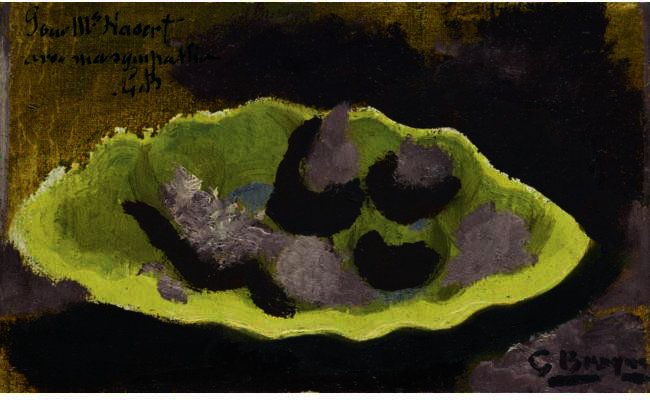
Dead nature

Explore Georges Braque's masterful still lifes—featuring serene landscapes and subtle color palettes—in *The Poetry of Things*, a London exhibition celebrating his enduring legacy beyond Cubism.

Explore la vida y el arte de Georges Braque (1882-1963), una figura clave en la pintura del siglo XX. Pionero del Cubismo junto a Picasso, conocido por el Fauvismo, el collage y formas geométricas innovadoras. Descubre su legado en TopImpressionists!

Adquiera una imagen digital de alta resolución y optimizada, muy superior a la vista previa en línea.

Cada archivo es preparado meticulosamente por nuestros especialistas internos mediante el uso de herramientas avanzadas y un experto retoque manual. Nos aseguramos de que cada imagen posea una claridad excepcional, una precisión cromática impecable y un detalle minucioso.

El archivo final se entrega por correo electrónico en un plazo de 72 horas, optimizado para su uso inmediato en entornos profesionales, editoriales y de impresión. Esta es la misma calidad en la que confían los estudios de diseño, las editoriales y las galerías de primer nivel.

Imagen Digital

Descarga un archivo de alta resolución para exhibición personal, impresión y proyectos creativos.

Precio total

$9.99

Incluido en cada pedido de imagen digital

Entrega digital experta, garantizada.

Al elegir TopImpressionists.com, no solo está adquiriendo una imagen; está recibiendo una obra de arte digital mejorada profesionalmente, elaborada con precisión y respaldada por una garantía de satisfacción. Esto es todo lo que incluye su pedido, automáticamente:

shipping_icon
Entrega rápida por email

Recibirá su archivo de imagen digital en alta resolución por correo electrónico en un plazo de 72 horas tras realizar su pedido, listo para su uso inmediato.

canvas_icon
Archivo digital optimizado con IA

Su obra de arte se optimiza profesionalmente mediante herramientas avanzadas de IA y edición manual, garantizando el máximo detalle, claridad y precisión cromática.

insurance_icon
Reenvío gratuito de por vida

¿Has borrado o perdido tu archivo por error? No te preocupes: te lo volveremos a enviar en cualquier momento, sin coste adicional.

tax_icon
Sin cargos de importación - Siempre

Disfrute de su obra de arte al instante sin aduanas, aranceles ni gastos de envío; las descargas digitales siempre están libres de impuestos.

color_icon
Garantía de fidelidad de color

Garantizamos que su imagen digital refleje los colores originales con la mayor fidelidad posible, mediante el uso de herramientas profesionales y gestión del color.

return_icon
Garantía de satisfacción de 60 días

Si no está satisfecho con su imagen digital, la revisaremos o le reembolsaremos el 100% en un plazo de 60 días, sin preguntas.

guarantee_icon
100% Garantía de devolución de dinero

¿No está satisfecho? Obtenga un reembolso completo dentro de los 60 días posteriores a la recepción de su archivo digital, sin preguntas.

discount_icon
Descuentos por pedidos al por mayor

Compra 3 imágenes, ahorra 10% - Compra 5, ahorra 15% - Compra 10+, ahorra 20%. Ideal para proyectos creativos, galerías y agencias.

Datos clave

  • Notable elements or techniques: Bowl with greenish-yellow color; Black dots
  • Subject or theme: Still life
  • Influences: Paul Cézanne
  • Artistic style: Analytical Cubism
  • Medium: Painting
  • Movement: Cubism

Descripción del coleccionable

Georges Braque: A Quiet Revolution in Still Life

The painting “Dead Nature,” by Georges Braque—a deceptively understated work from 1930—represents more than just a depiction of fruit and glass; it embodies the core tenets of Cubism’s radical reimagining of visual perception. Exhibited at Bernard Jacobson Gallery, alongside other masterful pieces from Braque's oeuvre, this artwork speaks volumes about his artistic philosophy and its enduring legacy within modern art history.

The Genesis of Cubist Vision

Born in Argenteuil, France, in 1882, Georges Braque’s formative years instilled in him a profound appreciation for form and structure—a sensibility that would propel him to the forefront of the avant-garde movement. Initially pursuing a career as a house painter alongside his father, he swiftly recognized the limitations of traditional artistic representation and sought new ways to capture reality. His encounter with Pablo Picasso at Académie Humbert in Paris proved pivotal, sparking an intellectual collaboration that irrevocably altered the course of art. Together, they dismantled conventional perspective and compositional conventions, prioritizing simultaneous viewpoints—a technique central to Cubism’s revolutionary approach.

Analyzing “Dead Nature”: Form and Texture

“Dead Nature” exemplifies Braque's meticulous attention to detail and his masterful manipulation of texture. The painting showcases a simple arrangement: a ceramic bowl containing greenish-yellow fruit juxtaposed with a glass vessel reflecting ambient light. However, the brilliance lies not in its apparent simplicity but in the fragmented representation of each element. Geometric planes—primarily cubes and cylinders—intersect and overlap, disrupting any illusion of depth or spatial coherence. The artist’s use of muted earthy tones—particularly ochre and umber—creates a harmonious balance against the vibrant yellow hue of the fruit bowl. Furthermore, Braque skillfully employs glazing techniques to achieve remarkable luminosity and textural variation, capturing the subtle sheen of glass and the velvety surface of the fruit.

Historical Context: Embracing Fragmentation

Cubism emerged in Paris during the early 1920s as a reaction against Impressionism’s focus on fleeting impressions of light and color. Artists like Picasso and Braque sought to depict objects from multiple perspectives simultaneously, reflecting the influence of Cezanne's explorations into geometric abstraction. This stylistic innovation wasn’t merely an aesthetic experiment; it mirrored broader intellectual currents—particularly Einstein’s theory of relativity—which challenged Newtonian conceptions of space and time. “Dead Nature” stands as a testament to this transformative period in art history, demonstrating Braque’s unwavering commitment to pushing the boundaries of artistic expression.

Symbolism Beyond Representation

While seemingly objective in its depiction of inanimate objects, "Dead Nature" carries subtle symbolic resonances. The bowl itself—often associated with containment and reflection—represents both the materiality of existence and the artist's attempt to capture a moment frozen in time. The black dots scattered throughout the composition serve as visual anchors, disrupting the flatness of the surface and emphasizing Braque’s preoccupation with geometric abstraction. They invite contemplation on the nature of perception and challenge viewers to consider alternative ways of seeing—a core principle of Cubist thought.

Emotional Resonance: Quiet Contemplation

Despite its intellectual rigor, “Dead Nature” possesses a remarkable emotional depth. The subdued palette and meticulous rendering convey a sense of stillness and contemplative observation—mirroring Braque’s own artistic temperament. It's an artwork that invites viewers to slow down, to appreciate the beauty of simplicity, and to engage in a dialogue with the fundamental questions posed by modern art. Like many of Braque’s paintings, it speaks not just to the eye but also to the soul—a testament to his enduring ability to capture profound truths about human experience within the framework of geometric abstraction.

Biografía del artista

**vida temprana y formación**

georges braque, un destacado pintor francés, collageador, dibujante, grabador y escultor, nació el 13 de mayo de 1882 en Argelo, Val-d'Oise. Creció en Le Havre y inicialmente se formó para ser pintor de casas y decorador, como su padre y abuelo. Sin embargo, las inclinaciones artísticas de Braque lo llevaron a estudiar pintura en la École des Beaux-Arts en Le Havre de 1897 a 1899.

**evolución artística y fauvismo**

En 1902, después de completar su aprendizaje con un decorador en París, Braque asistió a la Academia Humbert hasta 1904. Este período marcó su introducción al fauvismo, un estilo caracterizado por colores vibrantes y respuestas emocionales. Influenciado por las obras de henri matisse y andré derain, Braque adoptó un enfoque fauvista, como se ve en su pintura the patience (fauvismo, óleo sobre lienzo).

**contribución al cubismo**

La colaboración de Braque con pablo picasso desde 1908 hasta 1912 llevó al desarrollo del cubismo. Sus obras cubistas analíticas, como georges braque: the patience y pablo picasso: clarinet(cubismo analítico, óleo sobre lienzo), se consideran hitos en la historia del arte.

**legado y obras notables**

* Houses at l'Estaque: un testimonio del uso innovador de la geometría y la perspectiva simultánea de Braque. * The Patience(fauvismo, óleo sobre lienzo): demuestra el estilo fauvista de Braque. * Clarinet(cubismo analítico, óleo sobre lienzo): una obra cubista colaborativa con Picasso.

**museos y colecciones**

* Musée d'Orsay: presenta una extensa colección de arte impresionista y postimpresionista, incluyendo obras de Braque. * Musée de l'Orangerie: exhibe una amplia gama de obras de arte, incluyendo las de Braque y otros artistas notables. **Georges Braque's estilo innovador y su colaboración con Pablo Picasso continúan inspirando a artistas y entusiastas del arte.**
Georges Braque

Georges Braque

1882 - 1963 , Francia

Información clave

  • Artistas Influenciados Por Este Artista: ['Pablo Picasso']
  • Artistas Que Influyeron:
    • Henri Matisse
    • André Derain
    • Paul Cézanne
  • Fecha De Muerte: 31 de agosto de 1963
  • Fecha De Nacimiento: 13 de mayo de 1882
  • Lugar De Nacimiento: Argenteuil, Francia
  • Movimiento Artístico: Cubismo, Fauvismo
  • Nacionalidad: Francés
  • Nombre Completo: Georges Braque
  • Obras Notables:
    • Casas en L'Estaque
    • La paciencia (Fauvismo)
    • Violin y Paleta
    • Mandola
© TopImpressionists.com — Todos los derechos reservados  ·  100% Pintado a mano · Satisfacción garantizada · Envío gratuito a todo el mundo
VISA MASTERCARD