

Se muestra: · Con su marco:
 Ver en contexto
 Enviar
 Compartir
 Detalles
 Guía
Guía

 Descargar
 Similares
 Radiografía
 Presentación de diapositivas
 Preguntas y respuestas
 Estadísticas

€ 239
Reproducción al óleo hecha a mano
Óleo sobre lienzo pintado a mano en el tamaño y marco de su elección, realizado por encargo por nuestros artistas. ( Cambiar a impresiones Cambiar a imagen digital)
Tamaño
·Tamaño estándar
a medida
CM
INCH
Elija entre nuestros tamaños predefinidos que respetan las proporciones originales de la obra.
Cargando tamaños...

ancho
altura
Indique el ancho y el alto que necesite para adaptarse a su marco o pared. Al tratarse de una obra pintada a mano, si requiere un tamaño con una proporción distinta, el artista puede pintar un poco más alrededor de la imagen o recortarla ligeramente; usted elige. Le enviaremos una maqueta digital para su aprobación antes de comenzar la pintura. La imagen que se muestra en esta página no refleja el resultado real; solo la maqueta lo hace.
 Leer más información
Finalizar
·
Blanco €1

Bordes difuminados €1

Continuación de imagen €1

P118B €10

P118H €10

P118W €10

P438Z €10

P508JH €12

P508YH €12

P805H €10

P805Z €10

P919BZ €10

P919G €10

P919XJ €10

P959ZH €10

P968JZ €12

W106C €8

W218G €10

W218JH €8

W218Y €10

W307PJ €10

W316G €10

W316PJ €8

W316Y €10

W398PJ €8

W4111J €10

W500HY €15

W500JH €15

W692G €12

W849H €8

W940BG €15

W953PJ €8

H24-GOLD €30

H24-SILVER €30

H36-GOLD €45

H36-SILVER €45
Se envía en un tubo protector, listo para que lo enmarque su profesional de confianza.
Servicios adicionales
opcional¿Qué incluyen los extras?
Ejemplos de lo que se puede cambiar: Reemplazar el rostro con la foto del cliente; Añadir una mascota (por ejemplo, cambiar un gato por un perro); Incluir un mensaje oculto en el fondo; Cambiar el paisaje o los elementos del fondo.
Tras realizar el pedido, el equipo de TopImpressionists.com enviará un correo electrónico al cliente para solicitar instrucciones y proporcionar una vista previa del boceto
Tras realizar el pedido, el equipo de TopImpressionists.com enviará un correo electrónico al cliente para solicitar instrucciones y proporcionar una vista previa del boceto
Envío a todo el mundo () en 3-4 semanas en lugar de las 5 semanas estándar. (4 noviembre). Sin comprometer la calidad.
Barniz protector
Cartela
Detalles de la placa de bronce grabada
This elegant plaque features the artist's name and the title of the artwork, finely engraved for a timeless presentation.
It is made from bronze with a refined, elegant finish. The text is precisely laser-engraved for a sharp and permanent result. Measuring 9x2 cm, the plaque is compact yet easy to read. It's built to be durable and scratch-resistant, offering a professional, museum-quality look. Mounting is simple thanks to the included adhesive backing.
Detalles de la placa de acrílico transparente
The plaque includes essential engraved details such as the artist's name, the title of the artwork, the date it was created, the type of media used-like oil on canvas or watercolor-a brief description of the piece, and a QR code that links to the complete artwork information.
It is crafted from clear acrylic, offering a sleek, modern appearance. The text is UV-engraved in black to ensure strong visual contrast. With a size of 10x15 cm, it ensures optimal readability. It comes equipped with two metal hooks for secure wall mounting. The plaque is designed to be weather-resistant, making it suitable for various environments, and it includes interactive features that work seamlessly with smartphone scanning.
Detalles de la placa de acrílico negro
This elegant plaque includes engraved information such as the artist's name, the title of the artwork, the date it was created, the type of media used (like oil on canvas or watercolor), a short description of the artwork, and a QR code for quick access to more information.
The plaque itself is made from refined black acrylic with a premium finish. The text is laser-engraved in white for high contrast and readability. Its size is 10x15 cm, designed to be easy to read. It comes with two metal hooks for professional mounting. The design is sleek and fits any interior style. It is also weather-resistant and durable, with built-in digital integration for mobile compatibility.
La opción de vidrio solo está disponible en tamaños inferiores a 110 cm.
 La opción de vidrio solo está disponible en tamaños inferiores a 110 cm.
- Envío exprés gratuito a todo el mundo
- Lienzo de lino de alta calidad
- Seguro de envío total
- Garantía de reembolso de aranceles aduaneros
- Garantía de fidelidad cromática exacta
- Política de devolución de 100 días (solo por defectos)
- Garantía de devolución del 100% del dinero
- Descuento por cantidad


Descripción del objeto
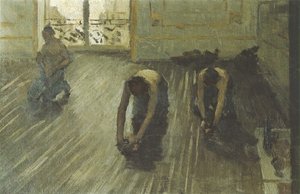
Gustave Caillebotte's 'The Floor Scrapers (study)' captures Parisian laborers with striking realism and light. Explore this iconic Impressionist work depicting urban life, showcasing Caillebotte’s unique perspective.
Biografía del artista
Descubre a Gustave Caillebotte (1848-1894): pintor realista e impresionista francés, conocido por sus escenas de la vida parisina moderna y perspectivas únicas. ¡Admira 'Les Raboteurs'!
Sobre la obra
The Floor Scrapers (Study) 02: A Glimpse into Parisian Labor
Gustave Caillebotte’s “The Floor Scrapers (Study) 02,” painted in 1875, isn't merely a depiction of three men diligently working; it’s a meticulously observed and subtly powerful portrait of urban life in late 19th-century Paris. This early work, often considered a pivotal piece in Caillebotte’s artistic development, offers a rare and intimate view into the lives of the city's working class – a subject largely absent from the grand narratives of the era. The painting immediately draws the eye with its stark contrast: the muted tones of the darkened room, punctuated by the bright white of the freshly sanded floorboards, create an almost photographic realism that was revolutionary for its time.
Caillebotte’s artistic journey began with a formal training in law and engineering, but it was his encounter with photography – particularly the work of Nadar – that profoundly shaped his approach to painting. He recognized the power of capturing fleeting moments and precise details, mirroring the photographic process. This influence is evident in the meticulous rendering of the men’s postures, their tools, and the textures of the wood. The composition itself feels deliberately staged, reminiscent of a photograph, with its careful attention to perspective and lighting. The figures are not idealized; they are presented as ordinary laborers, their faces obscured by shadow, emphasizing their anonymity within the bustling city.
Impressionistic Techniques and a Revolutionary Perspective
“The Floor Scrapers” exemplifies Caillebotte’s early embrace of Impressionism, though with a distinct realism that sets him apart from many of his contemporaries. He employed broken brushstrokes to capture the play of light on the wood and the men's clothing, creating a sense of movement and atmosphere. The use of complementary colors – the cool blues and greens of the shadows against the warm browns and yellows of the floor – adds depth and vibrancy to the scene. Notably, Caillebotte’s decision to depict these laborers in a darkened room, bathed in the diffused light of an unseen window, was a bold departure from traditional studio settings. This choice immediately imbued the painting with a sense of immediacy and authenticity.
Furthermore, Caillebotte's innovative perspective—a low-angle shot that emphasizes the scale of the men and their work—was groundbreaking. It forces the viewer to confront the scene directly, fostering a feeling of intimacy and engagement. The composition isn’t about glorifying labor; it’s about presenting it as a fundamental aspect of urban existence. The painting's technical mastery lies in its ability to convey both the physical reality of the work and the emotional weight of the men’s efforts.
Symbolism and Social Commentary
While seemingly straightforward, “The Floor Scrapers” carries subtle layers of symbolism. The act of scraping floors represents a repetitive, demanding task – a symbol of the daily grind endured by countless working-class individuals in Paris at the time. The absence of any discernible hierarchy or leadership among the men suggests a shared experience of labor and resilience. It’s important to note that Caillebotte was one of the first artists to depict urban proletariat, a subject rarely addressed in art during this period. This choice speaks volumes about his desire to challenge conventional artistic norms and offer a more nuanced representation of Parisian society.
The painting's historical context is crucial to understanding its significance. Paris in the 1870s was undergoing rapid industrialization, leading to significant social and economic changes. The working class faced harsh conditions, long hours, and low wages. Caillebotte’s work serves as a poignant reminder of these realities, offering a glimpse into the lives of those often overlooked by history.
A Timeless Reflection on Labor and Urban Life
“The Floor Scrapers (Study) 02” remains a powerful and evocative artwork. It's not just a depiction of three men working; it’s a meditation on labor, poverty, and the human condition. Caillebotte’s meticulous observation, innovative perspective, and subtle symbolism combine to create a work that continues to resonate with viewers today. Reproductions of this painting offer an opportunity to appreciate Caillebotte's artistic vision and gain a deeper understanding of Parisian life in the 19th century – a testament to the enduring power of art to illuminate social realities.
Preguntas y respuestas
¿De qué técnica y estilo se compone "The Floor Scrapers (study) 02"?
"The Floor Scrapers (study) 02" está realizada en Acrylic On Canvas, con el estilo Impressionist Painting.
¿Existe una ficha informativa sobre "The Floor Scrapers (study) 02" de Gustave Caillebotte para estudiantes?
La página Ficha informativa de "The Floor Scrapers (study) 02" de Gustave Caillebotte ofrece una ficha informativa imprimible de dos páginas: la obra con su ficha técnica, una línea de tiempo por décadas que la sitúa en la vida del artista, otras obras del mismo autor, la paleta de colores extraída de la pieza y citas listas para copiar en cuatro estilos diferentes.
¿Qué color predomina en "The Floor Scrapers (study) 02"?
El color que más destaca en "The Floor Scrapers (study) 02" es el Espresso (#504d40). El color dominante resulta muy útil a la hora de combinar una obra de arte con un espacio interior.
Datos rápidos y cuestionario de arte
Sobre Gustave Caillebotte

Gustave Caillebotte
1848 - 1894, Francia
Biografía del artista
**Primeros años y educación**
Gustave Caillebotte, pintor francés, nació el 19 de agosto de 1848 en París, proveniente de una familia de la alta sociedad. Su padre, Martial Caillebotte, era heredero del negocio familiar de textiles militares y también se desempeñaba como juez en el tribunal de comercio del departamento del Sena. El temprano interés de Gustave por la fotografía como forma de arte influiría más tarde en su estilo pictórico.**Trayectoria artística**
En 1868, Gustave obtuvo un título en derecho y una licencia para ejercer la abogacía en 1870, pero su verdadera pasión residía en las artes. Comenzó a visitar el estudio del pintor Léon Bonnat, donde estudió pintura con seriedad. Su estilo, caracterizado por su realismo, fue influenciado por sus colegas impresionistas, incluyendo a Edgar Degas y Giuseppe de Nittis.**Obras destacadas y estilo**
- Les Raboteurs de Parquet (Los Scrapers de Piso) (1875): Esta obra maestra temprana, ahora en el Musée d'Orsay, muestra la mezcla única de Caillebotte entre realismo e influencias impresionistas.
- Vista de Techos (Efecto de Nieve) (Vue de toits (effet de neige)) (1878): Demuestra su uso de puntos de vista elevados, una técnica posiblemente influenciada por grabados japoneses y fotografía.
- Un Balcón en París: Captura la vida parisina con un realismo sereno y una composición única.
- El Hombre en la Ventana (1875): Explora el aislamiento parisino y la modernidad a través de una obra maestra realista conmovedora.
- Villas Rosadas en Trouville (1884): Una escapada costera impresionista con tonos serenos que reflejan la vida moderna parisina.
- Calle de París, Día Lluvioso: Captura la vida parisina atemporal a través del realismo y el simbolismo.
- Los Escupidores de Suelo (también conocidos como Los Descapadores de Suelo): Una obra maestra del impresionismo realista que representa el trabajo parisino con elegancia y detalles sutiles.
**Legado e influencia**
El estilo de Caillebotte, aunque parte de la escuela del realismo, estuvo fuertemente influenciado por sus compañeros impresionistas. Sus obras, como Boulevard visto desde arriba (1880), muestran una mezcla única de técnicas realistas e impresionistas. Su contribución al arte francés es significativa, y su obra ha sido objeto de creciente reconocimiento en las últimas décadas.**El legado de Caillebotte**
Tras la muerte de Caillebotte en 1894, su hermano Martial y Auguste Renoir, su albacea, informaron a las autoridades sobre el legado que había instituido: más de sesenta obras maestras del Impresionismo. Las autoridades dudaron. Después de dos años de negociaciones, se aceptaron cuarenta obras y se exhibieron en un anexo al Musée du Luxembourg, donde causaron escándalo. El impresionismo aún estaba lejos de ser aceptado por el establishment artístico. La colección ahora reside en el Musée d'Orsay e incluye obras excepcionales como El Balcón de Manet, Baile en Le moulin de la Galette de Renoir y La Gare Saint-Lazare y su Regata en Argenteuil de Monet.Datos rápidos sobre Gustave Caillebotte
- Artistas Que Influyeron:
- Léon Bonnat
- Edgar Degas
- Giuseppe De Nittis
- Estilo Artístico: Realismo e Impresionismo
- Fecha De Muerte: 1894
- Fecha De Nacimiento: 19 de agosto de 1848
- Lugar De Nacimiento: París, Francia
- Nacionalidad: Francesa
- Nombre Completo: Gustave Caillebotte
- Obras Notables:
- Les Raboteurs de parquet
- Vista de tejados (efecto de nieve)
- Un Balcón en París
- Calle de París, día lluvioso


Explore obras de arte organizadas por temas, estilos y características.


Gustave Caillebotte
The Floor Scrapers (study) 02
() ·
Con su marco: · Pintado a mano al óleo sobre lienzo
Total