

Shown: · With its frame:
 Ver en contexto
 Enviar
 Compartir
 Detalles
 Guía
Guía

 Descargar
 Similares
 Radiografía
 Presentación de diapositivas
 Q&A
Q&A Estadísticas
- 66.0 x 82.0 cm


€ 239
Reproducción al óleo hecha a mano
Óleo sobre lienzo pintado a mano en el tamaño y marco de su elección, realizado por encargo por nuestros artistas. ( Cambiar a impresiones Cambiar a imagen digital)
Size
·Tamaño estándar
a medida
CM
INCH
Elija entre nuestros tamaños predefinidos que respetan las proporciones originales de la obra.
Loading sizes...

ancho
altura
Indique el ancho y el alto que necesite para adaptarse a su marco o pared. Al tratarse de una obra pintada a mano, si requiere un tamaño con una proporción distinta, el artista puede pintar un poco más alrededor de la imagen o recortarla ligeramente; usted elige. Le enviaremos una maqueta digital para su aprobación antes de comenzar la pintura. La imagen que se muestra en esta página no refleja el resultado real; solo la maqueta lo hace.
 Leer más información
Finish
·
White €1

Blurside €1

Extended €1

P118B €10

P118H €10

P118W €10

P438Z €10

P508JH €12

P508YH €12

P805H €10

P805Z €10

P919BZ €10

P919G €10

P919XJ €10

P959ZH €10

P968JZ €12

W106C €8

W218G €10

W218JH €8

W218Y €10

W307PJ €10

W316G €10

W316PJ €8

W316Y €10

W398PJ €8

W4111J €10

W500HY €15

W500JH €15

W692G €12

W849H €8

W940BG €15

W953PJ €8

H24-GOLD €30

H24-SILVER €30

H36-GOLD €45

H36-SILVER €45
Shipped in a protective tube, ready for your own framer.
Above 105 cm the frame is shipped as a kit for a professional framer — read the details.
Extras
optionalWhat do the extras include?
Examples of what can be changed: Replace face with customer photo; Add pet (e.g., replace cat with dog); Include hidden message in background; Change background landscape or elements.
After order, TopImpressionists.com team will email client for instructions and provide a mockup preview
After order, TopImpressionists.com team will email client for instructions and provide a mockup preview
Envío a todo el mundo () en 3-4 semanas en lugar de las 5 semanas estándar. (3 noviembre). Sin comprometer la calidad.
Barniz protector
Cartela
Detalles de la placa de bronce grabada
This elegant plaque features the artist's name and the title of the artwork, finely engraved for a timeless presentation.
It is made from bronze with a refined, elegant finish. The text is precisely laser-engraved for a sharp and permanent result. Measuring 9x2 cm, the plaque is compact yet easy to read. It's built to be durable and scratch-resistant, offering a professional, museum-quality look. Mounting is simple thanks to the included adhesive backing.
Detalles de la placa de acrílico transparente
The plaque includes essential engraved details such as the artist's name, the title of the artwork, the date it was created, the type of media used-like oil on canvas or watercolor-a brief description of the piece, and a QR code that links to the complete artwork information.
It is crafted from clear acrylic, offering a sleek, modern appearance. The text is UV-engraved in black to ensure strong visual contrast. With a size of 10x15 cm, it ensures optimal readability. It comes equipped with two metal hooks for secure wall mounting. The plaque is designed to be weather-resistant, making it suitable for various environments, and it includes interactive features that work seamlessly with smartphone scanning.
Detalles de la placa de acrílico negro
This elegant plaque includes engraved information such as the artist's name, the title of the artwork, the date it was created, the type of media used (like oil on canvas or watercolor), a short description of the artwork, and a QR code for quick access to more information.
The plaque itself is made from refined black acrylic with a premium finish. The text is laser-engraved in white for high contrast and readability. Its size is 10x15 cm, designed to be easy to read. It comes with two metal hooks for professional mounting. The design is sleek and fits any interior style. It is also weather-resistant and durable, with built-in digital integration for mobile compatibility.
La opción de vidrio solo está disponible en tamaños inferiores a 110 cm.
 La opción de vidrio solo está disponible en tamaños inferiores a 110 cm.
- Envío exprés gratuito a todo el mundo
- Lienzo de lino de alta calidad
- Seguro de envío total
- Garantía de reembolso de aranceles aduaneros
- Garantía de fidelidad cromática exacta
- Política de devolución de 100 días (solo por defectos)
- Garantía de devolución del 100% del dinero
- Descuento por cantidad


Descripción del objeto
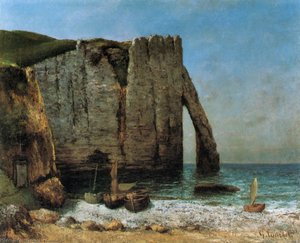
Experience Gustave Courbet's iconic Cliffs at Étretat! This stunning oil painting captures Normandy’s rugged beauty with raw realism & dramatic coastal views. A masterpiece of the Realist movement.
Biografía del artista
Gustave Courbet (1819-1877): Pionero del Realismo. Explora pinturas que representan la vida cotidiana y los temas de la clase trabajadora, como 'Un entierro en Ornans'. Descubre su impacto revolucionario en el arte del siglo XIX.
About the painting
A Vision of Normandy’s Rugged Beauty: Gustave Courbet's Cliffs at Étretat
Gustave Courbet, a Rebel’s Brush: The Life and Legacy of Gustave Courbet Born in the quiet village of Ornans, France, in 1819, Jean Désiré Gustave Courbet emerged as a defiant force against the established artistic norms of his time. His story isn't simply one of paint and canvas; it’s a narrative woven with threads of social commentary, political conviction, and an unwavering commitment to portraying the world exactly as he saw it – unidealized, raw, and profoundly real. Growing up in a relatively prosperous bourgeois family, Courbet received encouragement from his mother to pursue his artistic inclinations, a nurturing that would ultimately fuel a revolution in the art world. His formal training began at the École des Beaux-Arts in Paris in 1839, but he quickly found himself chafing against the academic conventions and Romantic idealism prevalent there. While acknowledging influences like Eugène Delacroix and Théodore Géricault, Courbet forged his own path, one that prioritized observation over imitation—a stance that would define his artistic identity for decades to come.The Landscape of Realism: Context and Conception
Courbet’s Cliffs at Étretat embodies the core tenets of the Realist movement, a reaction against Romantic sentimentality and academic formalism. Artists like Courbet rejected idealized depictions of nature and instead sought to capture the tangible world with unflinching accuracy. Étretat, a dramatic chalk cliff coastline in Normandy, served as inspiration for this monumental canvas—a deliberate choice reflecting Courbet’s fascination with the natural environment and his desire to represent it without embellishment. The painting emerged during a period marked by social unrest and political upheaval, mirroring Courbet's own rebellious spirit and aligning him with artists who championed artistic independence and challenged societal expectations.Composition and Technique: Capturing Movement and Texture
Courbet’s masterful technique is immediately apparent upon viewing Cliffs at Étretat. Employing thick impasto—a technique involving applying paint in heavy layers—he achieved remarkable textural richness, conveying the ruggedness of the cliffs and the turbulent sea with palpable immediacy. The pyramidal composition draws the viewer's eye upwards towards the towering cliffs, while horizontal bands delineate the shoreline and emphasize the expansive vista. Courbet skillfully utilized atmospheric perspective to create depth, subtly blurring distant elements and enhancing the sense of grandeur. Furthermore, he incorporated figures—a boat, people, and a dog—to ground the scene in reality and suggest human interaction with the landscape.Symbolism Within Nature: A Reflection of Courage and Resilience
Beyond its technical brilliance, Cliffs at Étretat carries symbolic weight. The cliffs themselves represent strength and permanence, mirroring Courbet’s own unwavering conviction in portraying the world truthfully. The turbulent sea symbolizes challenges and uncertainties—themes that resonated deeply with Courbet's artistic vision. The presence of a solitary dog adds an element of vulnerability amidst the imposing landscape, hinting at the human spirit's capacity for perseverance and appreciation for beauty even in difficult circumstances.A Legacy Enduring Inspiration
Gustave Courbet’s Cliffs at Étretat remains a cornerstone of Realist art and continues to inspire artists today. Its uncompromising realism challenged artistic conventions and solidified Courbet’s position as a pioneer of modern painting. Explore the masterpiece's profound impact on subsequent generations of artists—a testament to Courbet’s enduring legacy as an artist who dared to confront beauty with unflinching honesty. TopImpressionists.com offers handmade oil painting reproductions of Gustave Courbet's works, allowing art enthusiasts to bring a piece of history into their homes.Preguntas y respuestas
¿Qué emoción transmite la obra de Contemporary Realism "Cliffs at Étretat"?
"Cliffs at Étretat" transmite un tono emocional Sereno dentro del movimiento Contemporary Realism.
¿Qué sentimiento transmite "Cliffs at Étretat"?
"Cliffs at Étretat" se asocia con un sentimiento Sereno. El tono emocional describe la impresión que transmite la obra.
¿A qué etapa de la trayectoria de Gustave Courbet pertenece "Cliffs at Étretat" (1870)?
La fecha de 1870 sitúa a "Cliffs at Étretat" en el Mature Period del desarrollo de Gustave Courbet.
Quick facts and art quiz
About Gustave Courbet

Gustave Courbet
1819 - 1877, Francia
Biografía del artista
Gustave Courbet: Un Pionero del Realismo
Primeros Años y Educación
- Nacido el 31 de julio de 1819 en Ornans, Francia, Gustave Courbet emergió de una familia burguesa relativamente próspera.
- Sus primeras inclinaciones artísticas fueron cultivadas por su madre, quien animó sus habilidades para dibujar.
- Recibió formación formal en la École des Beaux-Arts en París, comenzando en 1839, aunque a menudo chocaba con las convenciones académicas.
- Influencias durante este período incluyeron a Eugène Delacroix y Théodore Géricault, pero Courbet finalmente rechazó su idealismo romántico.
Desarrollo Artístico y Temas Clave
- El desarrollo artístico de Courbet estuvo marcado por una deliberada rechazo a los estilos de pintura académica. Buscó representar el mundo tal como lo veía, sin idealización ni embellecimiento.
- Sus primeras obras exploraron paisajes y retratos, gradualmente desplazándose hacia escenas de la vida cotidiana y sujetos de la clase trabajadora.
- Temas clave en su obra incluyen el realismo social, la vida rural y la dignidad del trabajo.
- A menudo elegía formatos a gran escala tradicionalmente reservados para pinturas históricas o religiosas para representar a personas comunes y eventos cotidianos.
Obras Maestras y Logros
- “Los Pedreros” (1849): Esta obra maestra temprana, aunque lamentablemente destruida durante la Segunda Guerra Mundial, ejemplificó el compromiso de Courbet para representar las duras realidades de la vida de la clase trabajadora.
- “El Funeral en Ornans” (1850): Un lienzo monumental que desafió las nociones convencionales de la pintura histórica al retratar un funeral provincial con un realismo inquebrantable.
- “El Estudio del Pintor” (1855): Una obra alegórica que refleja la filosofía artística de Courbet y su compromiso con los problemas sociales contemporáneos.
- “Vista en el Bosque de Fontainebleau” (1855): Demuestra su habilidad en la pintura de paisajes, capturando la belleza natural del bosque mientras mantiene un enfoque realista.
- Su participación en el Salón des Refusés en 1863, mostrando obras rechazadas por el Salón oficial, consolidó aún más su reputación como artista rebelde.
Influencias y Legado
- Si bien rechazaba las tradiciones académicas, Courbet fue influenciado por maestros anteriores como Caravaggio por su realismo dramático y el uso de la luz y la sombra.
- Tuvo un impacto profundo en los movimientos artísticos posteriores, particularmente Impresionismo y Postimpresionismo, al liberar a los artistas de las limitaciones de la representación tradicional.
- Su énfasis en el comentario social allanó el camino para artistas posteriores comprometidos socialmente.
- El legado de Courbet se extiende más allá de sus pinturas; fue un defensor vocal de la libertad artística y el cambio político.
Significado Histórico
- Gustave Courbet desempeñó un papel fundamental en el desarrollo del Realismo como una fuerza dominante en el arte del siglo XIX.
- Su obra desafió las normas establecidas e inició un debate sobre el propósito y la función del arte en la sociedad.
- Participó activamente en los tumultos políticos de su tiempo, incluida la Comuna de París de 1871, lo que llevó a un período de exilio en Suiza.
- Courbet falleció el 29 de abril de 1877, dejando atrás un cuerpo de trabajo que continúa inspirando y provocando al público actual.
Quick facts about Gustave Courbet
- Artistas Influenciados Por Este Artista:
- Impresionismo
- Postimpresionismo
- Artistas Que Influyeron:
- Eugène Delacroix
- Théodore Géricault
- Caravaggio
- Fecha De Muerte: 29 de abril de 1877
- Fecha De Nacimiento: 31 de julio de 1819
- Lugar De Nacimiento: Orleans, Francia
- Movimiento Artístico: Realismo
- Nacionalidad: Francés
- Nombre Completo: Gustave Courbet
- Obras Notables:
- Los Pedreros
- Un entierro en Ornans
- El Estudio del Pintor
- Vista en el Bosque de Fontainebleau
- El Origen del Mundo
Explore obras de arte organizadas por temas, estilos y características.


Gustave Courbet
Cliffs at Étretat
() ·
With its frame: · Hand-painted in oil on linen
Total