

Shown: · With its frame:
 Ver en contexto
 Enviar
 Compartir
 Detalles
 Guía
Guía

 Descargar
 Similares
 Radiografía
 Presentación de diapositivas
 Q&A
Q&A Estadísticas
 Oil On Canvas
- WallArt
- Les Nabis
 1894
1894- 19th Century
 26.0 x 22.0 cm
€ 237
Reproducción al óleo hecha a mano
Óleo sobre lienzo pintado a mano en el tamaño y marco de su elección, realizado por encargo por nuestros artistas. ( Cambiar a impresiones Cambiar a imagen digital)
Size
·Tamaño estándar
a medida
CM
INCH
Elija entre nuestros tamaños predefinidos que respetan las proporciones originales de la obra.
Loading sizes...

ancho
altura
Indique el ancho y el alto que necesite para adaptarse a su marco o pared. Al tratarse de una obra pintada a mano, si requiere un tamaño con una proporción distinta, el artista puede pintar un poco más alrededor de la imagen o recortarla ligeramente; usted elige. Le enviaremos una maqueta digital para su aprobación antes de comenzar la pintura. La imagen que se muestra en esta página no refleja el resultado real; solo la maqueta lo hace.
 Leer más información
Finish
·
White €1

Blurside €1

Extended €1

P118B €10

P118H €10

P118W €10

P438Z €10

P508JH €12

P508YH €12

P805H €10

P805Z €10

P919BZ €10

P919G €10

P919XJ €10

P959ZH €10

P968JZ €12

W106C €8

W218G €10

W218JH €8

W218Y €10

W307PJ €10

W316G €10

W316PJ €8

W316Y €10

W398PJ €8

W4111J €10

W500HY €15

W500JH €15

W692G €12

W849H €8

W940BG €15

W953PJ €8

H24-GOLD €30

H24-SILVER €30

H36-GOLD €45

H36-SILVER €45
Shipped in a protective tube, ready for your own framer.
Above 105 cm the frame is shipped as a kit for a professional framer — read the details.
Extras
optionalWhat do the extras include?
Examples of what can be changed: Replace face with customer photo; Add pet (e.g., replace cat with dog); Include hidden message in background; Change background landscape or elements.
After order, TopImpressionists.com team will email client for instructions and provide a mockup preview
After order, TopImpressionists.com team will email client for instructions and provide a mockup preview
Envío a todo el mundo () en 3-4 semanas en lugar de las 5 semanas estándar. (29 octubre). Sin comprometer la calidad.
Barniz protector
Cartela
Detalles de la placa de bronce grabada
This elegant plaque features the artist's name and the title of the artwork, finely engraved for a timeless presentation.
It is made from bronze with a refined, elegant finish. The text is precisely laser-engraved for a sharp and permanent result. Measuring 9x2 cm, the plaque is compact yet easy to read. It's built to be durable and scratch-resistant, offering a professional, museum-quality look. Mounting is simple thanks to the included adhesive backing.
Detalles de la placa de acrílico transparente
The plaque includes essential engraved details such as the artist's name, the title of the artwork, the date it was created, the type of media used-like oil on canvas or watercolor-a brief description of the piece, and a QR code that links to the complete artwork information.
It is crafted from clear acrylic, offering a sleek, modern appearance. The text is UV-engraved in black to ensure strong visual contrast. With a size of 10x15 cm, it ensures optimal readability. It comes equipped with two metal hooks for secure wall mounting. The plaque is designed to be weather-resistant, making it suitable for various environments, and it includes interactive features that work seamlessly with smartphone scanning.
Detalles de la placa de acrílico negro
This elegant plaque includes engraved information such as the artist's name, the title of the artwork, the date it was created, the type of media used (like oil on canvas or watercolor), a short description of the artwork, and a QR code for quick access to more information.
The plaque itself is made from refined black acrylic with a premium finish. The text is laser-engraved in white for high contrast and readability. Its size is 10x15 cm, designed to be easy to read. It comes with two metal hooks for professional mounting. The design is sleek and fits any interior style. It is also weather-resistant and durable, with built-in digital integration for mobile compatibility.
La opción de vidrio solo está disponible en tamaños inferiores a 110 cm.
 La opción de vidrio solo está disponible en tamaños inferiores a 110 cm.
- Envío exprés gratuito a todo el mundo
- Lienzo de lino de alta calidad
- Seguro de envío total
- Garantía de reembolso de aranceles aduaneros
- Garantía de fidelidad cromática exacta
- Política de devolución de 100 días (solo por defectos)
- Garantía de devolución del 100% del dinero
- Descuento por cantidad


Descripción del objeto
Vibrant early 20th-century scene of a social meal by Jean-Édouard Vuillard; explore the rich color and intimate atmosphere of this masterpiece today.
Biografía del artista
Descubre "Interior con Luz de Sol" de Jean Vuillard – una cautivadora pintura impresionista post-impresionista de la tranquilidad doméstica. Explora esta serena obra del 1921 y su estilo fresco y vibrante.
About the painting
A Moment Captured at the Table
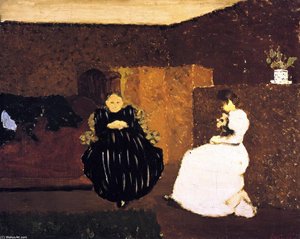
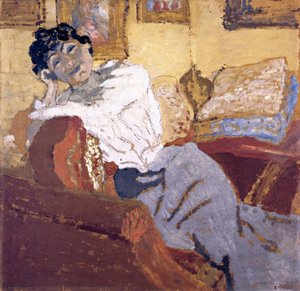
Jean-Édouard Vuillard’s Breakfast, dating from 1894, invites us into an intimate tableau of domestic life. It is more than just a depiction of a meal; it is a carefully composed study in human connection and quiet afternoon ritual. The scene unfolds around a richly appointed dining table, laden with the artifacts of conviviality—cups, bowls, and two inviting cakes rest upon its surface. At the heart of this gathering sits the central female figure, her presence anchoring the composition while surrounding figures complete the sense of shared experience. The arrangement suggests a pause in time, a moment suspended between conversation and consumption.
The Influence of Les Nabis
To understand Breakfast, one must appreciate its context within the vibrant artistic ferment of late 19th-century Paris. Vuillard was a key member of Les Nabis, a group whose vision sought to infuse everyday subjects with spiritual resonance and decorative pattern. This movement steered art away from grand historical narratives toward the intimate, the domestic, and the subjective experience. In this painting, we see the Nabis influence manifest not through overt symbolism alone, but through the very structure of the space. Vuillard masterfully flattens planes of color and form, giving the interior a decorative rhythm that is both modern and deeply personal.
Technique and Atmosphere
Vuillard’s technique here is characterized by an almost tapestry-like richness. His application of paint emphasizes pattern—the patterns on the chairs, the textiles, and even the interplay of light across the table suggest a meticulous attention to surface detail. While the subject matter appears straightforward—a family or group enjoying breakfast—the emotional resonance comes from the way he handles shadow and light. The atmosphere is one of warm enclosure; the viewer feels as if they have slipped through an unseen doorway into this private gathering. It speaks to the quiet luxury of shared time, a feeling that transcends mere depiction.
A Touch for the Modern Collector
For those who appreciate art that whispers rather than shouts, Breakfast offers profound depth. Whether adorning a formal drawing-room or lending an intellectual patina to a contemporary space, this piece brings with it the sophisticated elegance of early modernism. It appeals equally to the collector seeking a tangible link to the avant-garde spirit and the designer who values art that enhances lived experience. Reproducing this work allows one to bring home not just paint on canvas, but a carefully curated echo of Parisian intellectual life at the turn of the century.
Preguntas y respuestas
¿Qué paleta y qué color predominante definen a "Breakfast"?
"Breakfast" de Jean-Édouard Vuillard utiliza una paleta de Dark, con el Rosy Brown (#d2a26f) como color dominante.
¿Qué nivel de saturación cromática tiene "Breakfast" de Jean-Édouard Vuillard?
La paleta de "Breakfast" presenta una saturación Clear Color Presence.
¿Dónde puedo encontrar obras de arte similares a "Breakfast" de Jean-Édouard Vuillard?
La página de Obras similares de "Breakfast" de Jean-Édouard Vuillard muestra obras relacionadas.
Quick facts and art quiz
About Jean-Édouard Vuillard
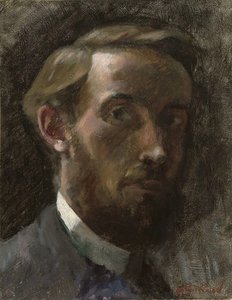
Jean-Édouard Vuillard
1868 - 1940, Francia
Biografía del artista
early life and artistic beginnings
Jean-Édouard Vuillard (1868–1940) was a french painter, decorative artist, and printmaker. His life's work would later become a cornerstone of the avant-garde artistic group les nabis, alongside fellow visionaries like Maurice Denis and Édouard Vuillard. This collective would revolutionize the art world with their innovative approach to color and form.
Vuillard was born on november 11, 1868, in cuiseaux, france. His father was a civil servant, and his mother, a seamstress. He showed an early aptitude for drawing and painting, studying art from 1886 to 1888 at the Académie Julian and the École des Beaux-Arts in paris.
In 1889 he joined a group of art students that included Maurice Denis, Pierre Bonnard, Paul Sérusier, Ker-Xavier Roussel, and Félix Vallotton. They called themselves les Nabis (Hebrew for “Prophets”), and they drew their inspiration from the Synthetist paintings of Paul Gauguin’s Pont-Aven period.
the nabis movement and its influence
Like Gauguin, the Nabis advocated a symbolic, rather than a naturalistic, approach to color, and they usually applied their paint in ways that emphasized the flat surface of the canvas. Their admiration of japanese woodcuts, which were then in vogue in europe, inspired them to use simplified shapes and strong contours.
Les nabis, a group of young french artists active in paris from 1888 until 1900, played a large part in the transition from impressionism and academic art to abstract art, symbolism, and the other early movements of modernism. Their philosophy was based upon the philosophy of positivism, and the writings of auguste comte and hippolyte taine.
vuillard's later work and legacy
After 1900, when les nabis disbanded, Vuillard adopted a more realistic style, approaching landscapes and interiors with greater detail and vivid colors. He continued to produce paintings that explored domestic scenes and portraits of individuals from the intellectual and artistic circles of paris.
Vuillard’s distinctive style—characterized by muted palettes, flattened perspectives, and meticulous attention to texture—established him as one of the most important figures in french art at the turn of the century. His work anticipates many developments in cubism and fauvism, demonstrating a profound understanding of visual perception.
key works and exhibitions
Vuillard’s paintings can be found in various museums, including the musée de la révolution française (france), which boasts a rich collection of artworks, documents, and objects related to the revolutionary period. Some of his notable works include “Woman Sweeping” by Maurice Denis and “Jean de la Barre” by Jean Clouet, which depict a young man condemned to death for blasphemy during the ancien régime.
Vuillard’s later work, such as his portraits of french industry and arts figures, can be seen in various galleries, including those at intimism art movement and jean-édouard vuillard's page on TopImpressionists.
Quick facts about Jean-Édouard Vuillard
- Artistic Movement Or Style: Nabis
- Artists Or Movements Influenced By This Artist:
- Cubism
- Fauvism
- Artists Who Influenced This Artist: ['Paul Gauguin']
- Date Of Birth: November 11, 1868
- Full Name: Jean-Édouard Vuillard
- Nationality: French
- Notable Artworks:
- Woman Sweeping
- Sunlit Interior
- Place Of Birth: Cuiseaux, France
Obras relacionadas


Explore obras de arte organizadas por temas, estilos y características.








Jean-Édouard Vuillard
Breakfast
() ·
With its frame: · Hand-painted in oil on linen
Total