
Se muestra: · Con su marco:
 Ver en contexto
 Enviar
 Compartir
 Detalles
 Guía
Guía

 Descargar
 Similares
 Radiografía
 Presentación de diapositivas
 Preguntas y respuestas
 Estadísticas
- 101.0 x 58.0 cm


€ 240
Reproducción al óleo hecha a mano
Óleo sobre lienzo pintado a mano en el tamaño y marco de su elección, realizado por encargo por nuestros artistas. ( Cambiar a impresiones Cambiar a imagen digital)
Tamaño
·Tamaño estándar
a medida
CM
INCH
Elija entre nuestros tamaños predefinidos que respetan las proporciones originales de la obra.
Cargando tamaños...

ancho
altura
Indique el ancho y el alto que necesite para adaptarse a su marco o pared. Al tratarse de una obra pintada a mano, si requiere un tamaño con una proporción distinta, el artista puede pintar un poco más alrededor de la imagen o recortarla ligeramente; usted elige. Le enviaremos una maqueta digital para su aprobación antes de comenzar la pintura. La imagen que se muestra en esta página no refleja el resultado real; solo la maqueta lo hace.
 Leer más información
Finalizar
·
Blanco €1

Bordes difuminados €1

Continuación de imagen €1

P118B €10

P118H €10

P118W €10

P438Z €10

P508JH €12

P508YH €12

P805H €10

P805Z €10

P919BZ €10

P919G €10

P919XJ €10

P959ZH €10

P968JZ €12

W106C €8

W218G €10

W218JH €8

W218Y €10

W307PJ €10

W316G €10

W316PJ €8

W316Y €10

W398PJ €8

W4111J €10

W500HY €15

W500JH €15

W692G €12

W849H €8

W940BG €15

W953PJ €8

H24-GOLD €30

H24-SILVER €30

H36-GOLD €45

H36-SILVER €45
Se envía en un tubo protector, listo para que lo enmarque su profesional de confianza.
Servicios adicionales
opcional¿Qué incluyen los extras?
Ejemplos de lo que se puede cambiar: Reemplazar el rostro con la foto del cliente; Añadir una mascota (por ejemplo, cambiar un gato por un perro); Incluir un mensaje oculto en el fondo; Cambiar el paisaje o los elementos del fondo.
Tras realizar el pedido, el equipo de TopImpressionists.com enviará un correo electrónico al cliente para solicitar instrucciones y proporcionar una vista previa del boceto
Tras realizar el pedido, el equipo de TopImpressionists.com enviará un correo electrónico al cliente para solicitar instrucciones y proporcionar una vista previa del boceto
Envío a todo el mundo () en 3-4 semanas en lugar de las 5 semanas estándar. (4 noviembre). Sin comprometer la calidad.
Barniz protector
Cartela
Detalles de la placa de bronce grabada
This elegant plaque features the artist's name and the title of the artwork, finely engraved for a timeless presentation.
It is made from bronze with a refined, elegant finish. The text is precisely laser-engraved for a sharp and permanent result. Measuring 9x2 cm, the plaque is compact yet easy to read. It's built to be durable and scratch-resistant, offering a professional, museum-quality look. Mounting is simple thanks to the included adhesive backing.
Detalles de la placa de acrílico transparente
The plaque includes essential engraved details such as the artist's name, the title of the artwork, the date it was created, the type of media used-like oil on canvas or watercolor-a brief description of the piece, and a QR code that links to the complete artwork information.
It is crafted from clear acrylic, offering a sleek, modern appearance. The text is UV-engraved in black to ensure strong visual contrast. With a size of 10x15 cm, it ensures optimal readability. It comes equipped with two metal hooks for secure wall mounting. The plaque is designed to be weather-resistant, making it suitable for various environments, and it includes interactive features that work seamlessly with smartphone scanning.
Detalles de la placa de acrílico negro
This elegant plaque includes engraved information such as the artist's name, the title of the artwork, the date it was created, the type of media used (like oil on canvas or watercolor), a short description of the artwork, and a QR code for quick access to more information.
The plaque itself is made from refined black acrylic with a premium finish. The text is laser-engraved in white for high contrast and readability. Its size is 10x15 cm, designed to be easy to read. It comes with two metal hooks for professional mounting. The design is sleek and fits any interior style. It is also weather-resistant and durable, with built-in digital integration for mobile compatibility.
La opción de vidrio solo está disponible en tamaños inferiores a 110 cm.
 La opción de vidrio solo está disponible en tamaños inferiores a 110 cm.
- Envío exprés gratuito a todo el mundo
- Lienzo de lino de alta calidad
- Seguro de envío total
- Garantía de reembolso de aranceles aduaneros
- Garantía de fidelidad cromática exacta
- Política de devolución de 100 días (solo por defectos)
- Garantía de devolución del 100% del dinero
- Descuento por cantidad


Descripción del objeto
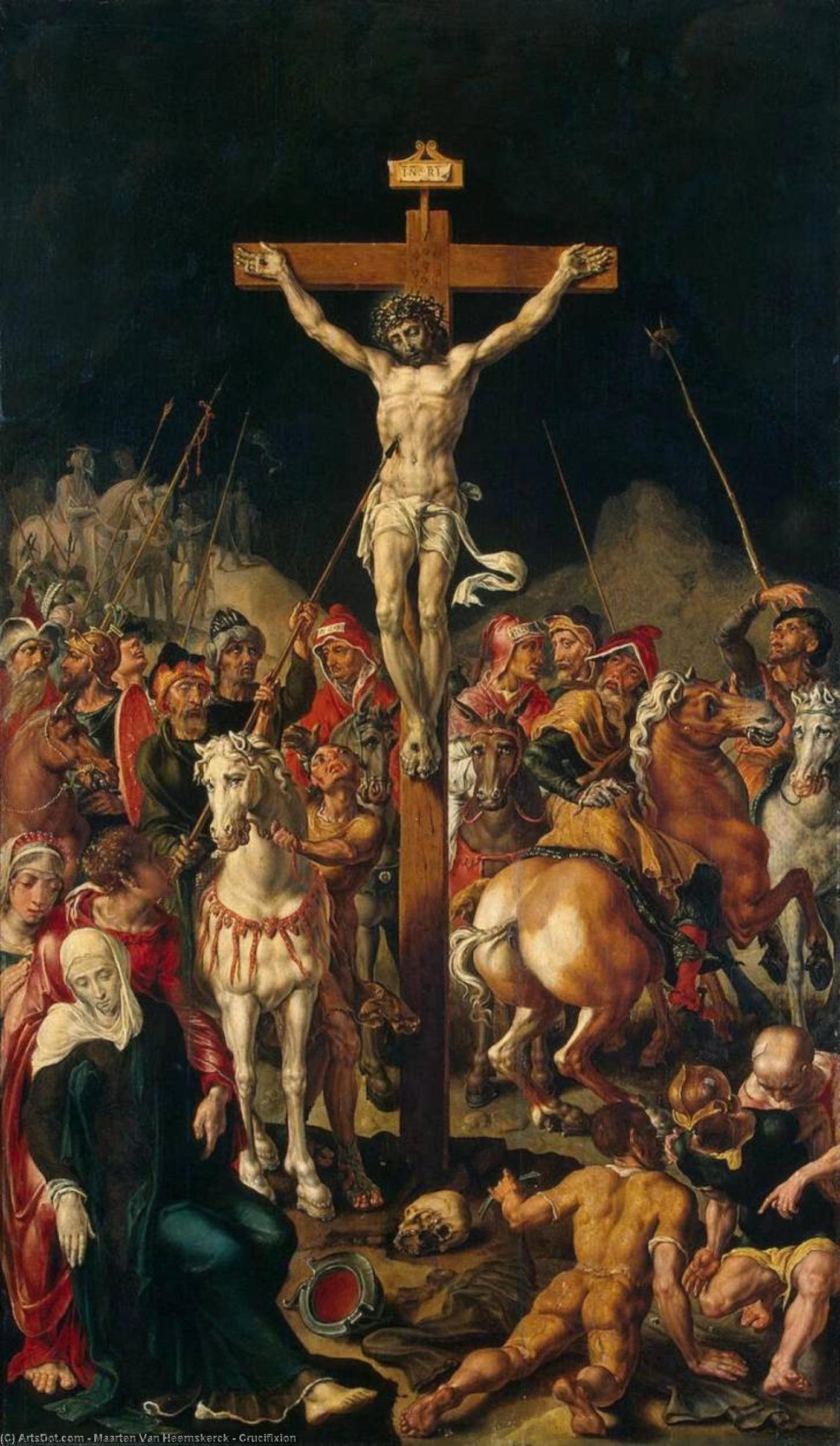
Experience the dramatic realism of Van Heemskerck's 1545 Crucifixion triptych, blending Dutch detail with Italian grandeur; discover this masterpiece today.
Biografía del artista
Maerten van Heemskerck (1498-1574) fue pintor flamenco del Renacimiento conocido por retratos innovadores y escenas religiosas influenciadas por Italia. Descubre sus obras maestras como 'Samson Shattering the Pillars' y conoce su impacto en la historia artística holandesa.
Sobre la obra
A Window Into Faith: Maerten van Heemskerck’s Crucifixion Triptych
The Crucifixion by Maerten van Heemskerck, completed in 1545, stands as a monumental achievement of the Dutch Renaissance and a testament to the enduring power of religious iconography. More than just a depiction of Christ's suffering – though undeniably poignant – this triptych transcends mere representation, immersing viewers in a meticulously crafted tableau that speaks volumes about humanist ideals and artistic innovation. Painted during a period marked by fervent piety and intellectual curiosity, it embodies the spirit of its time while simultaneously securing its place as one of the most influential artworks of the era.Style and Technique: Bridging Italian Renaissance Grandeur with Dutch Realism
Van Heemskerck skillfully blended elements of Italian Renaissance grandeur with the burgeoning realism characteristic of Dutch art. Influenced by artists like Michelangelo and Raphael, he adopted a pyramidal composition – a technique favored in monumental religious paintings – to convey stability and solemnity. However, unlike many Italian counterparts that prioritized idealized beauty, Van Heemskerck’s approach embraced meticulous detail and naturalistic observation. The artist painstakingly rendered textures—the rough linen of Christ's robe, the weathered stone of the cross—creating a palpable sense of physicality that distinguishes it from more stylized depictions. This careful attention to realism was further enhanced by his masterful use of chiaroscuro – dramatic contrasts between light and shadow – which sculptured form and imbued the scene with emotional depth.Historical Context: Rome Under Charles V and the Reformation’s Influence
The Crucifixion's creation coincided with a pivotal moment in European history: the reign of Charles V, Holy Roman Emperor, and the escalating tensions surrounding the Protestant Reformation. The Habsburg monarch championed Catholicism fiercely, commissioning artworks like this to reaffirm papal authority and bolster religious faith. Yet, Van Heemskerck’s work wasn’t solely driven by political considerations; it reflected a broader humanist preoccupation with human suffering and mortality – themes explored extensively in classical literature and philosophy. The triptych served as part of a larger project to decorate the Porta San Sebastiano in Rome, commemorating Charles V's victory over Protestant forces—a visual declaration of imperial piety amidst religious upheaval.Symbolism: Layers of Meaning Beyond Visual Representation
The Crucifixion’s symbolism is rich and multifaceted. The central panel depicts Jesus Christ crucified on the cross, a universally recognized emblem of sacrifice and redemption. His outstretched arms symbolize humility and acceptance of divine judgment, while his gaze directs upward towards God—a gesture signifying hope and spiritual aspiration. Surrounding him are figures representing Mary Magdalene, Nicodemus, Joseph of Arimathea, and others who witnessed Christ’s death – each embodying compassion and devotion. The inclusion of a horse on the right panel reinforces the imagery of royalty and divine majesty, mirroring the emperor's patronage. Furthermore, the cup positioned at the bottom left corner symbolizes the Eucharist—the sacrament commemorating Jesus’s sacrifice—underscoring the theological significance of the artwork.Emotional Impact: A Profound Reflection on Suffering and Faith
Ultimately, Maerten van Heemskerck’s Crucifixion transcends mere visual spectacle; it evokes a profound emotional response in viewers. The subdued palette – dominated by earthy tones – contributes to an atmosphere of solemn contemplation. Yet, the artist's masterful manipulation of light and shadow intensifies the drama of the scene, conveying the agony of Christ’s torment and eliciting empathy for his suffering. It compels us to confront questions about faith, mortality, and divine compassion—themes that continue to resonate across centuries. The Crucifixion remains a powerful reminder of humanity's capacity for sorrow and its unwavering belief in redemption – an enduring masterpiece that secures its place as one of the most poignant expressions of Renaissance spirituality.Preguntas y respuestas
¿Dónde se encuentra actualmente en exposición "Crucifixion" de Maerten Van Heemskerck?
"Crucifixion" de Maerten Van Heemskerck se encuentra en exhibición en Museo del Hermitage, San Petersburgo, Russia. La información del museo se refiere a la obra original, no a reproducciones.
¿Es "Crucifixion" de Maerten Van Heemskerck una composición en formato vertical, horizontal o cuadrado?
"Crucifixion" de Maerten Van Heemskerck tiene un formato Alargado verticalmente. El formato describe las proporciones de la composición.
¿A qué periodo pertenece "Crucifixion" de Maerten Van Heemskerck?
"Crucifixion" pertenece a la época Renacimiento.
Datos rápidos y cuestionario de arte
Sobre Maerten Van Heemskerck

Maerten Van Heemskerck
1498 - 1574, Países Bajos
Biografía del artista
Early Life and Training
Maerten Jacobsz van Heemskerck (1498 – 1574), a titan of the Dutch Renaissance, emerged from humble beginnings in the village of Heemskerk, North Holland. His artistic journey commenced under the tutelage of Cornelius Willemsz in Haarlem, where he honed his foundational skills before briefly immersing himself in Delft’s artistic milieu alongside Jan Lucasz. However, it was his association with Jan van Scorel that truly cemented his path, adopting his teacher's distinctive Italianate style – a stylistic hallmark that would permeate his entire oeuvre. This formative period instilled within him an appreciation for classical ideals and established the groundwork for his groundbreaking contributions to art history.Career Highlights: A Synthesis of Dutch Tradition and Italian Innovation
Van Heemskerck’s artistic reputation rests upon a singular achievement: the creation of *The Donor and Saint Mary Magdalene*, considered by many to be the inaugural masterpiece of Dutch family portraiture. This ambitious undertaking demonstrated an unprecedented level of realism and psychological insight, marking a decisive break from prevailing conventions. Simultaneously, he undertook a monumental collaborative project – the decoration of the Porta San Sebastiano in Rome – alongside luminaries such as Antonio da Sangallo the Younger, Battista Franco, and Francesco de’ Rossi (il Salviati). This undertaking showcased his remarkable ability to execute complex artistic visions swiftly and effectively, solidifying his position as one of the era's foremost scene painters. Furthermore, his meticulous drawings of classical sculpture and architecture—now housed in two sketchbooks at the Kupferstichkabinett Berlin—revealed a profound engagement with Italian artistic heritage and underscored his mastery of capturing visual nuance.Notable Works and Legacy
Van Heemskerck’s artistic legacy extends beyond individual paintings; it resides in the very paradigm he established for portraying familial bonds and religious devotion. His canvases, imbued with luminous color palettes and masterful compositional techniques, continue to captivate audiences today. Among his most celebrated works are *Lamentation on the Dead Christ*, a poignant depiction of sorrowful grief rendered with exquisite detail—a testament to his profound understanding of human emotion—and *Pieter Jan Foppeszoon and His Family*, an exemplary illustration of Dutch domestic life executed with remarkable precision. Finally, *Samson Shattering the Pillars of the Temple*, a dramatic scene depicting biblical heroism, exemplifies Van Heemskerck’s ability to convey narrative power through visual storytelling. These masterpieces stand as enduring symbols of Renaissance artistic excellence and serve as inspiration for generations of artists.Influence and Artistic Style
Van Heemskerck's distinctive style—characterized by its meticulous realism, subtle shading, and harmonious color palettes—represents a pivotal juncture between Gothic tradition and Mannerism. Drawing heavily from Italian masters like Raphael and Michelangelo, he skillfully blended stylistic elements to forge a uniquely Dutch expression of Renaissance ideals. His approach prioritized anatomical accuracy and psychological depth, reflecting the humanist spirit of his time and establishing him as a pioneer in portraiture and religious painting alike.Historical Significance
Maerten van Heemskerck’s contribution to art history transcends mere aesthetic beauty; it embodies the transformative forces shaping European culture during the sixteenth century. His pioneering family portraits redefined artistic conventions, fostering a new appreciation for domestic life and familial piety. Moreover, his involvement in monumental architectural projects—particularly the Porta San Sebastiano—demonstrated his versatility as an artist and cemented his reputation as a visionary collaborator. Today, Van Heemskerck’s works reside in prestigious museums across Europe, ensuring that his artistic genius continues to resonate with scholars and enthusiasts alike – securing his place as one of the most influential figures of the Dutch Renaissance.Datos rápidos sobre Maerten Van Heemskerck
- Artistic Movement Or Style: Manierismo
- Artists Who Influenced This Artist:
- Jan van Scorel
- Antonio da Sangallo el joven
- Date Of Birth: Junio 1, 1498
- Date Of Death: Octubre 1, 1574
- Full Name: Maerten Jacobsz van Heemskerck
- Nationality: Holandés
- Notable Artworks:
- Lamentación sobre Cristo muerto
- Pieter Jan Foppeszoon y su familia
- Sansón destruyendo los pilares del templo
- Place Of Birth: Heemskerk, Países Bajos
Explore obras de arte organizadas por temas, estilos y características.


Maerten Van Heemskerck
Crucifixion
() ·
Con su marco: · Pintado a mano al óleo sobre lienzo
Total