

 Ver en contexto
 Enviar
 Compartir
 Detalles
 Guía
Guía

 Descargar
 Similares
 Radiografía
 Presentación de diapositivas
 Estadísticas
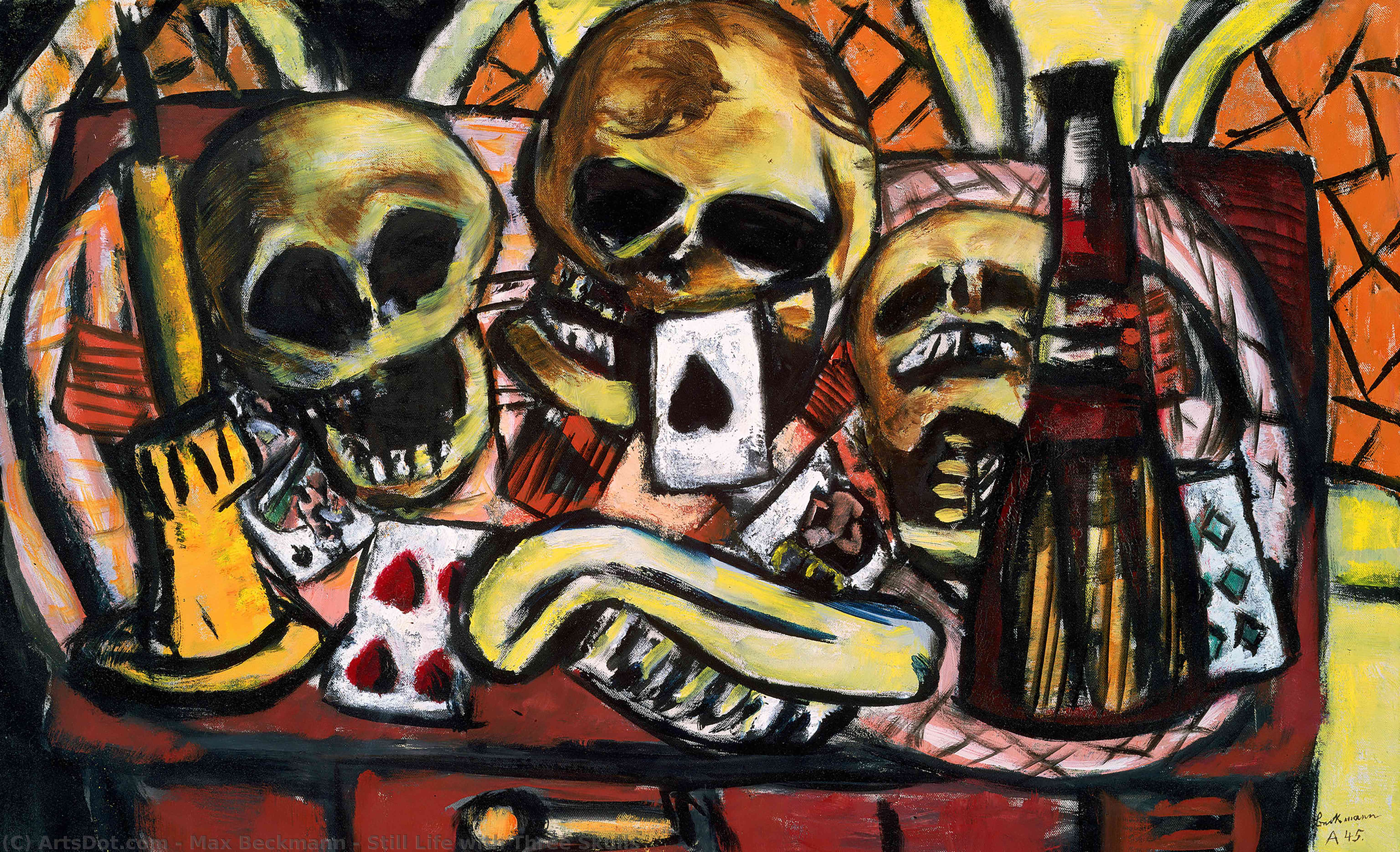
Still Life with Three Skulls


Three haunting skulls and scattered bottles create a profound sense of mortality in this powerful German Expressionist still life by Max Beckmann, inviting you to explore the depths of this evocative masterpiece.
 Ver más
Descubre la poderosa obra de Max Beckmann (1884-1950), figura clave del Expresionismo Alemán. Sus pinturas, marcadas por figuras distorsionadas y paisajes inquietantes, reflejan el trauma de la WWI y temas existenciales.
Reproducción al óleo hecha a mano
Óleo sobre lienzo pintado a mano en el tamaño y marco de su elección, realizado por encargo por nuestros artistas. ( Cambiar a impresiones Cambiar a imagen digital)




P118B €10

P118H €10

P118W €10

P438Z €10

P508JH €12

P508YH €12

P805H €10

P805Z €10

P919BZ €10

P919G €10

P919XJ €10

P959ZH €10

P968JZ €12

W106C €8

W218G €10

W218JH €8

W218Y €10

W307PJ €10

W316G €10

W316PJ €8

W316Y €10

W398PJ €8

W4111J €10

W500HY €15

W500JH €15

W692G €12

W849H €8

W940BG €15

W953PJ €8




Tamaño estándar
a medida
CM
INCH
Elija entre nuestros tamaños predefinidos que respetan las proporciones originales de la obra.
Loading sizes...

ancho
altura
Indique el ancho y el alto que necesite para adaptarse a su marco o pared. Al tratarse de una obra pintada a mano, si requiere un tamaño con una proporción distinta, el artista puede pintar un poco más alrededor de la imagen o recortarla ligeramente; usted elige. Le enviaremos una maqueta digital para su aprobación antes de comenzar la pintura. La imagen que se muestra en esta página no refleja el resultado real; solo la maqueta lo hace.
Ejemplos de lo que se puede personalizar: Reemplace el rostro con una foto del cliente; Agregue una mascota (por ejemplo, cambie un gato por un perro); Incluya un mensaje oculto en el fondo; Cambie el paisaje o los elementos del fondo.
Tras realizar el pedido, el equipo de TopImpressionists.com enviará un correo electrónico al cliente para solicitar instrucciones y proporcionarle una vista previa del boceto.
Tras realizar el pedido, el equipo de TopImpressionists.com enviará un correo electrónico al cliente para solicitar instrucciones y proporcionarle una vista previa del boceto.
Envío a todo el mundo () en 3-4 semanas en lugar de las 5 semanas estándar. (27 octubre). Sin comprometer la calidad.

Envío exprés gratuito a todo el mundo

Lienzo de lino de alta calidad

Seguro de envío total

Garantía de reembolso de aranceles aduaneros

Garantía de fidelidad cromática exacta

Política de devolución de 100 días (solo por defectos)

Garantía de devolución del 100% del dinero

Descuento por cantidad
 La opción de vidrio solo está disponible en tamaños inferiores a 110 cm.

Still Life with Three Skulls
Técnica de reproducción
Dimensiones de la reproducción
-


Precio total final
€ 237
A Memento Mori in Modernity
In the hauntingly evocative Still Life with Three Skulls, the viewer is invited into a somber, introspective space where the boundaries between life and death blur through the lens of German Expressionism. Max Beckmann, a master of capturing the psychological weight of the human condition, presents a composition that transcends mere tabletop arrangement. The painting features three skulls arranged across a dark, textured surface, their hollow sockets staring back with an unsettling permanence. Interspersed among these skeletal remains are various bottles and a solitary knife, objects that ground the macabre subject matter in a domestic, almost mundane reality. This juxtaposition creates a profound tension, as the everyday items of life sit alongside the undeniable symbols of mortality.
The technique employed by Beckmann is nothing short of visceral. Eschewing the delicate smoothness of classical still lifes, he utilizes a bold, distorted approach to space and form that reflects his experience as a medical orderly during World War I. The brushwork feels heavy and deliberate, imbuing each object with a sense of sculptural weight. There is a rhythmic quality to the placement of the bottles—one perched in the upper right, another near the center, and a third anchoring the lower left—which guides the eye through a labyrinth of light and shadow. This use of chiaroscuro, reminiscent of the Old Masters like Rembrandt, serves to heighten the drama, pulling the skulls out of the darkness and forcing a confrontation with their stark, bony architecture.
Symbolism and the Weight of Existence
To gaze upon this work is to engage with the ancient tradition of memento mori—the reminder that death is an ever-present companion. However, Beckmann breathes a modern, existential dread into this classical theme. The skulls are not merely decorative symbols; they represent the fragility of the human ego and the inevitable decay of all material things. The presence of the knife adds a layer of latent violence or perhaps the surgical precision of fate, while the bottles suggest the fleeting pleasures of the senses that cannot stave off the end. For the collector or interior designer, this piece offers more than just visual interest; it provides a profound intellectual anchor for a room, sparking conversation about the cyclical nature of life and the enduring legacy of human struggle.
For those seeking to integrate such a powerful work into a curated space, a high-quality reproduction of Still Life with Three Skulls serves as a centerpiece of immense character. It is an ideal selection for a study, a library, or a sophisticated gallery wall where art is intended to provoke thought and evoke emotion. The painting’s dark palette and commanding presence allow it to harmonize with rich textures like leather, dark wood, and velvet, creating an atmosphere of timelessness and intellectual depth. Owning this piece is an invitation to contemplate the beauty found within the shadows and to appreciate the raw, unfiltered truth of the human experience as captured by one of the twentieth century's most significant artistic voices.
Preguntas y respuestas
¿Los colores de "Still Life with Three Skulls" de Max Beckmann son intensos o tenues?
"Still Life with Three Skulls" de Max Beckmann presenta una saturación de Balanced Soft y una intensidad de Balanced.
¿Cuál es el formato de "Still Life with Three Skulls"?
"Still Life with Three Skulls" de Max Beckmann tiene un formato Panoramic. El formato describe las proporciones de la composición.
¿Cómo puedo conseguir una lámina de "Still Life with Three Skulls" de Max Beckmann?
Puede solicitar una impresión de "Still Life with Three Skulls" de Max Beckmann directamente en su página de Impresión de arte de bellas artes: una impresión de bellas artes sobre lienzo de algodón o papel de lienzo de archivo.
Biografía del artista
Vida temprana y desarrollo artístico
Max Beckmann, un renombrado pintor, dibujante, grabador, escultor y escritor alemán, nació el 12 de febrero de 1884 en Leipzig, Sajonia. Su viaje artístico comenzó con representaciones académicamente correctas, que luego se transformaron en figuras y espacios distorsionados, reflejando su visión alterada de la humanidad después de servir como ordenanza médica durante la Primera Guerra Mundial.Estilo artístico e influencias
El estilo de Beckmann, arraigado en la imaginería del vidrio medieval, estuvo influenciado por varios artistas, incluyendo a Cézanne, Van Gogh, Blake, Rembrandt y Rubens. También se inspiró en los artistas europeos del norte del siglo tardío medieval y del Renacimiento temprano, como Bosch, Bruegel y Matthias Grünewald.Obras notables y exposiciones
- El Bark (adquirido por la Galería Nacional de Berlín)
- Autorretrato con esmoquin (comprado en 1928)
- Retrospectivas en la Städtische Kunsthalle Mannheim (1928) y en Basilea y Zúrich (1930)
Vida posterior y exilio
La fortuna de Beckmann cambió con el ascenso de Adolf Hitler, lo que llevó a su despido de la escuela de arte en Frankfurt y a la confiscación de más de 500 de sus obras. Vivió en autoexilio en Ámsterdam durante diez años, sin lograr obtener un visado para los Estados Unidos.Legado
- Enseñó en las escuelas de arte de la Universidad Washington en St. Louis y el Museo de Brooklyn
- La primera retrospectiva en los Estados Unidos tuvo lugar en 1948 en el City Art Museum, Saint Louis
- La Galería Max-Slevogt, Alemania, presenta una colección de sus obras
- Nació: 12 de febrero de 1884
- Falleció: 27 de diciembre de 1950
Contexto Histórico y Recepción
Beckmann fue una figura central en el desarrollo del Expresionismo alemán, aunque rechazó la etiqueta. Su obra refleja las turbulencias sociales y políticas de su tiempo, especialmente los horrores de la Primera Guerra Mundial y el ascenso del nazismo. Su estilo evolucionó desde representaciones académicas hasta un lenguaje visual más abstracto y simbólico, que a menudo exploraba temas de alienación, violencia y desesperanza. A pesar de enfrentar persecución bajo el régimen nazi, su legado perdura como uno de los artistas más importantes del siglo XX.
Max Beckmann
1884 - 1950 , Alemania
Datos clave
- Artistas Que Influyeron:
- Cézanne
- Van Gogh
- Blake
- Rembrandt
- Rubens
- Bosch
- Bruegel
- Grünewald
- Fecha De Fallecimiento: 27 de diciembre de 1950
- Fecha De Nacimiento: 12 de febrero de 1884
- Lugar De Nacimiento: Leipzig, Alemania
- Movimiento Artístico: Expresionismo Alemán
- Nacionalidad: Alemán
- Nombre Completo: Max Beckmann
- Obras Notables:
- El Bark
- Autorretrato con Tuxedo
- La Noche
- Columbine
- Gran Escena de Angustia
Artículos relacionados

Unmasking Emotion: A Journey Through the Raw Power and Visceral Beauty of German Expressionism
Explore the raw emotional power of German Expressionism. From Kirchner to Die Brücke, discover how artists used distortion and vibrant color to unmask the human psyche. A deep dive into art history for the discerning collector and enthusiast.
Explore obras de arte organizadas por temas, estilos y características.


