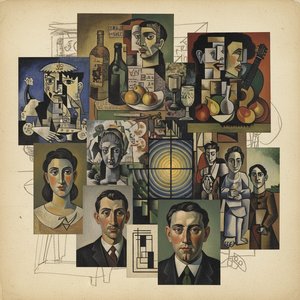
Pablo Picasso: A Revolutionary Artist
Pablo Ruiz y Picasso (1881–1973) stands as one of the most influential figures in 20th-century art, reshaping artistic conventions and captivating audiences worldwide with his groundbreaking innovations. Born in Málaga, Spain, Picasso demonstrated exceptional talent from a young age, nurtured by his father’s encouragement and early training. His formative years were marked by intense study and experimentation, culminating in distinct stylistic periods that solidified his legacy as a visionary artist.
The Blue Period (1901–1906)
- This melancholic phase saw Picasso primarily utilizing shades of blue and indigo to convey themes of poverty, despair, and loneliness—often depicting marginalized figures like beggars and prostitutes.
- Influenced by the works of Edvard Munch and Georges Seurat, Picasso’s palette reflected a profound emotional depth, capturing the psychological complexities of his subjects.
- Notable paintings from this period include “The Old Guitarist” and “La Vie,” demonstrating Picasso's mastery of tonal modulation and expressive brushwork.
The Rose Period (1906–1908)
- A shift towards warmer hues—particularly pinks, oranges, and reds—characterized the Rose Period, reflecting a newfound optimism and interest in portraying human relationships.
- Picasso’s subjects often included circus performers and acrobats, capturing their dynamism and grace with meticulous detail.
- “Family of Saltimbanques” exemplifies this stylistic evolution, showcasing Picasso's refined technique and his ability to convey emotion through subtle gestures and expressions.
Cubism (1907–1914)
- Picasso’s revolutionary embrace of Cubism marked a pivotal moment in art history, dismantling traditional perspective and presenting subjects from multiple viewpoints simultaneously.
- Collaborations with Georges Braque resulted in groundbreaking works like “Les Demoiselles d'Avignon,” challenging conventional notions of representation and paving the way for abstract expressionism.
- Cubist paintings utilize fragmented forms and geometric shapes to depict objects as seen through intersecting planes, creating a visually stimulating experience for viewers.
Bathers (1920)
Pablo Picasso’s “Bathers” is an iconic pastel masterpiece that embodies the artist's signature style during his mature years. Created in 1920 at Dinard, Brittany, France, this artwork exemplifies Picasso’s exploration of form and color—a deliberate departure from Impressionism and a powerful statement about human presence within nature.
The painting depicts three women lounging on the beach, bathed in sunlight, capturing a moment of serene contemplation. Picasso skillfully employs pastel crayons to achieve remarkable luminosity and textural richness, layering colors to create depth and illusionistic space.
Beyond its aesthetic beauty, “Bathers” resonates with symbolic significance—representing vitality, femininity, and the harmonious relationship between humanity and the environment. It stands as a testament to Picasso’s enduring influence on modern art and continues to inspire artists and collectors alike.
Conclusion
“Bathers” by Pablo Picasso transcends mere visual representation; it's an invitation to contemplate the essence of human experience—a celebration of beauty, tranquility, and artistic innovation. Its masterful execution and profound emotional impact solidify its place as one of Picasso’s most enduring achievements.
Discovering the Artworks Exhibited at Schloss Sanssouci, Berlin, Germany
Schloss Sanssouci in Berlin, Germany, houses an impressive collection of artworks. For more information on the museum and its exhibits, visit Discovering the Artworks Exhibited at Schloss Sanssouci.
TopImpressionists.com: Reproductions of Masterpieces
For art enthusiasts looking to own a piece of history, TopImpressionists.com offers handmade oil painting reproductions of famous artworks, including those by Pablo Picasso.



 Vista previa
 Comprar pintura hecha a mano
 Compartir
 Compartir
 Ver detalles

 Descargar
 Ver similares
 Radiografía
 Presentación de diapositivas


 Leer más






































 La opción de vidrio solo está disponible en tamaños inferiores a 110 cm.