Descripción de la obra
Pablo Picasso: A Revolutionary Artist
Pablo Diego José Francisco de Paula Juan Nepomuceno María de los Remedios Cipriano de la Santísima Trinidad Ruiz y Picasso (25 October 1881 – 8 April 1973) was a Spanish painter, sculptor, printmaker, ceramicist, and theatre designer who spent most of his adult life in France. One of the most influential artists of the 20th century, he is known for co-founding the Cubist movement, the invention of constructed sculpture, the co-invention of collage, and for the wide variety of styles that he helped develop and explore. Among his most famous works are Guernica (1937), a dramatic portrayal of the bombing of Guernica by German and Italian air forces during the Spanish Civil War, and Les Demoiselles d'Avignon (1907), considered one of the earliest examples of Cubism. Picasso’s legacy extends far beyond his artistic creations; he fundamentally reshaped Western art history and continues to inspire artists worldwide.
Composition and Technique
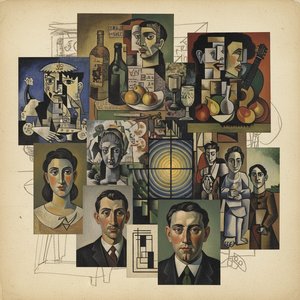
“Untitled (41)” presents a captivating portrait of a woman’s face, rendered in stark black and white charcoal. The artist skillfully employs this medium to convey both formal exploration and raw emotion—a hallmark of Picasso's approach. The composition is notable for its deliberate focus on depth and dimension; the woman dominates the image, her gaze downward creating an aura of melancholy. Her eyes are positioned centrally, drawing immediate attention, while her nose sits squarely in the middle of the canvas. The subtle shading techniques employed by Picasso imbue the portrait with a palpable sense of realism despite its simplified aesthetic. The placement of the hood or veil—extending from the top left to the bottom right corner—adds dynamism and contributes to the overall enigmatic atmosphere.
Artistic Movement
This artwork embodies Naive Art, an artistic movement characterized by its rejection of academic conventions and its embrace of spontaneous expression. Picasso’s fascination with this style stemmed from his desire to capture the essence of untutored creativity—a reaction against the rigid rules imposed by traditional art academies. Influenced by artists like Henri Rousseau and Maurice Sterne, Picasso sought inspiration in primitive visual languages, prioritizing emotional impact over technical precision. The movement's proponents believed that true artistic genius resided in unfiltered intuition rather than meticulous observation. As noted in “The Naïve Art (Primitivism) Art Movement,” this aesthetic was often pursued by trained artists who wished to reconnect with the origins of art—a deliberate departure from established norms.
Other Works by Picasso
Picasso’s artistic journey spanned numerous styles and periods, demonstrating his unparalleled versatility. Alongside “Untitled (41),” masterpieces such as “Guernica” exemplify his commitment to social commentary and political activism. His exploration of Surrealism, particularly in works like “The Weeping Woman,” reveals a preoccupation with psychological depth and subconscious imagery. Furthermore, Picasso’s sculptures—including “Head” and “Man with Guitar”—demonstrate his mastery of three-dimensional form and his ability to convey emotion through sculptural expression. These diverse creations solidify Picasso's position as one of the most prolific and influential artists of the 20th century.
Conclusion
“Untitled (41)” stands as a poignant testament to Picasso’s embrace of Naive Art—a stylistic choice that prioritizes emotional resonance over technical refinement. The masterful use of charcoal, combined with its deliberate compositional elements, elevates this portrait beyond mere representation, inviting contemplation on themes of vulnerability and introspection. For those seeking to immerse themselves in the artistic legacy of Pablo Picasso or exploring similar expressions of emotion through art reproductions, TopImpressionists.com offers exceptional quality prints crafted by skilled artisans. Visit their website today to discover a world of artistic masterpieces!



 Vista previa
 Pedir impresión
 Compartir
 Compartir
 Ver detalles

 Descargar
 Ver similares
 Radiografía
 Presentación de diapositivas


 Leer más






































 La opción de vidrio solo está disponible en tamaños inferiores a 110 cm.