
Shown: · With its frame:
 Ver en contexto
 Enviar
 Compartir
 Detalles
 Guía
Guía

 Descargar
 Similares
 Radiografía
 Presentación de diapositivas
 Q&A
Q&A Estadísticas


€ 239
Reproducción al óleo hecha a mano
Óleo sobre lienzo pintado a mano en el tamaño y marco de su elección, realizado por encargo por nuestros artistas. ( Cambiar a impresiones Cambiar a imagen digital)
Size
·Tamaño estándar
a medida
CM
INCH
Elija entre nuestros tamaños predefinidos que respetan las proporciones originales de la obra.
Loading sizes...

ancho
altura
Indique el ancho y el alto que necesite para adaptarse a su marco o pared. Al tratarse de una obra pintada a mano, si requiere un tamaño con una proporción distinta, el artista puede pintar un poco más alrededor de la imagen o recortarla ligeramente; usted elige. Le enviaremos una maqueta digital para su aprobación antes de comenzar la pintura. La imagen que se muestra en esta página no refleja el resultado real; solo la maqueta lo hace.
 Leer más información
Finish
·
White €1

Blurside €1

Extended €1

P118B €10

P118H €10

P118W €10

P438Z €10

P508JH €12

P508YH €12

P805H €10

P805Z €10

P919BZ €10

P919G €10

P919XJ €10

P959ZH €10

P968JZ €12

W106C €8

W218G €10

W218JH €8

W218Y €10

W307PJ €10

W316G €10

W316PJ €8

W316Y €10

W398PJ €8

W4111J €10

W500HY €15

W500JH €15

W692G €12

W849H €8

W940BG €15

W953PJ €8

H24-GOLD €30

H24-SILVER €30

H36-GOLD €45

H36-SILVER €45
Shipped in a protective tube, ready for your own framer.
Above 105 cm the frame is shipped as a kit for a professional framer — read the details.
Extras
optionalWhat do the extras include?
Examples of what can be changed: Replace face with customer photo; Add pet (e.g., replace cat with dog); Include hidden message in background; Change background landscape or elements.
After order, TopImpressionists.com team will email client for instructions and provide a mockup preview
After order, TopImpressionists.com team will email client for instructions and provide a mockup preview
Envío a todo el mundo () en 3-4 semanas en lugar de las 5 semanas estándar. (1 noviembre). Sin comprometer la calidad.
Barniz protector
Cartela
Detalles de la placa de bronce grabada
This elegant plaque features the artist's name and the title of the artwork, finely engraved for a timeless presentation.
It is made from bronze with a refined, elegant finish. The text is precisely laser-engraved for a sharp and permanent result. Measuring 9x2 cm, the plaque is compact yet easy to read. It's built to be durable and scratch-resistant, offering a professional, museum-quality look. Mounting is simple thanks to the included adhesive backing.
Detalles de la placa de acrílico transparente
The plaque includes essential engraved details such as the artist's name, the title of the artwork, the date it was created, the type of media used-like oil on canvas or watercolor-a brief description of the piece, and a QR code that links to the complete artwork information.
It is crafted from clear acrylic, offering a sleek, modern appearance. The text is UV-engraved in black to ensure strong visual contrast. With a size of 10x15 cm, it ensures optimal readability. It comes equipped with two metal hooks for secure wall mounting. The plaque is designed to be weather-resistant, making it suitable for various environments, and it includes interactive features that work seamlessly with smartphone scanning.
Detalles de la placa de acrílico negro
This elegant plaque includes engraved information such as the artist's name, the title of the artwork, the date it was created, the type of media used (like oil on canvas or watercolor), a short description of the artwork, and a QR code for quick access to more information.
The plaque itself is made from refined black acrylic with a premium finish. The text is laser-engraved in white for high contrast and readability. Its size is 10x15 cm, designed to be easy to read. It comes with two metal hooks for professional mounting. The design is sleek and fits any interior style. It is also weather-resistant and durable, with built-in digital integration for mobile compatibility.
La opción de vidrio solo está disponible en tamaños inferiores a 110 cm.
 La opción de vidrio solo está disponible en tamaños inferiores a 110 cm.
- Envío exprés gratuito a todo el mundo
- Lienzo de lino de alta calidad
- Seguro de envío total
- Garantía de reembolso de aranceles aduaneros
- Garantía de fidelidad cromática exacta
- Política de devolución de 100 días (solo por defectos)
- Garantía de devolución del 100% del dinero
- Descuento por cantidad


Descripción del objeto
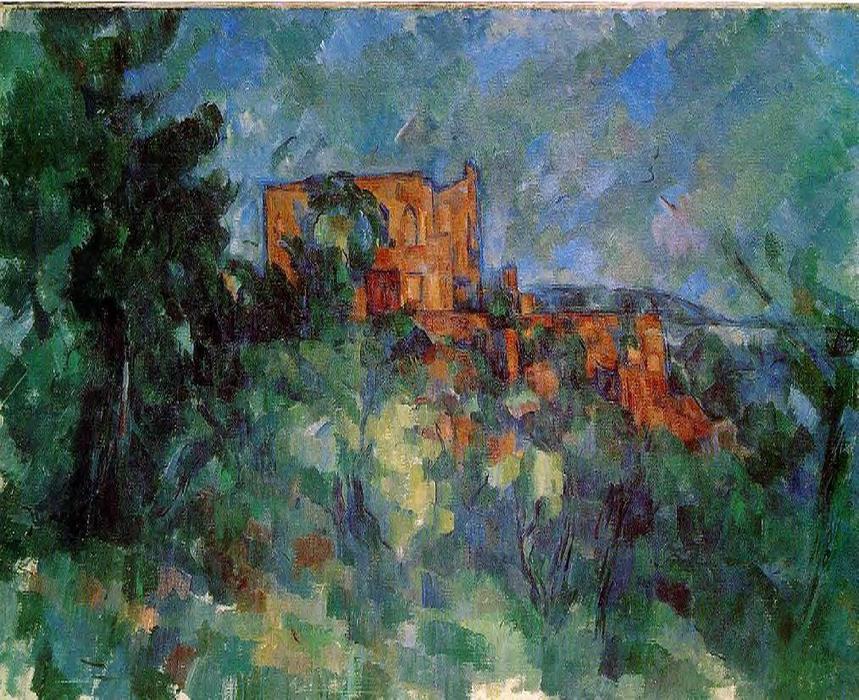
Paul Cézanne's Château Noir (1904): Un icono del impresionismo tardío que explora formas geométricas y colores vibrantes en un paisaje evocador. Descubre la maestría artística de Cézanne.
Biografía del artista
Explora el arte revolucionario de Paul Cézanne (1839-1906), un maestro del Postimpresionismo que conectó el Impresionismo y el Cubismo. Descubre sus formas geométricas, pinceladas únicas, pinturas de bodegones e impacto duradero en el arte moderno. #Cézanne #PostImpres
About the painting
A Citadel of Stone and Sky: Paul Cézanne’s *Château Noir*
Paul Cézanne's *Château Noir*, painted in 1904, isn’t merely a depiction of a castle; it’s an invitation into the heart of a revolutionary artistic vision. This oil on canvas, currently residing within the hallowed halls of the Musée du Louvre in Paris, embodies the culmination of Cézanne's lifelong pursuit to capture not just what he saw, but *how* he perceived – a profound shift away from traditional representation and towards an exploration of form, color, and structure. The painting immediately draws the eye with its bold contrasts: the fiery red of the castle’s roof against the deep azure of the sky, creating a visual tension that speaks to both power and tranquility.
Cézanne's approach to landscape painting was profoundly influenced by the Impressionists, particularly their focus on capturing fleeting moments of light. However, he quickly moved beyond mere observation, seeking to distill the essence of his subjects into fundamental geometric shapes. *Château Noir* exemplifies this shift brilliantly. The castle itself isn’t rendered with meticulous detail; instead, it's broken down into a series of interlocking planes and angles – rectangles, triangles, and cylinders – that suggest volume and depth. This deliberate simplification wasn’t an abandonment of realism but rather a conscious decision to prioritize the underlying structure of the scene, anticipating the radical innovations of Cubism by decades.
The Language of Color and Form
Cézanne's masterful use of color is equally significant. He employs a palette of rich, saturated hues – deep blues, vibrant reds, earthy greens – not to mimic reality but to convey emotional resonance. The red roof, for instance, isn’t simply painted red; it pulsates with energy and warmth, dominating the composition and drawing the viewer’s attention. Notice how Cézanne uses color to define space and create a sense of atmosphere. He employs broken brushstrokes, layering colors in small, distinct patches, rather than blending them smoothly – a technique that adds texture and dynamism to the surface of the canvas.
The surrounding landscape is rendered with equally expressive strokes. The trees, positioned strategically in the foreground and background, aren’t depicted as individual forms but as masses of color and shape, contributing to the overall sense of spatial ambiguity. Cézanne deliberately obscures precise details, inviting the viewer to actively participate in constructing the image – a hallmark of his unique style.
Historical Context and Cézanne’s Vision
Painted during Cézanne's final years—a period marked by intense experimentation and a deepening preoccupation with formal abstraction—*Château Noir* represents a pivotal moment in artistic history. Cézanne was responding to the challenges posed by Impressionism, rejecting its emphasis on optical illusion and striving instead for a more intellectually rigorous approach. Influenced by thinkers like Nietzsche and Bergson, he sought to capture not just what he saw but also the underlying vibrations of existence—a concept that would become central to his artistic philosophy.
The painting’s genesis lies in Cézanne's fascination with Mont Sainte-Victoire, a towering limestone massif overlooking Aix-en-Provence. He repeatedly depicted this mountain throughout his career, transforming it into an emblem of permanence and stability amidst the ephemeral beauty of nature. *Château Noir*, however, transcends mere topographical representation; it’s infused with Cézanne's desire to explore the fundamental principles of visual perception.
Symbolism and Emotional Resonance
*Château Noir* is laden with symbolic significance. The castle itself—a crumbling ruin—represents decay and transformation, mirroring Cézanne’s own contemplation of mortality. Yet, its fiery red roof symbolizes vitality and resilience, suggesting that beauty can endure even in the face of decline. The juxtaposition of color and form underscores Cézanne's belief that art should engage both intellect and emotion.
Ultimately, *Château Noir* stands as a testament to Cézanne’s unwavering commitment to artistic innovation—a legacy that continues to inspire artists and captivate audiences worldwide. Its enduring appeal resides in its ability to evoke contemplation and wonder, prompting viewers to consider the profound questions posed by art about the nature of reality.
If you’re seeking a high-quality reproduction of this iconic masterpiece, TopImpressionists offers meticulously crafted oil painting reproductions that capture the essence of Cézanne’s artistic genius. Explore Paul Cézanne: Château Noir today and bring a piece of art history into your home.
Preguntas y respuestas
¿Qué sentimiento y emoción transmite "Château Noir" de Paul Cézanne?
El estado de ánimo que transmite "Château Noir" de Paul Cézanne es Elegante, y su tono emocional es Contemplativo.
¿Cuándo y con qué técnica se realizó "Château Noir"?
La técnica de "Château Noir" de Paul Cézanne es Óleo sobre lienzo y la obra data de 1904.
¿Qué nivel de luminosidad transmite "Château Noir" de Paul Cézanne?
En términos generales, "Château Noir" presenta una luminosidad de sombra. La luminosidad percibida describe qué tan clara u oscura parece la obra.
Quick facts and art quiz
About Paul Cézanne

Paul Cézanne
1839 - 1906, Francia
Biografía del artista
vida temprana e influencias
paul cézanne, un pintor postimpresionista francés, nació el 19 de enero de 1839 en Aix-en-Provence, Francia. Su vida temprana estuvo marcada por una fuerte conexión con la empresa bancaria de su familia, lo que le proporcionó seguridad financiera. Esto le permitió concentrarse en sus aspiraciones artísticas sin la carga del estrés financiero. les nabis, neoimpresionismo y simbolismo influyeron en el trabajo temprano de Cézanne, que se caracterizó por su énfasis en las formas geométricas y una paleta de colores limitada. Su interés en las obras de paul gauguin y georges seurat fortaleció aún más su estilo postimpresionista.estilo artístico y técnicas
El uso innovador de Cézanne de los planos de color y pequeños trazos repetitivos creó campos complejos que transmitían su intenso estudio de los temas. Su enfoque a menudo exploratorio del arte condujo al desarrollo de un nuevo lenguaje pictórico, que enfatizaba la estructura subyacente de los objetos en una composición.- características clave:
- formas geométricas y facetado
- paleta de colores reducida
- énfasis en la esencia constructiva del mundo físico
- múltiples perspectivas y simultaneidad
- obras influyentes:
- el estanque de jas de bouffan (1880)
- retrato de emile zola (1866)
- bosque (1892)
- museos que exhiben el trabajo de Cézanne:
- museo marmottan monet en París, Francia
- el museo de bellas artes en Houston, Estados Unidos
legado e impacto
El trabajo pionero de Cézanne en el postimpresionismo allanó el camino para diversos movimientos vanguardistas, incluyendo cubismo, fauvismo y surrealismo. Su influencia se puede ver en las obras de pablo picasso, henri matisse y georges braque. El legado de Cézanne continúa inspirando a artistas y entusiastas del arte por igual, consolidando su lugar como una figura fundamental en la historia del arte moderno.- movimientos artísticos relacionados:
- vea las obras de Cézanne:
Quick facts about Paul Cézanne
- Artistas Que Influyeron:
- Paul Gauguin
- Georges Seurat
- Estilo Artístico: Postimpresionismo
- Fecha De Muerte: Octubre 22, 1906
- Fecha De Nacimiento: 19 de enero de 1839
- Influenciado A Artistas:
- Pablo Picasso
- Henri Matisse
- Georges Braque
- Lugar De Nacimiento: Aix-en-Provence, Francia
- Nacionalidad: Francés
- Nombre Completo: Paul Cézanne
- Obras Notables:
- El estanque de Jas de Bouffan
- Retrato de Émile Zola
- Bosque
- Grandes Bañistas
Explore obras de arte organizadas por temas, estilos y características.


Paul Cézanne
Château Noir
() ·
With its frame: · Hand-painted in oil on linen
Total