

Se muestra: · Con su marco:
 Ver en contexto
 Enviar
 Compartir
 Detalles
 Guía
Guía

 Descargar
 Similares
 Radiografía
 Presentación de diapositivas
 Preguntas y respuestas
 Estadísticas
- 90.0 x 106.0 cm


€ 240
Reproducción al óleo hecha a mano
Óleo sobre lienzo pintado a mano en el tamaño y marco de su elección, realizado por encargo por nuestros artistas. ( Cambiar a impresiones Cambiar a imagen digital)
Tamaño
·Tamaño estándar
a medida
CM
INCH
Elija entre nuestros tamaños predefinidos que respetan las proporciones originales de la obra.
Cargando tamaños...

ancho
altura
Indique el ancho y el alto que necesite para adaptarse a su marco o pared. Al tratarse de una obra pintada a mano, si requiere un tamaño con una proporción distinta, el artista puede pintar un poco más alrededor de la imagen o recortarla ligeramente; usted elige. Le enviaremos una maqueta digital para su aprobación antes de comenzar la pintura. La imagen que se muestra en esta página no refleja el resultado real; solo la maqueta lo hace.
 Leer más información
Finalizar
·
Blanco €1

Bordes difuminados €1

Continuación de imagen €1

P118B €10

P118H €10

P118W €10

P438Z €10

P508JH €12

P508YH €12

P805H €10

P805Z €10

P919BZ €10

P919G €10

P919XJ €10

P959ZH €10

P968JZ €12

W106C €8

W218G €10

W218JH €8

W218Y €10

W307PJ €10

W316G €10

W316PJ €8

W316Y €10

W398PJ €8

W4111J €10

W500HY €15

W500JH €15

W692G €12

W849H €8

W940BG €15

W953PJ €8

H24-GOLD €30

H24-SILVER €30

H36-GOLD €45

H36-SILVER €45
Se envía en un tubo protector, listo para que lo enmarque su profesional de confianza.
Servicios adicionales
opcional¿Qué incluyen los extras?
Ejemplos de lo que se puede cambiar: Reemplazar el rostro con la foto del cliente; Añadir una mascota (por ejemplo, cambiar un gato por un perro); Incluir un mensaje oculto en el fondo; Cambiar el paisaje o los elementos del fondo.
Tras realizar el pedido, el equipo de TopImpressionists.com enviará un correo electrónico al cliente para solicitar instrucciones y proporcionar una vista previa del boceto
Tras realizar el pedido, el equipo de TopImpressionists.com enviará un correo electrónico al cliente para solicitar instrucciones y proporcionar una vista previa del boceto
Envío a todo el mundo () en 3-4 semanas en lugar de las 5 semanas estándar. (7 noviembre). Sin comprometer la calidad.
Barniz protector
Cartela
Detalles de la placa de bronce grabada
This elegant plaque features the artist's name and the title of the artwork, finely engraved for a timeless presentation.
It is made from bronze with a refined, elegant finish. The text is precisely laser-engraved for a sharp and permanent result. Measuring 9x2 cm, the plaque is compact yet easy to read. It's built to be durable and scratch-resistant, offering a professional, museum-quality look. Mounting is simple thanks to the included adhesive backing.
Detalles de la placa de acrílico transparente
The plaque includes essential engraved details such as the artist's name, the title of the artwork, the date it was created, the type of media used-like oil on canvas or watercolor-a brief description of the piece, and a QR code that links to the complete artwork information.
It is crafted from clear acrylic, offering a sleek, modern appearance. The text is UV-engraved in black to ensure strong visual contrast. With a size of 10x15 cm, it ensures optimal readability. It comes equipped with two metal hooks for secure wall mounting. The plaque is designed to be weather-resistant, making it suitable for various environments, and it includes interactive features that work seamlessly with smartphone scanning.
Detalles de la placa de acrílico negro
This elegant plaque includes engraved information such as the artist's name, the title of the artwork, the date it was created, the type of media used (like oil on canvas or watercolor), a short description of the artwork, and a QR code for quick access to more information.
The plaque itself is made from refined black acrylic with a premium finish. The text is laser-engraved in white for high contrast and readability. Its size is 10x15 cm, designed to be easy to read. It comes with two metal hooks for professional mounting. The design is sleek and fits any interior style. It is also weather-resistant and durable, with built-in digital integration for mobile compatibility.
La opción de vidrio solo está disponible en tamaños inferiores a 110 cm.
 La opción de vidrio solo está disponible en tamaños inferiores a 110 cm.
- Envío exprés gratuito a todo el mundo
- Lienzo de lino de alta calidad
- Seguro de envío total
- Garantía de reembolso de aranceles aduaneros
- Garantía de fidelidad cromática exacta
- Política de devolución de 100 días (solo por defectos)
- Garantía de devolución del 100% del dinero
- Descuento por cantidad


Descripción del objeto
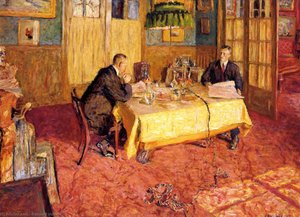
Experience Pierre Bonnard’s ‘Before Dinner,’ a captivating 1924 painting of a family enjoying a quiet meal in a warmly lit domestic setting, showcasing the artist's signature style and color palette. Discover this beautiful artwork and bring its charm into your home.
Biografía del artista
Descubre a Pierre Bonnard (1867-1947), pintor postimpresionista francés conocido por sus escenas íntimas, vibrantes colores y estilo 'Intimista'. ¡Explora su legado!
Sobre la obra
A Moment of Domestic Tranquility: Pierre Bonnard’s “Before Dinner”
Pierre Bonnard's "Before Dinner," painted in 1924, offers a poignant glimpse into the quiet intimacy of everyday life – a scene rendered with the masterly precision and luminous color palette that defined his mature style. Measuring 90 x 106 cm, this work captures a family gathered around a dining table, not as a grand spectacle but as a tender tableau of shared moments. The composition immediately draws the eye to the two figures seated at the table, their postures suggesting a comfortable familiarity, perhaps lost in conversation or simply enjoying the anticipation of the meal to come. Bonnard’s ability to distill complex emotion into simple gestures is evident in the woman on the right, her gaze downward hinting at a private thought or observation – a subtle detail that elevates the scene beyond mere representation.
The Nabis Influence and Bonnard's Palette
Painted during a period of relative stability after World War I, “Before Dinner” reflects Bonnard’s continued engagement with the principles of the Nabis group, of which he was a founding member. The Nabis, meaning "the prophets," sought to use color as the primary means of expression, rejecting academic realism in favor of subjective perception. This is powerfully evident in Bonnard's masterful manipulation of light and shadow, creating an atmosphere that is both warm and subtly melancholic. Notice the interplay of ochres, blues, and greens – colors he frequently employed to evoke a sense of nostalgia and domestic comfort. His technique involved layering thin glazes of paint, building up depth and luminosity with remarkable skill. The brushstrokes are visible yet controlled, contributing to the painting’s tactile quality and reinforcing its impressionistic character.
Symbolism of Still Life and Family
Beyond its immediate depiction of a family meal, “Before Dinner” is rich in symbolic resonance. The carefully arranged table setting – the wine glasses, cutlery, and bottles – transcends mere practicality; it becomes a still life imbued with emotional significance. These objects are not simply props but contribute to the overall mood and narrative. The presence of multiple items suggests abundance and warmth, while the slightly disordered arrangement hints at the natural chaos of family life. Bonnard’s focus on domestic subjects was a deliberate choice, reflecting his deep empathy for the lives of ordinary people and his desire to capture the beauty he found in everyday moments. This work speaks to the core values of the time – family, comfort, and simple pleasures.
A Legacy of Light and Emotion
"Before Dinner" stands as a testament to Pierre Bonnard’s enduring legacy as one of France's most beloved Impressionist painters. Its quiet beauty, coupled with its technical brilliance, continues to resonate with viewers today. This hand-painted reproduction offers an exceptional opportunity to experience the full impact of Bonnard’s artistic vision – a chance to bring a touch of his luminous world into your own home or office. The meticulous detail and vibrant colors faithfully recreate the original painting's emotional depth, making it a truly captivating addition to any art collection.
Preguntas y respuestas
¿Qué nivel de contraste presenta "Before Dinner" de Pierre Bonnard?
El contraste entre luces y sombras de "Before Dinner" se registra como Bold. El contraste describe la intensidad con la que difieren las zonas claras y oscuras.
¿Qué tema y atmósfera combina "Before Dinner" de Pierre Bonnard?
"Before Dinner" de Pierre Bonnard representa family dinner, dining table, pierre bonnard, french art, domestic scene, wine glass, color palette, con un ambiente Nostalgic. El tema y la atmósfera describen juntos la obra.
¿Los colores de "Before Dinner" de Pierre Bonnard son intensos o tenues?
La paleta de "Before Dinner" presenta una saturación Clear Color Presence.
Datos rápidos y cuestionario de arte
Sobre Pierre Bonnard

Pierre Bonnard
1867 - 1947, Francia
Biografía del artista
Primeros años y formación
Pierre Bonnard, cuyo nombre completo era Pierre Émile Bonnard, nació el 3 de octubre de 1867 en Fontenay-aux-Roses, cerca de París. Proveniente de una familia burguesa acomodada – su padre era funcionario del Ministerio de Guerra –, disfrutó de una infancia relativamente tranquila y despreocupada. Desde temprana edad demostró un talento natural para el dibujo y la pintura, aunque inicialmente sus padres lo animaron a seguir una carrera más convencional.
Entre 1886 y 1887, Bonnard estudió derecho para complacer a su familia, pero pronto abandonó esta profesión para dedicarse por completo al arte. En 1888 ingresó en la École des Beaux-Arts de París, donde conoció a otros artistas que influirían profundamente en su desarrollo artístico, como Paul Sérusier y Édouard Vuillard.
El movimiento Nabis y las primeras influencias
A finales de la década de 1880, Bonnard se unió al grupo de artistas conocido como los "Nabis" (que significa “profetas” en hebreo). Este grupo, que incluía a Vuillard, Sérusier, Denis y otros, buscaba una renovación del arte a través de la simplificación de las formas, el uso expresivo del color y la exploración de temas íntimos y cotidianos.
Los Nabis se inspiraron en el arte japonés, especialmente en las estampas ukiyo-e, que admiraban por su composición plana, sus líneas elegantes y sus colores vibrantes. Esta influencia es evidente en las primeras obras de Bonnard, como "La modista" (1890), donde se aprecia una simplificación de las formas y un uso audaz del color.
Desarrollo artístico: Intimismo y escenas domésticas
A partir de la década de 1890, Bonnard desarrolló su propio estilo distintivo, caracterizado por el intimismo y la representación de escenas domésticas. Se centró en pintar momentos cotidianos de la vida familiar, como cenas, paseos o conversaciones, capturando la atmósfera íntima y los matices emocionales de estos encuentros.
Su esposa, Marthe de Meligny, se convirtió en una modelo recurrente en sus obras, apareciendo en numerosas pinturas que reflejan su relación personal y su visión del mundo. Bonnard prefería trabajar a partir de la memoria y los bocetos, lo que le permitía crear imágenes con un carácter onírico y evocador.
Características clave de su estilo:
- Uso expresivo del color: Bonnard empleaba el color no solo para representar la realidad, sino también para transmitir emociones y sensaciones.
- Composiciones inusuales: A menudo utilizaba perspectivas descentradas y encuadres inesperados para crear una sensación de intimidad y cercanía con el espectador.
- Atmósfera onírica: Sus pinturas se caracterizan por una atmósfera suave y difusa, que evoca un mundo interior lleno de recuerdos y emociones.
Madurez y reconocimiento tardío
A pesar de su talento, Bonnard no gozó de un gran reconocimiento durante su vida. Su obra fue a menudo ignorada o malinterpretada por los críticos, quienes la consideraban demasiado personal e intimista.
Sin embargo, en las décadas posteriores a su muerte, en 1947, el trabajo de Bonnard ha sido objeto de una reevaluación crítica y ha ganado un amplio reconocimiento internacional. Hoy en día, es considerado uno de los principales representantes del postimpresionismo francés y un maestro del color y la luz.
Obras destacadas:
- La modista (1890)
- El Jardín en Le Vésinet (1922)
- Baño (1932-1933)
- El Almendro en flor (1947, su última obra)
Legado e influencia
La obra de Bonnard ha influido a numerosos artistas posteriores, tanto por su uso innovador del color como por su enfoque intimista y personal. Su capacidad para capturar la belleza de los momentos cotidianos y transmitir emociones sutiles lo convierte en un artista único y atemporal.
Hoy en día, sus pinturas se encuentran en importantes museos de todo el mundo, y continúan inspirando a artistas y amantes del arte por igual. Su legado perdura como testimonio de la importancia de la observación cuidadosa, la sensibilidad artística y la búsqueda constante de la belleza en las cosas simples de la vida.
Datos rápidos sobre Pierre Bonnard
- Artistas Que Influyeron:
- Paul Gauguin
- Hokusai
- Fecha De Fallecimiento: 23 de enero de 1947
- Fecha De Nacimiento: 3 de octubre de 1867
- Influencia Artística: Intimismo, Post-Impresionismo
- Lugar De Nacimiento: Fontenay-aux-Roses, Francia
- Movimiento Artístico: Postimpresionismo, Nabis
- Nacionalidad: Francesa
- Nombre Completo: Pierre Bonnard
- Obras Notables:
- Mujer con vestido a cuadros
- El almendro en flor
Obras relacionadas




Explore obras de arte organizadas por temas, estilos y características.


Pierre Bonnard
Before Dinner
() ·
Con su marco: · Pintado a mano al óleo sobre lienzo
Total