


 Ver en contexto
 Enviar
 Compartir
 Detalles
 Guía
Guía

 Descargar
 Similares
 Radiografía
 Presentación de diapositivas
 Estadísticas
Composition con Dobles Líneas y Amarillo
 Acrílico sobre lienzo
- Arte de pared
- Neoplasticism
 1932
1932- Modernismo
 Galería Nacional de Arte Moderno de Escocia
Una obra maestra de Mondrian que expresa armonía universal mediante líneas verticales y horizontales en colores primarios como el amarillo y el blanco.
 Ver más
Explore la obra de Piet Mondrian (1872-1944), un pionero del arte abstracto y el movimiento De Stijl. Descubre sus icónicos cuadros geométricos, su estilo Neoplasticismo y su influencia duradera en el diseño moderno, la arquitectura y el arte del siglo XX.
Giclée / Impresión de arte
Impresiones giclée o en lienzo de calidad de museo con producción rápida y opciones de acabado flexibles. ( Comprar pintura hecha a mano Cambiar a imagen digital)




P118B €10

P118H €10

P118W €10

P438Z €10

P508JH €12

P508YH €12

P805H €10

P805Z €10

P919BZ €10

P919G €10

P919XJ €10

P959ZH €10

P968JZ €12

W106C €8

W218G €10

W218JH €8

W218Y €10

W307PJ €10

W316G €10

W316PJ €8

W316Y €10

W398PJ €8

W4111J €10

W500HY €15

W500JH €15

W692G €12

W849H €8

W940BG €15

W953PJ €8




Tamaño estándar
a medida
CM
INCH
Elija entre nuestros tamaños predefinidos que respetan las proporciones originales de la obra.
Loading sizes...

ancho
altura
Introduzca el ancho y el alto que necesite para adaptarse a su marco o pared. Una impresión solo puede recortarse, nunca hacerse más grande que la imagen original, por lo que un tamaño con una forma distinta perderá parte de la obra. Le enviaremos una maqueta digital para su aprobación antes de realizar cualquier impresión. La imagen que se muestra en esta página no refleja el recorte real; solo la maqueta lo hace.
Envío a todo el mundo () en 2 semanas en lugar de las 4/5 semanas estándar. (27 octubre)

Envío exprés gratuito a todo el mundo

Lienzo de lino de alta calidad

Seguro de envío total

Garantía de reembolso de aranceles aduaneros

Garantía de fidelidad cromática exacta

Política de devolución de 100 días (solo por defectos)

Garantía de devolución del 100% del dinero

Descuento por cantidad
 La opción de vidrio solo está disponible en tamaños inferiores a 110 cm.

Composition con Dobles Líneas y Amarillo
Giclée / Impresión de arte
Dimensiones de la reproducción
-


Precio total final
€ 61
A Symphony of Balance: Deconstructing Mondrian’s ‘Composition with Double Line and Yellow’
Piet Mondrian's 1932 painting, ‘Composition with Double Line and Yellow,’ is not merely an arrangement of colors and lines; it is a visual distillation of a profound philosophical quest. Emerging from the crucible of early 20th-century artistic experimentation, this work embodies the core tenets of Neoplasticism – Mondrian’s signature style and a radical departure from representational art. The canvas presents a deceptively simple composition: a grid of black lines delineating rectangles of primary colors (primarily yellow), white, and black against a pale yellow background. Yet within this apparent austerity lies a dynamic tension, a carefully orchestrated balance that speaks to Mondrian’s ambition to express universal harmony.
The Evolution of an Aesthetic
To understand ‘Composition with Double Line and Yellow,’ one must trace the artist's journey. Born Pieter Cornelis Mondriaan in 1872, he initially painted traditional landscapes, influenced by the Hague School and Dutch Impressionism. However, a move to Paris in 1912 proved pivotal. Immersed in the avant-garde scene, particularly Cubism, Mondrian began deconstructing forms, gradually shedding representational elements. This process wasn’t merely stylistic; it was driven by a spiritual yearning. Inspired by Theosophy – a mystical philosophy emphasizing underlying unity – Mondrian sought to transcend the visible world and express essential truths through abstract art. The introduction of double lines in works like this one marked a subtle but significant shift, adding a sense of optical movement and depth that hadn’t been present in his earlier compositions with single black lines. This technique creates an almost vibrating energy within the confines of the geometric structure.
Decoding the Language of Neoplasticism
Mondrian believed that by reducing painting to its most fundamental elements – horizontal and vertical lines, primary colors, and neutral tones – he could achieve a pure, universal aesthetic. The horizontal and vertical lines, he argued, represented opposing forces in nature, while the primary colors symbolized essential energies. The black lines aren’t simply boundaries; they are active participants in the composition, creating a rhythmic interplay with the colored rectangles. The yellow, often featured prominently as in this work, is not merely a color but a radiant force, injecting vitality into the otherwise austere arrangement. This isn’t about depicting reality, but *creating* a new reality – one based on order, clarity, and spiritual resonance. The precise placement of each element wasn’t arbitrary; Mondrian meticulously adjusted proportions and relationships to achieve an equilibrium that he believed reflected cosmic harmony.
A Lasting Legacy: Beyond the Canvas
‘Composition with Double Line and Yellow’ is more than a historical artifact; it continues to resonate deeply with contemporary audiences. Its influence extends far beyond the realm of painting, permeating architecture, design, and fashion. The clean lines, geometric forms, and limited color palette have become synonymous with modernism itself. The work invites contemplation – a moment to pause and appreciate the power of simplicity, the beauty of balance, and the enduring human quest for meaning in an increasingly complex world. Owning a reproduction of this iconic piece isn’t just acquiring a beautiful artwork; it’s embracing a legacy of artistic innovation and philosophical inquiry.
- Artist: Piet Mondrian
- Born Year: 1872
- Death Year: 1944
- Birth City: Amersfoort
- Birth Country: Netherlands
Mondrian was born Pieter Cornelis Mondriaan in 1872, in the quiet Dutch town of Amersfoort, province of Utrecht. He was descended from Christian Dirkzoon Monderyan who lived in The Hague as early as 1670. The family moved to Winterswijk when his father, Pieter Cornelius Mondriaan, was appointed head teacher at a local primary school.
Additional Research:- Composition with Double Line and Yellow | Art UK: https://artuk.org/discover/artworks/composition-with-double-line-and-yellow-211519
- Piet Mondrian: https://en.wikipedia.org/wiki/Piet_Mondrian
- Composition with Double Line and Yellow, 1932 by Piet Mondrian: https://www.nationalgalleries.org/art/composition-with-double-line-and-yellow-1932
- 1932: https://en.wikipedia.org/wiki/1932
- Piet Mondrian: https://www.nationalgalleries.org/search?artists[3389]=3389
Unknown
Date:1932
Preguntas y respuestas
¿A qué movimiento y a qué época pertenece "Composition con Dobles Líneas y Amarillo" de Piet Mondrian?
"Composition con Dobles Líneas y Amarillo" de Piet Mondrian pertenece al movimiento Neoplasticism, dentro de la era Edad Moderna de su creador.
¿Qué colores predominan en "Composition con Dobles Líneas y Amarillo" de Piet Mondrian?
La identidad cromática de "Composition con Dobles Líneas y Amarillo" de Piet Mondrian: una paleta Neutros, dominada por el Celadón (#c0beaa).
¿En qué estancia del hogar quedaría bien una reproducción de "Composition con Dobles Líneas y Amarillo"?
Se recomienda "Composition con Dobles Líneas y Amarillo" de Piet Mondrian para un Salón principal. Esta sugerencia se basa en el tema, los colores y la atmósfera de la obra.
Biografía del artista
**vida temprana y carrera en los Países Bajos (1872-1911)**
pieter cornelis mondriaan, conocido a partir de 1911 como piet mondrian, fue un pintor y teórico del arte holandés nacido el 7 de marzo de 1872, en Amersfoort, Países Bajos. Comenzó su carrera como maestro en educación primaria mientras practicaba la pintura, inicialmente en el estilo impresionista holandés de la Escuela de Ámsterdam.- Su obra temprana, caracterizada por paisajes naturalistas, se puede ver en pinturas como the red mill y trees in moonrise, que se exhibieron en el kunstmuseum den haag.
- La búsqueda de Mondrian por parte de un estilo personal lo llevó a explorar diversos movimientos artísticos, incluyendo el puntillismo y el fauvismo.
- Su primera exposición en 1893 marcó el comienzo de su prolífica carrera.
**la evolución del estilo de Mondrian**
de figurativo a abstracto La dirección artística de Mondrian se desplazó hacia un estilo cada vez más abstracto, culminando en una forma no representacional que llamó neoplasticismo. Esta 'arte plástico puro' tenía como objetivo crear 'belleza universal', limitando su vocabulario formal a los colores primarios (rojo, azul y amarillo), valores (negro, blanco y gris) y direcciones (horizontal y vertical).- Ejemplos de este estilo se pueden ver en pinturas como composition with yellow patch (46 x 46 cm, neoplasticismo, óleo sobre lienzo).
- La obra de Mondrian tuvo una enorme influencia en el arte del siglo XX, impactando no solo la pintura abstracta sino también el diseño, la arquitectura y la moda.
**legado e influencia**
El legado de Mondrian se extiende más allá de su propia obra, influyendo en estilos y movimientos importantes como la pintura de campo de color, el expresionismo abstracto y el minimalismo. El historiador del diseño stephen bayley señaló que Mondrian se ha convertido en un símbolo para todo lo que el modernismo pretendía ser.- Explore más de la obra de Mondrian en TopImpressionists.com.
- Aprenda sobre el movimiento De Stijl y su influencia en el arte moderno en wikipedia.
- Descubra otros artistas influyentes como vincent van gogh y su impacto en el mundo del arte.
**obras clave y exposiciones**
* piet mondrian: apple blossom (cubismo) (ver en TopImpressionists.com) * piet mondrian: still life with vase of spices ii (cubismo) (ver en TopImpressionists.com) * piet mondrian: passionflower (73 x 48 cm, kunstmuseum den haag, post impressionismo, acuarela) (ver en TopImpressionists.com)
Piet Mondrian
1872 - 1944 , Países Bajos
Datos clave
- Artistas Que Influyeron:
- Hague School
- Puntillismo
- Fauvismo
- Cubismo
- Estilo Artístico: Neoplasticismo, De Stijl
- Fecha De Nacimiento: 7 de marzo de 1872
- Influenciado A Artistas:
- Expresionismo abstracto
- Minimalismo
- Color Field painting
- Lugar De Nacimiento: Amersfoort, Países Bajos
- Nacionalidad: Holandés
- Nombre Completo: Piet Mondrian
- Obras Notables:
- Nueva York I
- Composición con Rojo, Azul y Amarillo
- Broadway Boogie Woogie
- Tableau no. 2
Artículos relacionados

Abstracción Geométrica: 10 Obras Maestras que Transformaron el Arte Moderno | TopImpressionists
Descubre las 10 obras maestras de la abstracción geométrica que revolucionaron el arte moderno. Explora a Mondrian, Malevich y Kandinsky en TopImpressionists.com. Reproducciones de alta calidad para tu hogar.

Theo van Doesburg: Pioneering De Stijl & the Evolution of Neo-Plasticism
Explore the revolutionary De Stijl movement & Neo-Plasticism with our expert guide. Discover Piet Mondrian, Theo van Doesburg, and the lasting impact of this influential art style. Learn about collecting & investing in De Stijl masterpieces.

Beyond Form & Color: Geometric Abstraction's Evolution in 20th/21st Century Art
Explore the evolution of geometric abstraction from Cubism to contemporary art. Discover key artists like Malevich & Mondrian, investment insights, and expert collecting advice at TopImpressionists.
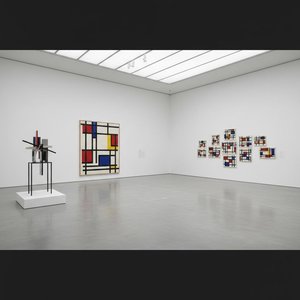
Neoplasticism Unveiled: The Power of Pure Color and Geometric Form in Modern Abstract Art
Explore the profound essence of Neoplasticism. Discover how Piet Mondrian and De Stijl masters used pure color and geometric form to redefine modern art. An essential guide for collectors seeking to understand the enduring power of abstract harmony and universal order.
Más Allá de la Forma: Explorando los Fundamentos Filosóficos de la Abstracción Geométrica
Descubre los fundamentos filosóficos de la abstracción geométrica. Explora el suprematismo de Malévich y el neoplasticismo de Mondrian, su impacto en el arte moderno y su legado perdurable. Análisis experto.
Explore obras de arte organizadas por temas, estilos y características.


