

Se muestra: · Con su marco:
 Ver en contexto
 Enviar
 Compartir
 Detalles
 Guía
Guía

 Descargar
 Similares
 Radiografía
 Presentación de diapositivas
 Preguntas y respuestas
 Estadísticas
- 43.0 x 50.0 cm


€ 240
Reproducción al óleo hecha a mano
Óleo sobre lienzo pintado a mano en el tamaño y marco de su elección, realizado por encargo por nuestros artistas. ( Cambiar a impresiones Cambiar a imagen digital)
Tamaño
·Tamaño estándar
a medida
CM
INCH
Elija entre nuestros tamaños predefinidos que respetan las proporciones originales de la obra.
Cargando tamaños...

ancho
altura
Indique el ancho y el alto que necesite para adaptarse a su marco o pared. Al tratarse de una obra pintada a mano, si requiere un tamaño con una proporción distinta, el artista puede pintar un poco más alrededor de la imagen o recortarla ligeramente; usted elige. Le enviaremos una maqueta digital para su aprobación antes de comenzar la pintura. La imagen que se muestra en esta página no refleja el resultado real; solo la maqueta lo hace.
 Leer más información
Finalizar
·
Blanco €1

Bordes difuminados €1

Continuación de imagen €1

P118B €10

P118H €10

P118W €10

P438Z €10

P508JH €12

P508YH €12

P805H €10

P805Z €10

P919BZ €10

P919G €10

P919XJ €10

P959ZH €10

P968JZ €12

W106C €8

W218G €10

W218JH €8

W218Y €10

W307PJ €10

W316G €10

W316PJ €8

W316Y €10

W398PJ €8

W4111J €10

W500HY €15

W500JH €15

W692G €12

W849H €8

W940BG €15

W953PJ €8

H24-GOLD €30

H24-SILVER €30

H36-GOLD €45

H36-SILVER €45
Se envía en un tubo protector, listo para que lo enmarque su profesional de confianza.
Servicios adicionales
opcional¿Qué incluyen los extras?
Ejemplos de lo que se puede cambiar: Reemplazar el rostro con la foto del cliente; Añadir una mascota (por ejemplo, cambiar un gato por un perro); Incluir un mensaje oculto en el fondo; Cambiar el paisaje o los elementos del fondo.
Tras realizar el pedido, el equipo de TopImpressionists.com enviará un correo electrónico al cliente para solicitar instrucciones y proporcionar una vista previa del boceto
Tras realizar el pedido, el equipo de TopImpressionists.com enviará un correo electrónico al cliente para solicitar instrucciones y proporcionar una vista previa del boceto
Envío a todo el mundo () en 3-4 semanas en lugar de las 5 semanas estándar. (5 noviembre). Sin comprometer la calidad.
Barniz protector
Cartela
Detalles de la placa de bronce grabada
This elegant plaque features the artist's name and the title of the artwork, finely engraved for a timeless presentation.
It is made from bronze with a refined, elegant finish. The text is precisely laser-engraved for a sharp and permanent result. Measuring 9x2 cm, the plaque is compact yet easy to read. It's built to be durable and scratch-resistant, offering a professional, museum-quality look. Mounting is simple thanks to the included adhesive backing.
Detalles de la placa de acrílico transparente
The plaque includes essential engraved details such as the artist's name, the title of the artwork, the date it was created, the type of media used-like oil on canvas or watercolor-a brief description of the piece, and a QR code that links to the complete artwork information.
It is crafted from clear acrylic, offering a sleek, modern appearance. The text is UV-engraved in black to ensure strong visual contrast. With a size of 10x15 cm, it ensures optimal readability. It comes equipped with two metal hooks for secure wall mounting. The plaque is designed to be weather-resistant, making it suitable for various environments, and it includes interactive features that work seamlessly with smartphone scanning.
Detalles de la placa de acrílico negro
This elegant plaque includes engraved information such as the artist's name, the title of the artwork, the date it was created, the type of media used (like oil on canvas or watercolor), a short description of the artwork, and a QR code for quick access to more information.
The plaque itself is made from refined black acrylic with a premium finish. The text is laser-engraved in white for high contrast and readability. Its size is 10x15 cm, designed to be easy to read. It comes with two metal hooks for professional mounting. The design is sleek and fits any interior style. It is also weather-resistant and durable, with built-in digital integration for mobile compatibility.
La opción de vidrio solo está disponible en tamaños inferiores a 110 cm.
 La opción de vidrio solo está disponible en tamaños inferiores a 110 cm.
- Envío exprés gratuito a todo el mundo
- Lienzo de lino de alta calidad
- Seguro de envío total
- Garantía de reembolso de aranceles aduaneros
- Garantía de fidelidad cromática exacta
- Política de devolución de 100 días (solo por defectos)
- Garantía de devolución del 100% del dinero
- Descuento por cantidad


Descripción del objeto
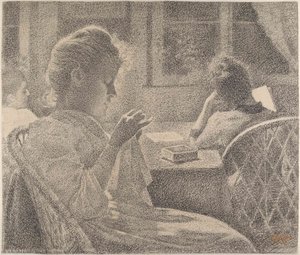
Theo Van Rysselberghe’s ‘Intimacy,’ a captivating 1890 crayon painting, showcases two women in quiet companionship within a Post-Impressionist scene. Explore this serene moment of connection and add a touch of timeless beauty to your collection.
Biografía del artista
Descubre Theo van Rysselberghe: pintor neoimpresionista belga clave de Les XX. Paisajes luminosos, retratos y escenas marroquíes vibrantes llenas de luz y color.
Sobre la obra
Theo Van Rysselberghe's Intimacy, created in 1890, is a captivating piece that embodies the essence of Post-Impressionism. This crayon painting measures 43 x 50 cm and presents a serene scene of two women engaged in quiet activities within a cozy room.
For those who appreciate the beauty of handmade oil painting reproductions, TopImpressionists offers a range of high-quality pieces that capture the essence of original works like Intimacy.
The Composition
The composition of Intimacy is characterized by its simplicity and elegance. Two chairs are placed on either side of the room, with one woman seated on the left, engrossed in reading a book. Her hand is positioned near her face, suggesting deep concentration or contemplation. The other woman, situated on the right, appears to be observing something else, possibly engaging in conversation or taking in the surroundings. A book lies nearby the woman on the left, reinforcing the idea that she is immersed in reading. The overall atmosphere of the painting exudes a sense of closeness and quiet companionship between the two women as they spend time together in this peaceful setting.Artistic Style
Theo Van Rysselberghe's use of crayon as the medium for Intimacy adds a unique texture and depth to the painting. The Post-Impressionist style is evident in the bold lines, vibrant colors, and the emphasis on capturing the emotional essence of the scene rather than strict realism.Context and Significance
Intimacy reflects the artist's ability to capture moments of everyday life with a sense of intimacy and warmth. This painting is part of a broader movement in art history that sought to break away from traditional techniques and explore new ways of expressing emotions and experiences.Relevance Today
Today, Intimacy can be found at the Musee d'Art Moderne et d'Art Contemporain de Liege (France), a haven for art lovers. This museum is renowned for its collection of modern and contemporary art, providing a rich context in which to appreciate Van Rysselberghe's work. For those interested in exploring more Post-Impressionist works, Vincent Van Gogh's Snow-Covered Cottages and Pine Trees in Front of the Wall of the Asylum are notable examples. These paintings, like Intimacy, capture the essence of everyday life with a unique blend of color and emotion. In conclusion, Intimacy by Theo Van Rysselberghe is a poignant representation of Post-Impressionist art, offering a glimpse into the quiet moments of human connection. Its presence in the Musee d'Art Moderne et d'Art Contemporain de Liege (France) underscores its significance in the broader context of modern and contemporary art.For those who appreciate the beauty of handmade oil painting reproductions, TopImpressionists offers a range of high-quality pieces that capture the essence of original works like Intimacy.
Preguntas y respuestas
¿Quién creó "Intimacy" y en qué año?
"Intimacy" es una obra de Theo van Rysselberghe, realizada en 1890.
¿Dónde se recomienda exhibir el formato Landscape de "Intimacy"?
El formato (Landscape) y el espacio recomendado (Living Room) son los dos datos de colocación registrados para "Intimacy" de Theo van Rysselberghe.
¿Qué tan intensos son los colores de "Intimacy"?
Los colores de "Intimacy" de Theo van Rysselberghe presentan una saturación Muted con una intensidad Monochromatic.
Datos rápidos y cuestionario de arte
Sobre Theo van Rysselberghe

Theo van Rysselberghe
1862 - 1926, Bélgica
Biografía del artista
Un pionero de la luz: La vida y el arte de Théo van Rysselberghe
Théophile “Théo” van Rysselberghe, nacido en Gante, Bélgica, en 1862, emergió como una figura fundamental que tendió un puente entre el Impresionismo y el Neoimpresionismo. Su trayectoria no fue la de una convicción estilística inmediata, sino más bien una exploración evolutiva impulsada por los viajes, el intercambio intelectual y una búsqueda incansable por capturar la esencia misma de la luz. Proveniente de una acomodada familia burguesa de habla francesa, van Ryslserberghe recibió su formación artística inicial en la Academia de Gante bajo la tutela de Theo Canneel, seguida de estudios en la prestigiosa Académie Royale des Beaux-Arts en Bruselas. Estos años formativos le inculcaron una base arraigada en el realismo tradicional, evidente en obras tempranas como Autorretrato con pipa (1880), caracterizada por tonos sombríos y un detalle meticuloso, reflejo del clima artístico belga de la época. Sin embargo, incluso en estas primeras piezas, comenzaron a aflorar indicios de una creciente sensibilidad hacia la luz y el color, presagiando su trayectoria futura. Una obra clave de este periodo, Niño en un claro del bosque (1880), marcó un sutil alejamiento, sugiriendo la paleta más brillante y la pincelada más suelta que definirían su estilo posterior.Impresiones marroquíes y el nacimiento de Les XX
Un capítulo transformador se desplegó con los viajes de van Rysselberghe a Marruecos entre 1882 y 1888. Estas estancias prolongadas lo sumergieron en un mundo de colores vibrantes, luz solar intensa y paisajes exóticos, un contraste radical con los tonos apagados de su obra anterior. Pinturas como Zapatero callejero árabe (1881882), Niño árabe (1882) y Guardia descansando (1883) demuestran una fascinación creciente por capturar los efectos de la luz sobre la forma, alejándose del realismo estricto hacia una sensibilidad más impresionista. La experiencia marroquí no fue meramente una observación visual; fue una inmersión en una cultura diferente que amplió sus horizontes artísticos e instiló un amor de por vida por los viajes. Al regresar a Bruselas, van Rysselberghe se convirtió en un motor de la escena artística belga, cofundando el influyente grupo Les XX (Los Veinte) en 1883 junto a Octave Maus y Émile Verhaeren. Este colectivo sirvió como plataforma para exhibir el arte de vanguardia, introduciendo nuevos movimientos como el Impresionismo y el Simbolismo ante un público belga que, en gran medida, desconocía tales innovaciones. Fantasía árabe (1884), una pintura exótica de gran formato, se convirtió en su obra más celebrada de este periodo, demostrando su maestría en la luz y la composición.Abrazando el Neoimpresionismo: Un enfoque científico del color
El verdadero punto de inflexión en el desarrollo artístico de van Rysselberghe llegó con su encuentro con Un domingo en la Grande Jatte de Georges Seurat en la octava exposición impresionista de París en 1886. Inicialmente escéptico ante la meticulosa técnica "puntillista" de Seurat —la aplicación sistemática de diminutos puntos de color puro—, van Rysselberghe llegó a apreciar gradualmente su base científica y su potencial para lograr efectos luminosos. Comenzó a experimentar con el divisionismo, el método neoimpresionista de separar los colores en sus partes constituyentes para permitir que el ojo del espectador los mezclara ópticamente. Esto no fue simplemente un cambio técnico; representó una transformación fundamental en su enfoque de la pintura: un movimiento hacia una representación más analítica y objetiva de la luz y el color. Forjó amistades cercanas con otros pintores neoimpresionistas como Paul Signac, viajando con él por la Riviera francesa e intercambiando ideas sobre técnica y teoría. Van Rysselberghe se distinguió dentro del movimiento al aplicar el puntillismo no solo al paisaje, sino también al retrato, creando semblanzas sorprendentemente vibrantes y psicológicamente profundas de su familia y amigos; obras como Madame Charles Maus (1890) son ejemplos primordiales.Más allá del puntillismo: Un legado perdurable
Aunque estuvo profundamente comprometido con el Neoimpresionismo durante un periodo significativo, van Rysselberghe finalmente trascendió sus estrictos dogmas a finales de la década de 1890. Buscó una mayor libertad en su pincelada y en sus composiciones, explorando nuevas formas de expresar la emoción y la atmósfera. Continuó siendo un artista prolífico, trabajando en diversos medios que incluyeron el diseño de mobiliario, la ilustración de libros y las artes decorativas. Su influencia se extendió mucho más allá de Bélgica, impactando a artistas como Piet Mondrian y Jan Toorop, quienes se vieron inspirados por su uso innovador del color y la luz. El legado de van Rysselberghe reside no solo en sus hermosas pinturas, sino también en su papel como catalizador del cambio artístico: un defensor del modernismo que ayudó a introducir nuevas ideas y técnicas en el mundo del arte belga. Sus obras se encuentran hoy en destacadas colecciones de museos de todo el mundo, incluyendo el Musée du Luxembourg en París y el Museum voor Schone Kunsten en Gante, asegurando que su contribución a la historia del arte siga siendo celebrada y apreciada por las generaciones venideras. Su dedicación a explorar la interacción entre la luz, el color y la forma consolidó su lugar como un verdadero pionero de la pintura moderna.Datos rápidos sobre Theo van Rysselberghe
- Artistas Que Influyeron:
- Georges Seurat
- Frantz Charlet
- Constantin Meunier
- Fecha De Muerte: 14 de diciembre de 1926
- Fecha De Nacimiento: 23 de noviembre de 1862
- Influenciado A Artistas: ['Luminismo belga']
- Lugar De Nacimiento: Gante, Bélgica
- Movimiento Artístico: Neoimpresionismo
- Nacionalidad: Belga
- Nombre Completo: Theo van Rysselberghe
- Obras Notables:
- Arabian Fantasía (1884)
- La Costurera (1890)
- Arcoíris
- Pointe-Saint-Pierre, Saint-Tropez
Obras relacionadas



Explore obras de arte organizadas por temas, estilos y características.

![Autorretrato con pipa [esbozo]](/media/artworks/images-thumb/7e/ef/7eefa5079c911ff86b92e42e2518becb.jpg)


Theo van Rysselberghe
Intimacy
() ·
Con su marco: · Pintado a mano al óleo sobre lienzo
Total