

 Ver en contexto
 Enviar
 Compartir
 Detalles
 Guía
Guía

 Descargar
 Similares
 Radiografía
 Presentación de diapositivas
 Preguntas y respuestas
 Estadísticas
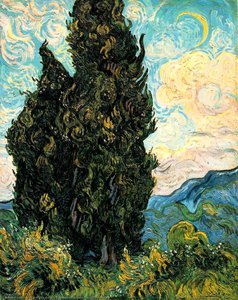
Dos Cipreses

- 74.0 x 93.0 cm


"Dos Cipreses" de Vincent van Gogh: Un paisaje expresionista con árboles altos y cielos nubosos que simbolizan la vida eterna y el duelo. Descubre este icono del arte moderno en TopImpressionists.
 Ver más
Vincent van Gogh (1853-1890): Maestro postimpresionista holandés conocido por sus colores audaces, paisajes emocionales y obras icónicas como 'La noche estrellada'. Explore sus girasoles, retratos e impacto perdurable en el arte moderno en TopImpressionists.
Giclée / Impresión de arte
Impresiones giclée o en lienzo de calidad de museo con producción rápida y opciones de acabado flexibles. ( Comprar pintura hecha a mano Cambiar a imagen digital)




P118B €10

P118H €10

P118W €10

P438Z €10

P508JH €12

P508YH €12

P805H €10

P805Z €10

P919BZ €10

P919G €10

P919XJ €10

P959ZH €10

P968JZ €12

W106C €8

W218G €10

W218JH €8

W218Y €10

W307PJ €10

W316G €10

W316PJ €8

W316Y €10

W398PJ €8

W4111J €10

W500HY €15

W500JH €15

W692G €12

W849H €8

W940BG €15

W953PJ €8




Tamaño estándar
a medida
CM
INCH
Elija entre nuestros tamaños predefinidos que respetan las proporciones originales de la obra.
Loading sizes...

ancho
altura
Introduzca el ancho y el alto que necesite para adaptarse a su marco o pared. Una impresión solo puede recortarse, nunca hacerse más grande que la imagen original, por lo que un tamaño con una forma distinta perderá parte de la obra. Le enviaremos una maqueta digital para su aprobación antes de realizar cualquier impresión. La imagen que se muestra en esta página no refleja el recorte real; solo la maqueta lo hace.
Envío a todo el mundo () en 2 semanas en lugar de las 4/5 semanas estándar. (4 noviembre)

Envío exprés gratuito a todo el mundo

Lienzo de lino de alta calidad

Seguro de envío total

Garantía de reembolso de aranceles aduaneros

Garantía de fidelidad cromática exacta

Política de devolución de 100 días (solo por defectos)

Garantía de devolución del 100% del dinero

Descuento por cantidad
 La opción de vidrio solo está disponible en tamaños inferiores a 110 cm.

Dos Cipreses
Giclée / Impresión de arte
Dimensiones de la reproducción
-


Precio total final
€ 62
Two Cypresses
Vincent van Gogh’s “Two Cypresses” stands as a poignant emblem of late Impressionism, capturing not merely visual beauty but also profound emotional resonance—a characteristic hallmark of the artist's oeuvre. Painted in 1889 during his stay at Saint-Rémy asylum, this artwork transcends its formal elements to convey a deeply felt contemplation on mortality and resilience. The scene depicts two towering cypress trees against a turbulent sky, punctuated by a distant mountain silhouette and a solitary clock—details meticulously rendered with Van Gogh’s signature impasto technique.Artistic Style and Technique
The painting exemplifies Van Gogh's distinctive post-impressionist style, prioritizing expressive brushstrokes and vibrant color palettes over strict representational accuracy. Employing oil on canvas allowed him to achieve an unparalleled textural richness, mirroring the artist’s internal state—a deliberate choice intended to communicate emotion rather than simply documenting reality. As discussed in The Art Media Oil On Canvas, this medium has been foundational to artistic expression for centuries, facilitating the creation of monumental works like “Starry Night.”Symbolism and Interpretation
The cypress trees themselves are laden with symbolic significance. Traditionally associated with mourning and remembrance—often planted in cemeteries—they represent a yearning for transcendence and an acceptance of life’s inevitable cycle. Simultaneously, their upward thrust embodies aspiration and spiritual striving. The brooding sky mirrors the artist's inner turmoil, while the clock serves as a poignant reminder of passing time—a motif recurrent throughout Van Gogh’s work, reflecting his preoccupation with mortality.Comparison with Other Works
“Two Cypresses” shares stylistic affinities with other notable paintings by Van Gogh, notably “The Starry Night,” where similarly bold brushstrokes and luminous colors coalesce to evoke a sense of awe and wonder. Both canvases demonstrate an unwavering commitment to conveying emotion through visual form—a testament to Van Gogh’s enduring influence on modern art. The expressive dynamism found in "Two Cypresses" echoes the turbulent energy characteristic of “Starry Night,” highlighting Van Gogh's consistent exploration of psychological depth within his landscapes.Relevance in Modern Art
The impact of “Two Cypresses” extends far beyond its own time, informing subsequent artistic endeavors. Consider Paul Signac’s “Two Cypresses,” executed in 1890 and housed at the Kröller-Müller Museum (Otterlo, Netherlands). Signac's work similarly embraces Impressionistic principles—particularly the use of broken color and atmospheric perspective—demonstrating Van Gogh’s lasting legacy as a pioneer of expressive painting.- Artist: Vincent Van Gogh
- Painting Title: Two Cypresses
- Size: 74 x 93 cm
- Medium: Oil On Canvas
- Style: Post-Impressionism
- Date: 1889
Preguntas y respuestas
¿En qué estancia del hogar quedaría bien una reproducción de "Dos Cipreses"?
El espacio recomendado para "Dos Cipreses" de Vincent Willem Van Gogh es un Salón principal. Por supuesto, esta sugerencia puede adaptarse a su decoración.
¿Dónde se recomienda exhibir el formato Formato vertical de "Dos Cipreses"?
Con su formato Formato vertical, se sugiere una reproducción de "Dos Cipreses" para un Salón principal.
¿Cómo se combinan la técnica y el movimiento en "Dos Cipreses"?
"Dos Cipreses" está realizada en Acrílico sobre lienzo, con el estilo Post-Impressionism.




Biografía del artista
Vincent van Gogh: Vida, Arte y Legado
Primeros Años e Influencias
- Nacido el 30 de marzo de 1853 en Groot-Zundert, Países Bajos, Vincent Willem van Gogh fue el mayor de seis hijos.
- Su padre, Teodorus van Gogh, era un ministro protestante, y su crianza estuvo profundamente influenciada por la religión.
- Sus primeros intereses incluían dibujar, pero persiguió varios oficios antes de dedicarse a las artes. Trabajó como comerciante de arte, maestro y misionero.
- Influencias Clave: Las primeras influencias incluyeron a los Maestros holandeses como Rembrandt van Rijn y Frans Hals, así como a los pintores franceses contemporáneos Jean-François Millet y Camille Corot.
Desarrollo Artístico y Estilo
- Van Gogh comenzó a pintar seriamente en 1880, principalmente de forma autodidacta.
- Sus primeras obras se centraron en representar la vida de los campesinos y trabajadores, reflejando su empatía por la clase trabajadora.
- Una mudanza a París en 1886 lo expuso al Impresionismo y Postimpresionismo, lo que llevó a una paleta más brillante y a la experimentación con nuevas técnicas.
- Estilo Distintivo: Van Gogh desarrolló un estilo altamente individual caracterizado por colores audaces, pinceladas expresivas e intensidad emocional. A menudo utilizaba el *impasto* – capas gruesas de pintura – para crear textura y transmitir sentimiento.
Períodos Clave y Obras
- El Período Holandés (1880-1886): Se centró en tonos oscuros y terrosos y en la representación de la vida rural. Obras notables incluyen Los Comedores de Patatas.
- El Período Parísino (1886-1888): Experimentación con técnicas impresionistas y colores más brillantes.
- El Período de Arles (1888-1889): Un período de intensa creatividad marcado por paisajes vibrantes, retratos y bodegones. Obras clave incluyen Girasoles, El Café Nocturno y Estrellas sobre el Río Rodano.
- Saint-Rémy y Auvers-sur-Oise (1889-1890): Después de un colapso mental, Van Gogh ingresó voluntariamente a un asilo en Saint-Rémy. Sus últimos años estuvieron marcados por una continua producción artística pero también por un creciente sufrimiento emocional. Obras notables incluyen La Noche Estrellada y retratos del Dr. Gachet.
Logros Importantes y Reconocimiento
- A pesar de luchar contra la enfermedad mental y enfrentarse al rechazo durante su vida, Van Gogh creó más de 2,100 obras de arte en poco más de una década – aproximadamente 860 pinturas en óleo.
- Su obra influyó profundamente en el desarrollo del arte moderno, particularmente en el Expresionismo y el Fauvismo.
- Fama Póstuma: El reconocimiento llegó después de su muerte en 1890. Sus obras ganaron popularidad creciente a principios del siglo XX, convirtiéndose en algunas de las obras de arte más reconocibles y valiosas del mundo.
Significado Histórico y Legado
- La obra de Van Gogh sigue resonando con el público actual debido a su honestidad emocional, colores vibrantes y poderosa expresión de la experiencia humana.
- Se considera uno de los personajes más importantes en la historia del arte occidental, inspirando a generaciones de artistas.
- Su vida ha llegado a ser un símbolo del “artista atormentado”, aunque esta narrativa a menudo eclipsa su dedicación, habilidad y visión artística.
- Museos de todo el mundo, incluido el Museo Van Gogh en Ámsterdam, exhiben su obra y celebran su perdurable legado.

Vincent Willem Van Gogh
1853 - 1890 , Países Bajos
Datos clave
- Artistic Movement Or Style: Postimpresionismo
- Artists Or Movements Influenced By This Artist:
- Expresionismo
- Fauvismo
- Artists Who Influenced This Artist:
- Rembrandt
- Millet
- Date Of Birth: 30 de marzo 1853
- Date Of Death: 29 de julio 1890
- Full Name: Vincent Willem van Gogh
- Nationality: Holandés
- Notable Artworks:
- Los Comedores de Patatas
- Girasoles
- La Noche Estrellada
- Place Of Birth: Zundert, Países Bajos
Artículos relacionados

El peso de la emoción: Cómo el impasto de Van Gogh transforma el lienzo en relieve
Descubre la maestría técnica del impasto y cómo Van Gogh esculpió emociones con relieve. Explora el alma de su pincelada hoy mismo.
Explore obras de arte organizadas por temas, estilos y características.


![Irises [1889]](/media/artworks/images-thumb/ca/85/ca85582a4fd1dc392efef83ec4dc3124.jpg)

