


 Vaata sisu
 Jaga teost
 Jaga
Jaga
 Detailid
 Õppekate juhend

 Laadi alla
 Sarnased teosed
 Röntgenuuring
 Slaidietendus
 Statistika
Valve Trombone


This painting captures the essence of Adolphe Sax's Six-Valve Trombone (1885), highlighting its intricate design and pioneering valve system. Explore this remarkable piece of musical history through high-quality reproductions.
Adolphe Sax
 Loe lähemalt
Käsitsi valmistatud õlimaalireproduktsioon
Meie kunstnike poolt tellimusel valmistatud käsitsi maalitud õli-kainaste teos teie soovitud suuruses ja raamis. ( Lülita trükkitoodetele Ülemineku digitaalse pildi müügi kanalisse)




P118B €10

P118H €10

P118W €10

P438Z €10

P508JH €12

P508YH €12

P805H €10

P805Z €10

P919BZ €10

P919G €10

P919XJ €10

P959ZH €10

P968JZ €12

W106C €8

W218G €10

W218JH €8

W218Y €10

W307PJ €10

W316G €10

W316PJ €8

W316Y €10

W398PJ €8

W4111J €10

W500HY €15

W500JH €15

W692G €12

W849H €8

W940BG €15

W953PJ €8




Standardne suurus
kohandatud
CM
INCH
Vali meie eelmääratud suurused, mis vastavad teose algupärastele proportsioonidele.
Loading sizes...

laius
kõrgus
Sisestage vajalik laius ja kõrgus, et teos sobiks teie raamile või seinale. Kuna tegu on käsipainatud teosega, siis erineva kujuga suuruse korral võib kunstnik jätta pildi ümber veidi rohkem marginaali või lõigata osa ära — valik on teie. Enne maali alustamist saadame teile kinnitamiseks digitaalse näidisprojektsiooni. Sellel lehel näidatud pilt ei kajasta tegelikku tulemust — seda näitab ainult näidisprojekttsioon.
Näited muudetavatest elementidest: asenda nägu kliendi fotoga; lisa lemmikloom (nt asenda kass koeraga); lisa taustale peidetud sõnum; muuda tausta maastikku või elemente.
Pärast tellimust saadab TopImpressionists.com meeskond kliendile e-posti juhised ning esitab eelvaate kavandi
Pärast tellimust saadab TopImpressionists.com meeskond kliendile e-posti juhised ning esitab eelvaate kavandi
Maailmline tarne 3–4 nädala jooksul tavalise 5 nädala asemel. (20 oktoober). Kvaliteedis kompromisse ei tehta.

Tasuta ekspresssaatmine üle maailma

Kõrgekvaliteediline lina-kangastest muld

Täielik transpordikindlustus

Tollimaksude tagastamise garantii

Värvitoime täpsuse garantii

100 päeva tagastusõigus (ainult defektide korral)

100% raha tagasi garantii

Hulgusoodustus
 Klaasivalik on saadaval ainult kuni 110 cm suuruses teostes

Valve Trombone
Reproduktsiooni materjal
Reproduktsiooni mõõtmed
-


Lõppsumma
€ 234
Kunstniku elulugu
A Legacy Forged in Sound: The Life and Innovations of Adolphe Sax
Antoine-Joseph ‘Adolphe’ Sax, born in Dinant, Belgium, on November 6, 1814, was more than just an inventor; he was a sonic architect who reshaped the landscape of musical expression. His name is inextricably linked to the saxophone, yet to define him solely by this iconic instrument would be to overlook a lifetime dedicated to refining and expanding the possibilities of brass and woodwind instruments. Sax’s journey was one driven by a relentless pursuit of tonal perfection, fueled by both artistic vision and a deep understanding of acoustics and mechanics. From his earliest days immersed in his father's workshop, surrounded by the scent of wood shavings and the gleam of polished brass, Adolphe displayed an innate curiosity and a remarkable aptitude for instrument making. His childhood was marked not only by this creative environment but also by a series of near-fatal accidents – tales that earned him the nickname “little Sax, the ghost” – perhaps imbuing his life with a sense of urgency and purpose. This formative period instilled in him a profound respect for craftsmanship and an unwavering determination to overcome obstacles, qualities that would define his career.Bridging Worlds: The Genesis of the Saxophone and Beyond
Sax’s ambition wasn't merely to create new instruments but to address perceived deficiencies in existing ones. He envisioned a sound world where the brilliance of brass could be seamlessly blended with the warmth and expressiveness of woodwinds – a tonal bridge that had long eluded instrument makers. This vision culminated in the invention of the saxophone, patented in 1846. It was not born from pure inspiration but from meticulous experimentation and a deep understanding of acoustic principles. The saxophone’s single-reed mouthpiece, conical bore, and brass construction combined to produce a uniquely versatile sound capable of both powerful projection and delicate nuance. However, the saxophone was just one facet of Sax's prolific inventiveness. He didn’t rest on this singular achievement; instead, he embarked on a relentless campaign of innovation, designing or significantly redesigning a remarkable array of instruments. The saxhorn, a family of valved brass instruments designed for greater versatility in military bands, emerged as another significant contribution. He also developed the saxtuba, a hybrid instrument blending features of both tuba and saxophone, and made substantial improvements to the bass clarinet, creating a model that remains widely used today. His work extended to valved trumpets – including versions with six independent valves aimed at enhancing chromatic capabilities – and even a pioneering six-valve trombone, showcasing his commitment to improving intonation and expanding instrumental range.Challenges and Triumphs: Navigating the 19th-Century Musical Landscape
Despite his groundbreaking innovations, Sax faced considerable resistance from established instrument manufacturers and conservative musical circles. His patents were frequently challenged, and his designs often copied without proper compensation. This period was marked by protracted legal battles and financial struggles, testing his resilience and determination. The burgeoning Romantic era, with its demand for richer orchestral textures and more expressive instrumental capabilities, provided a fertile ground for Sax’s inventions, yet acceptance wasn't immediate. He tirelessly promoted his instruments through performances with orchestras and military bands, demonstrating their unique sonic qualities firsthand. His association with composers like Hector Berlioz – who championed the saxophone in his compositions – proved crucial in gaining recognition. Berlioz recognized the instrument’s potential and incorporated it into several of his works, helping to establish its place within the orchestral palette. However, even with such endorsements, Sax continued to grapple with skepticism and competition throughout much of his career.A Lasting Resonance: Adolphe Sax's Enduring Legacy
Adolphe Sax died in Paris on February 7, 1894, leaving behind a legacy that continues to resonate profoundly within the world of music. While he may not have achieved widespread fame or fortune during his lifetime, his inventions irrevocably altered the course of musical history. The saxophone quickly gained popularity in military bands and Parisian dance halls, eventually finding its way into classical compositions by composers like Berlioz, Verdi, and Debussy. However, it was in the realm of jazz that the saxophone truly found its voice, becoming an indispensable instrument in this uniquely American art form. From the pioneering improvisations of Sidney Bechet to the virtuosic performances of Charlie Parker and John Coltrane, the saxophone has been central to the evolution of jazz music. Beyond the saxophone’s iconic status, Sax's other innovations significantly advanced brass instrument design, contributing to the evolution of orchestral sound and providing musicians with a wider range of tonal possibilities. He remains a pivotal figure in the history of musical instruments, a true pioneer whose vision continues to inspire generations of musicians and instrument makers alike. His story is a testament to the power of innovation, perseverance, and an unwavering commitment to artistic expression.
Adolphe Sax
1814 - 1894 , Belgium
Lühikest infot
- Full Name: Antoine-Joseph 'Adolphe' Sax
- Nationality: Belgian-French
- Date Of Birth: 1814
- Date Of Death: 1894
- Place Of Birth: Dinan, Belgium
- Notable Artworks:
- Saxophone
- Saxhorn
- Saxtuba
- Valved Trumpet
- Six-Valve Trombone
- Artistic Movement Or Style: Instrument Design
- Artists Or Movements Influenced By This Artist:
- Berlioz
- Verdi
- Debussy
- Jazz music
Sarnased artiklid
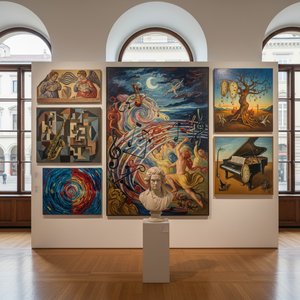
Harmonies on Canvas: Exploring the Visual Representation of Music in Art History
Explore the fascinating history of music's visual representation in art! From ancient symbolism to modern abstraction, discover how artists have captured sound and emotion on canvas. Expert insights & stunning examples.

The Symphony of Canvas: Capturing the Timeless Resonance of Musical Instruments in Fine Art Masterpieces
Explore the profound connection between music and fine art. From ancient iconography to Impressionist masterpieces, discover how legendary instruments are captured on canvas with unparalleled artistry and historical depth for the discerning collector.

Adolph von Menzel: Realism, Prussian Society & the Painterly Chronicle of a Changing Era
Explore the life & work of Adolph von Menzel, a leading German Realist painter. Discover his detailed depictions of Prussian society, innovative techniques, and lasting influence on art history. Hand-painted reproductions available at TopImpressionists.