

Näidatud: · koos raamiga:
 Eelvaade
 Saada
Saada Jaga
Jaga
 Teave teose kohta
 Juhend

 Laadi alla
 Sarnased teosed
 Röntgenuuring
 Slaidietendus
 KÜSIMUSED JA VASTUSID
 Statistika


€ 285
Käsitsi valmistatud õlimaalireproduktsioon
Meie kunstnike poolt tellimusel valmistatud käsitsi maalitud õli-kainaste teos teie soovitud suuruses ja raamis. ( Lülita trükkitoodetele Lülita digitaalse pildi juurde)
See teos on autoriõigusega kaitstud
Sellel lehel kuvatav kunstiteos on kaitstud autoriõigusega, mis tähendab, et meil ei ole seaduslikku õigust luua või müüa identset reproduktsiooni. Seda kaitset rakendatakse rahvusvaheliste kokkulepete alusel, nagu näiteks Berne konventsioon ning riiklike seadustega, sealhulgas nendega, mida on sätestatud USA autoriõiguse seadus – 17. peatükk.
Austasena ja seaduslikuna alternatiivina pakume originaalist inspireeritud, käsitsi maalitud isikupärastatud teoseid. Meie osutavad ja professionalsed kunstnikud uurivad hoolikalt originaali stiili, meelemoi ja kunstilist olemust, et luua uus, ainulaadne teos, mis tekitab sama tunnet – olles samal ajal omaette originaalne looming.
See meetod järgib täielikult autoriõiguse reegleid, kuna see ei põhine kaitstud kunstiteose kopeerimisel või dupliteerimisel. Selle asemel on tegu loova reinterpreetatsiooniga – uue maaldisega, mis on algteosest inspireeritud, kuid ei ole sellest identiline.
 Loe lähemalt
Suurus
·Standardne suurus
kohandatud
CM
INCH
Vali meie eelmääratud suurused, mis vastavad teose algupärastele proportsioonidele.
Suuruste laadimine...

laius
kõrgus
Sisestage vajalik laius ja kõrgus, et teos sobiks teie raamile või seinale. Kuna tegu on käsipainatud teosega, siis erineva kujuga suuruse korral võib kunstnik jätta pildi ümber veidi rohkem marginaali või lõigata osa ära — valik on teie. Enne maali alustamist saadame teile kinnitamiseks digitaalse näidisprojektsiooni. Sellel lehel näidatud pilt ei kajasta tegelikku tulemust — seda näitab ainult näidisprojektsioon.
Lõpuleviimine
·
Valge serv €1

häguse servaga lõppviimistlus €1

Laiendatud €1

P118B €10

P118H €10

P118W €10

P438Z €10

P508JH €12

P508YH €12

P805H €10

P805Z €10

P919BZ €10

P919G €10

P919XJ €10

P959ZH €10

P968JZ €12

W106C €8

W218G €10

W218JH €8

W218Y €10

W307PJ €10

W316G €10

W316PJ €8

W316Y €10

W398PJ €8

W4111J €10

W500HY €15

W500JH €15

W692G €12

W849H €8

W940BG €15

W953PJ €8

H24-GOLD €30

H24-SILVER €30

H36-GOLD €45

H36-SILVER €45
Saadetakse kaitsetorus, et te võiksite selle ise raamida.
Üle 105 cm suurust raami saadetakse komplektina professionaalse raamija jaoks — lugeege lisainfot.
Lisateenused
valikulineMida lisad sisaldavad?
Näited sellest, mida saab muuta: asendage nägu kliendi fotoga; lisage lemmikloom (nt asendage kass koega); lisage taustale peidetud sõnum; muutke tausta maastikku või elemente.
Pärast tellimust saadetab TopImpressionists.com meeskond klientile e-posti juhised ning esitab ette tasandatud eelvaate
Pärast tellimust saadetab TopImpressionists.com meeskond klientile e-posti juhised ning esitab ette tasandatud eelvaate
Maailmline tarne 3–4 nädala jooksul tavalise 5 nädala asemel. (4 november). Kvaliteedis kompromisse ei tehta.
Kaitsevärnitsus
Nimesildikiri
Graveeritud pronksplaadi üksikasjad
This elegant plaque features the artist's name and the title of the artwork, finely engraved for a timeless presentation.
It is made from bronze with a refined, elegant finish. The text is precisely laser-engraved for a sharp and permanent result. Measuring 9x2 cm, the plaque is compact yet easy to read. It's built to be durable and scratch-resistant, offering a professional, museum-quality look. Mounting is simple thanks to the included adhesive backing.
Läbipaistva akrüülplaadi üksikasjad
The plaque includes essential engraved details such as the artist's name, the title of the artwork, the date it was created, the type of media used-like oil on canvas or watercolor-a brief description of the piece, and a QR code that links to the complete artwork information.
It is crafted from clear acrylic, offering a sleek, modern appearance. The text is UV-engraved in black to ensure strong visual contrast. With a size of 10x15 cm, it ensures optimal readability. It comes equipped with two metal hooks for secure wall mounting. The plaque is designed to be weather-resistant, making it suitable for various environments, and it includes interactive features that work seamlessly with smartphone scanning.
Musta akrüülplaadiรายละเอียด (Note: The user provided "Musta akrüülplaadi detailid" as the current translation and asked for an improved version. Since "Musta akrüülplaadi
This elegant plaque includes engraved information such as the artist's name, the title of the artwork, the date it was created, the type of media used (like oil on canvas or watercolor), a short description of the artwork, and a QR code for quick access to more information.
The plaque itself is made from refined black acrylic with a premium finish. The text is laser-engraved in white for high contrast and readability. Its size is 10x15 cm, designed to be easy to read. It comes with two metal hooks for professional mounting. The design is sleek and fits any interior style. It is also weather-resistant and durable, with built-in digital integration for mobile compatibility.
Klaasivalik on saadaval ainult kuni 110 cm suuruses teostes
 Klaasivalik on saadaval ainult kuni 110 cm suuruses teostes
- Tasuta ekspresssaatmine üle maailma
- Kõrgekvaliteediline lina-kangas
- Täielik transpordikindlustus
- Tollimaksude tagastamise garantii
- Värvitoime täpsuse garantii
- 100 päeva tagastusõigus (ainult valmistusdefektide korral)
- 100% raha tagasi garantii
- Hulgusoodustus


Kogumisobjekti kirjeldus
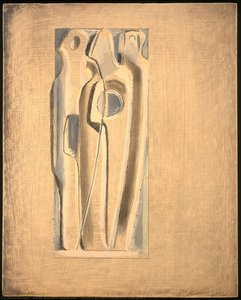
Explore Dame Barbara Hepworth’s ‘Three Figures’ (1951), a captivating abstract study of human forms. Discover her pioneering modernist style & layered brushwork in this evocative piece.
Kunstniku elulugu
Avastage Dame Barbara Hepworthi (1903-1975) modernistlikke skulptuure. Abstraktsuse pioneer, Hepworthi teos – sealhulgas 'Oval Form' ja 'Two Forms' – ühendab surrealismi ja abstraktsiooni. Avastage tema pärand Hepworth Wakefields.
Teemal maalid
Barbara Hepworth’s ‘Three Figures – Project for Sculpture’: A Meditation on Form and Connection
“Three Figures – Project for Sculpture,” created in 1951 by the influential British sculptor Barbara Hepworth, offers a compelling glimpse into her exploration of form and space during a pivotal moment in modern art. This work, rendered in a luminous golden hue, transcends mere representation to become a deeply evocative study of human presence—a testament to Hepworth’s mastery of abstraction and her profound engagement with the fundamental principles of sculpture. The painting's strength lies not in literal depiction but in its ability to conjure a sense of quiet contemplation, inviting viewers to consider the relationships between individuals and their shared experience.
A Modernist Vision: Style and Technique
Hepworth’s approach aligns squarely with the modernist movement, particularly its emphasis on reducing forms to their essential geometric elements. The composition is dominated by rectangular and triangular shapes, meticulously constructed to create a sense of depth through overlapping planes and subtle tonal variations. Visible brushstrokes, layered and glazed with oil paint, contribute significantly to the artwork's tactile quality – an invitation to almost reach out and touch the implied solidity of the figures. The directional lighting further enhances this three-dimensionality, casting carefully considered shadows that sculpt the forms themselves. This technique, rooted in Hepworth’s training at the Royal College of Art, demonstrates a sophisticated understanding of both representational space and abstract form.
Historical Context and Influences
Created in 1951, “Three Figures” reflects a period of significant artistic innovation. Hepworth was a key figure within the Unit One movement, alongside Ben Nicholson and Paul Nash, which sought to bridge the gap between Surrealism and Abstraction – a bold experiment that challenged traditional notions of representation. Her earlier work, heavily influenced by her time in Paris and engagement with abstraction-création, paved the way for this exploration of simplified forms and spatial relationships. The painting’s restrained style echoes the growing interest in geometric abstraction prevalent throughout Europe at the time, while retaining a distinctly humanistic focus.
Symbolism and Emotional Resonance
While overtly symbolic elements are absent, “Three Figures” possesses a powerful emotional resonance. The solemn postures of the figures suggest introspection and perhaps a shared experience – a quiet connection forged through form and space. Hepworth’s work often explored themes of human vulnerability and resilience, and this piece is no exception. It invites viewers to contemplate their own place within the larger world, prompting a sense of empathy and understanding. The painting's enduring appeal lies in its ability to tap into these universal emotions, making it a timeless meditation on the nature of human connection.
Korduvad küsimused
Kuna teose kuupäev on teada, millesse Barbara Hepworth karjääri etappi kuulub teos "Three Figures – Project for Sculpture"?
Aasta 1951 aitab teosele "Three Figures – Project for Sculpture" määrata Barbara Hepworth loomingulise arengu perioodi Mature Period.
Kuidas teos „Three Figures – Project for Sculpture“, autor Barbara Hepworth seob Modernism kunstniku kodumaaga?
Teos "Three Figures – Project for Sculpture" ühendab oma looja sünneloolise piirkonna ja Ühendkuninga Margimaa läbi Modernism suunaga.
Milline paigutus sobib teose „Three Figures – Project for Sculpture“, autor Barbara Hepworth formaadile?
Olles vormilt Portrait, on teose "Three Figures – Project for Sculpture" reproduktsiooni soovitatud kasutada ruumis Living Room.
Kiirinfo ja kunstiviktoriin
Info Barbara Hepworth kohta

Barbara Hepworth
1903 - 1975, Ühendkuninga Margimaa
Kunstniku elulugu
varaj puud ja haridus
dame barbara hepworth, auvakas inglise kunstnik ja skulptuurikunstnik, sündis 10. jaanuaril 1903 Yorkshire'i Wakefield'is. Tema kunstiline teekond algas Leeds School of Art'is alates 1920. aastast ning hiljem võitis ta maakonna stipendium, et õppida Londoni Kunsti Akadeemias (RCA) alates 1921. aastast kuni diplomile saamist 1924. aastal.kunstiline karjäär
- dame barbara hepworthi looming on modernismi, eriti kaasaegse skulptuuri, suurepärane näidis. Ta oli üks väheseid naiskunstnikuid, kes saavutas rahvusvahelist tuntust.
- 1933. aastal asutas ta koos ben nicholsoni, paul nashi ja teistega Unit One kunstiliikumingu, eesmärgiga ühendada surrealism ja abstraksjon Briti kunstis.
- Hepworthi varajane looming oli iseloomulik abstraksiale ning sellele, et ta osales Pariisis asunud kunstiliikumuses Abstraktion-Création.
olulised teosed ja näitusid
- Pronssist skulptuur oval form (trezion) on osa Kimbell Art Museumi kogumist Fort Worthis, USA. (vaata TopImpressionists'is)
- Skulptuur two forms on näitustel The Hepworth Wakefield muuseumis Wakefield'is, Ühendkuningustes. (vaata TopImpressionists'is)
- Marmorskulptuur totem on samuti osa The Hepworth Wakefield kogumikust. (vaata TopImpressionists'is)
pärand ja muuseumikogud
barbara hepworthi töö on laialdaselt tunnustatud ning tema skulptuurid ja maalid on osa erinevatest muuseumikogudest üle maailma. Kunstniku nimel nimetatud The Hepworth Wakefield peab endas arvukalt meistriteoseid tuntud kunstnikelt, sealhulgas ka ennast Hepworthit. (avasta rohkem The Hepworth Wakefieldi kohta TopImpressionists'is)johtlõpus
dame barbara hepworthi uuargustav töö kaasaegses Briti skulptuuris on jätnud temmatamat jälje kunstimaailma. Tema pärand jätkub inspireerima nii kunstnikke kui ka kunstihuvilisi, ning tema teosed jäävad kui tõestus tema uuenduslikust vaimust ja kunstilisest geniusest. luge aval Wikipedia'st barbara hepworthi kohtaKiirinfo Barbara Hepworth kohta
- Artistic Movement Or Style: Modernism, Abstraktioon
- Artists Or Movements Influenced By This Artist:
- Abstraction-Création
- Unit One
- Artists Who Influenced This Artist:
- Henry Moore
- Ben Nicholson
- Date Of Birth: 1903-01-10
- Date Of Death: 1975-05-20
- Full Name: Barbara Hepworth
- Nationality: Briti
- Notable Artworks:
- Oval Form (Trezion)
- Two Forms
- Totem
- Place Of Birth: Wakefield, Ülikool
Avastage teoseid, mis on koondatud teemade, stiilide ja omaduste kaupa.


Barbara Hepworth
Three Figures – Project for Sculpture
() ·
koos raamiga: · Käsitööna õliga linale maaldud
Kokkuvõte