Unveiling the Tension: Ernst Ludwig Kirchner's 'Arcrobats'
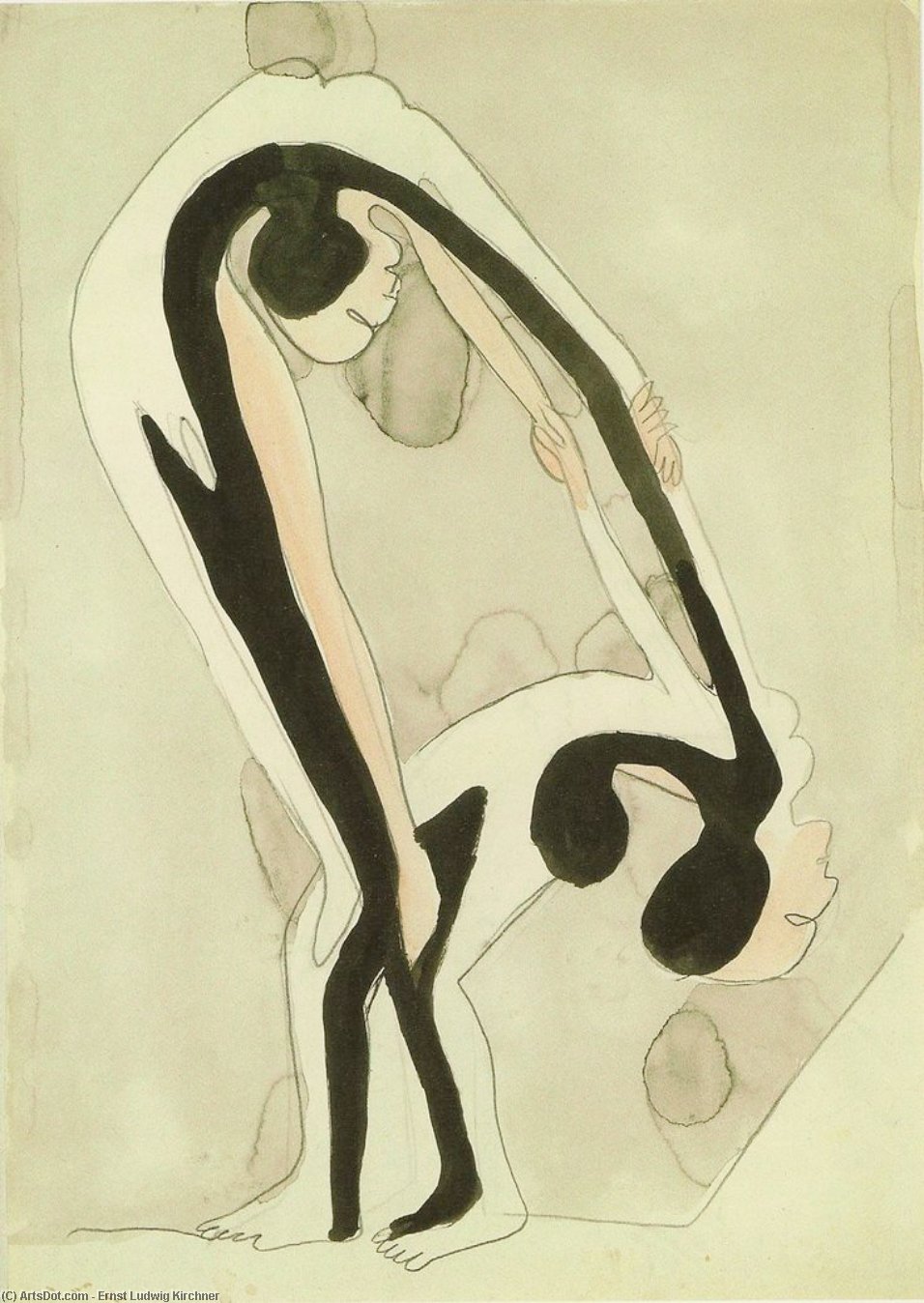
Ernst Ludwig Kirchner’s ‘Arcrobats,’ painted in 1932, is not merely a depiction of two figures; it’s a visceral plunge into the anxieties and uncertainties that defined the era. This work, rendered in stark black and white, exemplifies the core tenets of Expressionism – a movement born from a desire to translate inner emotional states onto canvas rather than simply mirroring external reality. Kirchner, a pivotal figure within the Brücke group, sought to dismantle traditional artistic conventions, employing bold lines, jarring color contrasts (though here presented in monochrome, the *effect* is powerfully chromatic), and deliberately distorted forms to evoke a profound sense of unease and psychological tension.
- A Composition of Disquiet: The two figures, positioned on either side of the frame with their limbs stretched outwards in awkward poses, immediately command attention. Their contorted stances suggest a struggle – perhaps physical, perhaps emotional – leaving the viewer suspended between observation and empathy.
- The Power of Contrast: Kirchner masterfully utilizes the stark white background to amplify the drama of the figures. This deliberate isolation heightens their vulnerability and intensifies the feeling of disorientation that permeates the painting. The absence of depth or context further contributes to this unsettling effect.
- Technique & Style: Kirchner’s signature style is evident in the rapid, almost frantic brushstrokes that build up the forms. He employs a technique characterized by thick impasto and a deliberate lack of blending, creating a textured surface that adds to the painting's raw energy. The elongated figures, characteristic of Expressionism, are not realistic representations but rather symbolic embodiments of inner turmoil.
Echoes of Modern Anxiety: Historical Context
'Arcrobats’ was created during a period of significant social and political upheaval in Germany. The rise of industrialization, coupled with the growing sense of alienation and disillusionment fostered by rapid change, fueled the Expressionist movement's exploration of psychological themes. Kirchner himself experienced personal struggles – including bouts of depression – which undoubtedly informed his artistic vision. This painting can be seen as a reflection of the anxieties prevalent in Weimar Republic Germany, a nation grappling with economic instability, political extremism, and a profound sense of cultural disorientation.
Kirchner’s work aligns perfectly with the broader Expressionist project of confronting uncomfortable truths about the human condition. Unlike Impressionism's focus on capturing fleeting moments of beauty, Kirchner sought to expose the darker aspects of modern life – the isolation, the fear, and the potential for psychological breakdown.
Symbolic Resonance: Interpreting the Figures
While the precise meaning behind ‘Arcrobats’ remains open to interpretation, the figures themselves are rich with symbolic resonance. Their awkward poses can be read as representing a loss of control, a struggle against external forces, or perhaps even a confrontation with one's own inner demons. The white background, devoid of any comforting elements, symbolizes isolation and vulnerability. Some scholars suggest that the acrobats represent the precariousness of modern life – a world where individuals are constantly performing for an unseen audience, struggling to maintain their balance amidst chaos.
A Window into Expressionism: Acquisition & Further Exploration
This 52 x 36 cm reproduction captures the essence of Kirchner’s masterpiece with exceptional detail and fidelity. It's a powerful addition to any collection seeking to engage with the intensity and emotional depth of Expressionist art. For those interested in exploring similar works, we encourage you to investigate other pieces within our extensive collection of Expressionist paintings, including Clyfford Still’s evocative abstractions or Ignaz Maybaum’s poignant depictions of urban life. Discover more about Kirchner's artistic journey and the broader context of Expressionism through links to related artworks and resources.


 Eelvaade
 Osta käsitsi maalitud maal
 Saada
Saada Jaga
Jaga
 Teave teose kohta

 Laadi alla
 Sarnased teosed
 Röntgenuuring
 Slaidietendus


 Loe lähemalt






































 Klaasivalik on saadaval ainult suuruses kuni 110 cm



