

Shown: · With its frame:
 Eelvaade
 Saada
Saada Jaga
Jaga
 Teave teose kohta
 Juhend

 Laadi alla
 Sarnased teosed
 Röntgenuuring
 Slaidietendus
 Q&A
Q&A Statistika
- 92.0 x 131.0 cm


€ 239
Käsitsi valmistatud õlimaalireproduktsioon
Meie kunstnike poolt tellimusel valmistatud käsitsi maalitud õli-kainaste teos teie soovitud suuruses ja raamis. ( Lülita trükkitoodetele Lülita digitaalse pildi juurde)
Size
·Standardne suurus
kohandatud
CM
INCH
Vali meie eelmääratud suurused, mis vastavad teose algupärastele proportsioonidele.
Loading sizes...

laius
kõrgus
Sisestage vajalik laius ja kõrgus, et teos sobiks teie raamile või seinale. Kuna tegu on käsipainatud teosega, siis erineva kujuga suuruse korral võib kunstnik jätta pildi ümber veidi rohkem marginaali või lõigata osa ära — valik on teie. Enne maali alustamist saadame teile kinnitamiseks digitaalse näidisprojektsiooni. Sellel lehel näidatud pilt ei kajasta tegelikku tulemust — seda näitab ainult näidisprojektsioon.
 Loe lähemalt
Finish
·
White €1

Blurside €1

Extended €1

P118B €10

P118H €10

P118W €10

P438Z €10

P508JH €12

P508YH €12

P805H €10

P805Z €10

P919BZ €10

P919G €10

P919XJ €10

P959ZH €10

P968JZ €12

W106C €8

W218G €10

W218JH €8

W218Y €10

W307PJ €10

W316G €10

W316PJ €8

W316Y €10

W398PJ €8

W4111J €10

W500HY €15

W500JH €15

W692G €12

W849H €8

W940BG €15

W953PJ €8

H24-GOLD €30

H24-SILVER €30

H36-GOLD €45

H36-SILVER €45
Shipped in a protective tube, ready for your own framer.
Above 105 cm the frame is shipped as a kit for a professional framer — read the details.
Extras
optionalWhat do the extras include?
Examples of what can be changed: Replace face with customer photo; Add pet (e.g., replace cat with dog); Include hidden message in background; Change background landscape or elements.
After order, TopImpressionists.com team will email client for instructions and provide a mockup preview
After order, TopImpressionists.com team will email client for instructions and provide a mockup preview
Maailmline tarne 3–4 nädala jooksul tavalise 5 nädala asemel. (3 november). Kvaliteedis kompromisse ei tehta.
Kaitsevärnitsus
Nimesildikiri
Graveeritud pronksplaadi üksikasjad
This elegant plaque features the artist's name and the title of the artwork, finely engraved for a timeless presentation.
It is made from bronze with a refined, elegant finish. The text is precisely laser-engraved for a sharp and permanent result. Measuring 9x2 cm, the plaque is compact yet easy to read. It's built to be durable and scratch-resistant, offering a professional, museum-quality look. Mounting is simple thanks to the included adhesive backing.
Läbipaistva akrüülplaadi üksikasjad
The plaque includes essential engraved details such as the artist's name, the title of the artwork, the date it was created, the type of media used-like oil on canvas or watercolor-a brief description of the piece, and a QR code that links to the complete artwork information.
It is crafted from clear acrylic, offering a sleek, modern appearance. The text is UV-engraved in black to ensure strong visual contrast. With a size of 10x15 cm, it ensures optimal readability. It comes equipped with two metal hooks for secure wall mounting. The plaque is designed to be weather-resistant, making it suitable for various environments, and it includes interactive features that work seamlessly with smartphone scanning.
Musta akrüülplaadiรายละเอียด (Note: The user provided "Musta akrüülplaadi detailid" as the current translation and asked for an improved version. Since "Musta akrüülplaadi
This elegant plaque includes engraved information such as the artist's name, the title of the artwork, the date it was created, the type of media used (like oil on canvas or watercolor), a short description of the artwork, and a QR code for quick access to more information.
The plaque itself is made from refined black acrylic with a premium finish. The text is laser-engraved in white for high contrast and readability. Its size is 10x15 cm, designed to be easy to read. It comes with two metal hooks for professional mounting. The design is sleek and fits any interior style. It is also weather-resistant and durable, with built-in digital integration for mobile compatibility.
Klaasivalik on saadaval ainult kuni 110 cm suuruses teostes
 Klaasivalik on saadaval ainult kuni 110 cm suuruses teostes
- Tasuta ekspresssaatmine üle maailma
- Kõrgekvaliteediline lina-kangas
- Täielik transpordikindlustus
- Tollimaksude tagastamise garantii
- Värvitoime täpsuse garantii
- 100 päeva tagastusõigus (ainult valmistusdefektide korral)
- 100% raha tagasi garantii
- Hulgusoodustus


Kogumisobjekti kirjeldus
Kunstniku elulugu
Georges de La Tour oli barokkiajan suurmeister kunstnik, kes kuulus maailma kõige suuremate kunstnike hulka. Tema töö oli täielikult mõjutatud Caravaggio stiilist ja oli üks väheseid kunstnike kes oli Caravaggio kohta täielikult õige. Georges de La Tour oli tuntud oma kiriklikest maalidest ning nende kasutuse tõttu oli ta maailma suurima kunstniku hulgas üks väheseid, kes olid Caravaggio kohta täi
About the painting
A Moment Frozen in Shadow: Georges de La Tour’s ‘The Dice Players’
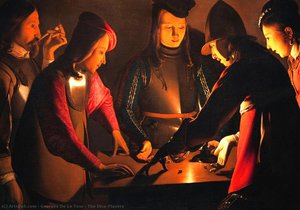
Georges de La Tour's “The Dice Players,” completed around 1650, is more than just a depiction of gambling; it’s an arresting exploration of faith and human vulnerability rendered with the masterful precision characteristic of Tenebrism—a technique that elevates this seemingly simple scene into a profound meditation on spirituality. Painted in stark contrast between light and darkness, the artwork exemplifies the Baroque aesthetic's preoccupation with dramatic emotion and psychological depth.The Anatomy of Darkness: Tenebrism Technique
De La Tour’s signature style is undeniably Tenebrism, derived from Italian “tenebroso,” meaning shadowy or dusky. This method involves plunging the majority of the canvas into impenetrable darkness—almost absolute black—while strategically illuminating select areas with pools of intense light emanating from a single candle. The candlelight casts dramatic shadows across the faces and hands of the players, emphasizing their concentration and highlighting the vulnerability inherent in their pursuit of fortune. Notice how the artist meticulously renders the textures of fabric and skin, capturing subtle nuances that contribute to the overall realism despite the pervasive gloom. This careful attention to detail underscores De La Tour’s commitment to portraying human experience with unflinching honesty.A Scene Steeped in Religious Symbolism
While ostensibly depicting a mundane activity—dice playing—the painting resonates with deeper religious symbolism. The darkened room itself can be interpreted as representing purgatory, the shadowy recesses of the soul awaiting redemption. The candle flame symbolizes divine grace and illuminates the players’ faces, suggesting that even amidst worldly pursuits, faith remains present. Furthermore, the dice themselves are often associated with chance and fate—themes central to Christian theology concerning God's providence. De La Tour subtly invites contemplation on these concepts, elevating the scene beyond mere entertainment into a visual parable.Historical Context: The Quiet Reformation
“The Dice Players” emerged during the turbulent period of the French Reformation (1562-1648), when Catholicism and Protestantism clashed violently across Europe. Despite the outward appearance of piety—the candlelit interior, the solemn expressions of the figures—there’s an underlying tension within the artwork. The players are absorbed in their game, seemingly oblivious to the spiritual implications of their actions. This juxtaposition speaks to the anxieties of the time – a questioning spirit challenging established dogma and prompting reflection on moral responsibility. De La Tour's depiction captures this subtle unease, reflecting the broader societal debates surrounding faith and morality prevalent during his era.Emotional Resonance: Intimacy and Vulnerability
Ultimately, “The Dice Players” succeeds in conveying a powerful emotional resonance. The artist’s masterful use of chiaroscuro creates an atmosphere of palpable intimacy—we are drawn into the players' world, witnessing their intense focus and confronting their vulnerability. There is no grand gesture or triumphant proclamation; instead, De La Tour presents us with a quiet tableau that speaks volumes about human nature. It’s a painting that lingers in the mind long after viewing, prompting reflection on themes of ambition, faith, and the inescapable realities of mortality—a testament to De La Tour's enduring artistic vision.Korduvad küsimused
Kas teose "The Dice Players" värvid on tugevad või pehmed?
Teose "The Dice Players" värvitoon on Balanced. Intensiivsus kirjeldab värvide tugevust ja ergitust.
Kust saan osta teose „The Dice Players“, autor Georges De La Tour trükki?
Teose „The Dice Players“, autor Georges De La Tour trüket saate tellida otse selle Kvaliteetne kunstutrüki print lehelt: kunstiprint puuvillalõikel kangas või arhiveeritaval kangaspaberil.
Kust saan näha teose "The Dice Players" eelvaadet?
Teose „The Dice Players“, autor Georges De La Tour reproduktsiooni eelvaate saamiseks avage teose Eelvaade leht.
Quick facts and art quiz
About Georges De La Tour

Georges De La Tour
1593 - 1652, Франція
Kunstniku elulugu
Georges de La Tour (1593–1652): French Baroque Master of Dramatic Chiaroscuro & Tenebrism
Georges de La Tour, a name that resonates with the hushed reverence reserved for masters of light and shadow, remains one of the most compelling figures of the French Baroque. Born in 1593 in Vic-sur-Seille, Lorraine—a region caught between the Habsburg Empire and burgeoning French influence—his life unfolded against a backdrop of fervent religious conviction and turbulent political upheaval. While precise details surrounding his formative years remain elusive—scholars speculate about potential journeys to Italy or apprenticeships with local artists like Jacques Bellange—the seeds of his artistic vision were undeniably sown in this environment, nurtured by the prevailing cultural currents of his time.
Early Life & Artistic Influences
Georges de La Tour’s parents were Jean and Sybille de La Tour. Jean was a baker, while Sybille’s lineage hinted at noble connections—a subtle element perhaps reflected in the dignified composure that characterizes his oeuvre. Despite lacking formal artistic training as we understand it today, De La Tour absorbed influences from various sources, shaping his distinctive style. Notably, Caravaggio—the Florentine painter who revolutionized Baroque art with his visceral realism and emotionally charged compositions—served as a pivotal mentor. However, De La Tour didn’t merely emulate Caravaggio; he skillfully filtered Caravaggism through the lens of Dutch Caravaggisti—particularly those from Utrecht School—resulting in a style that was both powerfully dramatic and exquisitely restrained.
The Style of Dramatic Chiaroscuro
De La Tour's artistic hallmark is undoubtedly his masterful manipulation of chiaroscuro—the stark contrast between light and dark—a technique perfected by Caravaggio himself. Unlike many contemporaries who embraced flamboyant ornamentation and vibrant color palettes, De La Tour opted for a muted palette dominated by earthy tones—browns, ochres, and siennas—creating scenes imbued with an atmosphere of solemn contemplation. His early works demonstrate a heightened dynamism and vibrancy, reflecting the influence of Utrecht School painters who championed Caravaggism’s uncompromising realism.
Major Works & Recurring Themes
The centerpiece of De La Tour's artistic legacy is undoubtedly his series of candlelit interiors—scenes depicting biblical narratives illuminated by flickering candlelight. These paintings aren’t merely depictions of religious events; they are meditations on faith, doubt, and the human condition. Consider *The Fortune-Teller*, painted around 1630—a genre scene rendered with meticulous observation and arresting lighting—where a young boy is absorbed in an activity that speaks to the quiet dignity of everyday life. Similarly, *Adoration of the Shepherds*, created circa 1640, exemplifies De La Tour’s ability to infuse a traditional subject with profound emotional resonance. The figures are not idealized or heroic; they are ordinary people—humbled by the presence of divine grace—rendered with breathtaking subtlety and realism.
Rediscovery & Enduring Significance
Despite achieving recognition during his lifetime—he was appointed “Painter to the King” by Louis XIII in 1638—De La Tour’s work languished in obscurity for centuries, largely due to misattribution. It wasn't until the early 20th century that scholars like Hermann Voss spearheaded a concerted effort to reassess his oeuvre—revealing an artist of extraordinary originality and depth whose influence extended far beyond his own era. De La Tour’s innovative use of light and shadow—combined with his psychological insight into his subjects—continues to captivate audiences today, reminding us that even in the darkest recesses of human experience, there exists a glimmer of hope illuminated by faith and compassion. His legacy endures as a testament to the transformative power of artistic vision and the enduring beauty of simplicity.
Quick facts about Georges De La Tour
- Artistic Movement Or Style: Baroque, Tenebrism
- Artists Who Influenced This Artist:
- Caravaggio
- Hendrick Terbrugghen
- Date Of Birth: March 13, 1593
- Date Of Death: Jan. 30, 1652
- Full Name: Georges de La Tour
- Nationality: French
- Notable Artworks:
- The Fortune Teller
- Adoration of the Shepherds
- Saint Joseph Carpenter
- Place Of Birth: Vic-le-Comte, France
Avastage teoseid, mis on koondatud teemade, stiilide ja omaduste kaupa.


Georges De La Tour
The Dice Players
() ·
With its frame: · Hand-painted in oil on linen
Total