

Näidatud: · koos raamiga:
 Eelvaade
 Saada
Saada Jaga
Jaga
 Teave teose kohta
 Juhend

 Laadi alla
 Sarnased teosed
 Röntgenuuring
 Slaidietendus
 KÜSIMUSED JA VASTUSID
 Statistika


€ 240
Käsitsi valmistatud õlimaalireproduktsioon
Meie kunstnike poolt tellimusel valmistatud käsitsi maalitud õli-kainaste teos teie soovitud suuruses ja raamis. ( Lülita trükkitoodetele Lülita digitaalse pildi juurde)
Suurus
·Standardne suurus
kohandatud
CM
INCH
Vali meie eelmääratud suurused, mis vastavad teose algupärastele proportsioonidele.
Suuruste laadimine...

laius
kõrgus
Sisestage vajalik laius ja kõrgus, et teos sobiks teie raamile või seinale. Kuna tegu on käsipainatud teosega, siis erineva kujuga suuruse korral võib kunstnik jätta pildi ümber veidi rohkem marginaali või lõigata osa ära — valik on teie. Enne maali alustamist saadame teile kinnitamiseks digitaalse näidisprojektsiooni. Sellel lehel näidatud pilt ei kajasta tegelikku tulemust — seda näitab ainult näidisprojektsioon.
 Loe lähemalt
Lõpuleviimine
·
Valge serv €1

häguse servaga lõppviimistlus €1

Laiendatud €1

P118B €10

P118H €10

P118W €10

P438Z €10

P508JH €12

P508YH €12

P805H €10

P805Z €10

P919BZ €10

P919G €10

P919XJ €10

P959ZH €10

P968JZ €12

W106C €8

W218G €10

W218JH €8

W218Y €10

W307PJ €10

W316G €10

W316PJ €8

W316Y €10

W398PJ €8

W4111J €10

W500HY €15

W500JH €15

W692G €12

W849H €8

W940BG €15

W953PJ €8

H24-GOLD €30

H24-SILVER €30

H36-GOLD €45

H36-SILVER €45
Saadetakse kaitsetorus, et te võiksite selle ise raamida.
Üle 105 cm suurust raami saadetakse komplektina professionaalse raamija jaoks — lugeege lisainfot.
Lisateenused
valikulineMida lisad sisaldavad?
Näited sellest, mida saab muuta: asendage nägu kliendi fotoga; lisage lemmikloom (nt asendage kass koega); lisage taustale peidetud sõnum; muutke tausta maastikku või elemente.
Pärast tellimust saadetab TopImpressionists.com meeskond klientile e-posti juhised ning esitab ette tasandatud eelvaate
Pärast tellimust saadetab TopImpressionists.com meeskond klientile e-posti juhised ning esitab ette tasandatud eelvaate
Maailmline tarne 3–4 nädala jooksul tavalise 5 nädala asemel. (7 november). Kvaliteedis kompromisse ei tehta.
Kaitsevärnitsus
Nimesildikiri
Graveeritud pronksplaadi üksikasjad
This elegant plaque features the artist's name and the title of the artwork, finely engraved for a timeless presentation.
It is made from bronze with a refined, elegant finish. The text is precisely laser-engraved for a sharp and permanent result. Measuring 9x2 cm, the plaque is compact yet easy to read. It's built to be durable and scratch-resistant, offering a professional, museum-quality look. Mounting is simple thanks to the included adhesive backing.
Läbipaistva akrüülplaadi üksikasjad
The plaque includes essential engraved details such as the artist's name, the title of the artwork, the date it was created, the type of media used-like oil on canvas or watercolor-a brief description of the piece, and a QR code that links to the complete artwork information.
It is crafted from clear acrylic, offering a sleek, modern appearance. The text is UV-engraved in black to ensure strong visual contrast. With a size of 10x15 cm, it ensures optimal readability. It comes equipped with two metal hooks for secure wall mounting. The plaque is designed to be weather-resistant, making it suitable for various environments, and it includes interactive features that work seamlessly with smartphone scanning.
Musta akrüülplaadiรายละเอียด (Note: The user provided "Musta akrüülplaadi detailid" as the current translation and asked for an improved version. Since "Musta akrüülplaadi
This elegant plaque includes engraved information such as the artist's name, the title of the artwork, the date it was created, the type of media used (like oil on canvas or watercolor), a short description of the artwork, and a QR code for quick access to more information.
The plaque itself is made from refined black acrylic with a premium finish. The text is laser-engraved in white for high contrast and readability. Its size is 10x15 cm, designed to be easy to read. It comes with two metal hooks for professional mounting. The design is sleek and fits any interior style. It is also weather-resistant and durable, with built-in digital integration for mobile compatibility.
Klaasivalik on saadaval ainult kuni 110 cm suuruses teostes
 Klaasivalik on saadaval ainult kuni 110 cm suuruses teostes
- Tasuta ekspresssaatmine üle maailma
- Kõrgekvaliteediline lina-kangas
- Täielik transpordikindlustus
- Tollimaksude tagastamise garantii
- Värvitoime täpsuse garantii
- 100 päeva tagastusõigus (ainult valmistusdefektide korral)
- 100% raha tagasi garantii
- Hulgusoodustus


Kogumisobjekti kirjeldus
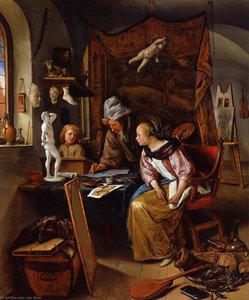
A warm snapshot of Dutch domesticity unfolds in Jan Havickszoon Steen's The Drawing Lesson, capturing a tender family moment from the Golden Age that invites you to bring this masterpiece of human comedy into your home.
Kunstniku elulugu
Jan Steen (1626-1679) oli hollandi kuldaja žanrimaalija, tuntud eluliste ja humoorikate stseenide poolest. Avastage tema värvilisi igapäevaelu kujutusi ning mõju baroki kunstile.
Teemal maalid
A Window into Dutch Domesticity
In the quiet, sun-dappled corners of a seventeenth-century Dutch home, Jan Havickszoon Steen captures a moment that feels both profoundly intimate and timelessly universal. The Drawing Lesson is not merely a depiction of an instructional afternoon; it is a masterful snapshot of domestic life, where the boundaries between education, leisure, and family connection blur into a single, harmonious scene. As we gaze upon this composition, we are invited into a room filled with the warmth of togetherness, watching as a father guides his children through the delicate art of sketching. The atmosphere is thick with a sense of quiet purpose, yet there is an underlying vitality—a pulse of life that prevents the scene from feeling static or overly formal.
Steen, a true master of the human comedy, had an unparalleled ability to find the extraordinary within the ordinary. While his contemporaries often reached for the grandiosity of mythological legends or the stiff dignity of royal portraits, Steen turned his gaze toward the kitchen, the tavern, and the schoolroom. In this work, he utilizes the textures of everyday objects—the smooth surface of a wooden table, the delicate curve of a ceramic bowl, and the weathered grain of a violin—to ground the viewer in a tangible reality. For the collector or the interior designer, this painting offers more than just visual beauty; it provides a narrative anchor, a piece of history that breathes life into a room through its depiction of shared human experience.
Technique and the Art of Light
The technical brilliance of Steen’s approach lies in his ability to manipulate light and shadow to create psychological depth. Though he was known for his vibrant palettes, his mastery of tonal gradations allows The Drawing Lesson to possess a sculptural quality. He employs a sophisticated understanding of light to illuminate the faces of the learners, drawing our eyes toward the focal point of the instruction. This interplay of light does more than just reveal form; it creates a sense of atmosphere, suggesting the soft, diffused glow of a northern afternoon filtering through a window.
One cannot discuss Steen without acknowledging his innovative use of texture and volume. Through careful layering, he achieves an illusion of depth that makes the objects on the table—the books, the cup, and the scattered art materials—appear almost within reach. This tactile quality is essential for anyone seeking a reproduction that commands attention in a modern space. The painting does not merely sit upon a wall; it interacts with the light of its environment, offering subtle shifts in mood depending on the time of day. It is this technical rigor, paired with his approachable aesthetic, that makes Steen’s work so enduringly captivating for those who appreciate the fine details of Baroque mastery.
Symbolism and Emotional Resonance
Beyond the surface level of a family activity, The Drawing Lesson is rich with the subtle moralizing characteristic of the Dutch Golden Age. In the seventeenth century, the act of learning was often viewed as a metaphor for the cultivation of the soul. The careful guidance of the child mirrors the societal importance of discipline, patience, and the transmission of knowledge across generations. Every element in the room—from the presence of music, suggested by the violin, to the scholarly weight of the books—serves to elevate the domestic scene into a meditation on the virtues of a well-ordered life.
Yet, despite these underlying lessons, the emotional impact of the piece remains profoundly accessible. There is no heavy-handedness here; instead, there is a gentle, rhythmic beauty found in the way the figures lean toward one another. For an art lover, the painting offers a sense of nostalgia for a simpler, more connected era. For an interior designer, it serves as a sophisticated element of storytelling, capable of evoking feelings of warmth, stability, and intellectual curiosity. To possess a reproduction of this work is to bring a piece of the Dutch Golden Age's heart into one's own home, celebrating the enduring beauty of life’s most quiet, instructional moments.
Korduvad küsimused
Kuidas teose „The Drawing Lesson“, autor Jan Steen värvid seostuvad selle emotsiooniga?
Teoses "The Drawing Lesson" on Earthy värvid koosldes Reflective tunnetega.
Kuidas teos "The Drawing Lesson" tasakaalustab valgust ja pimendust?
Teose „The Drawing Lesson“, autor Jan Steen eregus on deep_shadow ja luminants on Dark.
Mis vanuses loos Jan Steen teose "The Drawing Lesson"?
Jan Steen loobus teose "The Drawing Lesson" 37 aasta vanuses. Kunstnik on sündinud aastal 1626 ning teos on dateeritud 1663.
Kiirinfo ja kunstiviktoriin
Info Jan Steen kohta

Jan Steen
1626 - 1679, Holland
Kunstniku elulugu
Jan Havickszoon Steeni Elu ja Varajased Aastad
Jan Havickszoon Steen (1626–1679) oli Hollandi Kuldaja žanripainter, kelle loomingut iseloomustab elavus, huumor ning igapäevaelu psühholoogiline tabamine. Sündinud Leidenis 1626. aastal, kasvas Steen kunstnikuperes – tema isa oli õllepruulija ja ema pärit kunstnike perekonnast. Kuigi täpsed andmed tema varajase hariduse kohta on napid, teame, et ta alustas kunstiõpinguid Hendrick Jacobsz. Stoffelsi juures Leidenis. Stoffels oli tuntud portree- ja maastikumaalija, kelle õpetus pakkus Steeni jaoks vajalikku põhja, kuid samas avas ukse stiilisuunale, mis hiljem mõjutas tema isikupärast loomingut. Leidensi kunstikeskkond oli 17. sajandi Hollandis elav ja mitmekesine ning Steen sai varakult tuttav erinevate žanrite ja maalimistehnikatega. Tema perekonna side kunstimaailmaga aitas kaasa tema huvi ärkamisele maalimise vastu, kuid eriti oluline oli tema iseseisev soov kujutada inimeste igapäevast elu ning selle varjatud emotsioone.Žanripainingu Valik ja Individuaalne Stiil
Steeni teekond kunstnikuna erines oma kaasaegsetest selles, et ta valis keskenduda žanripainingale – kunstiliigile, mis kujutas tavaliste inimeste eluolukordi. See oli julge otsus ajastul, mil prestiižsemateks peeti ajaloolisi ja müstilisi teemasid. Steen tundis tõelist kirge maalida taluperekonnad, kõrtsikohtumised, kooliklassid – stseenid, mis olid täis psühholoilist sügavust ja peent moraaliõpetusi. Tema varajased tööd näitasid juba selget kalduvust realistlikule kujutamisele ning huvi detailide vastu. Ta ei piirdunud pelgalt välise sarnasusega, vaid püüdles tabada inimeste iseloomu ja nende vahelisi suhteid. Steeni loomingut iseloomustab *chiaroscuro* – dramaatiliste valgusvarjude kasutamine, mis süvendab emotsionaalset mõju ning loob ruumilist sügavust tema lõuenditel. Ta täheldas hoolikalt igapäevaelu detaile – rõivaid, mööblit, näoilme – ja kujutas neid hämmastavalt täpselt. Kuid Steen ei piirdunud pelgalt reaalsuse dokumenteerimisega; ta kasutas osavalt visuaalseid vihjeid moraaliõpetuste edasiandmiseks. Tema maalid kujutavad sageli tegelasi, kes on seotud näiliselt tühiste tegevustega – kikkermängijad, farmerid põllul töötamas –, kuid need stseenid on täis sümboolset tähendust, mis kutsub vaatajat mõtisklema piisuse, lolluse ja inimkäitumise tagajärgede üle. Näiteks “Kikkermängijad kõrtsis” (1663) kujutab elavat mängu maalähedase interjööri taustal, tuletades meelde mõõdukat käitumist ja sotsiaalset vastutust.Mõjud ja Baroki Kunsti Mõju
Steeni looming ei tekkinud vaakumis; tema stiilile avaldasid mõju mitmed kaasaegsed kunstnikud ja kultuurisuunad. Kuigi ta ei olnud otseselt seotud ühe konkreetse koolkonna või õpetajaga, võib tema töödes märgata Hendrick Jacobsz. Stoffelsi varase mõju realistlikule kujutamisele. Samuti oli Steeni loomingus näha itaalia baroki kunstnike – eriti Caravaggio – dramaatilise valgusvarjude kasutuse ja emotsionaalse intensiivsuse jälgi. Tema innovatiivne stiil resoneeris kunstnikega üle Euroopa, eriti Prantsusmaal, kus barokimaalijad võtsid omaks tema tehnikad emotsionaalselt laetud kompositsioonide loomiseks. Kunstnikud nagu Nicolas Sustris ja Rembrandt imetlesid Steeni oskust edasi anda psühholoogilist nüanssi näiliselt lihtsates stseenides – baroki esteetika tunnusmärk. Musée Memling Brugge’is asub tähelepanuväärne Steeni maalidest koosnev kollektsioon, pakkudes külastajatele ainulaadset võimalust hinnata tema loomingut ja sügavust.Olulisemad Teosed ja Pärand
Steeni loomingu hulgas on mitmeid tuntud teoseid, mis demonstreerivad tema meisterlikkust žanripainingu alal. “Ristija Johannese jutlus” (1653) ja “Range Õpetaja” (1668) on vaid kaks näidet tema võimest tabada dramaatilise valguse ja värvi abil olulisi piibellikke hetki ning edasi anda palpataavat emotsiooni. "Ristija Johannese jutlus" näitab Steeni dramaatilist valgusvarjude kasutust, kujutades elavat stseeni külaelanikest, kes kuulevad tähelepanuvõetult Ristija Johannese sõnu – visuaalne metafoor jumalikku ilmutusele. Samuti “Range Õpetaja” kujutab klassiruumi, mis on täis pinget ja huumorit, rõhutades haridusasutuste väljakutseid noorte mõistuse kujundamisel. Steeni hoolikas detailitäpsus ja psühholoogiline realism tõstavad selle näiliselt tavalise teema sügavale inimloomuse ja moraalse vastutuse meditatsiooniks. Tema looming ei piirdunud pelgalt kaasaegsete kunstnike mõjutamisega; Steeni innovatiivne stiil resoneeris laiemas kultuuriruumis, inspireerides teatrikunstnikke ja kirjamehi. Jan Steen’i pärand jätkab tänapäevaste kunstnike inspireerimist, kes püüdlevad autentsuse ja emotsionaalse resonantsi poole. Ta jääb Hollandi kunstilise uuenduse sümboliks – maalikunstnikuks, kes julges tähistada igapäevaelu ilu ja keerukust ning samal ajal edasi anda väärtuslikke moraaliõpetusi, kindlustades oma koha baroki kunstiajaloo üheks mõjukaimaks figuuriks.Kiirinfo Jan Steen kohta
- Artistic Movement Or Style: Kuldaja žanrimaal
- Artists Or Movements Influenced By This Artist: ['Barokk kunst']
- Artists Who Influenced This Artist: ['Hendrick Jacobsz. Stoffels']
- Date Of Birth: 1626
- Date Of Death: 1679
- Full Name: Jan Havickszoon Steen
- Nationality: Hollandlane
- Notable Artworks:
- John the Baptist Preaching
- Skittle Players outside an Inn
- The Severe Teacher
- Place Of Birth (City And Country): Leiden, Holland
Avastage teoseid, mis on koondatud teemade, stiilide ja omaduste kaupa.

Jan Steen
The Drawing Lesson
() ·
koos raamiga: · Käsitööna õliga linale maaldud
Kokkuvõte