

Näidatud: · koos raamiga:
 Eelvaade
 Saada
Saada Jaga
Jaga
 Teave teose kohta
 Juhend

 Laadi alla
 Sarnased teosed
 Röntgenuuring
 Slaidietendus
 KÜSIMUSED JA VASTUSID
 Statistika

€ 485
Käsitsi valmistatud õlimaalireproduktsioon
Meie kunstnike poolt tellimusel valmistatud käsitsi maalitud õli-kainaste teos teie soovitud suuruses ja raamis. ( Lülita trükkitoodetele Lülita digitaalse pildi juurde)
Suurus
·Standardne suurus
kohandatud
CM
INCH
Vali meie eelmääratud suurused, mis vastavad teose algupärastele proportsioonidele.
Suuruste laadimine...

laius
kõrgus
Sisestage vajalik laius ja kõrgus, et teos sobiks teie raamile või seinale. Kuna tegu on käsipainatud teosega, siis erineva kujuga suuruse korral võib kunstnik jätta pildi ümber veidi rohkem marginaali või lõigata osa ära — valik on teie. Enne maali alustamist saadame teile kinnitamiseks digitaalse näidisprojektsiooni. Sellel lehel näidatud pilt ei kajasta tegelikku tulemust — seda näitab ainult näidisprojektsioon.
 Loe lähemalt
Lõpuleviimine
·
Valge serv €1

häguse servaga lõppviimistlus €1

Laiendatud €1

P118B €10

P118H €10

P118W €10

P438Z €10

P508JH €12

P508YH €12

P805H €10

P805Z €10

P919BZ €10

P919G €10

P919XJ €10

P959ZH €10

P968JZ €12

W106C €8

W218G €10

W218JH €8

W218Y €10

W307PJ €10

W316G €10

W316PJ €8

W316Y €10

W398PJ €8

W4111J €10

W500HY €15

W500JH €15

W692G €12

W849H €8

W940BG €15

W953PJ €8

H24-GOLD €30

H24-SILVER €30

H36-GOLD €45

H36-SILVER €45
Saadetakse kaitsetorus, et te võiksite selle ise raamida.
Üle 105 cm suurust raami saadetakse komplektina professionaalse raamija jaoks — lugeege lisainfot.
Lisateenused
valikulineMida lisad sisaldavad?
Näited sellest, mida saab muuta: asendage nägu kliendi fotoga; lisage lemmikloom (nt asendage kass koega); lisage taustale peidetud sõnum; muutke tausta maastikku või elemente.
Pärast tellimust saadetab TopImpressionists.com meeskond klientile e-posti juhised ning esitab ette tasandatud eelvaate
Pärast tellimust saadetab TopImpressionists.com meeskond klientile e-posti juhised ning esitab ette tasandatud eelvaate
Maailmline tarne 3–4 nädala jooksul tavalise 5 nädala asemel. (6 november). Kvaliteedis kompromisse ei tehta.
Kaitsevärnitsus
Nimesildikiri
Graveeritud pronksplaadi üksikasjad
This elegant plaque features the artist's name and the title of the artwork, finely engraved for a timeless presentation.
It is made from bronze with a refined, elegant finish. The text is precisely laser-engraved for a sharp and permanent result. Measuring 9x2 cm, the plaque is compact yet easy to read. It's built to be durable and scratch-resistant, offering a professional, museum-quality look. Mounting is simple thanks to the included adhesive backing.
Läbipaistva akrüülplaadi üksikasjad
The plaque includes essential engraved details such as the artist's name, the title of the artwork, the date it was created, the type of media used-like oil on canvas or watercolor-a brief description of the piece, and a QR code that links to the complete artwork information.
It is crafted from clear acrylic, offering a sleek, modern appearance. The text is UV-engraved in black to ensure strong visual contrast. With a size of 10x15 cm, it ensures optimal readability. It comes equipped with two metal hooks for secure wall mounting. The plaque is designed to be weather-resistant, making it suitable for various environments, and it includes interactive features that work seamlessly with smartphone scanning.
Musta akrüülplaadiรายละเอียด (Note: The user provided "Musta akrüülplaadi detailid" as the current translation and asked for an improved version. Since "Musta akrüülplaadi
This elegant plaque includes engraved information such as the artist's name, the title of the artwork, the date it was created, the type of media used (like oil on canvas or watercolor), a short description of the artwork, and a QR code for quick access to more information.
The plaque itself is made from refined black acrylic with a premium finish. The text is laser-engraved in white for high contrast and readability. Its size is 10x15 cm, designed to be easy to read. It comes with two metal hooks for professional mounting. The design is sleek and fits any interior style. It is also weather-resistant and durable, with built-in digital integration for mobile compatibility.
Klaasivalik on saadaval ainult kuni 110 cm suuruses teostes
 Klaasivalik on saadaval ainult kuni 110 cm suuruses teostes
- Tasuta ekspresssaatmine üle maailma
- Kõrgekvaliteediline lina-kangas
- Täielik transpordikindlustus
- Tollimaksude tagastamise garantii
- Värvitoime täpsuse garantii
- 100 päeva tagastusõigus (ainult valmistusdefektide korral)
- 100% raha tagasi garantii
- Hulgusoodustus


Kogumisobjekti kirjeldus
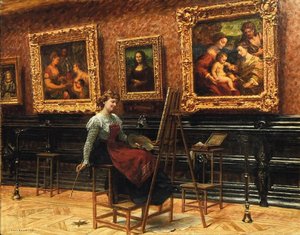
Explore 'A la gloire de Rubens' by Louis Beroud – a vibrant Baroque masterpiece inspired by Rubens! Capturing opulent revelry & sensual energy, this oil painting offers a glimpse into 19th-century Parisian art.
Kunstniku elulugu
Avastage Louis Beroud (1852-1930), Prantsuse maalidaja, kes on tuntud oma detailsete Pariisi interieuride ja mälestismide kujutuste poolest, sealhulgas Louvre'i ja Opéra Garnier'i.
Teemal maalid
À la gloire de Rubens – A Celebration of Baroque Grandeur
Louis Béroud’s “À la gloire de Rubens” is more than just a depiction of a painting; it's an embodiment of the artistic spirit of its time—the fervent embrace of academic tradition alongside a keen observation of modern life that characterized Parisian art in the early 20th century. Painted in 1905, this monumental canvas captures the atmosphere of the Louvre Museum during a period marked by significant cultural renewal and intellectual curiosity. The artwork’s subject matter is deceptively simple: a young woman diligently sketching “The Coronation” by Peter Paul Rubens from his celebrated Marie de Medici cycle—a masterpiece that embodies the Baroque ideal of dramatic grandeur and emotional intensity.- Composition & Style: Béroud adheres to the stylistic conventions of the École de Beaux-Arts, prioritizing clarity of form and meticulous detail. The scene unfolds within a richly ornamented interior space reminiscent of Rubens’s own studio, emphasizing architectural perspective and creating a sense of spatial depth. However, unlike Rubens's canvases which aim for idealized beauty, Béroud presents a realistic portrayal of artistic practice—a testament to the artist’s commitment to capturing the essence of his subject matter.
- Technique: Employing oil paint on canvas with visible brushstrokes, Béroud utilizes impasto – thick application of pigment – particularly noticeable in areas depicting drapery and skin tones. This technique lends texture and luminosity to the painting, mirroring the dramatic chiaroscuro employed by Rubens himself. The artist’s careful attention to light and shadow contributes significantly to the overall theatrical quality of the composition.
- Historical Context: Béroud's work emerged during a period of artistic debate following Impressionism’s dominance. Artists like Béroud sought to reaffirm classical principles while acknowledging the influence of contemporary life—a dynamic tension that reflects broader cultural shifts occurring in France at the time. The painting’s inclusion within the Louvre’s collection underscores its significance as an exemplar of academic art and a celebration of Rubens's legacy.
- Symbolism: The central figure, sketching “The Coronation,” symbolizes the dedication to artistic craft and the pursuit of excellence—values deeply ingrained in the Beaux-Arts tradition. The inclusion of Rubens’s monumental painting serves as a visual reminder of the Baroque aesthetic’s ambition to inspire awe and convey profound emotion.
- Emotional Impact: “À la gloire de Rubens” evokes a feeling of reverence for artistic heritage combined with an appreciation for meticulous observation. It invites viewers to contemplate the role of art in capturing beauty, conveying emotion, and preserving cultural memory—themes that resonate powerfully across generations.
Detailed Description & Artistic Considerations
The painting’s palette is dominated by muted earth tones – ochre, umber, Sienna – reflecting the subdued lighting of the Louvre’s galleries. Béroud skillfully renders textures with remarkable precision, capturing the folds of fabric and the subtle nuances of skin tone. The artist's meticulous brushwork contributes to a palpable sense of movement—suggesting the dynamism inherent in artistic creation itself. Careful attention is paid to architectural elements – moldings, arches – reinforcing the spatial illusion and enhancing the grandeur of the setting. Béroud’s masterful technique elevates the depiction beyond mere representation, transforming it into an evocative meditation on art history and artistic practice.Provenance & Acquisition
“À la gloire de Rubens” entered the Louvre's collection in 1993 as a bequest from Micheline Héblot (1930-1990), honoring her parents’ memory. The painting was originally exhibited at the Salon of Société des Artistes français in 1905 and subsequently reproduced as prints during that era. Its inclusion in Musée Carnavalet's permanent collection provides invaluable insight into Parisian artistic culture at the turn of the century.Further Research & Artistic Influences
Louis Béroud’s artistic trajectory was profoundly shaped by his training at the École Supérieure des Beaux-Arts, where he absorbed the precepts of classical art and technique. His unwavering devotion to realism combined with an artist's sensitivity distinguishes him as a pivotal figure in late 19th-century French painting—a legacy that continues to inspire artists today. References: Musée Carnavalet; Louvre éditions / Somogy, 2008, p. 149, coul. n°178; Bresc-Bautier, Geneviève ; Foucart, Jacques, « Le tableau du mois n° 9 : trois nouveaux tableaux pour l’histoire du Louvre : Louis Béroud, Henri Coroënne », Tableau du mois, 9, du 7 septembre au 3 octobre 1994, 1994, 1-4, p. 1-4, n&b, p. 1, B; Musée du Louvre, Département des Peintures; Bresc-Bautier, Geneviève ; Foucart, Jacques, « Le tableau du mois n° 9 : trois nouveaux tableaux pour l’histoire du Louvre : Louis Béroud, Henri Coroënne », Tableau du mois, 9, du 7 septembre au 3 octobre 1994, 1994, 1-4, p. 1-4, n&b, p. 1, B; Musée Carnavalet; Louvre éditions / Somogy, 2008, p. 149, coul. n°178; Musée du Louvre, Département des Peintures; Bresc-Bautier, Geneviève ; Foucart, Jacques, « Le tableau du mois n° 9 : trois nouveaux tableaux pour l’histoire du Louvre : Louis Béroud, Henri Coroënne », Tableau du mois, 9, du 7 septembre au 3 octobre 1994, 1994, 1-4, p. 1-4, n&b, p. 1, B; Musée Carnavalet; Louvre éditions / Somogy, 2008, p. 149, coul. n°178Korduvad küsimused
Kuidas leida teoseid, mis on stiilis sarnased teosele „A la gloire de Rubens“, autor Louis Beroud?
Teosed, mis sarnanevad teosega "A la gloire de Rubens", on loetletud selle teose Sarnased teosed lehel.
Kui eraldavad teose "A la gloire de Rubens" värvid?
Teose „A la gloire de Rubens“, autor Louis Beroud värvid on Balanced Soft kütkusega ja Balanced intensiivsusega.
Mida „A la gloire de Rubens“, autor Louis Beroud kujutab?
„A la gloire de Rubens“, autor Louis Beroud kujutab: mythological feast, nude figures, baroque revelry, sensual celebration, opulent interior, venus mythology, dynamic composition.
Kiirinfo ja kunstiviktoriin
Info Louis Beroud kohta
Louis Beroud
1852 - 1930, Prantsusmaa
Kunstniku elulugu
Louis Beroud: Pariisi visjonär, kes tabas oma ajastu vaimu
Louis Beroud (1852–1930) seisab 19. sajandi lõpus ja 20. sajandi alguses Prantsuse kunstis kui märkimisväärne kujund, keda tunnustatakse eriti tema täpsete Pariisi interjööride ja monumentaalsete mälestismide — eelkõige Louvre'i muuseumi ja Opéra Garnier'i — kujutamistena. Beroud, kes sündis Prantsus Aust Lyonist, arenes kunstiliselt impressionismi vähetlevane mõju taustal, saades kindlaks akadeemises traditsiooni raamides, kuid omades samas sügavale nüüdsust mõistvat vaadet modernile elu. Tema linaed pakuvad pilgu maailma, mis on täidetud hiilgusest, detailidest ja psühholoogilisest täpsusest — olles tõenduseks tema vankumatule pühendumisele realismile koos kunstniku tundlikusega.- Varajane elu ja kunstiline haridus: Beroud sai oma esialse kunstilise hariduse Pariisis École Supérieure des Beaux-Arts koolis, kus ta täisas oma oskusi mõjuva õpetajate all, kes eestlesid kompositsiooni ja tehnika klassikaliste põhimõtete eest. See kujundav periood instilleeris temasse sügava austuse traditsiooni vastu, kuid südames hoidis ka uudishimulik vaim, mis tõi teda uute teemade ja stiilide avastamise juurde.
- Olulised teosed ja kunstiline stiil: Beroudi loov}`, mis hõlmab hämmastavat teemade laiusust, ulatudes monumentaalsetest arhitektuursetest kujenditest — nagu tema kuulsad Louvre'i ja Opéra Garnier'i kujutused — kuni intiimsete portretemani, mis tabavad Pariisi elu olemust. Tema maalid on iseloomulikud hoolikale tähelepanule detailide suhtes, meisterliku valgus- ja varjundimängu ning võimega edastada atmosfääri erakordse täpsusega. Ta suutsid oskuslikult ühendada akadeemilise realismi ekspressiivse pinttööga, luues pilte, mis kõlavad nii intellektuaalse rangusega kui ka emotsionaalse sügavusega.
Louvre'i juhtum: surrealistliku huumori hetk
Ehkki Beroudi püsivaimus võib puestada tema unustamatust episoodist Louvre'i muuseumis 11. augustil 1911. Otsides inspiratsiooni maalidamiseks, mis austaks muuseumi sada aastat, saabus Beroud sketsima teost „Mona Lisa au Louvre“, vaid avastas, et Leonardo da Vinci ikooniline portret on kadunud — asendatud nelja raudast kruuniga, mis hoidis seda seinale. See kummaline asjaolu põhjustas uurimise suurelt teose varguse kohta ja haaras Pariisi avalikku arvamust. Juhtum muutus sümboliks murele kunstilise autentilisuse ja modernuse sisepeetuse ees väärikates institutsioonides.- Muuseumitellimused ja kunstiline tunnustus: lõimunud Beroudi maine maalrina sai olulist tõuset, tänu arvukatele tellimustele prominentsetelt kultuuriorganisatsioonidelt, sealhulami Louvre'ist ise. Need projektid võimaldasid tal näidata oma talenti suuremõõuliselt ja kinnistasid tema positsiooni ühe Prantsuse ajastu esimeesliku kunstniku positsioonina.
- Mõju ja pärand: Beroudi kunstiline stiil — mida iseloomustavad täpne realisme ja psühholoogiline vaade — mõjutas järgmisi maalide põlvkonnusid, eriti neid, kes olid huvitatud linnelu elu keerukuste tabamisest. Tema teosed on jätkuvalt imetlust väärivad oma tehnilise briljantsuse ja Belle Époque Pariisi ühiskonna evocatiivse kujutamise tõttu, kinnistades tema pärandi kui võtmefiguuri Prantsuse kunstiloostuses.
Pariisi ruumide avastamine: suuretest saalist kuni vaiksetele nurgadele
Beroudi kunstiline fookus kesknes Pariisi keskkondade põhjalikule dokumenteerimisele — nii monumentaalsetele kui ka kodustele. Ta tabas arhitektuursete ruumide, nagu Opéra Garnier ja Louvre, hiilgust hingust hingamustega täpsusega, kasutades tehnikaid, mis peegeldasid tema ajastu akadeemiliste maalide eelistusi. Samal ajal uuris ta igapäevase elu nüansse läbi intiimsete portretem ja stseenidest, mis kujutasid tavalisi parislasi oma igapäevastes rutiinides. Need linaed pakuvad vääramatut vaadet Belle Époque sotsiaalsesse ja kultuurilisse maastikku — ajastusse, mida iseloomustas kiire industrialiseerimine, kunstiline innovatsioon ja kasvav ihaadus modernsust vastu.Olulised maalid ja muuseuminäitusid
Beroudi kõige kuulsamate teosede hulka kuuluvad „Avenue de la Gare in Nice“ ja „Le dôme central de la galerie des machines à l'exposition universelle de 1889“, mis näitavad tema pühendumust oma ajastu vaimu tabamisele. Tema maalid on leitav Prantsus üle riigi prestiižsetes muuseumides, sealhulgas Louvre'i muuseumis ja Saint Louis Art Museumis, kus need jätkavad vaatajate inspireerimist oma kunstilise väärtuse ja ajaloolise tähtsuse tõttu.Kiirinfo Louis Beroud kohta
- Artistic Movement Or Style: Akadeemiline realism
- Artists Or Movements Influenced By This Artist: ['Art Deco']
- Artists Who Influenced This Artist: ['Gustave Moreau']
- Date Of Birth: 1852 Lyon, Prantsusmaa
- Date Of Death: 1930
- Full Name: Louis Beroud
- Nationality: Prantsusmaa
- Notable Artworks:
- Avenue de la Gare Nice'is
- Le dôme central de la galerie des machines à l'exposition universelle de 1889
- Bureau du Baron Schlichting
- Place Of Birth: Lyon, Prantsusmaa

Louis Beroud
A la gloire de Rubens
() ·
koos raamiga: · Käsitööna õliga linale maaldud
Kokkuvõte