

 Vaata sisu
 Jaga teost
 Jaga
Jaga
 Detailid
 Õppekate juhend

 Laadi alla
 Sarnased teosed
 Röntgenuuring
 Slaidietendus
 Statistika
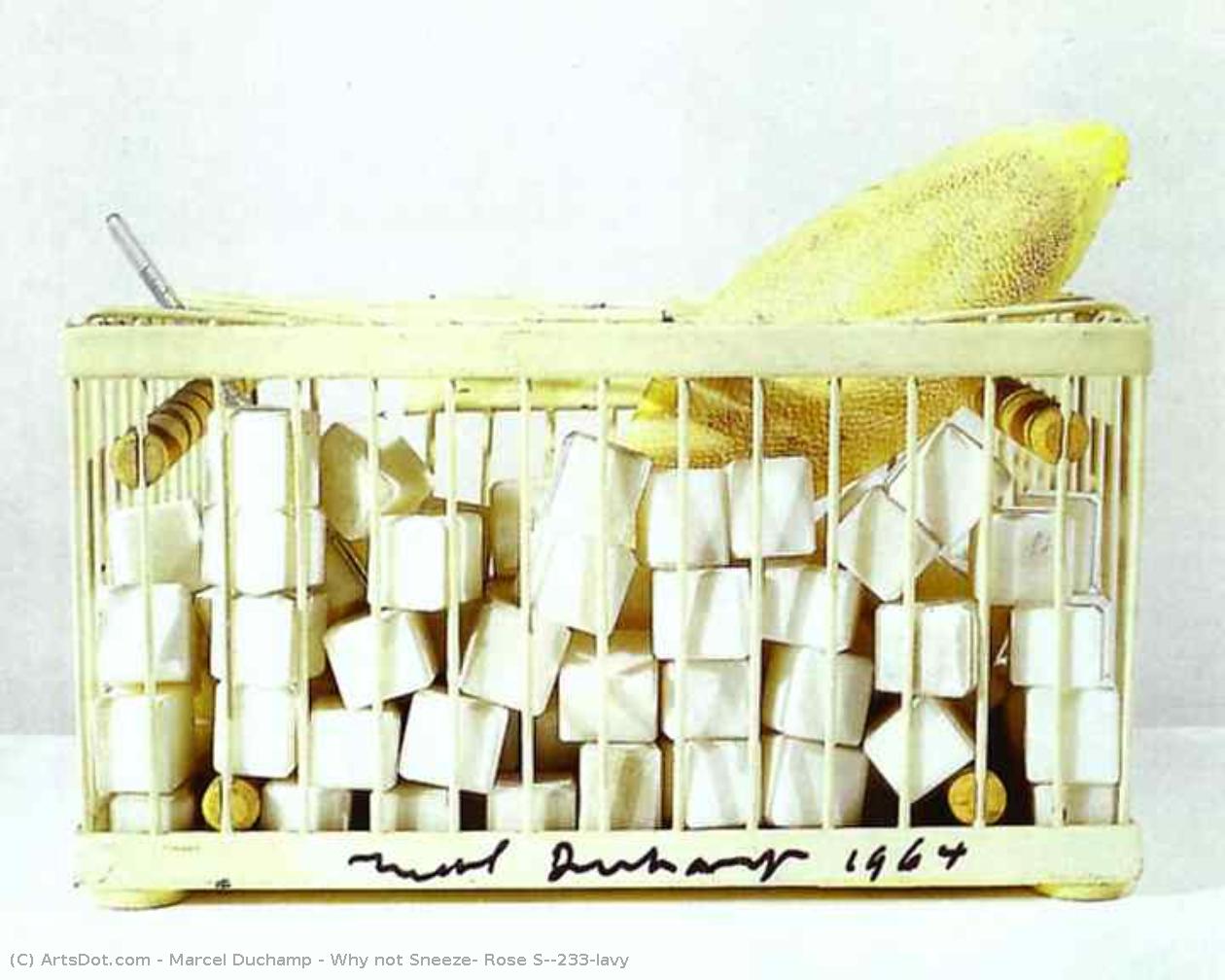
Why not Sneeze, Rose Sélavy
 Acrylic On Canvas
- WallArt
- Dada Gesamtkunstwerk
 1921
1921 12.0 x 22.0 cm
 Tate Modern
 Loe lähemalt
Marcel Duchamp: revolutsiooniline kunstnik, kes küsitles kunsti olemust Dadaismiga ja 'valmiskesed' nagu 'Fountain'. Avasta tema ikoonilisi teoseid ja filosoofilisest mõjust!
Sellel lehel kuvatav kunstiteos on kaitstud autoriõigusega, mis tähendab, et meil ei ole seaduslikku õigust luua või müüa identset reproduktsiooni. Seda kaitset rakendatakse rahvusvaheliste kokkulepete alusel, nagu näiteks Berne konventsioon ning riiklike seadustega, sealhulgas nendega, mida on sätestatud USA autoriõiguse seadus – 17. peatükk.
See meetod järgib täielikult autoriõiguse reegleid, kuna see ei põhine kaitstud kunstiteose kopeerimisel või dupliteerimisel. Selle asemel on tegu loova reinterpreetatsiooniga – uue maaldisega, mis on algteosest inspireeritud, kuid ei ole sellest identiline.
Giclée / Kunstiprint
Muuseumikvaliteediga giclée- või kangasprint kiire tootmisega ja paindlikud viimistlusvõimalused. ( Telli käsitsi maalitud reproduktsioon Ülemineku digitaalse pildi müügi kanalisse)




P118B €10

P118H €10

P118W €10

P438Z €10

P508JH €12

P508YH €12

P805H €10

P805Z €10

P919BZ €10

P919G €10

P919XJ €10

P959ZH €10

P968JZ €12

W106C €8

W218G €10

W218JH €8

W218Y €10

W307PJ €10

W316G €10

W316PJ €8

W316Y €10

W398PJ €8

W4111J €10

W500HY €15

W500JH €15

W692G €12

W849H €8

W940BG €15

W953PJ €8




Standardne suurus
kohandatud
CM
INCH
Vali meie eelmääratud suurused, mis vastavad teose algupärastele proportsioonidele.
Loading sizes...

laius
kõrgus
Sisestage vajalik laius ja kõrgus, et see sobiks teie raamile või seinale. Trükki saab ainult lõigata, seda ei saa kunagi pildist suuremaks teha, seega ka differentse vormiga suurus kaotab osa pildist. Enne trükkimist saadame teile kinnitamiseks digitaalse näidisprojektsiooni. Sellel lehel näidatud pilt ei kujuta reaalset lõiget — seda näitab ainult näidisprojekttsioon.
Ülemaailmne tarne () 2 nädala jooksul, tavalise 4/5 nädala asemel. (22 oktoober)

Tasuta ekspresssaatmine üle maailma

Kõrgekvaliteediline lina-kangastest muld

Täielik transpordikindlustus

Tollimaksude tagastamise garantii

Värvitoime täpsuse garantii

100 päeva tagastusõigus (ainult defektide korral)

100% raha tagasi garantii

Hulgusoodustus
 Klaasivalik on saadaval ainult kuni 110 cm suuruses teostes

Why not Sneeze, Rose Sélavy
Giclée / Kunstiprint
Reproduktsiooni mõõtmed
-


Lõppsumma
€ 60
A Provocative Pause: Unpacking “Why Not Sneeze, Rose Sélavy”
Marcel Duchamp’s "Why Not Sneeze, Rose Sélavy," painted in 1921, isn't merely a still life; it’s an audacious declaration. This deceptively simple image – a white box containing a yellow banana alongside several cups and spoons – immediately throws the viewer off balance, demanding they reconsider their assumptions about art itself. Duchamp, a pivotal figure in the Dada movement, wasn’t interested in replicating reality or expressing personal emotion through traditional means. Instead, he sought to dismantle established artistic conventions, forcing us to confront the very definition of what constitutes “art” and its role within society.
The painting's genesis lies within Duchamp’s exploration of chance and readymades – everyday objects presented as art without alteration. "Why Not Sneeze" exemplifies this approach perfectly. The choice of a banana, an utterly mundane item, elevates it to the status of subject matter through its placement within the box, transforming it into something worthy of contemplation. The inclusion of the cups and spoons further complicates the scene, suggesting a potential for consumption or ritual – elements deliberately devoid of inherent meaning, yet imbued with a subtle tension.
Dadaist Disruptions: Style and Technique
“Why Not Sneeze” is firmly rooted in the principles of Dadaism, a movement born from the disillusionment following World War I. Rejecting logic and reason, Dada artists embraced absurdity, chance, and anti-art sentiments. Duchamp’s technique reflects this ethos; he employed a precise, almost clinical approach to rendering the objects, using oil paint on canvas with a smooth, matte finish. There's no attempt at illusionistic depth or vibrant color – instead, the focus is entirely on the arrangement of the elements and their juxtaposition. The stark white box acts as a frame, isolating the objects and intensifying their impact.
Interestingly, Duchamp’s process involved a degree of chance. He reportedly placed the banana in the box after it had been emptied, allowing the positioning to be determined by accident. This element of randomness underscores the movement's core belief that art should not be dictated by conscious intention but rather emerge from unexpected encounters and unforeseen circumstances.
Symbolic Whispers: Interpretation and Context
The symbolism within “Why Not Sneeze” is deliberately ambiguous, inviting multiple interpretations. The banana itself has been suggested to represent fertility, sexuality, or even a subtle critique of consumer culture – a small, yellow object placed in an enclosed space, hinting at both abundance and confinement. The cups and spoons could symbolize hospitality, offering, or perhaps the act of consuming – again, devoid of any specific narrative but laden with potential meanings.
Furthermore, the title itself, “Why Not Sneeze?”, is a direct challenge to conventional artistic expectations. Duchamp’s question implies that there are no rules governing art, no prescribed methods for creating it. It's an invitation to embrace spontaneity and reject rigid constraints. The painting can be viewed as a meditation on the absurdity of artistic norms and a playful provocation against established aesthetic values.
A Timeless Dialogue: Emotional Impact and Legacy
Despite its seemingly simple composition, “Why Not Sneeze, Rose Sélavy” possesses a profound emotional impact. It’s unsettling, humorous, and thought-provoking – qualities that have cemented its place as one of the most significant works in modern art history. Duchamp's work continues to resonate today, prompting us to question our own perceptions of beauty, value, and the very nature of artistic expression. A reproduction of this iconic piece offers a unique opportunity to engage with a pivotal moment in art history and contemplate the enduring legacy of Marcel Duchamp’s revolutionary spirit.
Küsimused ja vastused
Kas teos "Why not Sneeze, Rose Sélavy" on saadaval kunstiprentina?
Teose „Why not Sneeze, Rose Sélavy“, autor Marceli Dupšan trüket saate tellida otse sellelt lehelt Kõlblik kunstutrüki kvaliteetne trükis: kunstiprint puuvillalõikel}}^{\text{canvas}}$ või arhiveeritaval kangaspaberil.
Milline meeleolu ja emotsioon koosnevad teoses "Why not Sneeze, Rose Sélavy"?
Teose „Why not Sneeze, Rose Sélavy“, autor Marceli Dupšan edastatud meeleolu on Playful ning selle emotsionaalne toon on Playful.
Kuhu Marceli Dupšan loomingulise perioodi kuulub teos "Why not Sneeze, Rose Sélavy"?
Teos "Why not Sneeze, Rose Sélavy" kuulub Marceli Dupšan loomingulise karjääri perioodi Dada Phase. See klassifikatsioon seostab teose kunstniku loovliku arenguga.
Kunstniku elulugu
Marcel Duchamp: Kunstirevolutsioon ja Ideede Võlu
Marcel Duchamp, sündinud Henri-Robert-Marcel Duchamp 28. juulil 1887 Blainville’is Normandias, oli rohkem kui kunstnik; ta oli filosoofiline provokaator, kes muutis radikaalselt kaasaegse kunsti suunda. Tema varajane elu, kuigi näiliselt tavapärane – kasvatatud perekonnas, mis hindas kunstilist väljendust ning kus mõlemad vennad jätkasid edukat karjääri artistitena – viitas tulevasele ikoonohjele. Duchamp alustas esmalt ametlikku õpet, omandades traditsioonilised oskused ja katsetades postimpressionistlike stiilidega. Kuid see akadeemiline vundament ei olnud iseendasse suunatud eesmärk, vaid pigem hüpe küsimuste juurde, mis puudutasid kunsti olemust, selle otstarvet ja definitsiooni. Ta ei tahtnud pelgalt kujutada maailma; ta püüdis väljakutsetele vastata, kuidas me seda tajume ning mida kunstist endast arusaadavaks teeb. See rahutu intellektuaalne uudishimu sai tema vilja saamise määravaks jooneks.Kuberismist Dadaismini: Konventsioonide Hüljamine
Duchampi kunstiline tee oli märgitud pideva arenemisega, kindlalt kehtestatud normidest loobumisega. Tema esmane seotus kubismiga, mis on näha teostes nagu *Portree malemängijatest* (1911), näitas huvi fragmentaarse vormi ja mitmekordsete perspektiivide vastu – lahkumine traditsioonilisest kujutusest. Siiski, ta liikus peagi kaugemale puhtalt esteetilistest murest, teades, et pelgalt visuaalsete elementide ümberkorraldamine ei piisaks süvemate küsimuste lahendamiseks. Esimese maailmasõja õudused suurendasid seda rahulolematust, viies Duchampi Dadaismi omaktseltsele. See oli liikumine, mis sündis pettumusest ja loogika, mõistuse ning traditsiooniliste kunstiväärtuste hüljamisest. Just Dadaistliku raamistikus alustas Duchamp tõeliselt konventsionaalsete kunstimõistetega lõhkumist. Ta ei tahtnud luua ilusaid objekte; ta soovis provotseerida mõtlemist, väljakutsetele vastata ning paljastada esteetilise hindamise meeldivat juhuslikkust. Sel perioodil sündis tema kõige radikaalsem innovatsioon: 'readymade'.Readymaded ja Kunsti Alandamine
Tavaste valmistoodete – valitud ja kunstina esitatud igapäevaste objektide – tutvustamine oli Duchampi olulisim panus 20. sajandi kunstile. Need ei olnud lihtsalt leitud objekte; need olid tahtlikud kunstilise alandamise aktid. Võttes tavalise eseme, nagu näiteks tualetipoti (*Vesinurgas*, 1917), kirjutades sellele nimega "R. Mutt" ja saates see kunstitreeningule, Duchamp küsis küsimusi kunstniku oskuse ning autorluse definitsioonist. Kas teose looja oli artistide käsi või pigem artisti *idee*? See küsimus sai keskseks tema praktikale ning pani aluse Kontseptuaalsele Kunstile. Teised tuntud readymaded, nagu *L.H.O.O.Q.* (1919), Mona Lisa postkaartreproduktsiooni, millele on lisatud vitsaga ja habe, olid mängulised, kuid teravad kriitika kunstiajaloo ning kehtestatud kultuuriikoonide vastu. Need teosed ei pidanud olema esteetiliste kvaliteetide poolest imetletavad; nad pidi provotseerima arutelu ning sundima vaatajaid ümber hindama, mis kunsti moodustab. Duchamp uskus, et kunst peaks elama meeles, mitte ainult silmas.Pärand ja Püsiv Mõjutus
Marcel Duchampi mõju järgnevatele kunstnike põlvkondadele on mõõdetav. Ta muutis radikaalselt meie arusaamist kunstist ning rajas tee selliste liikumiste jaoks nagu Kontseptuaalne Kunst, Minimalismi, Pop Art ja arvukad teised. Tema rõhk artisti ideel – teose taga oleval kontseptsioonil – tema esteetiliste kvaliteetide ees jätkab kunstnike inspireerimist tänapäevani.- Kuberism: Varajane uurimine fragmentaarse vormi ja ruumilise kujutuse üle.
- Dadaism: Loogika, mõistuse ning traditsiooniliste kunstiväärtuste hüljamine Esimese maailmasõja reaktsioonina.
- Kontseptuaalne Kunst: Põhirõhk teose taga oleval ideel pigem kui selle esteetilistel kvaliteetidel.

Marceli Dupšan
1887 - 1968 , Prantsusmaa
Lühikest infot
- Artistic Movement Or Style:
- Kubism
- Dadaism
- Kontseptsionaalne kunst
- Artists Or Movements Influenced By This Artist:
- Kontseptsionaalne kunst
- Pop Art
- Minimalism
- Date Of Birth: 28. juuli 1887
- Date Of Death: 2. oktoober 1968
- Full Name: Marcel Duchamp
- Nationality: Prantsuse-Ameerika
- Notable Artworks:
- Fountain
- L.H.O.O.Q.
- The Large Glass
- Place Of Birth: Blainville, Prantsusmaa
Sarnased artiklid

Dadaism Unveiled: The Beautiful Chaos of Art's Most Rebellious Movement
Explore the profound rebellion of Dadaism. Discover how this avant-garde movement emerged from the chaos of WWI to redefine art through absurdity, anti-logic, and a legacy that shaped Surrealism and Pop Art. A deep dive into the beautiful chaos of art history for the true enthusiast.

Pop Surrealism Unveiled: The Sophisticated Intersection of Vibrant Pop Art and Dreamlike Subconscious Landscapes
Explore the captivating world of Pop Surrealism. Discover how vibrant Pop Art meets dreamlike subconscious imagery through the works of masters like Jeff Soto and Ryan Heshka. An expert guide for discerning collectors seeking to understand this profound contemporary art movement.
Avastage teoseid, mis on koondatud teemade, stiilide ja omaduste kaupa.


