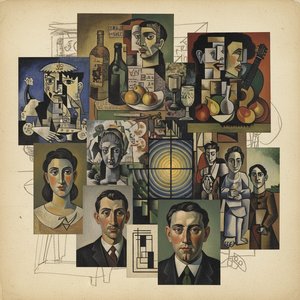
A Surrealist Reverie: Picasso’s Reimagining of Velázquez
Pablo Picasso's 1957 painting, “Las Meninas (Velazquez),” isn’t merely a copy; it’s a profound dialogue with history, a vibrant reimagining of Diego Velázquez’s iconic masterpiece. This work, measuring 129 x 161 cm, transcends the simple act of reproduction, becoming an intensely personal exploration of perception, memory, and the very nature of representation. Picasso, already a titan of modern art, here deliberately disrupts the established order, inviting us into a dreamlike space where reality and illusion intertwine with breathtaking skill.
The Echoes of Velázquez – A Complex Conversation
To understand Picasso’s ambition, one must first appreciate the original. Velázquez's “Las Meninas,” painted around 1656, depicts the Spanish royal family in a grand hall at the Alcázar palace in Madrid. The scene is meticulously observed – the posture of the Infanta Margarita, the attentive gaze of her maids of honor, the subtle gestures of King Philip IV and his queen, Mariana. Picasso doesn’t simply replicate this; he actively engages with it. He borrows the composition, the figures, even the suggestion of a royal portrait being painted, but then subtly – and sometimes dramatically – alters them. The most striking element is the presence of Picasso himself, standing in the background, seemingly observing the scene alongside an artist (likely Picasso’s friend Georges Braque) and a model. This inclusion immediately destabilizes the viewer's perspective, forcing us to question who is truly being painted and by whom.
Cubist Techniques & Shifting Perspectives
Picasso employs his signature Cubist techniques with remarkable precision in this work. The figures are fragmented, broken down into geometric shapes and reassembled from multiple viewpoints simultaneously. This isn’t a haphazard deconstruction; it's a deliberate strategy to convey the simultaneous experience of seeing – a concept central to Picasso’s artistic philosophy. Notice how the faces are rendered with sharp angles and planes, creating an unsettling yet captivating effect. The use of color is equally significant. While retaining some of Velázquez’s muted palette, Picasso introduces vibrant blues and greens, injecting a sense of dynamism and emotional intensity into the scene. The brushwork itself is loose and expressive, contributing to the overall feeling of movement and instability.
Symbolism & The Illusion of Reality
Beyond the purely formal elements, “Las Meninas” is rich in symbolism. The presence of Picasso and Braque within the painting suggests a meditation on the act of artistic creation itself – the process of representation and the role of the artist. The mirror at the back reflects not just the figures in the room but also a blurred image of Velázquez himself, further blurring the lines between reality and illusion. The bowl of fruit, the bottle, and the other objects are rendered with meticulous detail, echoing Velázquez’s masterful observation, yet they exist within a context that feels distinctly Picassoesque – dreamlike and unsettling. The painting ultimately invites us to consider how our own perceptions shape our understanding of the world around us, challenging us to question what is ‘real’ and what is merely a constructed image.
TopImpressionists offers exquisite hand-painted reproductions of “Las Meninas (Velazquez),” allowing you to bring this iconic work into your home or office. Each reproduction captures the painting's complex layers of meaning and technical brilliance, providing a stunning tribute to Picasso’s genius and Velázquez’s legacy.



 Eelvaade
 Osta käsitsi maalitud maal
 Saada
Saada Jaga
Jaga
 Teave teose kohta

 Laadi alla
 Sarnased teosed
 Röntgenuuring
 Slaidietendus


 Loe lähemalt






































 Klaasivalik on saadaval ainult suuruses kuni 110 cm