

Shown: · With its frame:
 Esikatselu
 Jaa teos
 Jaa
Jaa
 Tiedot
 Opas
Opas

 Lataa kuva
 Samanlaisia kohteita
 Röntgenkuvaus
 Diaesitys
 Q&A
Q&A Tilastot
 Oil On Canvas
- WallArt
- Spanish Baroque
 67.0 x 81.0 cm
 Cádizin museo
€ 239
Käsinmaalattu öljyvärinen jäljennös
Käsinmaalattu öljyväri kankaalle haluamassasi koossa ja kehyksissä, taiteilijoidemme valmistamana tilauksesta. ( Vaihda tulosteeseen Siirry digitaaliseen kuvaan)
Size
·Vakiokoko
räätälöity
CM
INCH
Valitse valmiista mitoistamme sellaiset, jotka vastaavat teoksen alkuperäisiä mittasuhteita.
Loading sizes...

leveys
korkeus
Kirjoita tarvitsemasi leveys ja korkeus, jotta teos sopii kehyksiisi tai seinällesi. Koska kyseessä on käsinmaalattu teos, taiteilija voi maalata hieman enemmän kuvan ympärille tai rajata sitä hieman, jos haluat eri muotoisen koon — valinta on sinun. Lähetämme sinulle digitaalisen mallikuvan hyväksyttäväksi ennen kuin maalaus alkaa. Tällä sivulla näkyvä kuva ei vastaa lopullista tulosta — vain mallikuva näyttää sen.
 Lue lisää
Finish
·
White €1

Blurside €1

Extended €1

P118B €10

P118H €10

P118W €10

P438Z €10

P508JH €12

P508YH €12

P805H €10

P805Z €10

P919BZ €10

P919G €10

P919XJ €10

P959ZH €10

P968JZ €12

W106C €8

W218G €10

W218JH €8

W218Y €10

W307PJ €10

W316G €10

W316PJ €8

W316Y €10

W398PJ €8

W4111J €10

W500HY €15

W500JH €15

W692G €12

W849H €8

W940BG €15

W953PJ €8

H24-GOLD €30

H24-SILVER €30

H36-GOLD €45

H36-SILVER €45
Shipped in a protective tube, ready for your own framer.
Above 105 cm the frame is shipped as a kit for a professional framer — read the details.
Extras
optionalWhat do the extras include?
Examples of what can be changed: Replace face with customer photo; Add pet (e.g., replace cat with dog); Include hidden message in background; Change background landscape or elements.
After order, TopImpressionists.com team will email client for instructions and provide a mockup preview
After order, TopImpressionists.com team will email client for instructions and provide a mockup preview
Maailmanlaajuinen toimitus () 3–4 viikossa tavallisen 5 viikon sijaan. (31 lokakuu). Laadusta ei tingitä.
Suojalakkaus
Nimilaatta
Kaiverretun pronssilaatan tiedot
This elegant plaque features the artist's name and the title of the artwork, finely engraved for a timeless presentation.
It is made from bronze with a refined, elegant finish. The text is precisely laser-engraved for a sharp and permanent result. Measuring 9x2 cm, the plaque is compact yet easy to read. It's built to be durable and scratch-resistant, offering a professional, museum-quality look. Mounting is simple thanks to the included adhesive backing.
Läpinäkyvän akryylilaatan tiedot
The plaque includes essential engraved details such as the artist's name, the title of the artwork, the date it was created, the type of media used-like oil on canvas or watercolor-a brief description of the piece, and a QR code that links to the complete artwork information.
It is crafted from clear acrylic, offering a sleek, modern appearance. The text is UV-engraved in black to ensure strong visual contrast. With a size of 10x15 cm, it ensures optimal readability. It comes equipped with two metal hooks for secure wall mounting. The plaque is designed to be weather-resistant, making it suitable for various environments, and it includes interactive features that work seamlessly with smartphone scanning.
Mustan akryylilaatan tiedot
This elegant plaque includes engraved information such as the artist's name, the title of the artwork, the date it was created, the type of media used (like oil on canvas or watercolor), a short description of the artwork, and a QR code for quick access to more information.
The plaque itself is made from refined black acrylic with a premium finish. The text is laser-engraved in white for high contrast and readability. Its size is 10x15 cm, designed to be easy to read. It comes with two metal hooks for professional mounting. The design is sleek and fits any interior style. It is also weather-resistant and durable, with built-in digital integration for mobile compatibility.
Lasivaihtoehto on saatavilla vain alle 110 cm kokoisille teoksille
 Lasivaihtoehto on saatavilla vain alle 110 cm kokoisille teoksille
- Ilmainen pikatoimitus ympäri maailman
- Korkealaatuinen pellavakangas
- Kattava kuljetusvakuutus
- Tulliveron palautustakuu
- Takuu täydellisestä värien vastaavuudesta
- 100 päivän palautusoikeus (vain valmistusvirheet)
- 100% rahat takaisin -takuu
- Määräalennus tarjolla


Keräilykohteen kuvaus
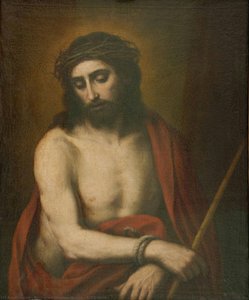
Bartolomé Esteban Murillo’s "ECCE HOMO" presents a dramatic portrait of Jesus Christ in a dark room, showcasing his iconic pose and red robe, typical of the Spanish Baroque period. Discover this captivating artwork and bring its timeless beauty into your space.
Taiteilijan elämäkerta
Bartolomé Esteban Murillo (1618-1682) oli espanjalainen barokkimaalari, tunnettu lempeistä uskonnollisista ja arkielämän maalauksista. Hänen tyylinsä yhdistää kauneuden ja tunteellisuuden.
About the painting
ECCE HOMO: A Portrait of Timeless Humanity by Bartolomé Esteban Murillo
- Subject: This arresting depiction of Jesus Christ, rendered in the iconic “ECCE HOMO” pose – Latin for "Here is the man" – immediately draws the viewer into a profound and deeply personal encounter. The subject, presented with an almost unnerving directness, embodies humility, sacrifice, and ultimately, divine grace.
- Artist: Bartolomé Esteban Murillo (1618-1682), born in Seville, Spain, was a pivotal figure of the Spanish Baroque period. His work reflects the religious fervor and social complexities of his time, yet possesses an enduring humanity that transcends historical context.
- Size & Date: Measuring 67 x 81 cm, this painting dates from an unknown period within Murillo’s prolific career, likely produced during his peak artistic output. The intimate scale invites a close and contemplative viewing experience.
A Study in Baroque Drama and Symbolism
Murillo masterfully employs the conventions of Baroque art to create a scene brimming with dramatic intensity. The dark, almost claustrophobic setting – punctuated by the stark white of Jesus’s robe – heightens the sense of isolation and vulnerability. The inclusion of a cross and a book immediately anchors the image within a Christian narrative, referencing both Christ's sacrifice and his role as the Word of God. The staff, a symbol of authority and power, subtly underscores the immense weight of Jesus’s mission. Murillo’s use of tenebrism – dramatic contrasts between light and dark – further amplifies this emotional impact, directing the viewer’s gaze directly to the central figure.
Technique and Materiality
- Medium: Executed in oil on canvas, the painting showcases Murillo's meticulous attention to detail and his skillful manipulation of color. The rich red of Jesus’s robe is particularly striking, potentially symbolizing blood, martyrdom, or divine royalty.
- Brushwork: Murillo’s brushstrokes are characterized by a smooth, polished surface achieved through layering and glazing – a technique that lends the painting an almost luminous quality. This careful application of paint contributes to the overall sense of realism and emotional depth.
- Composition: The composition is carefully balanced, with Jesus positioned centrally within the frame, his gaze unwavering and compelling. The background elements are deliberately understated, serving only to enhance the impact of the central figure.
Historical Context and Emotional Resonance
Created during a period of significant religious upheaval in Spain – marked by the Counter-Reformation – Murillo’s “ECCE HOMO” reflects the Church's renewed emphasis on piety, devotion, and the direct relationship between individuals and God. The painting’s emotional power lies in its ability to evoke a sense of empathy and reverence for the subject. It is not merely a portrait; it is an invitation to contemplate themes of sacrifice, redemption, and the enduring human condition. This piece resonates with viewers across centuries, offering a timeless meditation on faith, humanity, and the profound mystery at the heart of Christian belief.
Kysymykset ja vastaukset
Mihin kohtaan Bartolomé Esteban Murillo uraa teos "ECCE HOMO" sijoittuu?
"ECCE HOMO" kuuluu Bartolomé Esteban Murillo uran Mature Period-vaiheeseen. Tämä luokittelu yhdistää teoksen taiteilijan kehitysvaiheeseen.
Miten teoksen Bartolomé Esteban Murillo:n "ECCE HOMO" väripaletti on kuvattu?
Teoksen "ECCE HOMO" värit muodostavat Earthy-väripaletin. Tämä luokitus kuvaa hallitsevia väriperheitä.
Voinko tutkia teosta "ECCE HOMO" yksityiskohtaisemmin?
Teosta "ECCE HOMO" voi tutkia kerros kerrokselta sen Röntgentutkimus -sivulla, joka on konservointityön valupöytää mukaillen luotu interaktiivinen katselija ja sisältää yksitoista kuvan optista kerrosta.
Quick facts and art quiz
About Bartolomé Esteban Murillo

Bartolomé Esteban Murillo
1618 - 1682, Espanja
Taiteilijan elämäkerta
A Life Bathed in Andalusian Light
Bartolomé Esteban Murillo, a name synonymous with the golden age of Spanish Baroque painting, emerged from the vibrant heart of Seville in 1618. His life, though marked by personal tragedy and societal shifts, blossomed into an artistic career that captured the spirit of his time—a period of religious fervor, social change, and burgeoning artistic innovation. Born to Gaspar Esteban, a barber-surgeon, and María Pérez Murillo, within a large family of fourteen children, young Bartolomé experienced early loss with the passing of both parents in quick succession during his childhood. This hardship led him into the guardianship of his sister’s husband, Juan Agustín Lagares, a pivotal figure who would indirectly guide his artistic path. Murillo's initial training began under Juan del Castillo, a local artist and relative through his mother, laying the foundation for a style that would eventually become uniquely his own. The early years were steeped in the realist traditions prevalent in Seville, absorbing influences from masters like Zurbarán, Ribera, and Cano—artists who prioritized stark realism and dramatic intensity. However, Murillo’s genius lay not in mere imitation but in transforming these foundations into something softer, more luminous, and profoundly human.From Realism to Radiant Grace
Murillo's artistic journey wasn’t a sudden leap to fame but rather an evolution marked by distinct phases. His early works, heavily influenced by the austere realism of his contemporaries, showcased a meticulous attention to detail and a somber palette. Young Man with a Basket of Fruit (Personification of Summer), created around 1640-50, exemplifies this period—a grounded depiction of everyday life rendered with remarkable precision. The figures are depicted in natural light, capturing the essence of the season. Yet, even in these early pieces, hints of the tenderness and emotional depth that would define his mature style began to emerge. The Young Beggar, painted circa 1645, demonstrates a growing sensitivity towards human suffering, echoing the influence of Velázquez’s masterful portrayals of everyday people. The painting captures the vulnerability and quiet dignity of a young child in poverty, a theme that would recur throughout Murillo's career. As Murillo matured, his style underwent a remarkable transformation. He moved away from the stark realism of his predecessors, embracing a more polished and refined aesthetic that resonated with the tastes of Seville’s burgeoning bourgeois and aristocratic classes. This shift was particularly evident in his religious works, where he infused traditional iconography with an unprecedented sense of warmth, grace, and emotional accessibility. St. Jerome, painted between 1650-52, stands as a testament to this mature style—a softly luminous depiction that radiates serenity and devotion. The figure is bathed in golden light, conveying a profound sense of contemplation and spiritual peace.A Master of Religious Sentiment and Genre Scenes
Murillo’s artistic output was remarkably diverse, encompassing religious paintings, genre scenes, portraits, and mythological subjects. However, he is most celebrated for his depictions of the Immaculate Conception—a subject that captivated him throughout his career and resulted in numerous variations, each imbued with a unique sense of ethereal beauty. These works, characterized by their delicate brushwork, luminous colors, and graceful compositions, became immensely popular and established Murillo as the preeminent painter of religious imagery in Spain. He skillfully blended traditional iconography with a deeply human touch, creating images that were both reverent and emotionally engaging. Beyond his sacred subjects, Murillo also excelled at capturing the everyday lives of ordinary people. His genre scenes—depictions of flower girls, street urchins, and beggars—offer a poignant glimpse into the social realities of 17th-century Seville. These paintings are not merely observational studies; they are imbued with a deep sense of empathy and compassion, elevating the humble subjects to a level of dignity and grace. He possessed an extraordinary ability to capture the innocence of childhood, portraying young children with remarkable realism and tenderness. The figures in these scenes often interact with each other, creating a sense of community and shared humanity.Influences and Development
Murillo’s artistic development was shaped by a complex interplay of influences. Initially, he absorbed the stark realism and tenebrist techniques of masters like Zurbarán and Ribera, artists who dominated the Seville art scene in the preceding decades. However, Murillo quickly distinguished himself through his softer palette, luminous colors, and emphasis on human emotion—qualities that set him apart from his predecessors. A pivotal moment in his artistic evolution occurred during a visit to Madrid in 1658, where he encountered the works of Titian, Rubens, and Van Dyck. These encounters profoundly influenced his style, leading him to adopt a more dynamic composition, richer colors, and a greater sense of elegance. He also drew inspiration from the religious art of the Venetian Renaissance, particularly its emphasis on beauty, grace, and emotional intensity. Murillo’s style evolved over time, reflecting both his artistic influences and his own personal vision. His early works are characterized by their meticulous detail and somber palette, while his later paintings are marked by a greater sense of light, color, and emotional warmth.Legacy and Enduring Influence
Bartolomé Esteban Murillo’s impact on the course of Spanish art—and indeed, European painting—is undeniable. He established a distinctive style that blended religious devotion with humanistic sentiment, creating works that resonated deeply with audiences across social strata. His influence extended far beyond his native Spain, inspiring generations of artists throughout Europe. Gainsborough and Greuze, among others, acknowledged their debt to Murillo’s luminous style and sensitive portrayals of human emotion. He trained numerous pupils in his Seville workshop, ensuring the continuation of his artistic legacy. His paintings can be found in prestigious museums worldwide, including the Museo del Prado in Madrid, the Hermitage Museum in Saint Petersburg, the Wallace Collection in London, and the Timken Museum of Art in San Diego—testaments to his enduring appeal and historical significance. Murillo’s art continues to captivate viewers with its beauty, grace, and profound humanity, solidifying his place as one of the most beloved and influential painters of the Spanish Baroque period. His ability to infuse religious imagery with emotional depth and portray everyday life with empathy ensures that his work remains relevant and inspiring centuries after his death in 1682.Quick facts about Bartolomé Esteban Murillo
- Artistic Movement Or Style: Barokki
- Artists Or Movements Influenced By This Artist:
- Gainsborough
- Greuze
- Artists Who Influenced This Artist:
- Zurbarán
- Ribera
- Date Of Birth: 1. tammikuuta 1618
- Date Of Death: 3. huhtikuuta 1682
- Full Name: Bartolomé Esteban Murillo
- Nationality: Espanjalainen
- Notable Artworks:
- Immakula
- Nuori tyttö
- Jeremia
- Place Of Birth: Sevilla, Espanja
Bartolomé Esteban Murillo
ECCE HOMO
() ·
With its frame: · Hand-painted in oil on linen
Total