The Silent Architect of Venetian Grandeur
In the vibrant, sun-drenched world of the Italian Renaissance, certain names shine with an almost blinding brilliance, while others linger in the soft, essential shadows that give those lights their depth. Benedetto Caliari was a master of such shadows. Born in Verona in 1538 into a family where art was as much a vocation as breathing, Benedetto’s life was inextricably woven into the fabric of Venetian Mannerism. While his brother, the legendary Paolo Veronese, commanded the grandest stages of the Republic, Benedetto operated with a quiet, meticulous precision that made him an indispensable pillar of one of history's most prolific artistic workshops.
His early years were shaped by a unique duality of influence. From his father, Gabriele, a skilled stonecutter, Benedetto inherited a profound respect for structure, volume, and the tactile reality of form. This foundation in disegno—the art of design and drawing—would later become his greatest contribution to the Venetian school. Moving to Venice around 1555, he entered the orbit of his brother’s studio, not merely as a sibling, but as a specialized collaborator capable of translating architectural grandeur onto canvas and fresco. He possessed a rare ability to breathe life into the cold stone of painted architecture, creating illusionistic spaces that felt as vast and imposing as the Roman ruins themselves.
A Symbiotic Legacy of Light and Stone
The collaboration between Benedetto and Veronese remains one of the most fascinating studies in artistic synergy. To look upon a great Veronese masterpiece is often to encounter the silent hand of Benedetto. He was the architect of the background, the creator of the soaring columns, the intricate cornices, and the deep, perspectival vistas that provided the stage for Veronese’s fluid, luminous figures. In monumental projects such as the ceiling frescoes of San Sebastiano and the breathtaking Villa Barbaro at Maser, Benedetto’s touch is felt in the way light interacts with painted marble and the way shadows retreat into seemingly infinite corridors.
While his brother focused on the rhythmic movement of drapery and the ethereal glow of skin, Benedetto provided the structural soul of the composition. His style was characterized by a certain sturdiness; where Veronese might be fluid and spontaneous, Benedetto was deliberate and sculptural. He favored heavier, more planar forms that anchored the compositions, preventing the grand Venetian scenes from drifting into mere decorative whimsy. This tension between his solid, architectural foundations and his brother's atmospheric brilliance created a visual harmony that defined the era’s aesthetic of splendor.
The Heirs of Paul and the Persistence of Vision
The true test of Benedetto’s artistry arrived with the death of Veronese in 1588. Rather than allowing the workshop's flame to flicker out, Benedetto stepped into a leadership role alongside Veronese’s sons, Carlo and Gabriele. Together, they operated under the collective signature Haeredes Pauli—the Heirs of Paul. This period was one of immense responsibility, as they worked to complete the master's unfinished commissions, ensuring that the grand visions of the previous generation reached fruition. Through this stewardship, Benedetto helped preserve the continuity of the Venetian style during a period of shifting artistic tides.
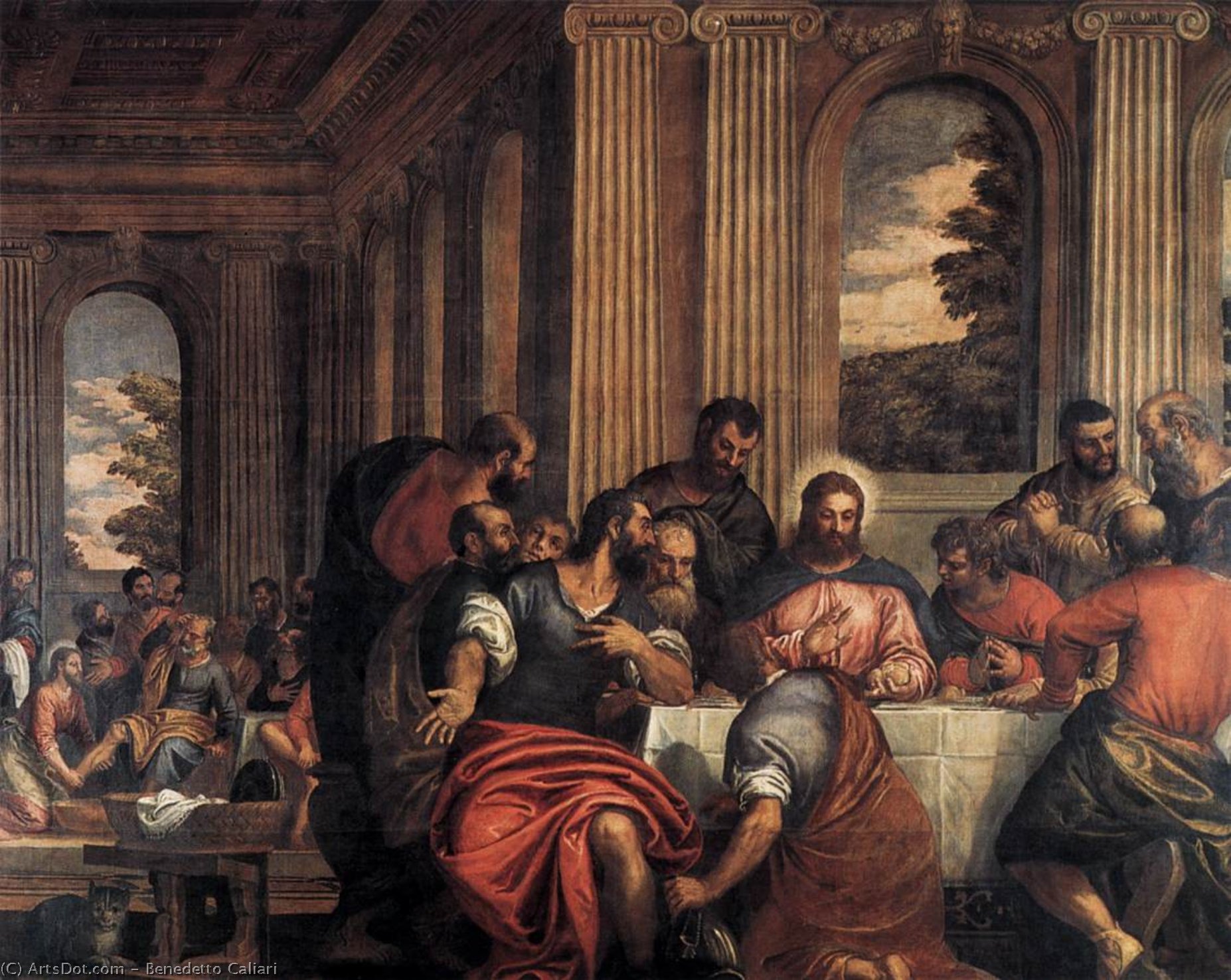
Though his independent body of work is more modest in scale than that of his brother, Benedetto’s individual achievements reveal a painter of profound religious devotion and technical mastery. His treatments of subjects such as the Holy Family or the Last Supper showcase a sophisticated command of pyramidal composition and dramatic chiaroscuro. Even in his most personal works, the influence of his architectural training remains evident in the way he models musculature and drapery with a sense of weight and permanence. Benedetto Caliari may have lived in the shadow of a giant, but it was his steady, masterful hand that helped build the very stage upon which that giant performed, leaving behind a legacy of structural beauty that continues to anchor the history of Italian art.


 Preview
 Tilaa painos
 Jaa
Jaa Jaa
Jaa
 Tarkemmat tiedot

 Lataa
Lataa
 Samanlaisia
 Röntgenkuva
 Diaesitys
 Näytä lisää



