


 Katso seinällä
 Lähetä
 Jaa
Jaa
 Tarkemmat tiedot
 Opas
Opas

 Lataa kuva
 Samanlaisia kohteita
 Röntgenkuvaus
 Diaesitys
 Tilastot
Eibseen Näkymä
 Akryyli kankaalle
- Seinätaide
- Romantic Landscape Painting
 1825
1825 76.0 x 100.0 cm
 Neue Pinakothek
Carl Rottmannin Eibseen Näkymä on vaikuttava vuoristomaalaus Münchenissä. Tämä romanttinen näkymä vangitsee Baijerin luonnon kauneuden ja hiljaisuuden vuoden 1825 pohjoisessa valossa.
 Lue lisää
Explore the evocative landscapes of Carl Rottmann – German Romanticism master! Discover his mythical scenes & Bavarian vistas. A key figure in 19th-century art.
Käsinmaalattu öljyvärinen jäljennös
Käsinmaalattu öljyväri kankaalle haluamassasi koossa ja kehyksissä, taiteilijoidemme valmistamana tilauksesta. ( Vaihda tulosteeseen Siirry digitaaliseen kuvaan)




P118B €10

P118H €10

P118W €10

P438Z €10

P508JH €12

P508YH €12

P805H €10

P805Z €10

P919BZ €10

P919G €10

P919XJ €10

P959ZH €10

P968JZ €12

W106C €8

W218G €10

W218JH €8

W218Y €10

W307PJ €10

W316G €10

W316PJ €8

W316Y €10

W398PJ €8

W4111J €10

W500HY €15

W500JH €15

W692G €12

W849H €8

W940BG €15

W953PJ €8




Vakiokoko
mittatilaustyö
CM
INCH
Valitse valmiista mitoistamme sellaiset, jotka vastaavat teoksen alkuperäisiä mittasuhteita.
Loading sizes...

leveys
korkeus
Voit syöttää omat mitat sopimaan tiettyyn kehykseen tai tilaan. Jos valitsemasi koko ei vastaa alkuperäisen kuvan mittasuhteita, rajaamme taideteoksen tai jatkamme maalausta käsin maalatuilla elementeillä. Digitaalinen esikatselu lähetetään hyväksyttäväksi ennen tuotannon aloittamista.
Huomioithan, että näytöllä oleva esikatselu ei vastaa todellista rajausta tai jatkamista. Vain digitaalinen mallikuva näyttää lopullisen sommittelun tarkasti.
Vaikka mittatilaustyöt ovat mahdollisia, suosittelemme valitsemaan mitan ennalta määritetystä listasta alkuperäisten mittasuhteiden säilyttämiseksi.
Esimerkkejä muokattavista asioista: Vaihda kasvot asiakkaan omaan valokuvaan; Lisää lemmikki (esim. korvaa kissa koiralla); Lisää taustalle piilotettu viesti; Muuta taustan maisemaa tai elementtejä.
Tilauksen jälkeen TopImpressionists.com -tiimi lähettää asiakkaalle sähköpostitse ohjeet ja esikatselukuvan.
Tilauksen jälkeen TopImpressionists.com -tiimi lähettää asiakkaalle sähköpostitse ohjeet ja esikatselukuvan.
Maailmanlaajuinen toimitus () 3–4 viikossa tavallisen 5 viikon sijaan. (10 lokakuu). Laadusta ei tingitä.

Ilmainen pikatoimitus ympäri maailman

Korkealaatuinen pellavakangas

Kattava kuljetusvakuutus

Tulliveron palautustakuu

Takuu täydellisestä värien vastaavuudesta

100 päivän palautusoikeus valmistusvirhetapauksissa

100% rahat takaisin -takuu

Määräalennus saatavilla
 Lasivaihtoehto on saatavilla vain alle 110 cm kokoisille teoksille

Eibseen Näkymä
Reproduktiotapa
Replikaatin koko
-


Kokonaishinta
€ 232
A Sublime Vision of Bavarian Tranquility: Exploring Rottmann’s “View of the Eibsee”
Carl Anton Joseph Rottmann's "View of the Eibsee," painted in 1825, stands as a cornerstone of German Romantic landscape painting. More than just a depiction of a picturesque Alpine lake, it embodies the spirit of its era—a yearning for untamed beauty and an embrace of the sublime—captured with masterful precision and imbued with profound emotional resonance.
Born in Handschuhsheim, Bavaria, Rottmann (1797-1850) emerged from the artistic milieu fostered by Joseph Anton Koch’s influence at the Neue Pinakothek. This formative encounter instilled in him a dedication to observing and translating nature's grandeur onto canvas, establishing him as one of the foremost landscape artists of his time.
Technical Brilliance: Rottmann’s Pioneering Approach
Rottmann distinguished himself from many of his contemporaries through an innovative technique—a deliberate rejection of academic conventions in favor of a more expressive style. He eschewed meticulous detail, prioritizing instead the conveyance of atmosphere and emotion. The painting utilizes broad horizontal brushstrokes to dominate the composition, effectively mirroring the expansive panorama of the Eibsee mountains. This technique wasn’t merely stylistic; it reflected a philosophical shift toward perceiving nature as an overwhelming force capable of inspiring awe.
The artist skillfully employs chiaroscuro—the dramatic interplay between light and shadow—to heighten the visual impact. Rottmann meticulously studied Koch's paintings, recognizing the importance of capturing the ephemeral qualities of light on mountain surfaces. This careful observation is evident in the subtle gradations of color that illuminate the peaks and valleys, creating a sense of depth and realism without resorting to photographic accuracy.
Symbolism Within Landscape: Reflecting Romantic Ideals
"View of the Eibsee" transcends mere topographical representation; it speaks to core tenets of Romantic thought. The solitary figure on the outcrop—a small human element dwarfed by the immensity of the mountains—symbolizes humanity’s insignificance in comparison to the sublime power of nature. This motif underscores the Romantic preoccupation with confronting mortality and experiencing transcendent beauty.
Furthermore, the stillness of the lake itself serves as a counterpoint to the rugged peaks, representing serenity and contemplation amidst chaos. Rottmann's deliberate omission of human habitation reinforces this symbolic message—nature alone possesses the capacity for profound spiritual insight. The painting invites viewers to contemplate their place within the universe and to appreciate the majesty of the natural world.
A Legacy Enduring Through Reproduction
Today, a high-quality reproduction of Rottmann’s “View of the Eibsee” offers an unparalleled opportunity to experience the artist's vision firsthand. TopImpressionists.com presents meticulously crafted reproductions that faithfully capture the painting’s luminosity and textural richness—allowing collectors and interior designers alike to bring this iconic landscape into their homes, fostering a connection with the artistic spirit of Romantic Bavaria.
Kysymykset ja vastaukset
Onko Carl Anton Joseph Rottmann:n "Eibseen Näkymä" vaalea vai tumma teos?
Teoksen Carl Anton Joseph Rottmann:n "Eibseen Näkymä" kirkkaus on syvä varjo ja luminanssi Pehmeä varjo.
Mihin käyttöön "Eibseen Näkymä"-teoksen painos on suositeltava?
Carl Anton Joseph Rottmann:n "Eibseen Näkymä"-teoksen suositeltu käyttötarkoitus on Korostusväri. Se soveltuu kuitenkin myös muihin tarkoituksiin.
Missä koossa "Eibseen Näkymä" suositellaan tulostettavaksi?
Teokselle "Eibseen Näkymä" suositeltu tulostuskoko on Suuri. Muita kokoja on saatavilla samoissa mittasuhteissa.
Miten kontrasti ja harmonia yhdistyvät teoksessa "Eibseen Näkymä"?
Teoksen Carl Anton Joseph Rottmann:n "Eibseen Näkymä" värianalyysi osoittaa Väripaletin kontrasti kontrastin ja Ristiriitainen väripaletti harmonian.
Minä vuonna teos Carl Anton Joseph Rottmann:n "Eibseen Näkymä" on luotu?
Teos Carl Anton Joseph Rottmann:n "Eibseen Näkymä" on valmistunut vuonna 1825.
Kuka on luonut "Eibseen Näkymä"?
Teoksen "Eibseen Näkymä" taiteilija on Carl Anton Joseph Rottmann. Teos on luetteloitu Carl Anton Joseph Rottmann nimellä.
Kuinka vanha Carl Anton Joseph Rottmann oli tehdessään "Eibseen Näkymä"?
Kun "Eibseen Näkymä" luotiin vuonna 1825, Carl Anton Joseph Rottmann (syntynyt 1797) oli 28 vuotias.
Taiteilijan elämäkerta
The Visionary Landscapes of Carl Rottmann
Born in the tranquil setting of Handschuhsheim, Germany, in 1797, Carl Anton Joseph Rottmann emerged as a profound voice within the movement of German Romanticism. His life and artistry were deeply intertwined with the shifting landscapes of 19th-century Europe, reflecting a period where the sublime beauty of nature met the burgeoning spirit of national identity. Unlike many of his contemporaries who focused on the intimate or the domestic, Rottmann possessed an expansive vision, seeking to capture the monumental scale of the world through sweeping vistas and mythic atmospheres. His journey was one of constant movement, traveling through the rugged terrains of Greece, Italy, and the Bavarian Alps, each location leaving an indelible mark on his palette and his perception of the divine within the natural world.
The development of Rottmann’s style was a masterful evolution from classical precision to a more emotive, atmospheric approach. Influenced by the grand traditions of landscape painting, he moved beyond mere topographical accuracy to embrace the sublime—that specific Romantic quality of awe and terror inspired by the vastness of nature. His technique involved a sophisticated understanding of light and shadow, using them not just to define form, and shape, but to evoke a sense of historical weight and mythic presence. In his hands, a mountain range was never just stone and ice; it was a silent witness to antiquity, a stage for the legends of old. This ability to infuse physical geography with spiritual and historical narrative became the hallmark of his mature period.
A Legacy of Light and Myth
Rottmann’s achievements are most notably seen in his ability to bridge the gap between the tangible world and the realm of imagination. His works often serve as windows into a lost era, where the ruins of ancient civilizations seem to breathe under the soft glow of a Mediterranean sun or the misty shroud of a northern forest. Through his meticulous attention to the interplay of light upon textures—the roughness of weathered stone, the translucency of water, and the softness of clouds—he achieved a level of luminosity that captivated the art world of his time.
The historical significance of his oeuvre lies in its role as a cornerstone of Romantic landscape art. His contributions can be summarized through several key artistic pillars:
- The Synthesis of History and Nature: He pioneered a method of painting where the landscape itself acts as a vessel for historical memory, blending archaeological interest with poetic expression.
- Mastery of Atmospheric Perspective: His use of color temperature and clarity to create depth allowed viewers to feel immersed in the vastness of his depicted scenes.
- Cultural Documentation: Through his travels, he provided a visual record of the European landscapes that were central to the Romantic identity, particularly the Greek and Bavarian vistas.
Ultimately, the work of Carl Rottmann remains a testament to the power of the gaze to transform the ordinary into the extraordinary. He did not merely paint what he saw; he painted what he felt in the presence of greatness. His legacy continues to resonate with those who find beauty in the monumental and meaning in the silent, enduring features of our earth, ensuring his place as a vital figure in the tapestry of 19th-century European art.

Carl Anton Joseph Rottmann
1797 - 1850 , Germany
Tietoa taiteilijasta
- Full Name: Joseph Wright of Derby
- Nationality: English
- Date Of Birth: 1797
- Date Of Death: 1850
- Place Of Birth: Handschuhsheim, Germany
- Notable Artworks:
- An Experiment on a Bird in the Air Pump
- The Slaughtered Horse
- A Man Defending His Cart
- Artistic Movement Or Style: Romanticism, Neoclassicism
- Artists Who Influenced This Artist:
- Janys Zedres
- Rembrandt
- Artists Or Movements Influenced By This Artist:
- Joshua Reynolds
- Romanticism
Aiheeseen liittyvät artikkelit

Capturing the Soul of Nature: A Journey Through the Sublime Majesty of American Romanticism
Explore the breathtaking beauty of American Romanticism. Discover how Hudson River School masters captured the sublime spirit of the wilderness through luminous oil landscapes and emotional depth. A journey into the soul of nature for the true art enthusiast.
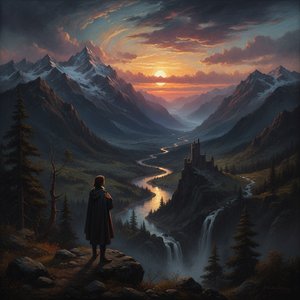
Capturing the Soul: The Emotional Majesty and Sublime Power of Romantic Landscape Painting
Explore the profound emotional depth of Romantic landscape painting. Discover how masters like Turner and Friedrich captured the sublime power of nature through intuition and imagination in this expert art history retrospective.

Capturing the Soul: The Emotional Magic and Sublime Grandeur of Romantic Landscape Painting
Explore the profound emotional depth of Romantic landscape painting. Discover how masters like Friedrich and Turner captured the sublime through light, shadow, and nature's power in this expert art history retrospective for discerning collectors.
Tutustu teoksiin, jotka on järjestetty aiheiden, tyylien ja ominaisuuksien mukaan.


