

Shown: · With its frame:
 Esikatselu
 Jaa teos
 Jaa
Jaa
 Tiedot
 Opas
Opas

 Lataa kuva
 Samanlaisia kohteita
 Röntgenkuvaus
 Diaesitys
 Q&A
Q&A Tilastot

€ 239
Käsinmaalattu öljyvärinen jäljennös
Käsinmaalattu öljyväri kankaalle haluamassasi koossa ja kehyksissä, taiteilijoidemme valmistamana tilauksesta. ( Vaihda tulosteeseen Siirry digitaaliseen kuvaan)
Tämä teos on tekijänoikeuden suojaama
Tällä sivulla esitettyä taideteosta suojaa tekijänoikeuslaki, mikä tarkoittaa, ettemme voi laillisesti luoda tai myydä täsmälleen samanlaista jäljennöstä. Tämä suoja toteutetaan kansainvälisten sopimusten, kuten esimerkiksi Berne-konventio ja kansallisilla laeilla, mukaan lukien niillä määritellyt Yhdysvaltain tekijänoikeuslaki – Luku 17. Kaikki oikeudet pidätetään. Luvaton kopiointi tai jäljittely on kielletty.
Kunnioittavana ja laillisena vaihtoehtona tarjoamme alkuperäisestä inspiroituneita, yksilöllisiä ja käsinmaalattuja taideteoksia. Taitavat ja ammattimaiset taiteilijamme tutkivat huolellisesti alkuperäisen teoksen tyyliä, tunnelmaa ja taiteellista ydintä luodakseen uuden, ainutlaatuisen teoksen, joka herättää saman tunteen – säilyttäen samalla oman itsenäisen alkuperäisyytensä.
Tämä menetelmä noudattaa täysin tekijänoikeussäännöksiä, sillä se ei sisällä suojatun taideteoksen kopioimista tai jäljentämistä. Sen sijaan kyseessä on luova uudelleentulkinta – uusi maalaus, joka ammentaa vaikutteita alkuperäisestä, mutta ei ole sen identtinen kopio.
 Lue lisää
Size
·Vakiokoko
räätälöity
CM
INCH
Valitse valmiista mitoistamme sellaiset, jotka vastaavat teoksen alkuperäisiä mittasuhteita.
Loading sizes...

leveys
korkeus
Kirjoita tarvitsemasi leveys ja korkeus, jotta teos sopii kehyksiisi tai seinällesi. Koska kyseessä on käsinmaalattu teos, taiteilija voi maalata hieman enemmän kuvan ympärille tai rajata sitä hieman, jos haluat eri muotoisen koon — valinta on sinun. Lähetämme sinulle digitaalisen mallikuvan hyväksyttäväksi ennen kuin maalaus alkaa. Tällä sivulla näkyvä kuva ei vastaa lopullista tulosta — vain mallikuva näyttää sen.
Finish
·
White €1

Blurside €1

Extended €1

P118B €10

P118H €10

P118W €10

P438Z €10

P508JH €12

P508YH €12

P805H €10

P805Z €10

P919BZ €10

P919G €10

P919XJ €10

P959ZH €10

P968JZ €12

W106C €8

W218G €10

W218JH €8

W218Y €10

W307PJ €10

W316G €10

W316PJ €8

W316Y €10

W398PJ €8

W4111J €10

W500HY €15

W500JH €15

W692G €12

W849H €8

W940BG €15

W953PJ €8

H24-GOLD €30

H24-SILVER €30

H36-GOLD €45

H36-SILVER €45
Shipped in a protective tube, ready for your own framer.
Above 105 cm the frame is shipped as a kit for a professional framer — read the details.
Extras
optionalWhat do the extras include?
Examples of what can be changed: Replace face with customer photo; Add pet (e.g., replace cat with dog); Include hidden message in background; Change background landscape or elements.
After order, TopImpressionists.com team will email client for instructions and provide a mockup preview
After order, TopImpressionists.com team will email client for instructions and provide a mockup preview
Maailmanlaajuinen toimitus () 3–4 viikossa tavallisen 5 viikon sijaan. (1 marraskuu). Laadusta ei tingitä.
Suojalakkaus
Nimilaatta
Kaiverretun pronssilaatan tiedot
This elegant plaque features the artist's name and the title of the artwork, finely engraved for a timeless presentation.
It is made from bronze with a refined, elegant finish. The text is precisely laser-engraved for a sharp and permanent result. Measuring 9x2 cm, the plaque is compact yet easy to read. It's built to be durable and scratch-resistant, offering a professional, museum-quality look. Mounting is simple thanks to the included adhesive backing.
Läpinäkyvän akryylilaatan tiedot
The plaque includes essential engraved details such as the artist's name, the title of the artwork, the date it was created, the type of media used-like oil on canvas or watercolor-a brief description of the piece, and a QR code that links to the complete artwork information.
It is crafted from clear acrylic, offering a sleek, modern appearance. The text is UV-engraved in black to ensure strong visual contrast. With a size of 10x15 cm, it ensures optimal readability. It comes equipped with two metal hooks for secure wall mounting. The plaque is designed to be weather-resistant, making it suitable for various environments, and it includes interactive features that work seamlessly with smartphone scanning.
Mustan akryylilaatan tiedot
This elegant plaque includes engraved information such as the artist's name, the title of the artwork, the date it was created, the type of media used (like oil on canvas or watercolor), a short description of the artwork, and a QR code for quick access to more information.
The plaque itself is made from refined black acrylic with a premium finish. The text is laser-engraved in white for high contrast and readability. Its size is 10x15 cm, designed to be easy to read. It comes with two metal hooks for professional mounting. The design is sleek and fits any interior style. It is also weather-resistant and durable, with built-in digital integration for mobile compatibility.
Lasivaihtoehto on saatavilla vain alle 110 cm kokoisille teoksille
 Lasivaihtoehto on saatavilla vain alle 110 cm kokoisille teoksille
- Ilmainen pikatoimitus ympäri maailman
- Korkealaatuinen pellavakangas
- Kattava kuljetusvakuutus
- Tulliveron palautustakuu
- Takuu täydellisestä värien vastaavuudesta
- 100 päivän palautusoikeus (vain valmistusvirheet)
- 100% rahat takaisin -takuu
- Määräalennus tarjolla


Keräilykohteen kuvaus
Explore Georges Braque's masterful still lifes—featuring serene landscapes and subtle color palettes—in *The Poetry of Things*, a London exhibition celebrating his enduring legacy beyond Cubism.
Taiteilijan elämäkerta
Georges Braque’nin "Harbour in Normandy" maalauksessa näkyy aikaisen kubismin uraauurtava lähestymistapa muotoon ja perspektiiviin. Värikäs teos vangitsee sataman tunnelman hajotettuina muodoissa ja rohkeilla linjoilla.
About the painting
A Quiet Revolution in Still Life
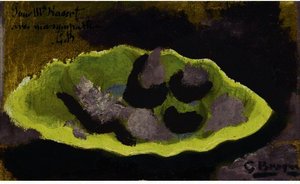
To gaze upon Georges Braque’s “Dead Nature” is to witness a profound moment of stillness within the turbulent currents of modern art history. Created in 1930, this work serves as a masterful testament to the artist's ability to find complexity within simplicity. While at first glance the painting appears to be a humble arrangement of fruit and glass, it is, in truth, a sophisticated exploration of how we perceive the physical world. Braque does not merely present a bowl of fruit; he invites the viewer into a reconstructed reality where the boundaries between object and space begin to dissolve. For the discerning collector or interior designer, this piece offers a captivating focal point that brings an intellectual depth and a sense of timelessness to any curated space.
The composition centers on a ceramic bowl, rendered in soft greenish-yellow tones, which holds a collection of fruit that seems to pulse with a muted, internal light. Beside it, a glass vessel catches the ambient light, its transparency interrupted by the rhythmic application of paint. Braque’s mastery lies in his ability to use geometric planes—subtle cubes and cylinders—to overlap and intersect, disrupting traditional perspective. This technique, a hallmark of his Cubist evolution, forces the eye to move across the canvas, discovering new facets of form with every glance. The interplay of light and shadow is not merely decorative but structural, creating a sense of weight and presence that anchors the entire composition.
The Alchemy of Texture and Tone
Braque’s technical prowess is most evident in his deliberate use of color and texture to evoke emotion. He moves away from the vibrant, almost aggressive palettes of his earlier Fauvist influences, opting instead for a harmonious arrangement of earthy ochres, deep umbers, and subtle creams. These muted tones create a sophisticated atmosphere that feels both grounded and ethereal. The artist employs delicate glazing techniques to build layers of depth, allowing light to seemingly trapped beneath the surface of the paint. This creates a tactile quality; one can almost feel the coolness of the glass and the matte smoothness of the ceramic bowl.
The emotional impact of “Dead Nature” is one of contemplative peace. There is no frantic movement here, only the quiet dignity of objects existing in a state of permanent repose. For those looking to decorate a sanctuary-like environment—perhaps a study, a library, or a minimalist living area—this artwork provides a sense of stability and intellectual rigor. It does not demand attention through loud colors but earns it through its nuanced textures and the subtle tension between its fragmented shapes. It is a piece that rewards slow looking, offering new layers of meaning to anyone willing to linger before its surface.
A Legacy of Visionary Thought
Understanding “Dead Nature” requires acknowledging the historical weight Braque carried as a pioneer of the Cubist movement. Alongside Pablo Picasso, Braque dismantled the "window onto the world" that had defined Western art since the Renaissance. He replaced it with a multidimensional experience, prioritizing how an object is known by the mind rather than just how it is seen by the eye. This painting represents a mature stage of this journey, where the radical experiments of his youth have settled into a refined, poetic language of form.
Owning a high-quality reproduction of such a seminal work allows for the integration of art history into the modern home. It is more than a decorative element; it is an invitation to participate in the dialogue of the avant-garde. Whether placed in a contemporary setting with clean lines or nestled within a classic, traditional interior, “Dead Nature” acts as a bridge between the revolutionary spirit of the early 20th century and the aesthetic sensibilities of today. It remains a profound symbol of how art can transform the mundane into the extraordinary.
Kysymykset ja vastaukset
Miksi teoksen "Dead nature" tekijänoikeustila on sellainen kuin se on?
Teoksen "Dead nature" tekijänoikeustilanne (on edelleen tekijänoikeuden alainen) määräytyy taiteilijan kuolinvuoden 1963 perusteella.
Miten "Dead nature" sijoittuu Georges Braque'n toistuvien aiheiden joukkoon?
"Dead nature" esittää aiheita bowl, ceramics, reflection, dots, contrast, composition, monochrome, kun taas Georges Braque tunnetaan teemoistaan geometric abstraction, picasso collaboration, formal exploration, minimalist aesthetic, cubist legacy. Näiden kahden vertaaminen osoittaa, miten teos liittyy taiteilijan tavallisiin aiheisiin.
Miten voin katsella teosta Georges Braque:n "Dead nature" diashow'na?
Katso kuvagalleria: Georges Braque:n "Dead nature" -teoksen Diaesitys -sivu.
Quick facts and art quiz
About Georges Braque

Georges Braque
1882 - 1963, Ranska
Taiteilijan elämäkerta
Nuoruus ja taiteelliset perusteet
Vuonna 1882 Ranskassa, Argenteuilissa syntynyt Georges Braque aloitti polun, joka kietoutui syvästi modernin taiteen muuttuvaan maisemaan. Hänen kasvatuksensa talonmaalareiden ja sisustajien perheessä antoi hänelle paitsi teknistä hallintaa materiaaleista, myös varhaisen arvostuksen muotoa ja rakennetta kohtaan. Vaikka hän aluksi seurasi isänsä ammattia, Braquen luontaiset taiteelliset taipumukset johtivat hänet pian Le Havren École des Beaux-Arts -kouluun suorittamaan muodollista koulutusta. Tämä merkitsi alkua matkalle, joka nostaisi hänet yhdeksi 20. vuosisadan vaikutusvaltaisimmista maalaajista. Tämä perusta – käytännön käsityötaidon ja akateemisen opiskelun liitto – osoittautui ratkaisevaksi, kun hän myöhemmin purki ja uudelleensynnytti perinteisiä taiteellisia konventioita.
Muuttaessaan Pariisiin vuonna 1902 Braque jatkoi opintojaan Académie Humbertissa uppoutuen kaupungin eloisaan taiteelliseen ilmapiiriin. Juuri täällä hän kohtasi taiteilijoita, kuten Marie Laurencin ja Francis Picabia, luoden yhteyksiä, jotka muovasivat hänen varhaista kehitystystään. Hänen ensimmäiset teoksensa heijastivat vallitsevia impressionismin ja postimpressionismin vaikutteita, mutta ratkaiseva kohtaaminen fauvismin rohkeiden värien ja ekspressiivisen vapauden kanssa vuonna 1905 sytytti uuden suunnan hänen taiteellisessa tutkimuksessaan.
Fauvismin syleily ja kubismin aamunkoitto
Braquen fauvististen periaatteiden omaksuminen – jolle oli ominaista intensiivinen, epäluonnollinen väri ja emotionaalinen ilmaisu – näkyy elävästi teoksissa kuten The Patience. Tänä aikana hän työskenteli taiteilijoiden, kuten Henri Matissen ja André Derainin, rinnalla kokeillen värikkäitä paletteja ja pelkistettyjä muotoja. Braquen suhde fauvismiin ei kuitenkaan ollut pelkkää jäljittelyä; hän täytti sen ainutlaataksensa tunnistettavalla herkkyydellä, tyynnyttäen liikkeen hillitöntä riemua maltillisemmalla ja analyyttisemmalla lähestymistavalla.
Käännekohta koitti vuonna 1907, kun hän kohtasi Paul Cézannen retrospektiivisen näyttelyn. Cézannen painotus geometrisiin muotoihin ja useisiin perspektiiveihin vaikutti Braqueen syvästi, valmistellen näyttämöä hänen mullistavalle yhteistyölleen Pablo Picasson kanssa. Vuodesta 1908 alkaen nämä kaksi taiteellista jättiläistä aloittivat intensiivisen älyllisen vaihdon, joka synnytti kubismin – vallankumouksellisen liikkeen, joka särki perinteiset käsitykset esittämisestä.
Yhdessä Braque ja Picasso kehittivät analyyttisen kubismin, pilkkoen kohteet fragmentoituneiksi geometrisiksi muodoiksi ja esittäen useita näkökulmia samanaikaisesti. Teokset kuten Houses at L'Estaque osoittavat tämän varhaisen vaiheen, näyttäen radikaalin poikkeaman perinteisestä perspektiivistä ja keskittyen muotojen perusrakenteeseen. Heidän palettinsa muuttui tietoisesti hillityksi, painottaen muotoa värin sijaan, kun he pyrkien esittämään kohteen olemuksen kokonaisuutena pelkän ulkomuodon sijaan.
Innovaatio fragmentaation ja kollaasin kautta
Braquen ja Picasson kumppanuus jatkoi taiteellisen ilmaisun rajojen rikkomista, mikä johti synteettisen kubismin kehittymiseen noin vuonna 1912. Tässä vaiheessa esiteltiin kollaasi – todellisen maailman materiaalien, kuten sanomalehtien palasten, tapettien ja kankaiden tuominen maalauksiin. Tämä innovaatio haastoi perinteisen hierarkian maalaustaiteen ja kuvanveiston välillä, hämärtäen rajoja taiteen ja elämän välillä.
Braquen uranuurtava *papier collé* (liimattu paperi) -tekniikan käyttö merkitsi merkittävää käännekohtaa hänen taiteellisessa evoluutiossaan. Integroimalla arkipäiväisten esineiden fragmentteja kompositiolleen, hän rikkoi perinteisen maalauksen illusiivista tilaa ja toi mukanaan uudenlaista materiaalisuutta ja tekstuuria. Tämä tekniikka ei ainoastaan laajentanut taiteen muodollisia mahdollisuuksia, vaan heijasti myös kasvavaa kiinnostusta esittämisen ja todellisuuden väliseen suhteeseen.
Ensimsimen maailmansodan syttyminen vuonna 1914 keskeytti tämän intensiivisen yhteistyön, kun Braque kutsuttiin sotapalvelukseen. Hänen sota-aikaiset kokemuksensa vaikuttivat syvästi hänen taiteelliseen visioonsa, johtaen hänet tutkimaan henkilökohtaisempia ja lyyrisempiä teemoja sodan jälkeisessä työssään.
Myöhemmät vuodet ja kestävä perintö
Sodan jälkeen Braquen tyyli kehittyi kubismin tiukkojen rajojen ulkopuolelle, yhdistäen klassisen komposition elementtejä ja uudistunutta kiinnostusta asetelmakuvaukseen. Säilyttäen geometriset vaikutteet, jotka olivat määrittäneet hänen varhaista työtään, hän kehitti vivahteikkaamman ja pohdiskelevamman lähestymistavan maalaamiseen. Hänen myöhemmät maisemansa ja sisätilansa tunnetaan seesteisestä tunnelmastaan ja hienovaraisesta väriharmoniastaan.
Koko uransa ajan Braque pysyi omistautuneena muodon, tilan ja esittämisen perusperiaatteiden tutkimiselle. Hän jatkoi kokeiluja eri materiaaleilla ja tekniikoilla työntäen taiteellisen ilmaisun rajoja kuolemaansa saakka vuonna 1963. Hänen vaikutuksensa myöhempiin taiteilolaskupolviin on mittaamaton; hän muovasi modernin taiteen kulkua ja inspiroi lukemattomia maalaajia, kuvanveistäjiä ja kollaasitaiteilijoita.
Georges Braquen perintö ulottuu pidemmälle kuin hänen yksittäiset teoksensa; hän muutti perustavanlaatuisesti ymmärrystämme siitä, miten havaitsemme ja esitämme ympäröivää maailmaa. Hänen yhteistyöhenkisyytensä Picasson kanssa, yhdistettynä omaan ainutlaatuiseen taiteelliseen visioonsa, vakiinnutti hänen paikkansa modernin taiteen todellisena pioneerina – mestarina, joka uskalsi haastaa konventiot ja määritellä maalauksen mahdollisuudet uudelleen.
Vaikutteet ja merkittävät teokset
- Vaikutteet: Henri Matisse, André Derain, Paul Cézanne
- Keskeiset teokset: Houses at L'Estaque, The Patience, Violin and Palette, Mandola
- Vaikutus taidehistoriaan: Mullisti 20. vuosisadan taiteen kubismin kautta; haastoi perinteiset käsitykset perspektiivistä ja esittämisestä.
Quick facts about Georges Braque
- Artistic Movement Or Style: Kubismi, Fauvismi
- Artists Or Movements Influenced By This Artist:
- Pablo Picasso
- Moderni taide
- Artists Who Influenced This Artist:
- Henri Matisse
- Paul Cézanne
- Date Of Birth: 13. toukokuuta 1882
- Date Of Death: 31. elokuuta 1963
- Full Name: Georges Braque
- Nationality: Ranskalainen
- Notable Artworks:
- L'Estaque
- Kärsivä
- Viulu ja puikko
- Place Of Birth: Argenteuil, Ranska
Tutustu teoksiin, jotka on järjestetty aiheiden, tyylien ja ominaisuuksien mukaan.


Georges Braque
Dead nature
() ·
With its frame: · Hand-painted in oil on linen
Total