

Esitetty: · Kehyksineen:
 Esikatselu
 Jaa teos
 Jaa
Jaa
 Tiedot
 Opas
Opas

 Lataa kuva
 Samanlaisia kohteita
 Röntgenkuvaus
 Diaesitys
 Kysymykset ja vastaukset
 Tilastot
€ 240
Käsinmaalattu öljyvärinen jäljennös
Käsinmaalattu öljyväri kankaalle haluamassasi koossa ja kehyksissä, taiteilijoidemme valmistamana tilauksesta. ( Vaihda tulosteeseen Siirry digitaaliseen kuvaan)
Tämä teos on tekijänoikeuden suojaama
Tällä sivulla esitettyä taideteosta suojaa tekijänoikeuslaki, mikä tarkoittaa, ettemme voi laillisesti luoda tai myydä täsmälleen samanlaista jäljennöstä. Tämä suoja toteutetaan kansainvälisten sopimusten, kuten esimerkiksi Berne-konventio ja kansallisilla laeilla, mukaan lukien niillä määritellyt Yhdysvaltain tekijänoikeuslaki – Luku 17. Kaikki oikeudet pidätetään. Luvaton kopiointi tai jäljittely on kielletty.
Kunnioittavana ja laillisena vaihtoehtona tarjoamme alkuperäisestä inspiroituneita, yksilöllisiä ja käsinmaalattuja taideteoksia. Taitavat ja ammattimaiset taiteilijamme tutkivat huolellisesti alkuperäisen teoksen tyyliä, tunnelmaa ja taiteellista ydintä luodakseen uuden, ainutlaatuisen teoksen, joka herättää saman tunteen – säilyttäen samalla oman itsenäisen alkuperäisyytensä.
Tämä menetelmä noudattaa täysin tekijänoikeussäännöksiä, sillä se ei sisällä suojatun taideteoksen kopioimista tai jäljentämistä. Sen sijaan kyseessä on luova uudelleentulkinta – uusi maalaus, joka ammentaa vaikutteita alkuperäisestä, mutta ei ole sen identtinen kopio.
 Lue lisää
Koko
·Vakiokoko
räätälöity
CM
INCH
Valitse valmiista mitoistamme sellaiset, jotka vastaavat teoksen alkuperäisiä mittasuhteita.
Koot ladataan...

leveys
korkeus
Kirjoita tarvitsemasi leveys ja korkeus, jotta teos sopii kehyksiisi tai seinällesi. Koska kyseessä on käsinmaalattu teos, taiteilija voi maalata hieman enemmän kuvan ympärille tai rajata sitä hieman, jos haluat eri muotoisen koon — valinta on sinun. Lähetämme sinulle digitaalisen mallikuvan hyväksyttäväksi ennen kuin maalaus alkaa. Tällä sivulla näkyvä kuva ei vastaa lopullista tulosta — vain mallikuva näyttää sen.
Viimeistely
·
Valkoinen reuna €1

pehmennetty reuna €1

Jatkuva reuna €1

P118B €10

P118H €10

P118W €10

P438Z €10

P508JH €12

P508YH €12

P805H €10

P805Z €10

P919BZ €10

P919G €10

P919XJ €10

P959ZH €10

P968JZ €12

W106C €8

W218G €10

W218JH €8

W218Y €10

W307PJ €10

W316G €10

W316PJ €8

W316Y €10

W398PJ €8

W4111J €10

W500HY €15

W500JH €15

W692G €12

W849H €8

W940BG €15

W953PJ €8

H24-GOLD €30

H24-SILVER €30

H36-GOLD €45

H36-SILVER €45
Toimitetaan suojaputkessa, valmiina kehystettäväksi omassa kehyksessäsi.
Yli 105 cm kokoiset kehykset toimitetaan osasarjana ammattilaiskehystäjälle — lue lisätiedot.
Lisäpalvelut
valinnainenMitä lisämateriaalit sisältävät?
Esimerkkejä muutettavista asioista: Vaihda kasvot asiakkaan valokuvaan; Lisää lemmikki (esim. vaihda kissa koiraksi); Lisää piilotettu viesti taustalle; Vaihda taustan maisemaa tai elementtejä.
Tilauksen jälkeen TopImpressionists.com -tiimi lähettää asiakkaalle sähköpostia ohjeita varten ja toimittaa luonnoksen esikatselun
Tilauksen jälkeen TopImpressionists.com -tiimi lähettää asiakkaalle sähköpostia ohjeita varten ja toimittaa luonnoksen esikatselun
Maailmanlaajuinen toimitus () 3–4 viikossa tavallisen 5 viikon sijaan. (7 marraskuu). Laadusta ei tingitä.
Suojalakkaus
Nimilaatta
Kaiverretun pronssilaatan tiedot
This elegant plaque features the artist's name and the title of the artwork, finely engraved for a timeless presentation.
It is made from bronze with a refined, elegant finish. The text is precisely laser-engraved for a sharp and permanent result. Measuring 9x2 cm, the plaque is compact yet easy to read. It's built to be durable and scratch-resistant, offering a professional, museum-quality look. Mounting is simple thanks to the included adhesive backing.
Läpinäkyvän akryylilaatan tiedot
The plaque includes essential engraved details such as the artist's name, the title of the artwork, the date it was created, the type of media used-like oil on canvas or watercolor-a brief description of the piece, and a QR code that links to the complete artwork information.
It is crafted from clear acrylic, offering a sleek, modern appearance. The text is UV-engraved in black to ensure strong visual contrast. With a size of 10x15 cm, it ensures optimal readability. It comes equipped with two metal hooks for secure wall mounting. The plaque is designed to be weather-resistant, making it suitable for various environments, and it includes interactive features that work seamlessly with smartphone scanning.
Mustan akryylilaatan tiedot
This elegant plaque includes engraved information such as the artist's name, the title of the artwork, the date it was created, the type of media used (like oil on canvas or watercolor), a short description of the artwork, and a QR code for quick access to more information.
The plaque itself is made from refined black acrylic with a premium finish. The text is laser-engraved in white for high contrast and readability. Its size is 10x15 cm, designed to be easy to read. It comes with two metal hooks for professional mounting. The design is sleek and fits any interior style. It is also weather-resistant and durable, with built-in digital integration for mobile compatibility.
Lasivaihtoehto on saatavilla vain alle 110 cm kokoisille teoksille
 Lasivaihtoehto on saatavilla vain alle 110 cm kokoisille teoksille
- Ilmainen pikatoimitus ympäri maailman
- Korkealaatuinen pellavakangas
- Kattava kuljetusvakuutus
- Tulliveron palautustakuu
- Takuu täydellisestä värien vastaavuudesta
- 100 päivän palautusoikeus (vain valmistusvirheet)
- 100% rahat takaisin -takuu
- Määräalennus tarjolla


Keräilykohteen kuvaus
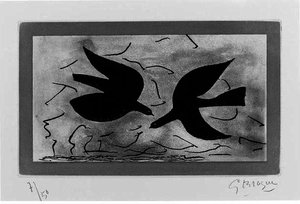
Georges Braque's "Two Birds" (1955) is a striking Cubist masterpiece featuring dynamic flight and bold contrasts, showcasing the artist’s mastery of form and color.
Taiteilijan elämäkerta
Georges Braque’nin "Harbour in Normandy" maalauksessa näkyy aikaisen kubismin uraauurtava lähestymistapa muotoon ja perspektiiviin. Värikäs teos vangitsee sataman tunnelman hajotettuina muodoissa ja rohkeilla linjoilla.
Tietoa maalauksesta
The Two Birds: A Study in Cubist Geometry and Silent Dialogue
Georges Braque’s “Two Birds,” painted in 1955, isn't merely a depiction of avian forms; it’s a carefully constructed meditation on movement, relationship, and the inherent ambiguity of visual representation. This monumental work, rendered in a restrained grayscale palette, exemplifies Braque’s mastery of Cubist principles while simultaneously hinting at a profound emotional depth. The painting immediately commands attention with its stark geometry – angular wings, simplified bodies, and fragmented planes that dismantle traditional notions of perspective. It's a deliberate rejection of mimetic realism, opting instead for an exploration of form and structure as the primary subjects.
The composition is strikingly balanced, yet subtly unsettling. Two birds, positioned in a dynamic diagonal relationship, appear to be engaged in some unspoken interaction. Are they pursuing each other? Challenging one another? Or simply sharing a fleeting moment of flight? The ambiguity is key – Braque offers no definitive answer, inviting the viewer to project their own interpretations onto the scene. This deliberate lack of closure contributes significantly to the painting’s enduring power and its ability to resonate with different viewers on multiple levels.
A Legacy Forged in Collaboration
To fully appreciate “Two Birds,” it's essential to understand Braque’s pivotal role within the early development of Cubism. Working closely alongside Pablo Picasso, he essentially co-invented this revolutionary style, pushing beyond the purely analytical approach initially championed by Picasso and introducing a greater emphasis on spatial ambiguity and flattened planes. This collaboration wasn’t simply a matter of shared ideas; it was a deeply intertwined artistic process, with each artist constantly influencing and responding to the other's work. The painting reflects this dynamic – a testament to the creative synergy between two giants of 20th-century art.
Braque’s earlier explorations in Fauvism, characterized by bold colors and expressive brushwork, laid the groundwork for his later Cubist innovations. He moved away from the vibrant hues of the Fauves, embracing a more restrained palette – predominantly grayscale – to focus on the underlying structure and geometry of objects. This shift reflects a growing interest in Cézanne’s emphasis on form and spatial relationships, which profoundly influenced Braque's artistic thinking.
Deconstructing Form: Technique and Process
“Two Birds” is not simply painted; it’s constructed. Braque meticulously employed a technique that combined elements of lithography with oil paint, resulting in a surface texture that is both grainy and subtly luminous. The use of strong black lines delineates the shapes of the birds and the background, creating a sense of depth and volume despite the flattened perspective. The painting’s monochromatic palette amplifies this effect, emphasizing the interplay of light and shadow and highlighting the intricate details of the composition.
Interestingly, archival research reveals that Braque experimented with various models – large canvases covered in preliminary sketches – before committing to the final version. This process underscores his meticulous approach to artmaking and his desire to achieve a perfect balance between structure and dynamism. The painting’s creation was a significant undertaking, reflecting Braque's commitment to pushing the boundaries of artistic expression.
Symbolic Resonance: Flight, Connection, and Contemplation
Beyond its formal qualities, “Two Birds” carries a subtle symbolic weight. Birds have long been associated with freedom, aspiration, and communication – themes that resonate deeply within the painting’s composition. The interaction between the two birds suggests a complex relationship, perhaps representing connection, conflict, or simply the shared experience of flight. The somber grayscale palette contributes to a mood of quiet contemplation, inviting viewers to reflect on the nature of relationships and the beauty of fleeting moments.
Ultimately, “Two Birds” is more than just a depiction of two birds in flight; it’s a profound exploration of form, space, and human connection. It stands as a testament to Georges Braque's genius and his enduring legacy as one of the most influential artists of the 20th century.
Kysymykset ja vastaukset
Kuinka tunnettu on Georges Braquen teos "The two birds"?
Teoksella Georges Braque:n "The two birds" on Iconic suosioaste. Tämä luokitus heijastaa teoksen tunnettuutta.
Mikä on suositeltu tulostuskoko teokselle Georges Braque:n "The two birds"?
Suositeltu tulostuskoko teokselle Georges Braque:n "The two birds" on Medium.
Mitä tunnetta Georges Braque:n "The two birds" välittää?
Teoksessa "The two birds" Calm-tunnelma kohtaa Melancholic-tunteen.
Pikaopas ja taidevisailu
Tietoa artistista Georges Braque

Georges Braque
1882 - 1963, Ranska
Taiteilijan elämäkerta
Nuoruus ja taiteelliset perusteet
Vuonna 1882 Ranskassa, Argenteuilissa syntynyt Georges Braque aloitti polun, joka kietoutui syvästi modernin taiteen muuttuvaan maisemaan. Hänen kasvatuksensa talonmaalareiden ja sisustajien perheessä antoi hänelle paitsi teknistä hallintaa materiaaleista, myös varhaisen arvostuksen muotoa ja rakennetta kohtaan. Vaikka hän aluksi seurasi isänsä ammattia, Braquen luontaiset taiteelliset taipumukset johtivat hänet pian Le Havren École des Beaux-Arts -kouluun suorittamaan muodollista koulutusta. Tämä merkitsi alkua matkalle, joka nostaisi hänet yhdeksi 20. vuosisadan vaikutusvaltaisimmista maalaajista. Tämä perusta – käytännön käsityötaidon ja akateemisen opiskelun liitto – osoittautui ratkaisevaksi, kun hän myöhemmin purki ja uudelleensynnytti perinteisiä taiteellisia konventioita.
Muuttaessaan Pariisiin vuonna 1902 Braque jatkoi opintojaan Académie Humbertissa uppoutuen kaupungin eloisaan taiteelliseen ilmapiiriin. Juuri täällä hän kohtasi taiteilijoita, kuten Marie Laurencin ja Francis Picabia, luoden yhteyksiä, jotka muovasivat hänen varhaista kehitystystään. Hänen ensimmäiset teoksensa heijastivat vallitsevia impressionismin ja postimpressionismin vaikutteita, mutta ratkaiseva kohtaaminen fauvismin rohkeiden värien ja ekspressiivisen vapauden kanssa vuonna 1905 sytytti uuden suunnan hänen taiteellisessa tutkimuksessaan.
Fauvismin syleily ja kubismin aamunkoitto
Braquen fauvististen periaatteiden omaksuminen – jolle oli ominaista intensiivinen, epäluonnollinen väri ja emotionaalinen ilmaisu – näkyy elävästi teoksissa kuten The Patience. Tänä aikana hän työskenteli taiteilijoiden, kuten Henri Matissen ja André Derainin, rinnalla kokeillen värikkäitä paletteja ja pelkistettyjä muotoja. Braquen suhde fauvismiin ei kuitenkaan ollut pelkkää jäljittelyä; hän täytti sen ainutlaataksensa tunnistettavalla herkkyydellä, tyynnyttäen liikkeen hillitöntä riemua maltillisemmalla ja analyyttisemmalla lähestymistavalla.
Käännekohta koitti vuonna 1907, kun hän kohtasi Paul Cézannen retrospektiivisen näyttelyn. Cézannen painotus geometrisiin muotoihin ja useisiin perspektiiveihin vaikutti Braqueen syvästi, valmistellen näyttämöä hänen mullistavalle yhteistyölleen Pablo Picasson kanssa. Vuodesta 1908 alkaen nämä kaksi taiteellista jättiläistä aloittivat intensiivisen älyllisen vaihdon, joka synnytti kubismin – vallankumouksellisen liikkeen, joka särki perinteiset käsitykset esittämisestä.
Yhdessä Braque ja Picasso kehittivät analyyttisen kubismin, pilkkoen kohteet fragmentoituneiksi geometrisiksi muodoiksi ja esittäen useita näkökulmia samanaikaisesti. Teokset kuten Houses at L'Estaque osoittavat tämän varhaisen vaiheen, näyttäen radikaalin poikkeaman perinteisestä perspektiivistä ja keskittyen muotojen perusrakenteeseen. Heidän palettinsa muuttui tietoisesti hillityksi, painottaen muotoa värin sijaan, kun he pyrkien esittämään kohteen olemuksen kokonaisuutena pelkän ulkomuodon sijaan.
Innovaatio fragmentaation ja kollaasin kautta
Braquen ja Picasson kumppanuus jatkoi taiteellisen ilmaisun rajojen rikkomista, mikä johti synteettisen kubismin kehittymiseen noin vuonna 1912. Tässä vaiheessa esiteltiin kollaasi – todellisen maailman materiaalien, kuten sanomalehtien palasten, tapettien ja kankaiden tuominen maalauksiin. Tämä innovaatio haastoi perinteisen hierarkian maalaustaiteen ja kuvanveiston välillä, hämärtäen rajoja taiteen ja elämän välillä.
Braquen uranuurtava *papier collé* (liimattu paperi) -tekniikan käyttö merkitsi merkittävää käännekohtaa hänen taiteellisessa evoluutiossaan. Integroimalla arkipäiväisten esineiden fragmentteja kompositiolleen, hän rikkoi perinteisen maalauksen illusiivista tilaa ja toi mukanaan uudenlaista materiaalisuutta ja tekstuuria. Tämä tekniikka ei ainoastaan laajentanut taiteen muodollisia mahdollisuuksia, vaan heijasti myös kasvavaa kiinnostusta esittämisen ja todellisuuden väliseen suhteeseen.
Ensimsimen maailmansodan syttyminen vuonna 1914 keskeytti tämän intensiivisen yhteistyön, kun Braque kutsuttiin sotapalvelukseen. Hänen sota-aikaiset kokemuksensa vaikuttivat syvästi hänen taiteelliseen visioonsa, johtaen hänet tutkimaan henkilökohtaisempia ja lyyrisempiä teemoja sodan jälkeisessä työssään.
Myöhemmät vuodet ja kestävä perintö
Sodan jälkeen Braquen tyyli kehittyi kubismin tiukkojen rajojen ulkopuolelle, yhdistäen klassisen komposition elementtejä ja uudistunutta kiinnostusta asetelmakuvaukseen. Säilyttäen geometriset vaikutteet, jotka olivat määrittäneet hänen varhaista työtään, hän kehitti vivahteikkaamman ja pohdiskelevamman lähestymistavan maalaamiseen. Hänen myöhemmät maisemansa ja sisätilansa tunnetaan seesteisestä tunnelmastaan ja hienovaraisesta väriharmoniastaan.
Koko uransa ajan Braque pysyi omistautuneena muodon, tilan ja esittämisen perusperiaatteiden tutkimiselle. Hän jatkoi kokeiluja eri materiaaleilla ja tekniikoilla työntäen taiteellisen ilmaisun rajoja kuolemaansa saakka vuonna 1963. Hänen vaikutuksensa myöhempiin taiteilolaskupolviin on mittaamaton; hän muovasi modernin taiteen kulkua ja inspiroi lukemattomia maalaajia, kuvanveistäjiä ja kollaasitaiteilijoita.
Georges Braquen perintö ulottuu pidemmälle kuin hänen yksittäiset teoksensa; hän muutti perustavanlaatuisesti ymmärrystämme siitä, miten havaitsemme ja esitämme ympäröivää maailmaa. Hänen yhteistyöhenkisyytensä Picasson kanssa, yhdistettynä omaan ainutlaatuiseen taiteelliseen visioonsa, vakiinnutti hänen paikkansa modernin taiteen todellisena pioneerina – mestarina, joka uskalsi haastaa konventiot ja määritellä maalauksen mahdollisuudet uudelleen.
Vaikutteet ja merkittävät teokset
- Vaikutteet: Henri Matisse, André Derain, Paul Cézanne
- Keskeiset teokset: Houses at L'Estaque, The Patience, Violin and Palette, Mandola
- Vaikutus taidehistoriaan: Mullisti 20. vuosisadan taiteen kubismin kautta; haastoi perinteiset käsitykset perspektiivistä ja esittämisestä.
Pikaaakkaukset taiteilijasta Georges Braque
- Artistic Movement Or Style: Kubismi, Fauvismi
- Artists Or Movements Influenced By This Artist:
- Pablo Picasso
- Moderni taide
- Artists Who Influenced This Artist:
- Henri Matisse
- Paul Cézanne
- Date Of Birth: 13. toukokuuta 1882
- Date Of Death: 31. elokuuta 1963
- Full Name: Georges Braque
- Nationality: Ranskalainen
- Notable Artworks:
- L'Estaque
- Kärsivä
- Viulu ja puikko
- Place Of Birth: Argenteuil, Ranska
Tutustu teoksiin, jotka on järjestetty aiheiden, tyylien ja ominaisuuksien mukaan.


Georges Braque
The two birds
() ·
Kehyksineen: · Käsinmaalattu öljyväreillä pellavalle
Yhteensä