Georges Braque’s Still Life Reverie: A Fragmented Symphony of Form
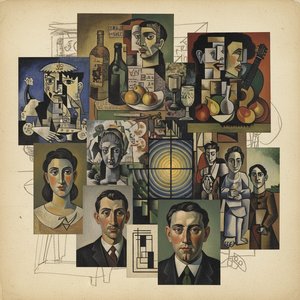
Georges Braque’s “untitled (6751)” presents a captivating visual puzzle—a meticulously crafted collage that transcends mere representation, delving into the core principles of Cubism and reflecting the intellectual ferment of its time. Created in 1951, this artwork embodies Braque's unwavering commitment to dismantling traditional artistic conventions while simultaneously celebrating the beauty inherent in geometric abstraction.
- Subject Matter: The composition centers around a serene tableau featuring two vases—one positioned on the left and another subtly placed on the right—alongside scattered books. These seemingly simple objects serve as anchors for an intricate arrangement of paper, fabric, and metal elements.
- Style & Technique: Braque’s masterful execution exemplifies Cubism's revolutionary approach to depicting reality. He employs multiple perspectives simultaneously, fracturing forms into interlocking planes that challenge conventional notions of depth and spatial illusion. The collage technique—characteristic of the period—further enhances this effect, layering textures and materials to create a dynamic surface.
A Dialogue Between Tradition and Innovation
Born in Argenteuil, France, in 1882, Georges Braque’s artistic journey began with an apprenticeship in his father's workshop—a formative experience that instilled him with a profound understanding of craftsmanship. However, his innate passion for art propelled him toward formal training at the École des Beaux-Arts in Le Havre, where he honed his skills and absorbed the influences of Impressionism and Post-Impressionism.
His encounter with Marie Laurencin and Francis Picabia in Paris solidified his artistic convictions. Together, they embarked on a daring exploration of Cubist principles—a movement spearheaded by Picasso—resulting in artworks that defied established aesthetic standards. This collaborative spirit fostered an environment of experimentation and intellectual debate, pushing the boundaries of artistic expression.
Symbolism Within Geometric Precision
The inclusion of books within “untitled (6751)” carries significant symbolic weight. They represent knowledge, contemplation, and the pursuit of understanding—themes central to Braque’s philosophical outlook. Furthermore, the geometric arrangement of the collage reflects Cubist's preoccupation with analyzing visual perception and reconstructing reality through fragmented planes.
The golden border framing the artwork adds a layer of elegance and formality, subtly elevating its aesthetic impact. It serves as a reminder that even in abstraction, Braque retained an appreciation for craftsmanship and artistic refinement. The overall impression is one of quiet contemplation—a testament to Braque’s ability to convey profound ideas through deceptively simple forms.
Emotional Resonance & Artistic Legacy
"untitled (6750)" isn't merely a visual spectacle; it’s an invitation to engage in a dialogue with art history. Like Picasso, Braque sought to liberate painting from the constraints of representational illusion, prioritizing form and structure as vehicles for conveying emotion and intellectual insight.
Braque’s enduring influence can be seen in countless subsequent artworks—a legacy cemented by his pioneering role in Cubism and his unwavering dedication to artistic innovation. Reproductions of “untitled (6751)” offer a remarkable opportunity to experience the beauty and complexity of this seminal masterpiece, allowing viewers to appreciate Braque's profound contribution to the canon of modern art.



 Tilaa maalaus
 Jaa
Jaa Jaa
Jaa
 Tarkemmat tiedot

 Lataa
Lataa
 Samanlaisia
 Röntgenkuva
 Diaesitys
 Näytä lisää






































 Lasivaihtoehto on saatavilla vain alle 110 cm kokoisina teoksina