A Moment of Fluidity: Unveiling "Blue-03"
Georgia O’Keeffe’s “Blue-03,” painted in 1916, isn't merely a watercolor; it’s a distilled essence of feeling, a fleeting capture of form and color that speaks to the heart of early Modernism. Created during a pivotal period of artistic experimentation, this work embodies O’Keeffe’s burgeoning independence from traditional academic training and her courageous embrace of abstraction. It represents a deliberate shift away from representational art towards an exploration of pure visual experience – a journey into the realm of color, shape, and texture as primary subjects. The piece whispers of a quiet intensity, inviting contemplation and revealing a profound connection to the natural world through a uniquely personal lens.

The Language of Form and Color
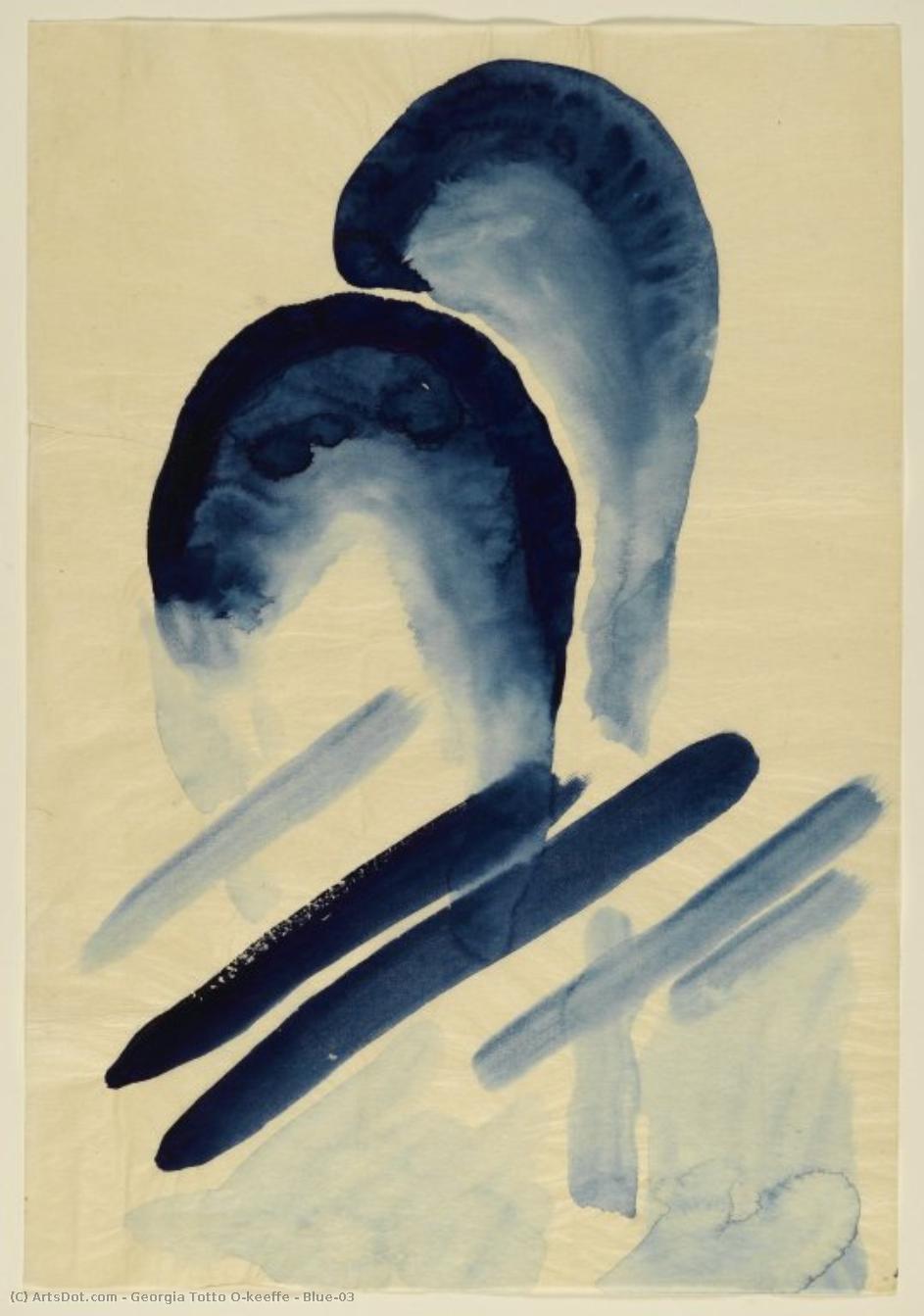
Dominating the composition is a large, curving shape—a suggestion of a flower or perhaps an abstracted organic form—rendered in varying shades of blue and grey. Below this central element, three horizontal rectangular shapes create a layered effect, introducing a sense of depth and spatial ambiguity. These planes don’t define objects; instead, they float within the space, their opacity subtly shifting to guide the viewer's eye. The color palette is strikingly monochromatic, relying on the nuanced interplay of blues and greys to generate visual interest and movement. Subtle tonal variations suggest transitions and echoes, creating a sense of fluidity that belies the static nature of the pigments on paper. Notice how the background cream provides a warm counterpoint, intensifying the coolness of the blues and adding to the overall atmospheric quality.
Technique and Process: Wet-on-Wet
O’Keeffe's masterful use of watercolor is immediately apparent. The technique employed—wet-on-wet washes—allows colors to bleed and blend seamlessly, creating soft edges and a remarkably fluid effect. There are no harsh lines; instead, shapes emerge through gradations of tone and the gentle blurring of boundaries. This process mirrors the spontaneity of the composition itself, suggesting an exploration of form and color rather than a meticulously planned design. The texture is smooth and wet, with subtle variations in pigment concentration that add depth and layering to the surface. It’s as if the paint itself is still glistening with moisture, capturing the immediacy of the artist's hand.
Symbolism and Emotional Resonance
"Blue-03" evokes a powerful sense of tranquility and introspection. The blues are often associated with calmness, serenity, and even melancholy—qualities that resonate deeply within the artwork. The abstract forms invite interpretation, prompting viewers to project their own emotions and experiences onto the canvas. Considering O’Keeffe's context at this time – her rejection of traditional representation and her exploration of inner experience – it’s not surprising that the piece feels both mysterious and profoundly personal. It speaks to a fundamental human desire for connection with nature, for finding beauty in simplicity, and for expressing emotions beyond words.
A Legacy of Abstraction
This work is a crucial bridge between O'Keeffe’s early training under Arthur Wesley Dow—who emphasized personal expression and the harmonious balance of color and line—and her later, more iconic explorations of Southwestern landscapes. “Blue-03” demonstrates her nascent ability to distill form and emotion into pure visual elements, foreshadowing the groundbreaking style that would define her career. It’s a testament to O'Keeffe’s pioneering spirit and her enduring influence on American art.


 Esikatselu
 Osta käsintehty maalaus
 Jaa
Jaa Jaa
Jaa
 Tarkemmat tiedot

 Lataa
Lataa
 Samanlaisia
 Röntgenkuva
 Diaesitys


 Näytä lisää






































 Lasivaihtoehto on saatavilla vain alle 110 cm kokoisina teoksina



