Jacqueline Leirner’s *Corpus Delicti*: A Meditation on Accumulation and the Fragments of Modern Life
Jacqueline Leirner's 1993 sculpture, *Corpus Delicti*, is not merely a collection of objects; it’s a quietly insistent interrogation of our relationship with possessions, memory, and the relentless accumulation that defines much of contemporary experience. Born in São Paulo in 1961, Leirner emerged from a vibrant Brazilian art scene deeply influenced by figures like Hélio Oiticica and Lygia Clark – artists who sought to dissolve the boundaries between art and life, exploring the very fabric of daily existence as material for their work.
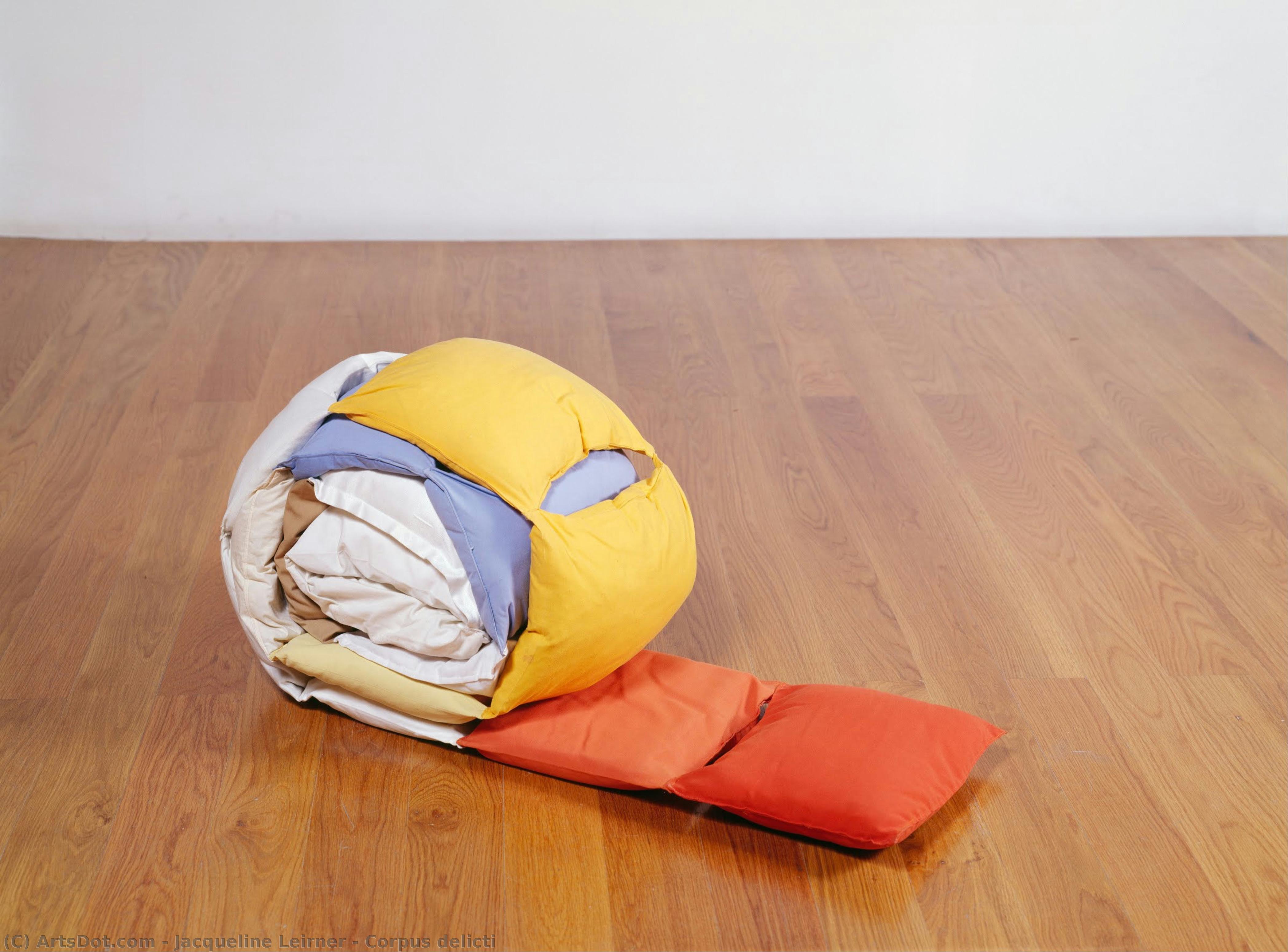
This particular piece, part of the Colecção da Caixa Geral de Depósitos, embodies Leirner’s signature approach: a meticulous gathering of detritus from the world of travel – flight pillows, blankets, glasses, and other incidental items salvaged from airplanes. These seemingly mundane objects are transformed through her deliberate arrangement into a sculptural form that resembles a distorted head or perhaps a burgeoning sphere. The work's title, *Corpus Delicti* (Latin for “body of offenses”), subtly hints at a transgression – not one of grand larceny, but a more insidious act: the accumulation itself, a quiet theft of moments and experiences.
- Materials: Constructed primarily from repurposed airplane accessories – fabric remnants, foam padding, plastic glasses, and other travel essentials.
- Technique: Leirner’s process is one of careful assemblage, building the sculpture through a layering and stacking technique that creates an organic, almost chaotic form. The deliberate lack of finishing or polish further emphasizes the raw nature of the materials.
- Dimensions: 41 x 100 cm – a compact scale that allows for intimate contemplation of its complex arrangement.
A Reflection on Hyperinflation and Brazilian Identity
The genesis of *Corpus Delicti* is inextricably linked to the tumultuous economic history of Brazil in the late 20th century, specifically the hyperinflation of the 1980s. Leirner’s use of worthless Cruzeiro notes – transformed into endless bundles in her earlier work, *Os Cem* – speaks to a broader critique of value systems and the ways in which objects can acquire meaning beyond their inherent worth. The flight paraphernalia collected for this piece echoes the transient nature of wealth and status, highlighting the ephemerality of possessions acquired during global travel.
Furthermore, the sculpture resonates with the broader Brazilian avant-garde movement that sought to reclaim national identity after decades of political instability. Leirner’s work can be seen as a response to the anxieties and uncertainties of a rapidly changing world, reflecting a desire to find meaning in the everyday – particularly within the context of Brazil's unique cultural landscape.
Symbolism and Emotional Impact
*Corpus Delicti* is profoundly evocative. The amorphous form invites viewers to project their own interpretations onto it, prompting questions about consumerism, memory, and the human impulse to collect. The ‘smile’ suggested by the sculpture's shape adds a layer of unsettling humor, suggesting a kind of passive acceptance or even complicity in this cycle of accumulation.
The work’s muted palette – primarily consisting of faded fabrics and worn plastics – contributes to its melancholic atmosphere. It is a poignant reminder of the transient nature of experience and the inevitable decay that accompanies all things. The sculpture's placement on a simple wooden floor, against a stark white background, further isolates it, intensifying its impact.
Perfect for Collection & Interior Design
This hand-painted reproduction captures the essence of Leirner’s masterful work, offering a stunning addition to any art collection or interior design scheme. The detailed rendering faithfully reproduces the sculpture's unique form and textural qualities, bringing this thought-provoking piece into your space. Its size (41 x 100 cm) makes it suitable for display on shelves, desks, or as a focal point in a larger room. A powerful statement of artistic inquiry, *Corpus Delicti* is an investment in both beauty and intellectual engagement.


 Osta käsintehty maalaus
 Jaa
Jaa Jaa
Jaa
 Tarkemmat tiedot

 Lataa
Lataa
 Samanlaisia
 Diaesitys


 Näytä lisää






































 Lasivaihtoehto on saatavilla vain alle 110 cm kokoisina teoksina



