

Shown: · With its frame:
 Esikatselu
 Jaa teos
 Jaa
Jaa
 Tiedot
 Opas
Opas

 Lataa kuva
 Samanlaisia kohteita
 Röntgenkuvaus
 Diaesitys
 Q&A
Q&A Tilastot
 1850
1850 19.0 x 12.0 cm
€ 239
Käsinmaalattu öljyvärinen jäljennös
Käsinmaalattu öljyväri kankaalle haluamassasi koossa ja kehyksissä, taiteilijoidemme valmistamana tilauksesta. ( Vaihda tulosteeseen Siirry digitaaliseen kuvaan)
Size
·Vakiokoko
räätälöity
CM
INCH
Valitse valmiista mitoistamme sellaiset, jotka vastaavat teoksen alkuperäisiä mittasuhteita.
Loading sizes...

leveys
korkeus
Kirjoita tarvitsemasi leveys ja korkeus, jotta teos sopii kehyksiisi tai seinällesi. Koska kyseessä on käsinmaalattu teos, taiteilija voi maalata hieman enemmän kuvan ympärille tai rajata sitä hieman, jos haluat eri muotoisen koon — valinta on sinun. Lähetämme sinulle digitaalisen mallikuvan hyväksyttäväksi ennen kuin maalaus alkaa. Tällä sivulla näkyvä kuva ei vastaa lopullista tulosta — vain mallikuva näyttää sen.
 Lue lisää
Finish
·
White €1

Blurside €1

Extended €1

P118B €10

P118H €10

P118W €10

P438Z €10

P508JH €12

P508YH €12

P805H €10

P805Z €10

P919BZ €10

P919G €10

P919XJ €10

P959ZH €10

P968JZ €12

W106C €8

W218G €10

W218JH €8

W218Y €10

W307PJ €10

W316G €10

W316PJ €8

W316Y €10

W398PJ €8

W4111J €10

W500HY €15

W500JH €15

W692G €12

W849H €8

W940BG €15

W953PJ €8

H24-GOLD €30

H24-SILVER €30

H36-GOLD €45

H36-SILVER €45
Shipped in a protective tube, ready for your own framer.
Above 105 cm the frame is shipped as a kit for a professional framer — read the details.
Extras
optionalWhat do the extras include?
Examples of what can be changed: Replace face with customer photo; Add pet (e.g., replace cat with dog); Include hidden message in background; Change background landscape or elements.
After order, TopImpressionists.com team will email client for instructions and provide a mockup preview
After order, TopImpressionists.com team will email client for instructions and provide a mockup preview
Maailmanlaajuinen toimitus () 3–4 viikossa tavallisen 5 viikon sijaan. (31 lokakuu). Laadusta ei tingitä.
Suojalakkaus
Nimilaatta
Kaiverretun pronssilaatan tiedot
This elegant plaque features the artist's name and the title of the artwork, finely engraved for a timeless presentation.
It is made from bronze with a refined, elegant finish. The text is precisely laser-engraved for a sharp and permanent result. Measuring 9x2 cm, the plaque is compact yet easy to read. It's built to be durable and scratch-resistant, offering a professional, museum-quality look. Mounting is simple thanks to the included adhesive backing.
Läpinäkyvän akryylilaatan tiedot
The plaque includes essential engraved details such as the artist's name, the title of the artwork, the date it was created, the type of media used-like oil on canvas or watercolor-a brief description of the piece, and a QR code that links to the complete artwork information.
It is crafted from clear acrylic, offering a sleek, modern appearance. The text is UV-engraved in black to ensure strong visual contrast. With a size of 10x15 cm, it ensures optimal readability. It comes equipped with two metal hooks for secure wall mounting. The plaque is designed to be weather-resistant, making it suitable for various environments, and it includes interactive features that work seamlessly with smartphone scanning.
Mustan akryylilaatan tiedot
This elegant plaque includes engraved information such as the artist's name, the title of the artwork, the date it was created, the type of media used (like oil on canvas or watercolor), a short description of the artwork, and a QR code for quick access to more information.
The plaque itself is made from refined black acrylic with a premium finish. The text is laser-engraved in white for high contrast and readability. Its size is 10x15 cm, designed to be easy to read. It comes with two metal hooks for professional mounting. The design is sleek and fits any interior style. It is also weather-resistant and durable, with built-in digital integration for mobile compatibility.
Lasivaihtoehto on saatavilla vain alle 110 cm kokoisille teoksille
 Lasivaihtoehto on saatavilla vain alle 110 cm kokoisille teoksille
- Ilmainen pikatoimitus ympäri maailman
- Korkealaatuinen pellavakangas
- Kattava kuljetusvakuutus
- Tulliveron palautustakuu
- Takuu täydellisestä värien vastaavuudesta
- 100 päivän palautusoikeus (vain valmistusvirheet)
- 100% rahat takaisin -takuu
- Määräalennus tarjolla


Keräilykohteen kuvaus
Taiteilijan elämäkerta
Tutustu John Ruskinin vaikuttavaan taiteeseen ja ajatuksiin – viktoriaaniseen polymaattiin, joka kehitti sekä estetiset näkemykset että yhteiskunnallisen muutoksen ideat. Näihin kuuluvat hänen maisemaöljyvärimaalauksensa, arkkitehtoninen analyysi ja vaikutukselliset esseet luonnosta, kauneudesta ja yhteiskunnasta.
About the painting
During the visits of 1849-50 and 1851-52 Ruskin spent two winters collecting material for The Stones of Venice, a work which proved to be very influential within the development of Victorian architecture.This architectural notebook, known as the ‘Door Book,’ is one of the series of ten which Ruskin used to record details and measurements of aspects of architectural features, carefully cross referencing them with worksheets and drawings. The smaller notebooks are named by Ruskin according to content, ‘Door Book’, ‘House Book 1’, ‘House Book 2’, ‘Palace Book’, ‘Gothic Book’ and ‘Bit Book’.
Kysymykset ja vastaukset
Mitkä värit hallitsevat teosta John Ruskin:n "Architectural Notebook ‘Door Book’ (p21)"?
John Ruskin:n "Architectural Notebook ‘Door Book’ (p21)"-teoksessa käytetään Neutrals väripalettia, jossa Rosy Brown (#aea98c) on hallitseva väri.
Kuka on luonut teoksen "Architectural Notebook ‘Door Book’ (p21)" ja milloin?
John Ruskin on luonut teoksen "Architectural Notebook ‘Door Book’ (p21)" vuonna 1850.
Millä muilla nimillä John Ruskin tunnetaan?
John Ruskin tunnetaan myös nimillä Sir John Everett Millais, Ruskin.
Quick facts and art quiz
About John Ruskin
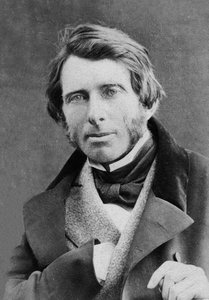
John Ruskin
1819 - 1900, Iso-Britannia
Taiteilijan elämäkerta
A Polymath of Vision: The Life and Legacy of John Ruskin
John Ruskin, born in London on February 8, 1819, was far more than simply an art critic; he was a Victorian polymath whose influence permeated the realms of aesthetics, social reform, political economy, and environmentalism. His life was shaped by a fascinating duality – the pragmatic commercial world of his father, John James Ruskin, a successful sherry merchant, and the fervent evangelical piety of his mother, Margaret Cock. This contrasting upbringing instilled in him both a keen observational eye for detail and a deeply moral sensibility that would define his entire oeuvre. From an early age, Ruskin’s education was meticulously curated at home, steeped in biblical study and exposure to Romantic literature, particularly the works of Byron and Walter Scott. These formative influences laid the groundwork for a mind that would relentlessly seek connections between beauty, truth, and ethical living. His academic journey continued at Christ Church, Oxford, where he began to articulate his burgeoning ideas about art and its relationship to society.The Dawn of an Art Historian: Early Writings and Influences
Ruskin’s emergence as a significant voice in the art world began with *Modern Painters* (1843-1860), a monumental five-volume work initially conceived as a defense of J.M.W. Turner against what Ruskin perceived as unjust criticism. However, *Modern Painters* quickly evolved into something far more profound – a comprehensive treatise on the nature of art itself. He argued passionately for “truth to nature,” emphasizing that great art wasn’t merely about skillful representation but about an artist's sincere and empathetic engagement with the natural world. This concept was revolutionary at the time, challenging prevailing academic standards and paving the way for new artistic sensibilities. Ruskin didn’t just analyze technique; he delved into the spiritual and moral qualities of art, believing that true beauty reflected a virtuous soul. His meticulous descriptions of landscapes, rocks, and botanical details reveal not only his keen observational skills but also his profound reverence for nature as a manifestation of divine creation. This early work established Ruskin as a formidable critic and set the stage for his later explorations into architecture and social issues. He was deeply influenced by the Pre-Raphaelite Brotherhood, championing their commitment to detailed observation and rejection of academic conventions. They shared a belief that art should aspire to moral elevation and capture the essence of genuine experience—a conviction that would permeate Ruskin’s subsequent endeavors.Beyond Aesthetics: Social Commentary and The Guild of St. George
As Ruskin matured, his interests expanded beyond the purely aesthetic realm. Deeply troubled by the social injustices he witnessed during the Industrial Revolution, he began to apply his critical lens to the economic and political structures of Victorian England. *Unto This Last* (1860), a series of essays originally published in *The Cornhill Magazine*, marked a turning point in his career. In this work, Ruskin vehemently critiqued utilitarian economics and advocated for a more humane and equitable social order based on principles of fellowship and craftsmanship. He argued that the dignity of labor was essential to a flourishing society and that true wealth lay not in material possessions but in the quality of human relationships. This conviction led him to establish *Fors Clavigera* (1871-1884), a monthly series of letters addressed “To the Workmen and Labourers of Great Britain,” where he expounded his social and political ideas with characteristic fervor. He saw the Industrial Revolution as a moral catastrophe, corrupting human spirit and undermining traditional values—a perspective that fueled his tireless efforts to promote ethical living and defend the rights of artisans and rural communities. The Guild of St. George, founded in 1871, was born from this conviction; it represented Ruskin’s unwavering belief in the transformative power of art and craftsmanship to elevate human life and foster a harmonious connection with the natural world.Notable Works & Further Exploration
- Modern Painters (1843-1860): Ruskin’s foundational work, defending Turner and establishing his theories of art.
- The Stones of Venice (1851-1853): A detailed analysis of Venetian architecture, exploring its historical, social, and artistic significance.
- Unto This Last (1860): A powerful critique of Victorian economics and a call for social reform.
- Fors Clavigera (1871-1884): A series of letters addressing the working class, outlining Ruskin’s vision for a more equitable society.
- Dawn, Coniston: This watercolor masterpiece exemplifies Ruskin's unparalleled ability to capture the sublime beauty of Lakeland scenery—a testament to his unwavering devotion to nature and its spiritual inspiration.
- Britannica: https://www.britannica.com/biography/John-Ruskin
- Wikipedia: https://en.wikipedia.org/wiki/John_Ruskin
Quick facts about John Ruskin
- Artistic Movement Or Style: Victorian Art
- Artists Or Movements Influenced By This Artist: ['Pre-Raphaelites']
- Artists Who Influenced This Artist: ['J.M.W. Turner']
- Date Of Birth: Feb 8, 1819
- Date Of Death: Jan 20, 1900
- Full Name: John Ruskin
- Nationality: British
- Notable Artworks:
- Dawn, Coniston
- Fors Clavigera
- Place Of Birth: London, UK

John Ruskin
Architectural Notebook ‘Door Book’ (p21)
() ·
With its frame: · Hand-painted in oil on linen
Total