

Esitetty: · Kehyksineen:
 Esikatselu
 Jaa teos
 Jaa
Jaa
 Tiedot
 Opas
Opas

 Lataa kuva
 Samanlaisia kohteita
 Röntgenkuvaus
 Diaesitys
 Kysymykset ja vastaukset
 Tilastot

€ 485
Käsinmaalattu öljyvärinen jäljennös
Käsinmaalattu öljyväri kankaalle haluamassasi koossa ja kehyksissä, taiteilijoidemme valmistamana tilauksesta. ( Vaihda tulosteeseen Siirry digitaaliseen kuvaan)
Koko
·Vakiokoko
räätälöity
CM
INCH
Valitse valmiista mitoistamme sellaiset, jotka vastaavat teoksen alkuperäisiä mittasuhteita.
Koot ladataan...

leveys
korkeus
Kirjoita tarvitsemasi leveys ja korkeus, jotta teos sopii kehyksiisi tai seinällesi. Koska kyseessä on käsinmaalattu teos, taiteilija voi maalata hieman enemmän kuvan ympärille tai rajata sitä hieman, jos haluat eri muotoisen koon — valinta on sinun. Lähetämme sinulle digitaalisen mallikuvan hyväksyttäväksi ennen kuin maalaus alkaa. Tällä sivulla näkyvä kuva ei vastaa lopullista tulosta — vain mallikuva näyttää sen.
 Lue lisää
Viimeistely
·
Valkoinen reuna €1

pehmennetty reuna €1

Jatkuva reuna €1

P118B €10

P118H €10

P118W €10

P438Z €10

P508JH €12

P508YH €12

P805H €10

P805Z €10

P919BZ €10

P919G €10

P919XJ €10

P959ZH €10

P968JZ €12

W106C €8

W218G €10

W218JH €8

W218Y €10

W307PJ €10

W316G €10

W316PJ €8

W316Y €10

W398PJ €8

W4111J €10

W500HY €15

W500JH €15

W692G €12

W849H €8

W940BG €15

W953PJ €8

H24-GOLD €30

H24-SILVER €30

H36-GOLD €45

H36-SILVER €45
Toimitetaan suojaputkessa, valmiina kehystettäväksi omassa kehyksessäsi.
Yli 105 cm kokoiset kehykset toimitetaan osasarjana ammattilaiskehystäjälle — lue lisätiedot.
Lisäpalvelut
valinnainenMitä lisämateriaalit sisältävät?
Esimerkkejä muutettavista asioista: Vaihda kasvot asiakkaan valokuvaan; Lisää lemmikki (esim. vaihda kissa koiraksi); Lisää piilotettu viesti taustalle; Vaihda taustan maisemaa tai elementtejä.
Tilauksen jälkeen TopImpressionists.com -tiimi lähettää asiakkaalle sähköpostia ohjeita varten ja toimittaa luonnoksen esikatselun
Tilauksen jälkeen TopImpressionists.com -tiimi lähettää asiakkaalle sähköpostia ohjeita varten ja toimittaa luonnoksen esikatselun
Maailmanlaajuinen toimitus () 3–4 viikossa tavallisen 5 viikon sijaan. (6 marraskuu). Laadusta ei tingitä.
Suojalakkaus
Nimilaatta
Kaiverretun pronssilaatan tiedot
This elegant plaque features the artist's name and the title of the artwork, finely engraved for a timeless presentation.
It is made from bronze with a refined, elegant finish. The text is precisely laser-engraved for a sharp and permanent result. Measuring 9x2 cm, the plaque is compact yet easy to read. It's built to be durable and scratch-resistant, offering a professional, museum-quality look. Mounting is simple thanks to the included adhesive backing.
Läpinäkyvän akryylilaatan tiedot
The plaque includes essential engraved details such as the artist's name, the title of the artwork, the date it was created, the type of media used-like oil on canvas or watercolor-a brief description of the piece, and a QR code that links to the complete artwork information.
It is crafted from clear acrylic, offering a sleek, modern appearance. The text is UV-engraved in black to ensure strong visual contrast. With a size of 10x15 cm, it ensures optimal readability. It comes equipped with two metal hooks for secure wall mounting. The plaque is designed to be weather-resistant, making it suitable for various environments, and it includes interactive features that work seamlessly with smartphone scanning.
Mustan akryylilaatan tiedot
This elegant plaque includes engraved information such as the artist's name, the title of the artwork, the date it was created, the type of media used (like oil on canvas or watercolor), a short description of the artwork, and a QR code for quick access to more information.
The plaque itself is made from refined black acrylic with a premium finish. The text is laser-engraved in white for high contrast and readability. Its size is 10x15 cm, designed to be easy to read. It comes with two metal hooks for professional mounting. The design is sleek and fits any interior style. It is also weather-resistant and durable, with built-in digital integration for mobile compatibility.
Lasivaihtoehto on saatavilla vain alle 110 cm kokoisille teoksille
 Lasivaihtoehto on saatavilla vain alle 110 cm kokoisille teoksille
- Ilmainen pikatoimitus ympäri maailman
- Korkealaatuinen pellavakangas
- Kattava kuljetusvakuutus
- Tulliveron palautustakuu
- Takuu täydellisestä värien vastaavuudesta
- 100 päivän palautusoikeus (vain valmistusvirheet)
- 100% rahat takaisin -takuu
- Määräalennus tarjolla


Keräilykohteen kuvaus
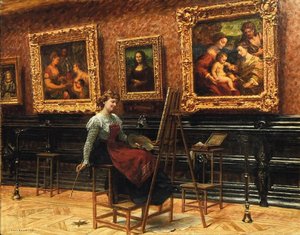
Explore 'A la gloire de Rubens' by Louis Beroud – a vibrant Baroque masterpiece inspired by Rubens! Capturing opulent revelry & sensual energy, this oil painting offers a glimpse into 19th-century Parisian art.
Taiteilijan elämäkerta
Tutustu Louis Beroudiin (1852-1930), ranskalaiseen taidemaalariin, joka tunnetaan yksityiskohtaisista Pariisin sisätilojen ja maamerkkien kuvauksistaan, kuten Louvresta ja Opéra Garnierista.
Tietoa maalauksesta
À la gloire de Rubens – A Celebration of Baroque Grandeur
Louis Béroud’s “À la gloire de Rubens” is more than just a depiction of a painting; it's an embodiment of the artistic spirit of its time—the fervent embrace of academic tradition alongside a keen observation of modern life that characterized Parisian art in the early 20th century. Painted in 1905, this monumental canvas captures the atmosphere of the Louvre Museum during a period marked by significant cultural renewal and intellectual curiosity. The artwork’s subject matter is deceptively simple: a young woman diligently sketching “The Coronation” by Peter Paul Rubens from his celebrated Marie de Medici cycle—a masterpiece that embodies the Baroque ideal of dramatic grandeur and emotional intensity.- Composition & Style: Béroud adheres to the stylistic conventions of the École de Beaux-Arts, prioritizing clarity of form and meticulous detail. The scene unfolds within a richly ornamented interior space reminiscent of Rubens’s own studio, emphasizing architectural perspective and creating a sense of spatial depth. However, unlike Rubens's canvases which aim for idealized beauty, Béroud presents a realistic portrayal of artistic practice—a testament to the artist’s commitment to capturing the essence of his subject matter.
- Technique: Employing oil paint on canvas with visible brushstrokes, Béroud utilizes impasto – thick application of pigment – particularly noticeable in areas depicting drapery and skin tones. This technique lends texture and luminosity to the painting, mirroring the dramatic chiaroscuro employed by Rubens himself. The artist’s careful attention to light and shadow contributes significantly to the overall theatrical quality of the composition.
- Historical Context: Béroud's work emerged during a period of artistic debate following Impressionism’s dominance. Artists like Béroud sought to reaffirm classical principles while acknowledging the influence of contemporary life—a dynamic tension that reflects broader cultural shifts occurring in France at the time. The painting’s inclusion within the Louvre’s collection underscores its significance as an exemplar of academic art and a celebration of Rubens's legacy.
- Symbolism: The central figure, sketching “The Coronation,” symbolizes the dedication to artistic craft and the pursuit of excellence—values deeply ingrained in the Beaux-Arts tradition. The inclusion of Rubens’s monumental painting serves as a visual reminder of the Baroque aesthetic’s ambition to inspire awe and convey profound emotion.
- Emotional Impact: “À la gloire de Rubens” evokes a feeling of reverence for artistic heritage combined with an appreciation for meticulous observation. It invites viewers to contemplate the role of art in capturing beauty, conveying emotion, and preserving cultural memory—themes that resonate powerfully across generations.
Detailed Description & Artistic Considerations
The painting’s palette is dominated by muted earth tones – ochre, umber, Sienna – reflecting the subdued lighting of the Louvre’s galleries. Béroud skillfully renders textures with remarkable precision, capturing the folds of fabric and the subtle nuances of skin tone. The artist's meticulous brushwork contributes to a palpable sense of movement—suggesting the dynamism inherent in artistic creation itself. Careful attention is paid to architectural elements – moldings, arches – reinforcing the spatial illusion and enhancing the grandeur of the setting. Béroud’s masterful technique elevates the depiction beyond mere representation, transforming it into an evocative meditation on art history and artistic practice.Provenance & Acquisition
“À la gloire de Rubens” entered the Louvre's collection in 1993 as a bequest from Micheline Héblot (1930-1990), honoring her parents’ memory. The painting was originally exhibited at the Salon of Société des Artistes français in 1905 and subsequently reproduced as prints during that era. Its inclusion in Musée Carnavalet's permanent collection provides invaluable insight into Parisian artistic culture at the turn of the century.Further Research & Artistic Influences
Louis Béroud’s artistic trajectory was profoundly shaped by his training at the École Supérieure des Beaux-Arts, where he absorbed the precepts of classical art and technique. His unwavering devotion to realism combined with an artist's sensitivity distinguishes him as a pivotal figure in late 19th-century French painting—a legacy that continues to inspire artists today. References: Musée Carnavalet; Louvre éditions / Somogy, 2008, p. 149, coul. n°178; Bresc-Bautier, Geneviève ; Foucart, Jacques, « Le tableau du mois n° 9 : trois nouveaux tableaux pour l’histoire du Louvre : Louis Béroud, Henri Coroënne », Tableau du mois, 9, du 7 septembre au 3 octobre 1994, 1994, 1-4, p. 1-4, n&b, p. 1, B; Musée du Louvre, Département des Peintures; Bresc-Bautier, Geneviève ; Foucart, Jacques, « Le tableau du mois n° 9 : trois nouveaux tableaux pour l’histoire du Louvre : Louis Béroud, Henri Coroënne », Tableau du mois, 9, du 7 septembre au 3 octobre 1994, 1994, 1-4, p. 1-4, n&b, p. 1, B; Musée Carnavalet; Louvre éditions / Somogy, 2008, p. 149, coul. n°178; Musée du Louvre, Département des Peintures; Bresc-Bautier, Geneviève ; Foucart, Jacques, « Le tableau du mois n° 9 : trois nouveaux tableaux pour l’histoire du Louvre : Louis Béroud, Henri Coroënne », Tableau du mois, 9, du 7 septembre au 3 octobre 1994, 1994, 1-4, p. 1-4, n&b, p. 1, B; Musée Carnavalet; Louvre éditions / Somogy, 2008, p. 149, coul. n°178Kysymykset ja vastaukset
Miten voin löytää teoksia, jotka muistuttavat teosta Louis Beroud:n "A la gloire de Rubens"?
Teokset, jotka muistuttavat teosta "A la gloire de Rubens", löytyvät sen Samankaltaisia teoksia -sivulta.
Ovatko teoksen "A la gloire de Rubens" värit voimakkaita vai hillittyjä?
Louis Beroud:n "A la gloire de Rubens"-teoksen värit ilmentävät Balanced Soft kylläisyyttä ja Balanced voimakkuutta.
Mitä Louis Beroud:n "A la gloire de Rubens" esittää?
Louis Beroud:n "A la gloire de Rubens" esittää: mythological feast, nude figures, baroque revelry, sensual celebration, opulent interior, venus mythology, dynamic composition.
Pikaopas ja taidevisailu
Tietoa artistista Louis Beroud
Louis Beroud
1852 - 1930, Ranska
Taiteilijan elämäkerta
Louis Beroud: Pariisilainen visionääri, joka vangitsi aikansa hengen
Louis Beroud (1852–1930) nousee esiin merkittävänä hahmona 1800-luvun lopun ja 1900-luvun alun ranskalaisessa taiteessa. Häntä on juhlittu erityisesti huolellisista kuvauksistaan Pariisin sisätiloista ja maamerkeistä, kuten Louvresta ja Opéra Garnierista. Beroudin taiteellinen matka, joka alkoi Lyonissa, sai alkunsa impressionismin vaikutusvallan hiipuessa. Tämä asetti hänet vankasti akateemisen perinteen piiriin, mutta samalla hän omaksui hienovaraisen ymmärryksen modernista elämästä. Hänen kankaansa tarjoavat ikkunoita maailmaan, joka on täynnä loistoa, yksityiskohtia ja psykologista havainnointia – todiste hänen järkähtämättömästä sitoutumisestaan realismiin yhdistettynä taiteilijan herkkyyteen.- Nuoruus ja taidekoulutus: Beroud sai ensimmäisen taidekoulutuksensa Pariisin École Supérieure des Beaux-Artsissa, jossa hän hioi taitojaan vaikutusvaltaisten opettajien johdolla, jotka puolustivat klassisia periaatteita sommittelussa ja tekniikassa. Tämä muovaava ajanjakso istutti häneen syvän kunnioituksen perinteitä kohtaan, mutta samalla se ruokki uteliasta henkeä, joka kannusti häntä tutkimaan monipuolisia aiheita ja tyylejä.
- Merkittävät teokset ja taiteellinen tyyli: Beroudin tuotanto kattaa hämmästyttävän laajan kirjon aiheita, monumentaalisista arkkitehtonisista esityksestä – kuten hänen kuuluisista kuvauksistaan Louvresta ja Opéra Garnierista – intiimeihin muotokuviin, jotka vangitsevat Pariisin elämän olemuksen. Hänen maalauksilleen on ominaista äärimmäinen tarkkuus yksityiskohdissa, mestarillinen valon ja varjon käyttö sekä kyky välittää tunnelmaa poikkeuksellisella tarkkuudella. Hän yhdisteli taitavasti akateemista realismia ja ilmeikästä sivellintekniikkaa luoden kuvia, jotka resonoivat sekä älyllisen kurinalaisuuden että emotionaalisen syvyyden kanssa.
Louvren välikohtaus: Surrealistisen huumorin hetki
Ehkä Beroudin pysyvin maine kumpuaa unohtumattomasta tapahtumasta hänen vieraillessaan Louvren museossa elokuussa 1911. Etsiessään inspiraatiota museon satavuotisjuhlan kunniaksi maalataksensa, Beroud saapui luonnostelemaan ”Mona Lisa au Louvre” -teosta, vain huomatakseen, että Leonardo da Vincin ikoninen muotokuva oli poissa – sen tilalla oli vain neljä rautatappia, jotka pitivät sen seinällä. Tämä outo olosuhde käynnisti tutkinnan mestariteoksen varkaudesta ja vangitsi koko Pariisin yleisen mielipiteen. Tapauksesta tuli symboli taiteellisen aitouden epävarmuudelle ja modernin maailman tunkeutumiselle arvokkaisiin instituutioihin.- Museotilaustyöt ja taiteellinen tunnustus: Beroudin maine taiteilijana sai huomattavaa vetovoimaa lukuisien merkittävien kulttuurijärjestöjen tilausten ansiosta, mukaan lukien itse Louvren museo. Nämä projektit antoivat hänelle mahdollisuuden näyttää lahjakkuutensa suuremmassa mittakaavassa ja vakiinnuttivat hänen asemansa yhtenä aikansa merkittävimmistä ranskalaisista taiteilijoista.
- Vaikutus ja perintö: Beroudin taiteellinen tyyli, jolle ovat ominaisia tarkka realismi ja psykologinen oivallus, vaikutti myöhempiin maalaajien sukupolviin, erityisesti niihin, jotka halusivat vangita urbaanin elämän monimutkaisuuden. Hänen teoksiaan ihaillaan edelleen teknisen loistonsa ja Belle Époquen aikaisen Pariisin yhteiskunnan puhuttelevan kuvauksen vuoksi, mikä vahvistaa hänen perintöään keskeisenä hahmona ranskalaisessa taidehistoriassa.
Pariisin tilojen tutkiminen: Suurista saleista hiljaisiin kulmiin
Beroudin taiteellinen painopiste keskittyi Pariisin ympäristöjen huolelliseen dokumentointiin – sekä monumentaalisiin että kotimaisiin tiloihin. Hän tallensi Opéra Garnierin ja Louvren kaltaisten arkkitehtonisten tilojen loiston hengästyttävällä tarkkuudella käyttäen tekniikoita, jotka heijastivat hänen aikansa akateemisten maalaajien suosimia menetelmiä. Samanaikaisesti hän tutki arkipäivän hienovaraisuuksia intiimien muotokuvien ja kohtausten kautta, jotka esittivät tavallisia parisilaisia päivittäisissä rutiineissaan. Nämä kankaat tarjoavat arvokasta tietoa Belle Époquen sosiaalisesta ja kulttuurisesta maisemasta – ajanjaksosta, jota leimasivat nopea teollistuminen, taiteellinen innovaatio ja kasvava kiehtomus modernisuuteen.Merkittävät maalaukset ja museonäyttelyt
Beroudin kuuluisimpien teosten joukossa ovat ”Avenue de la Gare in Nice” ja ”Le dôme central de la galerie des machines à l'exposition universelle de 1889”, jotka ilmentävät hänen sitoutumistaan aikansa hengen vangitsemiseen. Hänen maalauksiaan löytyy arvostetuista museoista ympäri Ranskaa, mukaan lukien Louvren museo ja Saint Louis Art Museum, joissa ne jatkavat katsojien inspiroimista taiteellisella arvollaan ja historiallisella merkityksellään.Pikaaakkaukset taiteilijasta Louis Beroud
- Artistic Movement Or Style: Akateeminen realismi
- Artists Or Movements Influenced By This Artist: ['Art Deco']
- Artists Who Influenced This Artist: ['Gustave Moreau']
- Date Of Birth: 1852 Lyon, Ranska
- Date Of Death: 1930
- Full Name: Louis Beroud
- Nationality: Ranskalainen
- Notable Artworks:
- Avenue de la Gare Nicessä
- Le dôme central de la galerie des machines à l'exposition universelle de 1889
- Bureau du Baron Schlichting
- Place Of Birth: Lyon, Ranska

Louis Beroud
A la gloire de Rubens
() ·
Kehyksineen: · Käsinmaalattu öljyväreillä pellavalle
Yhteensä