

Shown: · With its frame:
 Esikatselu
 Jaa teos
 Jaa
Jaa
 Tiedot
 Opas
Opas

 Lataa kuva
 Samanlaisia kohteita
 Röntgenkuvaus
 Diaesitys
 Q&A
Q&A Tilastot


€ 239
Käsinmaalattu öljyvärinen jäljennös
Käsinmaalattu öljyväri kankaalle haluamassasi koossa ja kehyksissä, taiteilijoidemme valmistamana tilauksesta. ( Vaihda tulosteeseen Siirry digitaaliseen kuvaan)
Size
·Vakiokoko
räätälöity
CM
INCH
Valitse valmiista mitoistamme sellaiset, jotka vastaavat teoksen alkuperäisiä mittasuhteita.
Loading sizes...

leveys
korkeus
Kirjoita tarvitsemasi leveys ja korkeus, jotta teos sopii kehyksiisi tai seinällesi. Koska kyseessä on käsinmaalattu teos, taiteilija voi maalata hieman enemmän kuvan ympärille tai rajata sitä hieman, jos haluat eri muotoisen koon — valinta on sinun. Lähetämme sinulle digitaalisen mallikuvan hyväksyttäväksi ennen kuin maalaus alkaa. Tällä sivulla näkyvä kuva ei vastaa lopullista tulosta — vain mallikuva näyttää sen.
 Lue lisää
Finish
·
White €1

Blurside €1

Extended €1

P118B €10

P118H €10

P118W €10

P438Z €10

P508JH €12

P508YH €12

P805H €10

P805Z €10

P919BZ €10

P919G €10

P919XJ €10

P959ZH €10

P968JZ €12

W106C €8

W218G €10

W218JH €8

W218Y €10

W307PJ €10

W316G €10

W316PJ €8

W316Y €10

W398PJ €8

W4111J €10

W500HY €15

W500JH €15

W692G €12

W849H €8

W940BG €15

W953PJ €8

H24-GOLD €30

H24-SILVER €30

H36-GOLD €45

H36-SILVER €45
Shipped in a protective tube, ready for your own framer.
Above 105 cm the frame is shipped as a kit for a professional framer — read the details.
Extras
optionalWhat do the extras include?
Examples of what can be changed: Replace face with customer photo; Add pet (e.g., replace cat with dog); Include hidden message in background; Change background landscape or elements.
After order, TopImpressionists.com team will email client for instructions and provide a mockup preview
After order, TopImpressionists.com team will email client for instructions and provide a mockup preview
Maailmanlaajuinen toimitus () 3–4 viikossa tavallisen 5 viikon sijaan. (30 lokakuu). Laadusta ei tingitä.
Suojalakkaus
Nimilaatta
Kaiverretun pronssilaatan tiedot
This elegant plaque features the artist's name and the title of the artwork, finely engraved for a timeless presentation.
It is made from bronze with a refined, elegant finish. The text is precisely laser-engraved for a sharp and permanent result. Measuring 9x2 cm, the plaque is compact yet easy to read. It's built to be durable and scratch-resistant, offering a professional, museum-quality look. Mounting is simple thanks to the included adhesive backing.
Läpinäkyvän akryylilaatan tiedot
The plaque includes essential engraved details such as the artist's name, the title of the artwork, the date it was created, the type of media used-like oil on canvas or watercolor-a brief description of the piece, and a QR code that links to the complete artwork information.
It is crafted from clear acrylic, offering a sleek, modern appearance. The text is UV-engraved in black to ensure strong visual contrast. With a size of 10x15 cm, it ensures optimal readability. It comes equipped with two metal hooks for secure wall mounting. The plaque is designed to be weather-resistant, making it suitable for various environments, and it includes interactive features that work seamlessly with smartphone scanning.
Mustan akryylilaatan tiedot
This elegant plaque includes engraved information such as the artist's name, the title of the artwork, the date it was created, the type of media used (like oil on canvas or watercolor), a short description of the artwork, and a QR code for quick access to more information.
The plaque itself is made from refined black acrylic with a premium finish. The text is laser-engraved in white for high contrast and readability. Its size is 10x15 cm, designed to be easy to read. It comes with two metal hooks for professional mounting. The design is sleek and fits any interior style. It is also weather-resistant and durable, with built-in digital integration for mobile compatibility.
Lasivaihtoehto on saatavilla vain alle 110 cm kokoisille teoksille
 Lasivaihtoehto on saatavilla vain alle 110 cm kokoisille teoksille
- Ilmainen pikatoimitus ympäri maailman
- Korkealaatuinen pellavakangas
- Kattava kuljetusvakuutus
- Tulliveron palautustakuu
- Takuu täydellisestä värien vastaavuudesta
- 100 päivän palautusoikeus (vain valmistusvirheet)
- 100% rahat takaisin -takuu
- Määräalennus tarjolla


Keräilykohteen kuvaus
Taiteilijan elämäkerta
Tutustu Nicolas Poussiniin, ranskalaisen klassismin suurtaan mestariin! Hänen maalauksensa ovat täynnä historiaa ja mystiikkaa sekä kauneutta ja syvyyttä – löydät lisää WikiArtista.
About the painting
A Moment Frozen in Time: Poussin’s ‘Two Silver Birches’
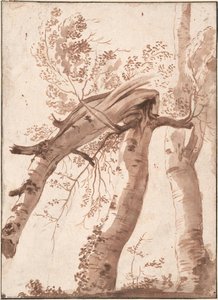
Nicolas Poussin's “Two Silver Birches, the Front One Fallen,” painted circa 1629, isn’t merely a depiction of trees; it’s a carefully constructed meditation on mortality, harmony, and the enduring power of classical ideals. Emerging from his formative years in France and culminating in his profound immersion within the Roman artistic landscape, Poussin sought to synthesize the sensual richness of Venetian painting with the rigorous order and intellectual depth of antiquity. This work, created during a pivotal period of his career, exemplifies this ambition – a quiet yet profoundly resonant scene that speaks volumes about the artist’s evolving philosophy.
The painting immediately draws the eye with its stark simplicity. Two birch trees dominate the composition, their silvery bark rendered with an almost luminous quality. The tree on the right stands tall and proud, branches reaching skyward as if in defiant grace, while its counterpart lies prone at the base of the canvas, a fallen sentinel marking the passage of time. The absence of leaves is deliberate; it strips away the seasonal distractions, focusing instead on the skeletal beauty of the trees themselves – a motif frequently associated with death and remembrance within classical art. This reduction to essential form allows Poussin to explore the underlying structure of nature, mirroring his broader interest in geometric principles and mathematical harmony.
The Language of Line and Light
Poussin’s technique is characterized by an exquisite control of line and light. He employs a meticulous layering of thin washes of paint – a hallmark of his style – to build up the forms with remarkable precision. The branches, particularly those of the upright birch, are delineated with delicate, almost hesitant strokes, creating a sense of movement and vulnerability. The fallen tree is rendered with a slightly heavier touch, suggesting its weight and the inevitability of decay. Light plays a crucial role in shaping the scene; it seems to emanate from an unseen source, bathing the trees in a soft, diffused glow that enhances their silvery sheen. This masterful manipulation of light not only creates visual beauty but also imbues the painting with a sense of spiritual depth.
Noticeably, Poussin includes a human figure – a small, dark silhouette standing near the base of the fallen tree. The identity and purpose of this figure remain deliberately ambiguous, adding another layer of complexity to the work. Some scholars interpret it as representing contemplation or perhaps even mourning, while others see it as a symbol of humanity’s relationship with nature—a witness to its cycles of growth and decline. The figure's presence subtly anchors the scene in the realm of human experience, reminding us that even within the grandeur of the natural world, we are confronted by our own mortality.
Symbolism Rooted in Antiquity
The birch tree itself carries a rich symbolic weight throughout Western art history. Often associated with purity, resilience, and the afterlife, it frequently appears in funerary monuments and depictions of mourning. Its slender form and delicate branches evoke images of fragility and vulnerability, while its ability to withstand harsh winters speaks to an enduring spirit. Poussin’s choice of birch trees aligns perfectly with his engagement with classical themes – particularly those found in Roman mythology and literature, where the tree frequently served as a symbol of transition and renewal.
Furthermore, the fallen tree can be interpreted as a representation of *memento mori*—a reminder of death. This concept was central to Renaissance art, serving as a powerful tool for prompting reflection on the transience of earthly life. Poussin’s painting, therefore, transcends mere botanical observation; it becomes a poignant meditation on the cyclical nature of existence and the inevitability of loss. The composition invites us to contemplate our own place within this grand scheme, fostering a sense of both melancholy and acceptance.
A Timeless Masterpiece for Reproduction
TopImpressionists offers meticulously crafted hand-painted reproductions of “Two Silver Birches, the Front One Fallen,” allowing you to bring this iconic work into your home or office. Our artists replicate Poussin’s delicate brushwork and masterful use of light with unparalleled precision, ensuring that every detail is faithfully reproduced. Whether you are an art enthusiast, a collector seeking to expand your collection, or an interior designer searching for a touch of classical elegance, our reproductions provide a beautiful and authentic representation of this timeless masterpiece. Experience the profound beauty and intellectual depth of Poussin’s vision – a moment frozen in time, brought vividly back to life.
Kysymykset ja vastaukset
Käyttääkö teos Nicolas Poussin:n "Two Silver Birches, the Front One Fallen, c. 1629" voimakkaita kontrasteja vai pehmeitä harmonioita?
Teoksessa "Two Silver Birches, the Front One Fallen, c. 1629" Gentle kontrasti ja Unified Palette harmonia kohtaavat.
Mitä Nicolas Poussin:n "Two Silver Birches, the Front One Fallen, c. 1629" esittää ja millainen on sen tunnelma?
"Two Silver Birches, the Front One Fallen, c. 1629" esittää aiheita birches, trees, fallen tree, tranquility, poussin, landscape, classical, harmony, ja sen tunnelmaksi on tallennettu Calm.
Miten taidesuuntaus ja aikakausi kohtaavat teoksessa Nicolas Poussin:n "Two Silver Birches, the Front One Fallen, c. 1629"?
"Two Silver Birches, the Front One Fallen, c. 1629" kuuluu French Baroque Painting-suuntaukseen, ja sen tekijä työskenteli Varhaismodernismi-aikakaudella.
Quick facts and art quiz
About Nicolas Poussin

Nicolas Poussin
1594 - 1665, Ranska
Taiteilijan elämäkerta
Nicolas Poussin – Klassinen ranskalainen maalari
Nicolas Poussin, nimi joka synnyttää klassisen ranskan maalauksen suurta yleisöä, oli kuitenkin sielu syvästi juurtunut italialaiseen maahan suurimmaksi osaksi hänen taiteellista uraansa. Hän syntyi Les Andelysissa, Normandian alueella kesällä 1594 ja hänen varhaiset vuotesi pysyvät jonkin verran mysteerinä, mutta ne asettivat varmasti pohjan uralle, joka muutti merkittävästi ranskan taiteen perinnettä. Hän opiskeli lyhyesti Pariisissa aikojen alussa 1610-luvulla, imien vaikutuksia vähemmän tunnetuista artisteista tuohon aikaan, mutta hänen matkansa Roomaan vuonna 1624 sytytti todellakin hänen taiteellisen kohtalonen. Tämä ei ollut pelkästään maantieteellinen siirtymä; se oli sukeltaminen antiikin sydämeen, pyhäkkö italialaisen inspiraation lähteelle, joka määrittäisi hänen esteettisen näkövyytensä. Poussinin ensimmäiset maalauksensa olivat tunnusmerkki venetsiläisten mestarien vaikutuksesta kuten Titian, mutta jopa näissä varhaisissa töissään kehittyi kasvava tunne järjestystä ja älyllistä syvyyttä – mikä oli ennusmerkki tyylille, jonka hän niin täydellisesti viimeisteli.Rooman vuodet: Klassisen ihanteen muotoilu
Rooma ei ollut Poussinille pelkästään studio; se oli hänen älyllinen kryysi. Hän löysi itsensä keskelle vilkasta ympäröivää yhteisöä tutkijoita, arkeologeja ja muita artisteja, erityisesti Cassiano dal Pozzoa, jonka syvä tietämys antiikin ajoista vaikutti voimakkaasti taiteilijan lähestymistapaan. Dal Pozzonin omistautuminen yksityiskohtaisen dokumentoinnin tekemiseen muinaisista raunioista loi Poussinille syvän kunnioituksen historiallisen tarkkuuden suhteen ja halun maalauksiinsa tuoda tunne ajattomuudesta. Tämä aikakausi näki Poussinin poikkeavan joistakin hänen aikansa suurimmista artisteista, vaan hän omaksui tyylin, joka oli tunnusmerkki selkeydelle, tasapainolle ja tarkoitukselliselle painopisteelle linjoille. Hän opiskeli huolellisesti Rafaelin töitä, imien niiden harmonisen järjestelyn ja gracen muodot sekä pyrki samalla inspiraatiota antiikin patsaskunnalta ja kirjallisuudelta kuten Ovidiuksen *Muodonmuutokset*. Hän alkoi maalata henkilöitä antiikin historiasta ja mytologiasta, jotka eivät olleet pelkästään koristeellisia elementtejä vaan ilmentymä moraalisille ihmisarvoille ja filosofisille ihanteille. Hänen työnsä kehittyivät klassisen vaikutuksen pohjalta, mutta myös henkilökohtaisen näkökulman kautta. Hän oli erityisesti vaikuttunut Rafaelin tyylistä ja hänen täydellisestä järjestelystään sekä yksityiskohtien huolellisuudesta.Historia, mytologia ja pyhäkoulu
Poussinin taiteellinen tuotanto oli hämmästyttävän monipuolinen, mutta pysyi johdonmukaisesti yhteydessä näihin keskeisiin periaatteisiin. Hän maalasi usein kohtauksia antiikin historiasta – esimerkiksi Germauksen traginen kohtalo – täynnä stoista kunnioitusta ja moraalin painoa. Hänen mytologiset maalaukset eivät olleet pelkästään kertomuksia tutuksi tulleista tarinoista; ne olivat ihmisen luonnon tutkimuksia, jotka olivat usein täynnä allegorisia merkityksiä. *Arcadia*-sarja, erityisesti ikoninen *Et in Arcadia ego*, tuli tunnusmerkiksi hänen filosofiselle syvyydelleen ja kannusti pohdintaan kuolevaisuudesta sekä muiston pysyvyydestä. Hän ei ollut pelkästään jäljitellyt Rafaelin tyyliä vaan hän oli kehittänyt oman henkilökohtaisen näkökulmansa taiteeseen. Hänen työnsä keskittyivät erityisesti klassisen ihmisen arvoihin ja filosofiseen tietoisuuteen. Hän pyrki luomaan maalauksiaan täydelliseksi sekä yksityiskohtien huolellisuudella että henkilökohtaisen näkökulman kautta.Klassinen vaikutus ranskan taiteeseen
Poussinin vaikutus ranskan taiteeseen oli valtava, vaikka hän olisi käyttänyt suurimman osan työstänsä ulkona. Hän palasi Pariisiin lyhyesti vuonna 1640 kardinaali Richelieun pyynnöstä ensimmäiseksi maalariksi kuninkaalle, mutta hän tunsi itseään tukahduneeksi kuninkaan linnan intrigojen ja vaatimusten keskellä. Hän lähti pian Roomaan uudelleen, jossa hän jatkoi maalaamista kuolemaansa vuonna 1665. Hänen omistautumisensa klassisille periaatteille loi standardin taiteelliselle koulutukselle ja käytännölle Ranskassa ja vaikutti sukupolviin seuraavia artisteja. Hänestä tuli keskeinen henkilö Académie Royale de Peinture et de Sculpture, vahvistaen asemansa klassisen ranskan taiteen kulmakivenä. Taiteilijoita kuten Jacques-Louis David ja Paul Cézanne tunnustivat avoimesti Poussinin tarkkaan harkitun lähestymistavan ja älyllisen syvyyden vaikutuksen. Hänen työnsä jatkoi klassisen ihanteen kannattamista Ranskassa ja hänestä tuli yksi ranskan taiteen keskeisistä henkilöistä. Hän oli erityisesti vaikuttunut Rafaelin tyylistä ja hänen täydellisestä järjestelystään sekä yksityiskohtien huolellisuudesta. Hänen työnsä kehittyivät klassisen vaikutuksen pohjalta, mutta myös henkilökohtaisen näkökulman kautta.- Merkittäviä teoksia: *Germauksen kuolema*, *Seitsemän sakramenttia*, *Rooman tie*, *Orion häikäisee aurinkoa etsien*, *Vuodenajat*.
- Keskeiset ominaisuudet: Klassinen kompositiio, linjat ja yksityiskohtien huolellisuus sekä historiallinen ja mytologinen teema.
Quick facts about Nicolas Poussin
- Artistic Movement Or Style: Barokki, Klassismi
- Artists Who Influenced This Artist:
- Rafael
- Titian
- Date Of Birth: 1594
- Date Of Death: 1665
- Full Name: Nicolas Poussin
- Nationality: Francussi
- Notable Artworks:
- Kuoleman Kuoro
- Seitsemän Sakramenttia Sarja
- Roomalainen Tie
- Orioni Häikäilemättömänä Aurinkoa Etsien
- Place Of Birth: Les Andelys, Francia
Tutustu teoksiin, jotka on järjestetty aiheiden, tyylien ja ominaisuuksien mukaan.


Nicolas Poussin
Two Silver Birches, the Front One Fallen, c. 1629
() ·
With its frame: · Hand-painted in oil on linen
Total