

Shown: · With its frame:
 Esikatselu
 Jaa teos
 Jaa
Jaa
 Tiedot
 Opas
Opas

 Lataa kuva
 Samanlaisia kohteita
 Röntgenkuvaus
 Diaesitys
 Q&A
Q&A Tilastot

€ 239
Käsinmaalattu öljyvärinen jäljennös
Käsinmaalattu öljyväri kankaalle haluamassasi koossa ja kehyksissä, taiteilijoidemme valmistamana tilauksesta. ( Vaihda tulosteeseen Siirry digitaaliseen kuvaan)
Size
·Vakiokoko
räätälöity
CM
INCH
Valitse valmiista mitoistamme sellaiset, jotka vastaavat teoksen alkuperäisiä mittasuhteita.
Loading sizes...

leveys
korkeus
Kirjoita tarvitsemasi leveys ja korkeus, jotta teos sopii kehyksiisi tai seinällesi. Koska kyseessä on käsinmaalattu teos, taiteilija voi maalata hieman enemmän kuvan ympärille tai rajata sitä hieman, jos haluat eri muotoisen koon — valinta on sinun. Lähetämme sinulle digitaalisen mallikuvan hyväksyttäväksi ennen kuin maalaus alkaa. Tällä sivulla näkyvä kuva ei vastaa lopullista tulosta — vain mallikuva näyttää sen.
 Lue lisää
Finish
·
White €1

Blurside €1

Extended €1

P118B €10

P118H €10

P118W €10

P438Z €10

P508JH €12

P508YH €12

P805H €10

P805Z €10

P919BZ €10

P919G €10

P919XJ €10

P959ZH €10

P968JZ €12

W106C €8

W218G €10

W218JH €8

W218Y €10

W307PJ €10

W316G €10

W316PJ €8

W316Y €10

W398PJ €8

W4111J €10

W500HY €15

W500JH €15

W692G €12

W849H €8

W940BG €15

W953PJ €8

H24-GOLD €30

H24-SILVER €30

H36-GOLD €45

H36-SILVER €45
Shipped in a protective tube, ready for your own framer.
Above 105 cm the frame is shipped as a kit for a professional framer — read the details.
Extras
optionalWhat do the extras include?
Examples of what can be changed: Replace face with customer photo; Add pet (e.g., replace cat with dog); Include hidden message in background; Change background landscape or elements.
After order, TopImpressionists.com team will email client for instructions and provide a mockup preview
After order, TopImpressionists.com team will email client for instructions and provide a mockup preview
Maailmanlaajuinen toimitus () 3–4 viikossa tavallisen 5 viikon sijaan. (3 marraskuu). Laadusta ei tingitä.
Suojalakkaus
Nimilaatta
Kaiverretun pronssilaatan tiedot
This elegant plaque features the artist's name and the title of the artwork, finely engraved for a timeless presentation.
It is made from bronze with a refined, elegant finish. The text is precisely laser-engraved for a sharp and permanent result. Measuring 9x2 cm, the plaque is compact yet easy to read. It's built to be durable and scratch-resistant, offering a professional, museum-quality look. Mounting is simple thanks to the included adhesive backing.
Läpinäkyvän akryylilaatan tiedot
The plaque includes essential engraved details such as the artist's name, the title of the artwork, the date it was created, the type of media used-like oil on canvas or watercolor-a brief description of the piece, and a QR code that links to the complete artwork information.
It is crafted from clear acrylic, offering a sleek, modern appearance. The text is UV-engraved in black to ensure strong visual contrast. With a size of 10x15 cm, it ensures optimal readability. It comes equipped with two metal hooks for secure wall mounting. The plaque is designed to be weather-resistant, making it suitable for various environments, and it includes interactive features that work seamlessly with smartphone scanning.
Mustan akryylilaatan tiedot
This elegant plaque includes engraved information such as the artist's name, the title of the artwork, the date it was created, the type of media used (like oil on canvas or watercolor), a short description of the artwork, and a QR code for quick access to more information.
The plaque itself is made from refined black acrylic with a premium finish. The text is laser-engraved in white for high contrast and readability. Its size is 10x15 cm, designed to be easy to read. It comes with two metal hooks for professional mounting. The design is sleek and fits any interior style. It is also weather-resistant and durable, with built-in digital integration for mobile compatibility.
Lasivaihtoehto on saatavilla vain alle 110 cm kokoisille teoksille
 Lasivaihtoehto on saatavilla vain alle 110 cm kokoisille teoksille
- Ilmainen pikatoimitus ympäri maailman
- Korkealaatuinen pellavakangas
- Kattava kuljetusvakuutus
- Tulliveron palautustakuu
- Takuu täydellisestä värien vastaavuudesta
- 100 päivän palautusoikeus (vain valmistusvirheet)
- 100% rahat takaisin -takuu
- Määräalennus tarjolla


Keräilykohteen kuvaus
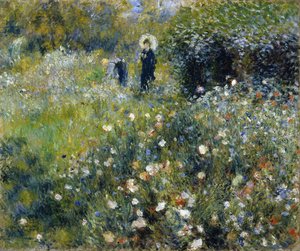
Immerse yourself in Renoir’s "The Garden," a masterpiece of Impressionism! Witness light, color, and fleeting beauty captured with loose brushstrokes & vibrant hues. Explore this iconic work's history & technique.
Taiteilijan elämäkerta
Pierre-Auguste Renoir (1841-1919): Ranskalainen impressionisti, joka vangitsi valon ja elämänilon maalauksissaan! Tutustu hänen mestariteoksiinsa TopImpressionistsissa.
About the painting
A Symphony of Light and Color: The Essence of Renoir’s Garden
In the pantheon of Impressionism, few works capture the ephemeral magic of a summer afternoon as tenderly as Pierre-Auguste Renoir’s “The Garden,” completed in 1875. This masterpiece is far more than a mere landscape; it is a profound meditation on the fleeting nature of beauty and the vibrant pulse of life. As one gazes upon the canvas, they are immediately transported to a sun-drenched sanctuary where the boundaries between humanity and nature seem to dissolve. The painting centers around a graceful woman strolling along a path, flanked by flowerbeds that erupt in a breathtaking palette of scarlet, ivory, and soft blush pink. Renoir’s ability to orchestrate these hues creates a sensory experience that feels almost tactile, inviting the viewer to step into this lush, breathing world.
The composition is masterfully layered to provide both intimacy and depth. While the woman in the foreground serves as our emotional anchor, scattered figures populate the background, suggesting a larger, lively social tapestry woven into the natural splendor. A subtle yet poignant detail—a bird perched delicately on a branch—serves as a reminder of the spontaneous, unscripted beauty found in the wild. For the discerning collector or interior designer, this painting offers a sense of movement and vitality; it is a piece that does not merely sit upon a wall but breathes life into a room, acting as a window into a more luminous era.
Technique and the Impressionist Spirit
Renoir’s technical brilliance lies in his rejection of the rigid, photographic realism favored by the academic traditions of his time. Instead, he embraced the revolutionary plein air approach, working directly from nature to capture the true essence of light. His technique is characterized by loose, rhythmic brushstrokes and a sophisticated use of broken color. Rather than blending pigments into a flat, uniform shade on his palette, Renoir applied thin glazes of color that blend optically in the viewer's eye. This method allows the sunlight to appear as if it is truly dancing across the petals and skin of his subjects.
This luminous effect creates an airy, weightless quality that is a hallmark of his style. The way light filters through the foliage, creating dappled shadows and brilliant highlights, demonstrates a mastery of atmosphere that few could replicate. For those seeking to adorn a space with art that evokes tranquility and warmth, Renoir’s method provides a perfect balance of complexity and softness. The painting does not demand attention through heavy, dark tones; rather, it seduces the eye with its brilliance and the delicate interplay of light and shadow.
Historical Resonance and Emotional Legacy
To understand “The Garden” is to understand the birth of a movement. Created during a period of intense artistic experimentation in Paris, the work stands as a testament to the courage of the Impressionist circle—including luminaries like Monet and Sisley—who dared to challenge the status quo. Renoir’s journey from a humble porcelain painter to a master of light informs the very texture of his work; there is a certain preciousness to his application of color that echoes his early training in delicate ornamentation.
Beyond its historical significance, the emotional impact of the piece is timeless. It evokes a sense of nostalgia for a pastoral ideal, a peaceful retreat from the complexities of modern life. The painting celebrates femininity, social harmony, and the simple joy of existence. Whether displayed in a grand salon or a quiet study, a high-quality reproduction of this work serves as a constant source of inspiration, reminding us to find beauty in the fleeting moments and to appreciate the vibrant colors that surround us every day.
Kysymykset ja vastaukset
Miten teoksen Pierre-Auguste Renoir:n "The Garden" tunnelma on kuvattu?
Teoksen Pierre-Auguste Renoir:n "The Garden" yleinen tunnelma on Serene. Tunnelma kuvaa teoksen yleistä ilmapiiriä.
Mitä tunnetta Pierre-Auguste Renoir:n "The Garden" välittää?
Pierre-Auguste Renoir:n "The Garden" välittää Joyful tunteen yleisessä Serene tunnelmassa.
Miten "The Garden" asettuu osaksi Pierre-Auguste Renoir'n teemoja ja tyyliä?
"The Garden" jakaa Pierre-Auguste Renoir'n muiden teosten kanssa Impressionism-tyylin sekä toistuvat teemat: light-infused impressionist style, romantic garden ideals, social leisure, beauty, renoir’s signature aesthetic, celebration of nature's charm.
Quick facts and art quiz
About Pierre-Auguste Renoir

Pierre-Auguste Renoir
1841 - 1919, Ranska
Taiteilijan elämäkerta
Varhaiset Vuodet ja Taiteilijan Alkutaival
Pierre-Auguste Renoir syntyi 25. helmikuuta 1841 Ranskan Limogesissa, vaatimattomiin oloihin räätälin poikana. Hänen lapsuutensa oli liikkuvaista, sillä perhe muutti Pariisiin vuonna 1844 etsimään parempia elanto-mahdollisuuksia. Juuri Pariisin vilkas kaupunkielämä ja sen monimuotoiset ihmiset alkoivat luoda pohjaa Renoirin myöhemmälle taiteelliselle näkemykselle. Nuori Auguste aloitti uransa posliininmaalajana – käytännöllinen valinta, joka oli sanelema velvollisuudesta huolehtia perheen toimeentulosta. Työn ohessa hän löysi lohdun ja inspiraation Louvren taidemuseon vierailuista, tutkien vanhojen mestareiden tekniikoita ja kehittäen syvää kauneudenarvostusta, joka tulisi olemaan hänen tyylinsä tunnusmerkki. Tämä varhainen altistus herätti hänessä intohimon, joka ylitti pelkän käsityötaidon; se oli kutsumus vangita valon ja elämän katoavaiset hetket kankaalle. Vuonna 1860 hän sai luvan jäljentää Louvren teoksia, mikä mahdollisti syvemmän paneutumisen taiteen maailmaan. Myöhemmin Renoir opiskeli Charles Gleyren ateljeessa, jossa hän solmi elinikäisiä ystävyyssuhteita tulevien impressionistien Claude Monet’n, Alfred Sisleyn ja Frédéric Bazillen kanssa – ratkaiseva hetki, joka loi pohjan impressionismin liikkeelle.Realismista Säteileviin Vaikutelmiin
Renoirin taiteellinen kehitys oli kiehtovaa evoluutiota, johon vaikuttivat moninaiset mestarit. Aluksi hän ihaili Gustave Courbet’n ja Édouard Manet’n realismia, arvostaen heidän sitoutumistaan nykyelämän kuvaamiseen rehellisesti ja suoraan. Kuitenkin juuri Peter Paul Rubensin ja Jean-Antoine Watteaun valoisat värit ja aistilliset muodot lumosivat häntä todella, istuttaen hänen teoksiinsa syvän kauneudenarvostuksen ja taipumuksen kuvata ilon ja vapaa-ajan kohtauksia. Nämä varhaiset vaikutteet kiteytyivät, kun Renoir alkoi luoda omaa ainutlaatuista tyyliään, jolle oli tunnusomaista eloisat värit, katkelmallinen siveltötekniikka ja keskittyminen valon hetkellisten vaikutusten vangitsemiseen. Osallistuminen ensimmäiseen impressionistien näyttelyyn vuonna 1874 oli vedenjakaja, vaikka se aluksi kohtasi perinteisen taidemaailman kritiikkiä. Tämä rohkea liike merkitsi akateemisten konventioiden hylkäämistä ja uuden taiteellisen vision omaksumista – visiota, joka pyrki vangitsemaan paitsi mitä silmä näkee, myös miten *tuntuu* kokea tietty hetki. Maalaukset kuten Dance at Le Moulin de la Galette (1876) ilmentävät tätä lähestymistapaa, upottaen katsojan pariisilaisen yöelämän eloisaan tunnelmaan sen hajanaisessa auringonvalossa ja iloisissa hahmoissa.Elämän Katoavaisten Hetkien Vangitseminen: Keskeiset Teokset ja Aiheet
Renoirin tuotanto on juhla elämän yksinkertaisista nautinnoista – intiimeistä kokoontumisista, auringonpaisteisista maisemista ja ihmisen kauneudesta. Luncheon of the Boating Party (1880-81) on ehkä yksi hänen tunnetuimmista teoksistaan, jossa kuvataan seuralaisten iloista iltapäivää Seinellä. Maalaus on mestarillinen valon ja liikkeen kuvaus, hahmot kylpevät lämpimässä auringonvalossa ja heijastukset kimaltelevat vedessä. After the Bath (1885-87) esittelee Renoirin hienoa taitoa naisvartalon kuvaamisessa, korostaen herkkiä ihonsävyjä ja sulavia asentoja. Hänen maalauksensa eivät ole pelkkiä todellisuuden kuvauksia; ne ovat täynnä lämpöä, intiimiä tunnelmaa ja iloa, joka resonoi syvästi katsojassa. Hän ei ollut kiinnostunut suurista historiallisista kertomuksista tai dramaattisista allegorioista; sen sijaan hän keskittyi vangitsemaan kauneuden, joka piilee jokapäiväisessä elämässä, kohottaen arkiset hetket taideteoksiksi. Dance at Bougival, toinen tunnettu teos, osoittaa hänen kykynsä vangita ohimeneviä vaikutelmia ja tunnelmaa, luoden liikkeen ja spontaanisuuden tunteen.Muodon ja Rakenteen Suuntaan: Myöhemmät Vuodet ja Perintö
1890-luvulla Renoirin tyyli koki merkittävän muutoksen. Vaikka hän ei koskaan hylännyt täysin impressionistisia juuriaan, hän alkoi siirtyä kohti veistoksellisempaa ja klassisempaa lähestymistapaa, johon vaikuttivat hänen matkansa Italiaan ja uusi kiinnostus muotoon ja rakenteeseen. Tähän muutokseen vaikutti myös fyysinen rajoittuneisuus – niveltulehdus rajoitti vähitellen hänen liikkuvuuttaan, pakottaen hänet sopeuttamaan tekniikkaansa. Näistä haasteista huolimatta Renoir jatkoi maalaamista horjumattomalla omistautumisella, tuottaen teoksia, joille on tunnusomaista täyteläisemmät muodot ja lämpimämpi väripaletti. Hänen myöhemmissä maalauksissaan heijastuu usein pohdiskelevampi tunnelma, mutta ne säilyttävät silti saman kauneuden juhlinnan, joka määritteli hänen varhaisemman työnsä. Renoirin perintö ulottuu taiteellisten saavutustensa lisäksi myös hänen perheeseensä; hänen poikansa Jean Renoirista tuli tunnettu elokuvantekijä, välittäen luovan hengen sukupolvelta toiselle. Pierre-Auguste Renoir kuoli vuonna 1919 jättäen jälkeensä kestävästi vaikuttavan tuotannon, joka jatkaa inspiroimasta ja ilahduttamasta yleisöä ympäri maailmaa. Hän on edelleen yksi rakastetuimmista hahmoista taidehistoriassa, jota ylistetään hänen kyvystään vangita elämäniloa ja ihmisen kokemuksen kauneutta vertaansa vailla olevalla herkkyydellä ja tyylikkyydellä.Kestävä Vaikutus
- Renoirin vaikutus myöhempiin taiteilijasukupolviin on kiistaton. Hänen painotuksensa valolle, värille ja hetkellisten hetkien vangitsemiselle tasoitti tietä monille moderneille taidesuuntauksille.
- Hänen kauneuden ja aistillisuuden juhlimisensa resonoi edelleen yleisön kanssa tänään, tehden hänen teoksistaan universaalisti vetoavia.
- Hänellä oli keskeinen rooli impressionismin vakiinnuttamisessa merkittävänä voimana taidehistoriassa, haastaen perinteisiä konventioita ja avaten uusia mahdollisuuksia taiteelliselle ilmaisulle.
- Hänen maalaustensa kestävä suosionsa – toistuen lukemattomissa julisteissa, kalentereissa ja muissa tuotteissa – todistaa hänen työnsä ajattomuudesta.
Quick facts about Pierre-Auguste Renoir
- Artistic Movement Or Style: impressionismi
- Artists Or Movements Influenced By This Artist: ['impressionismi']
- Artists Who Influenced This Artist:
- Rubens
- Watteau
- Courbet
- Manet
- Date Of Birth: 25. helmikuuta 1841
- Date Of Death: 3. joulukuuta 1919
- Full Name: Pierre-Auguste Renoir
- Nationality: ranskalainen
- Notable Artworks:
- Dance at Le Moulin de la Galette
- Luncheon of the Boating Party
- After the Bath
- Dance at Bougival
- Place Of Birth: Limoges, Ranska
Samankaltaisia teoksia




Tutustu teoksiin, jotka on järjestetty aiheiden, tyylien ja ominaisuuksien mukaan.


Pierre-Auguste Renoir
The Garden
() ·
With its frame: · Hand-painted in oil on linen
Total