

Shown: · With its frame:
 Esikatselu
 Jaa teos
 Jaa
Jaa
 Tiedot
 Opas
Opas

 Lataa kuva
 Samanlaisia kohteita
 Röntgenkuvaus
 Diaesitys
 Q&A
Q&A Tilastot
 Acrylic On Canvas
- WallArt
- Cubist Influences
 1938
1938 127.0 x 174.0 cm
 Royal Scottish Academy of Art - Architecture
€ 239
Käsinmaalattu öljyvärinen jäljennös
Käsinmaalattu öljyväri kankaalle haluamassasi koossa ja kehyksissä, taiteilijoidemme valmistamana tilauksesta. ( Vaihda tulosteeseen Siirry digitaaliseen kuvaan)
Tämä teos on tekijänoikeuden suojaama
Tällä sivulla esitettyä taideteosta suojaa tekijänoikeuslaki, mikä tarkoittaa, ettemme voi laillisesti luoda tai myydä täsmälleen samanlaista jäljennöstä. Tämä suoja toteutetaan kansainvälisten sopimusten, kuten esimerkiksi Berne-konventio ja kansallisilla laeilla, mukaan lukien niillä määritellyt Yhdysvaltain tekijänoikeuslaki – Luku 17. Kaikki oikeudet pidätetään. Luvaton kopiointi tai jäljittely on kielletty.
Kunnioittavana ja laillisena vaihtoehtona tarjoamme alkuperäisestä inspiroituneita, yksilöllisiä ja käsinmaalattuja taideteoksia. Taitavat ja ammattimaiset taiteilijamme tutkivat huolellisesti alkuperäisen teoksen tyyliä, tunnelmaa ja taiteellista ydintä luodakseen uuden, ainutlaatuisen teoksen, joka herättää saman tunteen – säilyttäen samalla oman itsenäisen alkuperäisyytensä.
Tämä menetelmä noudattaa täysin tekijänoikeussäännöksiä, sillä se ei sisällä suojatun taideteoksen kopioimista tai jäljentämistä. Sen sijaan kyseessä on luova uudelleentulkinta – uusi maalaus, joka ammentaa vaikutteita alkuperäisestä, mutta ei ole sen identtinen kopio.
 Lue lisää
Size
·Vakiokoko
räätälöity
CM
INCH
Valitse valmiista mitoistamme sellaiset, jotka vastaavat teoksen alkuperäisiä mittasuhteita.
Loading sizes...

leveys
korkeus
Kirjoita tarvitsemasi leveys ja korkeus, jotta teos sopii kehyksiisi tai seinällesi. Koska kyseessä on käsinmaalattu teos, taiteilija voi maalata hieman enemmän kuvan ympärille tai rajata sitä hieman, jos haluat eri muotoisen koon — valinta on sinun. Lähetämme sinulle digitaalisen mallikuvan hyväksyttäväksi ennen kuin maalaus alkaa. Tällä sivulla näkyvä kuva ei vastaa lopullista tulosta — vain mallikuva näyttää sen.
Finish
·
White €1

Blurside €1

Extended €1

P118B €10

P118H €10

P118W €10

P438Z €10

P508JH €12

P508YH €12

P805H €10

P805Z €10

P919BZ €10

P919G €10

P919XJ €10

P959ZH €10

P968JZ €12

W106C €8

W218G €10

W218JH €8

W218Y €10

W307PJ €10

W316G €10

W316PJ €8

W316Y €10

W398PJ €8

W4111J €10

W500HY €15

W500JH €15

W692G €12

W849H €8

W940BG €15

W953PJ €8

H24-GOLD €30

H24-SILVER €30

H36-GOLD €45

H36-SILVER €45
Shipped in a protective tube, ready for your own framer.
Above 105 cm the frame is shipped as a kit for a professional framer — read the details.
Extras
optionalWhat do the extras include?
Examples of what can be changed: Replace face with customer photo; Add pet (e.g., replace cat with dog); Include hidden message in background; Change background landscape or elements.
After order, TopImpressionists.com team will email client for instructions and provide a mockup preview
After order, TopImpressionists.com team will email client for instructions and provide a mockup preview
Maailmanlaajuinen toimitus () 3–4 viikossa tavallisen 5 viikon sijaan. (31 lokakuu). Laadusta ei tingitä.
Suojalakkaus
Nimilaatta
Kaiverretun pronssilaatan tiedot
This elegant plaque features the artist's name and the title of the artwork, finely engraved for a timeless presentation.
It is made from bronze with a refined, elegant finish. The text is precisely laser-engraved for a sharp and permanent result. Measuring 9x2 cm, the plaque is compact yet easy to read. It's built to be durable and scratch-resistant, offering a professional, museum-quality look. Mounting is simple thanks to the included adhesive backing.
Läpinäkyvän akryylilaatan tiedot
The plaque includes essential engraved details such as the artist's name, the title of the artwork, the date it was created, the type of media used-like oil on canvas or watercolor-a brief description of the piece, and a QR code that links to the complete artwork information.
It is crafted from clear acrylic, offering a sleek, modern appearance. The text is UV-engraved in black to ensure strong visual contrast. With a size of 10x15 cm, it ensures optimal readability. It comes equipped with two metal hooks for secure wall mounting. The plaque is designed to be weather-resistant, making it suitable for various environments, and it includes interactive features that work seamlessly with smartphone scanning.
Mustan akryylilaatan tiedot
This elegant plaque includes engraved information such as the artist's name, the title of the artwork, the date it was created, the type of media used (like oil on canvas or watercolor), a short description of the artwork, and a QR code for quick access to more information.
The plaque itself is made from refined black acrylic with a premium finish. The text is laser-engraved in white for high contrast and readability. Its size is 10x15 cm, designed to be easy to read. It comes with two metal hooks for professional mounting. The design is sleek and fits any interior style. It is also weather-resistant and durable, with built-in digital integration for mobile compatibility.
Lasivaihtoehto on saatavilla vain alle 110 cm kokoisille teoksille
 Lasivaihtoehto on saatavilla vain alle 110 cm kokoisille teoksille
- Ilmainen pikatoimitus ympäri maailman
- Korkealaatuinen pellavakangas
- Kattava kuljetusvakuutus
- Tulliveron palautustakuu
- Takuu täydellisestä värien vastaavuudesta
- 100 päivän palautusoikeus (vain valmistusvirheet)
- 100% rahat takaisin -takuu
- Määräalennus tarjolla


Keräilykohteen kuvaus
Gillies’ artistic development was significantly shaped by his exposure to Cubist principles and the visionary aesthetics of Paul Klee.
Taiteilijan elämäkerta
W.G. Gillies oli merkittävä skotlantilainen maisema- ja elämöiden maalari, jonka tyyli yhdistää modernismin ja perinteisen skotlantilaisen taiteen. Tunnettu 1922 Groupin jäsenenä ja Edinburghin taidekoulun johtajana.
About the painting
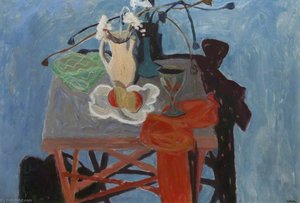
A Window Into Domestic Tranquility: Exploring William Gillies’ “Interior”
William George Gillies (1898 – 1973), a Scottish painter whose career spanned decades of artistic exploration, remains an enduring figure in British Modernism. His work embodies a quiet contemplation of everyday life, capturing the essence of domestic serenity with remarkable precision and subtle emotional resonance. “Interior,” completed in 1938, exemplifies Gillies’ distinctive approach – blending influences from Cézanne and Picasso with a burgeoning fascination for Paul Klee’s imaginative use of colour.
Subject Matter & Composition: The painting depicts a familial scene within a living room. A man and woman stand attentively near a window, bathed in diffused light—a deliberate choice that underscores the importance of natural illumination in Gillies' aesthetic vision. Two children are present, one playfully holding a ball, injecting an element of youthful energy into the otherwise tranquil composition. The arrangement is carefully considered, prioritizing balance and visual harmony.
Style & Technique: Gillies’ style leans heavily towards Cézanne’s geometric simplification and Picasso’s muted palette, yet he transcends mere imitation. He achieves a remarkable level of realism through meticulous observation—evident in the depiction of textures like the worn upholstery of the armchair and the smooth surface of the vases. However, unlike purely representational art, Gillies imbues his canvases with an underlying sense of abstraction. The fragmented planes of colour and form subtly suggest movement and depth, mirroring the complexities hidden beneath the surface of domestic life.
Historical Context: “Interior” was created during a period of significant artistic experimentation in Britain following World War I. Gillies’ engagement with Cubism reflected the broader intellectual currents of the time—a desire to challenge traditional perspectives and embrace new visual languages. Simultaneously, his encounter with Klee signaled a shift towards incorporating childlike spontaneity and emotional expression into his art – a reaction against the perceived rigidity of earlier artistic movements.
Symbolism & Emotional Impact: Beyond its formal qualities, “Interior” speaks to deeper themes of family connection and domestic comfort. The window serves as a visual metaphor for openness and contemplation—a reminder that beauty can be found in simplicity and stillness. The carefully placed objects – vases, bowls, apples – contribute to the overall atmosphere of refined elegance. Ultimately, Gillies’ masterpiece evokes a feeling of warmth, tranquility, and understated joy—capturing the quiet dignity of everyday life with an artist's unwavering eye.
Reproductions & Inspiration: Today, “Interior” continues to inspire artists and designers alike. High-quality reproductions allow viewers to appreciate Gillies’ masterful technique and capture the painting’s evocative mood. Consider incorporating elements of Cézanne’s geometric precision alongside Picasso’s muted palette into your own interior design projects – a testament to the enduring legacy of this remarkable Scottish painter.
Kysymykset ja vastaukset
Onko William George Gillies:n "Interior" maalaus, piirros vai grafiikan lehti?
Luettelossa teos William George Gillies:n "Interior" on luokiteltu tyypiksi WallArt. Kategoria auttaa löytämään samankaltaisia teoksia.
Kuinka suosittu "Interior" on Cubist Influences-suuntauksessa?
Cubist Influences-suuntauksen sisällä teoksella "Interior" on Recognized suosio.
Kuka on teoksen "Interior" tekijä ja mihin taidesuuntaukseen se kuuluu?
"Interior" on William George Gilliesn luoma Cubist Influences-tyylinen teos. Taiteilija ja tyylisuunta määrittelevät teoksen perinteet.
Quick facts and art quiz
About William George Gillies

William George Gillies
1898 - 1973, Iso-Britannia
Taiteilijan elämäkerta
Early Life and Artistic Beginnings
Sir William George Gillies, a name synonymous with the evocative beauty of Scottish landscapes and still lifes, was born in Haddington, East Lothian, in 1898. His early life unfolded amidst the rolling hills and historic charm of his native region – a landscape that would profoundly shape his artistic vision. Initially enrolled at the Edinburgh College of Art, Gillies’ academic pursuits were abruptly interrupted by the exigencies of World War I, where he served with distinction as an engineer in the Royal Engineers. This experience, marked by both hardship and camaraderie, undoubtedly instilled within him a resilience and perspective that would later inform his artistic approach. Following the war's conclusion, he returned to complete his education at the Edinburgh College of Art, ultimately securing a position as a dedicated teacher there for over four decades – a role that not only sustained his livelihood but also allowed him to nurture the talents of countless aspiring artists.A Journey Through Modernism: Influences and Early Style
Gillies’ artistic journey began with an exploration of Cubism after studying under André Lhote in Paris during 1923, and a subsequent visit to Italy in 1924. This exposure to European avant-garde movements ignited within him a desire to break from traditional representation, leading to early works that demonstrated a clear influence from Cézanne – particularly in their carefully arranged compositions and use of perspective – alongside the understated color palettes characteristic of artists like Braque and Picasso. However, a pivotal moment arrived in 1934 when he encountered the work of Paul Klee. Klee’s imaginative use of colour, his playful distortions of form, and his embrace of childlike qualities profoundly impacted Gillies' style, encouraging him to move beyond strict Cubist principles and infuse his paintings with a greater sense of spontaneity and emotional resonance. This shift marked a significant departure from the rigid structures of earlier works, paving the way for his distinctive, uniquely Scottish aesthetic.The 1922 Group: A Hub of Innovation
In 1922, Gillies played a crucial role in establishing the “1922 Group,” alongside fellow artists such as William Crozier, William Geissler, and William MacTaggart. This collective, operating out of the New Gallery in Edinburgh, served as a vital platform for emerging Scottish artists to showcase their work to a wider audience. The 1922 Group fostered a remarkable sense of community and collaboration within the Scottish art scene – a period of intense creative energy and experimentation. It provided a space where artists could challenge conventions, explore new ideas, and support one another’s endeavors, contributing significantly to the flourishing of modern art in Scotland during the interwar years.Themes and Artistic Focus: Landscapes and Still Lifes
Gillies' artistic focus primarily revolved around two distinct yet interconnected themes: landscapes and still lifes. He is particularly renowned for his evocative depictions of the Lothian, Fife, and Border regions of Scotland – capturing not just their physical beauty but also the spirit and character of these diverse environments. His paintings are imbued with a deep sense of place, reflecting his intimate knowledge of the region’s topography, light, and atmosphere. Simultaneously, Gillies developed a remarkable skill in creating still life compositions, often featuring ceramics crafted by his younger sister, Emma Smith Gillies – whose untimely death in 1936 profoundly affected him and became a recurring motif in his work. These poignant still lifes served as both personal memorials and explorations of themes such as loss, memory, and the passage of time.Recognition and Legacy
Throughout his distinguished career, Sir William George Gillies received numerous accolades recognizing his artistic merit and contributions to Scottish art. He was elected a Royal Academician (RA) in 1964, signifying the highest level of recognition within the British art world. In 1970, he was knighted for his services to the arts. His influence extended beyond his own paintings, shaping the direction of Scottish art through his teaching and mentorship at the Edinburgh College of Art, where he served as Principal from 1959 until his retirement in 1966. Gillies’ legacy endures not only through his captivating artworks – which are now held in prestigious collections across Scotland and internationally – but also through the countless artists he inspired to pursue their own creative visions. He died peacefully in 1973, leaving behind a body of work that continues to resonate with viewers today, embodying both the beauty of Scottish landscapes and the profound depths of human emotion.Quick facts about William George Gillies
- Artistic Movement Or Style: Skotlantilainen modernismi
- Artists Or Movements Influenced By This Artist: ['Skotlantilainen värimaalaus']
- Artists Who Influenced This Artist:
- André Lhote
- Cézanne
- Braque
- Picasso
- Paul Klee
- Date Of Birth: 1898
- Date Of Death: 1973
- Full Name: Sir William George Gillies
- Nationality: Skotlantilainen
- Notable Artworks:
- Young Boy with a Teapot
- Mediterranean Landscape
- Still Life – Yellow Jug
- Place Of Birth: Haddington, Iso-Britannia
Samankaltaisia teoksia


Tutustu teoksiin, jotka on järjestetty aiheiden, tyylien ja ominaisuuksien mukaan.




William George Gillies
Interior
() ·
With its frame: · Hand-painted in oil on linen
Total