

Esitetty: · Kehyksineen:
 Esikatselu
 Jaa teos
 Jaa
Jaa
 Tiedot
 Opas
Opas

 Lataa kuva
 Samanlaisia kohteita
 Röntgenkuvaus
 Diaesitys
 Kysymykset ja vastaukset
 Tilastot

€ 285
Käsinmaalattu öljyvärinen jäljennös
Käsinmaalattu öljyväri kankaalle haluamassasi koossa ja kehyksissä, taiteilijoidemme valmistamana tilauksesta. ( Vaihda tulosteeseen Siirry digitaaliseen kuvaan)
Koko
·Vakiokoko
räätälöity
CM
INCH
Valitse valmiista mitoistamme sellaiset, jotka vastaavat teoksen alkuperäisiä mittasuhteita.
Koot ladataan...

leveys
korkeus
Kirjoita tarvitsemasi leveys ja korkeus, jotta teos sopii kehyksiisi tai seinällesi. Koska kyseessä on käsinmaalattu teos, taiteilija voi maalata hieman enemmän kuvan ympärille tai rajata sitä hieman, jos haluat eri muotoisen koon — valinta on sinun. Lähetämme sinulle digitaalisen mallikuvan hyväksyttäväksi ennen kuin maalaus alkaa. Tällä sivulla näkyvä kuva ei vastaa lopullista tulosta — vain mallikuva näyttää sen.
 Lue lisää
Viimeistely
·
Valkoinen reuna €1

pehmennetty reuna €1

Jatkuva reuna €1

P118B €10

P118H €10

P118W €10

P438Z €10

P508JH €12

P508YH €12

P805H €10

P805Z €10

P919BZ €10

P919G €10

P919XJ €10

P959ZH €10

P968JZ €12

W106C €8

W218G €10

W218JH €8

W218Y €10

W307PJ €10

W316G €10

W316PJ €8

W316Y €10

W398PJ €8

W4111J €10

W500HY €15

W500JH €15

W692G €12

W849H €8

W940BG €15

W953PJ €8

H24-GOLD €30

H24-SILVER €30

H36-GOLD €45

H36-SILVER €45
Toimitetaan suojaputkessa, valmiina kehystettäväksi omassa kehyksessäsi.
Yli 105 cm kokoiset kehykset toimitetaan osasarjana ammattilaiskehystäjälle — lue lisätiedot.
Lisäpalvelut
valinnainenMitä lisämateriaalit sisältävät?
Esimerkkejä muutettavista asioista: Vaihda kasvot asiakkaan valokuvaan; Lisää lemmikki (esim. vaihda kissa koiraksi); Lisää piilotettu viesti taustalle; Vaihda taustan maisemaa tai elementtejä.
Tilauksen jälkeen TopImpressionists.com -tiimi lähettää asiakkaalle sähköpostia ohjeita varten ja toimittaa luonnoksen esikatselun
Tilauksen jälkeen TopImpressionists.com -tiimi lähettää asiakkaalle sähköpostia ohjeita varten ja toimittaa luonnoksen esikatselun
Maailmanlaajuinen toimitus () 3–4 viikossa tavallisen 5 viikon sijaan. (7 marraskuu). Laadusta ei tingitä.
Suojalakkaus
Nimilaatta
Kaiverretun pronssilaatan tiedot
This elegant plaque features the artist's name and the title of the artwork, finely engraved for a timeless presentation.
It is made from bronze with a refined, elegant finish. The text is precisely laser-engraved for a sharp and permanent result. Measuring 9x2 cm, the plaque is compact yet easy to read. It's built to be durable and scratch-resistant, offering a professional, museum-quality look. Mounting is simple thanks to the included adhesive backing.
Läpinäkyvän akryylilaatan tiedot
The plaque includes essential engraved details such as the artist's name, the title of the artwork, the date it was created, the type of media used-like oil on canvas or watercolor-a brief description of the piece, and a QR code that links to the complete artwork information.
It is crafted from clear acrylic, offering a sleek, modern appearance. The text is UV-engraved in black to ensure strong visual contrast. With a size of 10x15 cm, it ensures optimal readability. It comes equipped with two metal hooks for secure wall mounting. The plaque is designed to be weather-resistant, making it suitable for various environments, and it includes interactive features that work seamlessly with smartphone scanning.
Mustan akryylilaatan tiedot
This elegant plaque includes engraved information such as the artist's name, the title of the artwork, the date it was created, the type of media used (like oil on canvas or watercolor), a short description of the artwork, and a QR code for quick access to more information.
The plaque itself is made from refined black acrylic with a premium finish. The text is laser-engraved in white for high contrast and readability. Its size is 10x15 cm, designed to be easy to read. It comes with two metal hooks for professional mounting. The design is sleek and fits any interior style. It is also weather-resistant and durable, with built-in digital integration for mobile compatibility.
Lasivaihtoehto on saatavilla vain alle 110 cm kokoisille teoksille
 Lasivaihtoehto on saatavilla vain alle 110 cm kokoisille teoksille
- Ilmainen pikatoimitus ympäri maailman
- Korkealaatuinen pellavakangas
- Kattava kuljetusvakuutus
- Tulliveron palautustakuu
- Takuu täydellisestä värien vastaavuudesta
- 100 päivän palautusoikeus (vain valmistusvirheet)
- 100% rahat takaisin -takuu
- Määräalennus tarjolla


Keräilykohteen kuvaus
Explore Walter Ufer’s ‘Sleep,’ a poignant oil painting of Native American women in Taos. Discover realism, rich detail & cultural symbolism – a unique 20th-century artwork.
Taiteilijan elämäkerta
Saksalaissyntyinen amerikkalainen taiteilija Walter Ufer (1876–1936) tunnetaan vaikuttavista maalauksistaan Taoksessa, New Mexicossa. 'Taos Ten' -ryhmän jäsen, joka tunnetaan genrekuvista ja eloisista maisemista. Tutustu hänen taiteeseensa.
Tietoa maalauksesta
The Weight of Tradition: An Encounter with Walter Ufer’s “Sleep”
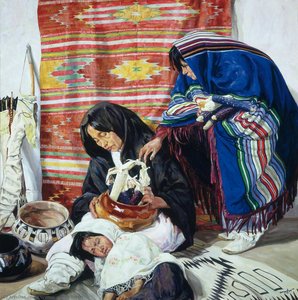
Walter Ufer's "Sleep," painted in 1923, isn’t merely a depiction of three Native American women; it’s an immersion into a world steeped in ritual and profound reverence. The painting immediately draws the viewer in with its rich tapestry of color – predominantly warm reds, oranges, and browns that evoke the earth itself, grounded by cooler blues and greens woven through the textiles and pottery. This palette isn't simply decorative; it speaks to the cultural heritage of the subjects, hinting at a deep connection to the land and ancestral traditions. The composition is carefully orchestrated, centering on the kneeling woman as a focal point, yet subtly inviting us into the periphery of the scene, suggesting an active participation in this sacred space.
Ufer’s masterful technique reveals layers of painstaking detail. He employs a layered oil painting approach, building up texture with deliberate brushstrokes that create a palpable sense of roughness on the clothing – perhaps representing the wear and tear of daily life intertwined with ceremonial garb – while simultaneously rendering the pottery with smooth, almost polished surfaces. This juxtaposition speaks to the duality inherent in Native American culture: the balance between practicality and spirituality, the tangible and the intangible. The lighting, soft and diffused, isn’t dramatic; it's deliberately muted, casting subtle shadows that lend a sense of solemnity and depth to the figures and objects, as if illuminating a secret whispered within a sacred space.
A Window into Taos: Contextualizing Ufer’s Vision
To fully appreciate “Sleep,” it's crucial to understand its historical context. Painted in 1923, during his time in Taos Pueblo, New Mexico, the artwork represents a pivotal moment in Walter Ufer’s career and his deep engagement with Native American culture. He was part of the "Taos Ten," a group of artists who sought to document and celebrate the lives and traditions of the region's indigenous communities. This wasn’t simply an act of observation; it was a deliberate attempt at understanding and portraying these cultures with respect and authenticity, a rare undertaking for American art at the time.
Ufer’s background as a German-born artist profoundly shaped his approach. His training in Europe instilled a meticulous attention to detail and a sophisticated understanding of composition – elements he skillfully translated into his depictions of Native American life. However, it was his immersion within the Taos community that truly informed his work, allowing him to capture not just appearances but also the spirit and essence of these traditions. The painting’s realism is tempered by an underlying sense of mystery, inviting viewers to contemplate the deeper meanings embedded within the scene.
Symbolism Woven into the Fabric
The details within “Sleep” are laden with symbolic significance. The intricately patterned rug serves as a visual anchor, framing the central figures and providing a rich backdrop that speaks to the importance of storytelling and communal life within Native American culture. The pottery, often adorned with geometric designs and natural motifs, represents both artistic skill and spiritual connection – a tangible link to ancestors and the earth. The women themselves, engaged in what appears to be a ritualistic activity, are not simply subjects; they embody generations of tradition, wisdom, and connection to the divine.
The act depicted—kneeling in reverence—suggests healing or a profound spiritual ceremony. The quiet dignity of the figures, coupled with the muted colors and soft lighting, evokes a sense of solemnity and timelessness. It’s an image that transcends mere representation, offering a glimpse into a world governed by ancient beliefs and deeply rooted traditions.
A Legacy of Authenticity: Reproductions and Beyond
Walter Ufer's "Sleep" remains a powerful testament to the beauty and complexity of Native American culture. TopImpressionists offers high-quality, hand-painted reproductions that faithfully capture the painting’s rich detail and evocative atmosphere. These reproductions are more than just images; they are windows into another world—a world of sacred rituals, profound traditions, and enduring wisdom. Investing in a reproduction is an investment in preserving this important piece of American art history and honoring the legacy of Walter Ufer's insightful portrayal.
Kysymykset ja vastaukset
Miten "Sleep" tasapainottaa valon ja varjon?
Teoksen Walter Ufer:n "Sleep" mitatut arvot ovat: kirkkaus bright, luminanssi Gentle Luminance.
Millaista tunnelmaa Walter Ufer:n "Sleep" välittää Contemporary Realism-suuntauksessa?
"Sleep" teoksen Melancholic tunnelma kulkee käsi kädessä sen Contemporary Realism tyylin kanssa.
Kuka on teoksen "Sleep" tekijä ja mihin taidesuuntaukseen se kuuluu?
"Sleep" on Walter Ufern luoma Contemporary Realism-tyylinen teos. Taiteilija ja tyylisuunta määrittelevät teoksen perinteet.
Pikaopas ja taidevisailu
Tietoa artistista Walter Ufer

Walter Ufer
1876 - 1936, Saksa
Taiteilijan elämäkerta
Lounaisen Amerikan sielu: Walter Uferin elämä ja perintö
Walter Ufer seisoo amerikkalaisen impressionismin keskeisenä hahmona, maalarina, jonka siveltimenvedot tekivät enemmän kuin vain vangitsivat valoa; ne tavoittivat koko kulttuurin sydämensykkeen. Saksassa, Hückeswagenissa vuonna 1876 syntyneen Uferin matka New Mexicon korkeille aavikoille oli muovautunut tiukan eurooppalaisen koulutuksen ja syvän uteliaisuuden myötä ihmisyyden tilaa kohtaan. Hänen varhaisia vuosiaan määritteli saksalais-amerikkalainen diaspora Louisvillessa, Kentuckyssa, missä hän alkoi ensimmäisen kerran imeä itseensä perintönsä rikkaita tekstuureja. Tämä perustavanlaatuinen ajanjakso, johon kuuluivat litografian ja grafiikan opinnot, antoi hänelle teknistä tarkkuutta, joka mahdollisti myöhemmin valon ja varjon monimutkaisuuksien hallinnan vertaansa vailla olevalla mestaruudella.
Tahto saavuttaa taiteellinen huippu johdatti hänet muutosvoimaiselle vaellukselle halki Euroopan. Matkaavana oppipoikana Ufer uppoutui mantereen monipuolisiin taideperinteisiin ja hioi tekniikkaansa arvostituissa Hampurin ja Dresdenin akatemioissa. Tämä intensiivisen älyllisen ja luovan laajentumisen kausi huipentui hänen aikaansa Münchenissä, missä hän omistautui syvälliselle ateljeotyölle. Kun hän lopulta palasi Yhdysvaltoihin vuonna 1911, hän kantoi mukanaan hienostunutta eurooppalaista herkkyyttä, joka oli valmis kohtaamaan Amerikan lännen karut ja auringon paahtamat maisemat.
Taos Ten -ryhmän visionääri
Vuosi 1914 merkitsi ratkaisevaa käännekohtaa Uferin elämässä ja amerikkalaisen taiteen suunnassa. Siirtyessään Taos Pueblon alueelle New Mexicossa, hän löysi itsensä osaksi poikkeuksellista taiteellista vallankumousta. Liittyessään vaikutusvaltaiseen "Taos Ten" -ryhmään Uferista tuli keskeinen hahmo kollektiivissa, joka pyrki liikkumaan pelkän maisemamaalauksen ulkopuolelle kohti alkuperäiskansojen elämän autenttisempaa ja viskeraalisempaa kuvausta. Toisin kuin monet hänen aikalaistensa, jotka näkivät lounaisosan romantisoituna tai kolonialistisena linssinä, Ufer lähestyi aiheitaan syvällä kunnioituksella ja silmällä, joka arvosti jokapäiväisen olemassaolon arvokkuutta.
Hänen työstään tuli silta eurooppalaisten impressionististen tekniikoiden ja Pueblo-kansan raa'an, henkisen energian välille. Hän ei ollut pelkkä tarkkailija, vaan rituaalien, maisemien ja yhteisöllisen elämän hiljaisten rytmien kronikoija. Tämän luovan evoluution ytimessä oli hänen suhteensa Jim Mirabaliin, taos-intiaaniksi, joka toimi sekä Uferin muusana että yhteistyökumppanina. Tämän yhteyden kautta Ufer saavutti intiimin ymmärryksen alueen kulttuurisista vivahteista, mikä antoi hänelle mahdollisuuden täyttää kankaansa elävällä totuudella, joka resonoi kauas New Mexicon rajojen ulkopuolelle.
Tekniikka, symboliikka ja historiallinen merkitys
Uferin tuotetta leimaa mestarillinen värinkäyttö ja rohkea, ekspressiivinen maalin levittäminen. Vaikka hänen tyylinsä oli juurtunut amerikkalaisen impressionismin periaatteisiin, se nojasi usein vankempaan ja tekstuuripitoisempaan lähestymistapaan, joka vangitsi aavikon auringon kuumuuden ja maan painon. Hän käytti valoa paitsi muodon valaisemiseen, myös tunteiden herättämiseen – luoden kohtauksia, joissa ilmapiiri tuntuu raskautuneen historiasta ja perinteistä.
Walter Uferin historiallinen merkitys piilee hänen kykyssään nostaa genremalaus syvälliseksi sosiaaliseksi ja kulttuuriseksi lausunnoksi. Hänen saavutuksiinsa kuuluvat:
- Autenttinen esittäminen: Eroaminen alkuperäiskansojen elämän "idyllistä" stereotyyppiä pitkin tarjoamalla vivahteikkaamman ja inhimillisemmän muotokuvan Taosin ihmisistä.
- Taos Ten -perintö: Ratkaiseva rooli Taosin vakiinnuttamisessa ensiluokkaisena kohteena amerikkalaiselle modernismille ja alkuperäiskansakeskeisen taiteen elinvoimaisena keskuksena.
Nykyään Uferin maalaukset säilyvät kestävinä todistuksina voimakkaasta kulttuurien kohtaamisesta. Hänen kykynsä kutoa yhteen eurooppalaisen koulutuksensa tekninen tarkkuus ja Pueblo-kulttuurin henkinen syvyys varmistaa, että hänen työnsä jatkavat lumoamistaan, kutsuen nykykatsojia todistamaan Taos-laakson ajatonta henkeä hänen vaikuttavien ja mestarillisten silmiensä kautta.
Pikaaakkaukset taiteilijasta Walter Ufer
- Artistic Movement Or Style: Taos-impressionismi
- Artists Or Movements Influenced By This Artist: ['']
- Artists Who Influenced This Artist: ['']
- Date Of Birth: 1876
- Date Of Death: 1936
- Full Name: Walter Ufer
- Nationality: Saksalais-amerikkalainen
- Notable Artworks:
- Her Daughter
- Builders Of The Desert
- After Them
- Place Of Birth: Hückeswagen, Saksa


Walter Ufer
Sleep
() ·
Kehyksineen: · Käsinmaalattu öljyväreillä pellavalle
Yhteensä