

Esitetty: · Kehyksineen:
 Esikatselu
 Jaa teos
 Jaa
Jaa
 Tiedot
 Opas
Opas

 Lataa kuva
 Samanlaisia kohteita
 Röntgenkuvaus
 Diaesitys
 Kysymykset ja vastaukset
 Tilastot


€ 240
Käsinmaalattu öljyvärinen jäljennös
Käsinmaalattu öljyväri kankaalle haluamassasi koossa ja kehyksissä, taiteilijoidemme valmistamana tilauksesta. ( Vaihda tulosteeseen Siirry digitaaliseen kuvaan)
Koko
·Vakiokoko
räätälöity
CM
INCH
Valitse valmiista mitoistamme sellaiset, jotka vastaavat teoksen alkuperäisiä mittasuhteita.
Koot ladataan...

leveys
korkeus
Kirjoita tarvitsemasi leveys ja korkeus, jotta teos sopii kehyksiisi tai seinällesi. Koska kyseessä on käsinmaalattu teos, taiteilija voi maalata hieman enemmän kuvan ympärille tai rajata sitä hieman, jos haluat eri muotoisen koon — valinta on sinun. Lähetämme sinulle digitaalisen mallikuvan hyväksyttäväksi ennen kuin maalaus alkaa. Tällä sivulla näkyvä kuva ei vastaa lopullista tulosta — vain mallikuva näyttää sen.
 Lue lisää
Viimeistely
·
Valkoinen reuna €1

pehmennetty reuna €1

Jatkuva reuna €1

P118B €10

P118H €10

P118W €10

P438Z €10

P508JH €12

P508YH €12

P805H €10

P805Z €10

P919BZ €10

P919G €10

P919XJ €10

P959ZH €10

P968JZ €12

W106C €8

W218G €10

W218JH €8

W218Y €10

W307PJ €10

W316G €10

W316PJ €8

W316Y €10

W398PJ €8

W4111J €10

W500HY €15

W500JH €15

W692G €12

W849H €8

W940BG €15

W953PJ €8

H24-GOLD €30

H24-SILVER €30

H36-GOLD €45

H36-SILVER €45
Toimitetaan suojaputkessa, valmiina kehystettäväksi omassa kehyksessäsi.
Yli 105 cm kokoiset kehykset toimitetaan osasarjana ammattilaiskehystäjälle — lue lisätiedot.
Lisäpalvelut
valinnainenMitä lisämateriaalit sisältävät?
Esimerkkejä muutettavista asioista: Vaihda kasvot asiakkaan valokuvaan; Lisää lemmikki (esim. vaihda kissa koiraksi); Lisää piilotettu viesti taustalle; Vaihda taustan maisemaa tai elementtejä.
Tilauksen jälkeen TopImpressionists.com -tiimi lähettää asiakkaalle sähköpostia ohjeita varten ja toimittaa luonnoksen esikatselun
Tilauksen jälkeen TopImpressionists.com -tiimi lähettää asiakkaalle sähköpostia ohjeita varten ja toimittaa luonnoksen esikatselun
Maailmanlaajuinen toimitus () 3–4 viikossa tavallisen 5 viikon sijaan. (6 marraskuu). Laadusta ei tingitä.
Suojalakkaus
Nimilaatta
Kaiverretun pronssilaatan tiedot
This elegant plaque features the artist's name and the title of the artwork, finely engraved for a timeless presentation.
It is made from bronze with a refined, elegant finish. The text is precisely laser-engraved for a sharp and permanent result. Measuring 9x2 cm, the plaque is compact yet easy to read. It's built to be durable and scratch-resistant, offering a professional, museum-quality look. Mounting is simple thanks to the included adhesive backing.
Läpinäkyvän akryylilaatan tiedot
The plaque includes essential engraved details such as the artist's name, the title of the artwork, the date it was created, the type of media used-like oil on canvas or watercolor-a brief description of the piece, and a QR code that links to the complete artwork information.
It is crafted from clear acrylic, offering a sleek, modern appearance. The text is UV-engraved in black to ensure strong visual contrast. With a size of 10x15 cm, it ensures optimal readability. It comes equipped with two metal hooks for secure wall mounting. The plaque is designed to be weather-resistant, making it suitable for various environments, and it includes interactive features that work seamlessly with smartphone scanning.
Mustan akryylilaatan tiedot
This elegant plaque includes engraved information such as the artist's name, the title of the artwork, the date it was created, the type of media used (like oil on canvas or watercolor), a short description of the artwork, and a QR code for quick access to more information.
The plaque itself is made from refined black acrylic with a premium finish. The text is laser-engraved in white for high contrast and readability. Its size is 10x15 cm, designed to be easy to read. It comes with two metal hooks for professional mounting. The design is sleek and fits any interior style. It is also weather-resistant and durable, with built-in digital integration for mobile compatibility.
Lasivaihtoehto on saatavilla vain alle 110 cm kokoisille teoksille
 Lasivaihtoehto on saatavilla vain alle 110 cm kokoisille teoksille
- Ilmainen pikatoimitus ympäri maailman
- Korkealaatuinen pellavakangas
- Kattava kuljetusvakuutus
- Tulliveron palautustakuu
- Takuu täydellisestä värien vastaavuudesta
- 100 päivän palautusoikeus (vain valmistusvirheet)
- 100% rahat takaisin -takuu
- Määräalennus tarjolla


Keräilykohteen kuvaus
Kandinsky’s artistic journey began with a transformative encounter with Monet’s Haystacks, sparking his fascination with color symbolism and influencing his exploration of musical composition. His Bauhaus teaching experience solidified his commitment to geometric abstraction and experimental art forms.
Taiteilijan elämäkerta
Wassily Kandinsky (1866-1944) oli vallankumouksellinen taiteilija, joka loi abstraktin taiteen ja tutki värin sekä mielen syvyyksiä. Tutustu upeisiin maalauksiin ja hänen vaikutukseensa!
Tietoa maalauksesta
Division -Unit: A Symphony of Color and Spirit
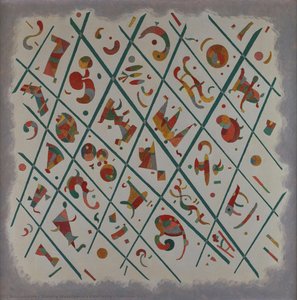
Wassily Kandinsky’s “Division - Unite,” created in 1934 during his formative Parisian period, stands as an emblem of abstract expressionism and a testament to the artist's relentless pursuit of spiritual resonance within visual art. Born in Moscow in 1866, Kandinsky embarked on a transformative artistic odyssey fueled by encounters with Impressionist painting—particularly Claude Monet’s “Haystacks”—and profoundly moved by Wagner’s opera "Lohengrin." These experiences instilled within him an unwavering conviction that art could transcend mere representation and communicate directly with the soul. This conviction would become the cornerstone of his groundbreaking approach to abstraction, forever altering the landscape of modern artistic endeavor. Early influences extended beyond purely visual stimuli; Kandinsky absorbed the vibrant hues and symbolic narratives of Russian folk art, gleaned from expeditions into the Vologda region. He meticulously documented these observations, recognizing their capacity to evoke emotional responses akin to musical harmonies—a concept he would champion throughout his career. This intellectual framework underpinned his artistic explorations, guiding him toward a deliberate rejection of conventional pictorial conventions in favor of forms that prioritized color and composition as primary expressive vehicles. The painting itself presents a striking visual experience: a square grid serves as the foundational structure for an astonishing array of organic shapes—circles, squares, triangles—interwoven with scattered letters. These elements are not uniformly distributed; rather, they cluster and overlap, generating a palpable sense of controlled chaos that belies Kandinsky’s meticulous planning. Diagonal lines intersect the grid, injecting dynamism into the composition and reinforcing the feeling of movement. The color palette is extraordinarily rich and diverse, encompassing reds, greens, blues, yellows, oranges, and purples—applied in both solid blocks and blended areas to create subtle gradations that heighten visual interest. Dominating the background is a pale grey or off-white hue, allowing the vibrant colors of the shapes to command attention and radiate luminosity. Kandinsky’s technique reflects his unwavering commitment to capturing inner experience. Executed primarily with oil paints on canvas—likely stretched taut—the application appears remarkably smooth, minimizing visible brushstrokes and prioritizing tonal harmony. This deliberate restraint underscores Kandinsky's belief that color alone could convey profound emotional significance. The resulting surface possesses a subtle textural quality, suggestive of the paper-like texture of his preparatory sketches, hinting at the artist’s ongoing engagement with traditional drawing methods alongside his pioneering explorations of abstraction. “Division - Unite” embodies Kandinsky’s mature abstract style—characterized by its rejection of representational imagery and its masterful manipulation of color relationships to evoke spiritual contemplation. It aligns seamlessly with the tenets of Abstract Expressionism, a movement that championed spontaneous gesture and emotional intensity as paramount considerations in artistic creation. More than just a visual spectacle, this artwork invites viewers into a realm where form and color coalesce to communicate unspoken truths—a legacy that continues to inspire artists and collectors alike.Composition & Structure
The square grid serves as the central organizing principle of “Division - Unite,” providing a framework for the arrangement of disparate elements while simultaneously fostering a sense of controlled dynamism. Unlike traditional perspectival representations, Kandinsky eschews depth illusion, opting instead for a flattened surface that emphasizes color and form as independent expressive forces. Diagonal lines intersect the grid, injecting movement into the composition and disrupting any potential static equilibrium. This deliberate disruption mirrors Kandinsky’s philosophical conviction that art should transcend rational thought and tap into primal instincts—a core tenet of his spiritual worldview.Color Palette & Harmony
Kandinsky's masterful use of color is arguably the painting's most striking feature. The palette encompasses a spectrum of hues—reds, greens, blues, yellows, oranges, and purples—each carefully positioned to create visual harmony and convey specific emotional resonances. Solid blocks of color coexist with blended areas, generating subtle gradations that enrich the overall tonal range. The dominant off-white background serves as a counterpoint to the vibrant shapes, maximizing their luminosity and enhancing their impact on the viewer’s eye. Kandinsky's meticulous attention to color theory—informed by Goethean aesthetics—demonstrates his profound understanding of how color can stimulate sensory perception and evoke psychological responses.Technique & Materials
The painting was crafted using oil paints on canvas, a medium favored by Kandinsky for its ability to achieve exceptional tonal fidelity and textural nuance. The application technique prioritizes smoothness and tonal consistency, minimizing visible brushstrokes and emphasizing the artist’s commitment to capturing inner experience through visual form. This deliberate restraint underscores Kandinsky's belief that color alone could convey profound emotional significance—a conviction that underpinned his entire artistic practice.Symbolic Significance & Emotional Impact
“Division - Unite” transcends mere aesthetic beauty; it embodies Kandinsky’s aspiration to communicate spiritual truths through abstraction. The scattered letters within the composition serve as visual anchors, grounding the organic shapes in a realm of intellectual contemplation—a reflection of Kandinsky's engagement with philosophical ideas and his belief that art could illuminate hidden dimensions of human consciousness. Ultimately, this painting invites viewers into a meditative state—a testament to Kandinsky’s enduring legacy as one of the foremost pioneers of abstract expressionism and a visionary artist who dared to explore the uncharted territories of visual perception.Historical Context
Created in 1934, “Division - Unite” emerged during Kandinsky's Parisian period—a time marked by profound intellectual ferment and artistic experimentation. The painting reflects the influence of Bauhaus, where Kandinsky taught from 1922 to 1933, and embodies the broader ethos of Abstract Expressionism—a movement that championed spontaneity and emotional intensity as paramount considerations in artistic creation. It stands as a pivotal work within Kandinsky’s oeuvre, solidifying his reputation as one of the most innovative and influential artists of the 20th century.Size & Dimensions
Unknown Date: 1934Kysymykset ja vastaukset
Kuinka kylläinen "Division -Unit"-teoksen väripaletti on?
Teoksen Wassily Wassilyevich Kandinsky:n "Division -Unit" värikylläisyys on Vaimea.
Onko Wassily Wassilyevich Kandinsky:n "Division -Unit" vapaasti käytettävissä oleva teos?
Wassily Wassilyevich Kandinsky:n "Division -Unit" on vapaasti käytettävissä – tekijänoikeussuoja on päättynyt. Tämä tila määrittää, miten teoksen kuvaa saa käyttää uudelleen.
Mikä on teoksen Wassily Wassilyevich Kandinsky:n "Division -Unit" luminanssi?
Teoksen "Division -Unit" värit heijastavat Pehmeä valoisuus luminanssia.
Pikaopas ja taidevisailu
Tietoa artistista Wassily Wassilyevich Kandinsky

Wassily Wassilyevich Kandinsky
1866 - 1944, Venäjä
Taiteilijan elämäkerta
A Life Immersed in Color and Spirit
Wassily Wassilyevich Kandinsky, syntyvä Moskovassa vuonna 1866, oli vallankumouksellinen taiteilija, joka mullisti täysin modernin taiteen kulkua. Hänen matkansa ei ollut välittömästi taiteelliseen kutsumukseen; hän oli alun perin määrätty lakimies- ja taloustieteen uralle Moskovan yliopistossa, mutta syvä kohtaaminen Impressionismin kanssa – erityisesti Claude Monetin “Peltolätkä” - ja koskettava kokemus Richard Wagnerin oopperasta "Lohengrin" sytyttivät hänessä sammuneen taiteellisen halun. Tämä keskeinen hetki, joka tapahtui noin kolmenkympin ikää myötä, ei merkinnyt pelkästään uran muutosta vaan täydellistä näkemyskentän muuttumista, asettaen hänet polulle, jolla hän pioneerili jo abstraktia taidetta. Hän muutti pian Müncheniin ja hakeutui arvostettuun Taideakatemian opiskelijaksi Franz von Stuckin valvonnassa, vaikka koulutuksen puitteissa Kandinsky’n henki kaipasi tutkimusta perinteisten rajojen ulkopuolelle. Varhaiset vaikutteet sisälsivät venäläistä kansantaidetta, jonka hän hankki etnografisella retkellä Vologdan alueelle vuonna 1889, mikä herätti hänen kiinnostuksensa eloisien väripalettien ja symbolisen kuvaston suhteen. Tämä pohja osoittautui ratkaisevaksi, kun hän alkoi kehittää ainutlaatuista taiteellista kieltään. Nämä varhaiset tutkimukset eivät olleet pelkästään esteettisiä mieltymyksiä; ne juonsivat juurensa syvään kulttuuriseen yhteyteen ja ymmärrykseen siitä, miten taide voisi kommunikoida ulkopuolella kirjaimellista.The Dawn of Abstraction: From Expressionism to Inner Necessity
Varhaisissa teoksissaan Kandinsky’n tyyli oli vahvasti ekspressionistinen, tunnusomaista olivat rohkeat värit ja tunteiden voima – esimerkiksi vuodelta 1902 oleva "Papeln (Poplars)" on esimerkki tästä ajanjaksosta. Hän ei kuitenkaan ollut tyytyväinen pelkästään ulkoisen maailman esittämiseen; hän etsi sisäisten todellisuuksien, hengellisiä totuuksia, jotka ylittivät pelkän visuaalisen esityksen. Tämä tavoite johti häntä vähitellen pois representaatiotaidetta ja kohti vallankumouksellista tutkimusta värien, muotojen ja niiden tunteellisen resonanssin suhteen. Hän alkoi uskoa, että värit omaavat omat sisäänrakennetut psykologiset vaikutukset, jotka pystyvät herättämään tiettyjä tunteita ja aistimuksia katsojassa. Tämä vakaumus oli tiiviisti sidoksissa hänen kasvavaan kiinnostukseensa Teosofiaa kohtaan, henkistä liikettä, joka korosti esoteerista tietoa ja universalia veljeilyä. Syventyessään näihin ideoihin Kandinsky’n maalaukset muuttuivat yhä vähemmän representaatiivisiksi, jättäen tunnistetut muodot taakseen ja keskittyen abstraktien komposiittien tutkimiseen, jotka perustuivat sisäiseen tarpeeseen. Tämä ei ollut pelkästään esityksen hylkäämistä; se oli uuden visuaalisen kielen löytämistä, joka pystyi ilmaisemaan aineettomia tunteita ja hengellisiä totuuksia. Hän pyrki luomaan visuaalisen vastineen musiikille, jossa värit ja muodot harmonisoituvat herättämään syviä tunteita.Geometric Harmony and Spiritual Resonance
Kandinsky’n taide kehittyi merkittävästi hänen osallistuessaan vaikutusvaltaiseen taiteilijaryhmään Der Blaue Reiter (Sininen ratsastaja), jonka hän perusti Münchenissä vuonna 1911. Vaikka aiemmissa teoksissa näkyi usein virtaavia, orgaanisia muotoja, hän alkoi tutkia geometrista abstraktiota keskittyen ympyröiden, kolmioiden ja neliöiden vuorovaikutukseen. "Several Circles" (140 x 140 cm) on esimerkki tästä vaiheesta – dynaaminen komposiitio, jossa värit ja muodot vuorovaikuttavat harmonisesti mutta energisesti. Tämä ei ollut kylmää tai tyhjää geometriaa; se oli kyllä sydän syvästi symbolinen. Kandinsky uskoi, että geometriset muodot omaavat omat sisäänrakennetut symboliset merkityksensä ja niiden järjestely taiteilijan maalauksessa voivat herättää tiettyjä tunteita. Hänen teoreettiset teoksensa, erityisesti "Concerning the Spiritual in Art" (1911), artikuloivat nämä uskomukset asettaen pohjan uudelle ymmärrykselle abstraktista taiteesta välineenä syvien hengellisten totuuksien ilmaisemiseen. Hän argumentoi, että taide ei tulisi pyrkiä jäljittelemään luontoa vaan paljastamaan taiteilijan sisämaailman ja yhdistämään katsojan syvemmälle, intuitiivisemmalle tasolle.Bauhaus Influence and Lasting Legacy
Ensimmäisen maailmansodan purkautuminen pakotti Kandinsky’n palaamaan Venäjälle vuonna 1914, mutta vallankumouksen jälkeen hän löysi itsensä yhä enemmän ristiriidassa vallitsevan taiteellisen ilmapiirin kanssa. Vuonna 1920 hän hyväksyi opettajan viran Bauhaus-taidekoulussa Saksassa, jossa hän vaikutti voimakkaasti useiden taiteilijoiden ajatteluun värien, muotojen ja abstraktion suhteen. Bauhaus tarjosi Kandinsky’lle ihanteellisen ympäristön kehittää ideoitaan ja tutkia uusia luovia polkuja. Hän jatkoi geometristen muotojen ja eloisien värien kokeilua usein sisällyttäen kerroksittaisia impasto-tekniikoita, jotka lisäsivät pintaan syvyyttä ja monimutkaisuutta. "An Intimate Party" (1942) on esimerkki tästä. Kandinsky’n vaikutus moderniin taiteeseen on mittaamaton; hän tunnetaan laajalti abstraktin ekspressionismin pioneerina ja keskeisenä hahmona ei-representatiivisen maalaustyylin kehityksessä. Teoksiaan säilytetään suurissa museoissa ympäri maailmaa, mukaan lukien Tretyakov Gallery Moskovassa, joka omistaa hänen monumentaalisen "Composition VII":n, testamenttinsa taiteelliseen visioon ja kestävään perintöön.Pikaaakkaukset taiteilijasta Wassily Wassilyevich Kandinsky
- Artistic Movement Or Style: Abstrakti taide, Ekspressionismi
- Artists Or Movements Influenced By This Artist: ['Abstrakti ekspressionismi']
- Artists Who Influenced This Artist:
- Claude Monet
- Richard Wagner
- Date Of Birth: 1866-12-04
- Date Of Death: 1944-12-13
- Full Name: Wassily Wassilyevich Kandinsky
- Nationality: Venäläinen, Ranskalainen
- Notable Artworks:
- Temppelikampanja
- Useita ympyröitä
- Intimate Party
- Place Of Birth: Moskova, Venäjä
Tutustu teoksiin, jotka on järjestetty aiheiden, tyylien ja ominaisuuksien mukaan.


Wassily Wassilyevich Kandinsky
Division -Unit
() ·
Kehyksineen: · Käsinmaalattu öljyväreillä pellavalle
Yhteensä