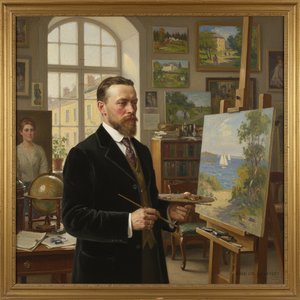
The Artistic Evolution of Alfred Hubert
Born in Liège, Belgium, Alfred Hubert began his journey through the arts in an unexpected manner. Though his father had intended for him to pursue a career in law, Hubert's interest in drawing led him to the Royal Academy of Fine Arts in Liège. His path took a decisive turn when he enlisted as a soldier in the 3rd Artillery Regiment. It was through this military life that his artistic identity began to coalesce, transitioning from a skilled draftsperson and illustrator into a painter. He taught himself the art of painting, moving naturally from graphic lines to the use of color, often working with instinct rather than formal instruction.
His early recognition came through his illustrations for various national works, such as Histoire d'un conscrit de 1813. By 1864, he transitioned into serious oil painting with Un Campement de Bohémiens. His repertoire expanded to include diverse subjects, from military scenes like L'Artillerie au repos and Les Cuirassiers à Waterloo to landscapes and genre studies. His work often captured the movement of troops and the character of horses, particularly the sturdy Ardennais breed. Beyond the canvas, he was a sculptor and a member of the Royal Belgian Society of Watercolorists.
Legacy and Versatility
Hubert's talent was characterized by a profound ability to capture the essence of his subjects through various media. His work spanned several disciplines, including:
His artistic reach extended through travels to Spain and Morocco, which inspired works like Un Marché à Tanger. His technical skill in capturing the "nervous forms" of horses and the collective movement of cavalry became a hallmark of his contribution to Belgian art. His diverse body of work is preserved in various institutions, including the Royal Museums of Fine Arts of Belgium and the Rijksmuseum Amsterdam.
Kysymykset ja vastaukset
Mistä löydän Alfred Hubert's teokset ryhmiteltynä väripaletin mukaan?
Alfred Hubert'n teoksia voi selata väripaletin mukaan taiteilijan Väripalettien mukaan -sivulla.
Mistä löytää Alfred Hubert teokset järjestettynä värin mukaan?
Alfred Hubert:n teoksia voi tutkia värin perusteella artistin Värispektri -sivulla.
Onko olemassa yleiskatsaus kaikista niistä aiheista, joita Alfred Hubert on maalannut?
Alfred Hubert:n teoksia voi tutkia aiheen mukaan artistin Aiheatlas -sivulla.
Mistä löytää Alfred Hubert's teokset ryhmiteltynä avainsanojen mukaan?
Alfred Hubert:n teoksia voi tutkia avainsanoittain artistin Avainsanojen mukaan -sivulla. Jokainen avainsana kokoaa yhteen aiheeseen liittyvät teokset.