

Présenté : · Avec son cadre :
 Aperçu en situation
 Envoyer
 Partager
 Détails de l'œuvre
 Guide
Guide

 Télécharger l'image
 Articles similaires
 Radiographie
 Diaporama
 Questions et réponses
 Statistiques

€ 239
Reproduction à l'huile faite à la main
Huile sur toile peinte à la main, avec cadre et dimensions personnalisés, réalisée sur commande par nos artistes. ( Passer au format impression Passer au format numérique)
Format
·Format standard
sur mesure
CM
INCH
Choisissez parmi nos formats prédéfinis qui respectent les proportions originales de l’œuvre.
Chargement des formats...

largeur
hauteur
Saisissez la largeur et la hauteur souhaitées, pour s'adapter à votre cadre ou à votre mur. Cette œuvre est peinte à la main ; ainsi, pour un format de forme différente, l'artiste peut peindre un peu plus autour du tableau ou réduire légèrement les bords — c'est vous qui choisissez. Nous vous envoyons une maquette numérique pour approbation avant que la peinture ne commence. L'image présentée sur cette page ne reflète pas le résultat réel — seule la maquette le fait.
 En savoir plus
Finition
·
Bords blancs €1

Bords estompés €1

Bords imprimés €1

P118B €10

P118H €10

P118W €10

P438Z €10

P508JH €12

P508YH €12

P805H €10

P805Z €10

P919BZ €10

P919G €10

P919XJ €10

P959ZH €10

P968JZ €12

W106C €8

W218G €10

W218JH €8

W218Y €10

W307PJ €10

W316G €10

W316PJ €8

W316Y €10

W398PJ €8

W4111J €10

W500HY €15

W500JH €15

W692G €12

W849H €8

W940BG €15

W953PJ €8

H24-GOLD €30

H24-SILVER €30

H36-GOLD €45

H36-SILVER €45
Expédié dans un tube de protection, prêt à être encadré par votre professionnel habituel.
Options supplémentaires
optionnelQue comprennent les extras ?
Exemples de personnalisation possibles : Remplacer le visage par la photo du client ; Ajouter un animal (ex: remplacer le chat par un chien) ; Inclure un message caché en arrière-plan ; Modifier le paysage ou les éléments de l'arrière-plan.
Après la commande, l'équipe de TopImpressionists.com contactera le client par e-mail pour obtenir ses instructions et lui fournir un aperçu de la maquette
Après la commande, l'équipe de TopImpressionists.com contactera le client par e-mail pour obtenir ses instructions et lui fournir un aperçu de la maquette
Livraison dans le monde entier () en 3 à 4 semaines au lieu des 5 semaines habituelles. (4 novembre). Aucun compromis sur la qualité.
Vernis de protection
Cartel
Détails de la plaque en bronze gravée
This elegant plaque features the artist's name and the title of the artwork, finely engraved for a timeless presentation.
It is made from bronze with a refined, elegant finish. The text is precisely laser-engraved for a sharp and permanent result. Measuring 9x2 cm, the plaque is compact yet easy to read. It's built to be durable and scratch-resistant, offering a professional, museum-quality look. Mounting is simple thanks to the included adhesive backing.
Détails de la plaque en acrylique transparent
The plaque includes essential engraved details such as the artist's name, the title of the artwork, the date it was created, the type of media used-like oil on canvas or watercolor-a brief description of the piece, and a QR code that links to the complete artwork information.
It is crafted from clear acrylic, offering a sleek, modern appearance. The text is UV-engraved in black to ensure strong visual contrast. With a size of 10x15 cm, it ensures optimal readability. It comes equipped with two metal hooks for secure wall mounting. The plaque is designed to be weather-resistant, making it suitable for various environments, and it includes interactive features that work seamlessly with smartphone scanning.
Détails de la plaque en acrylique noir
This elegant plaque includes engraved information such as the artist's name, the title of the artwork, the date it was created, the type of media used (like oil on canvas or watercolor), a short description of the artwork, and a QR code for quick access to more information.
The plaque itself is made from refined black acrylic with a premium finish. The text is laser-engraved in white for high contrast and readability. Its size is 10x15 cm, designed to be easy to read. It comes with two metal hooks for professional mounting. The design is sleek and fits any interior style. It is also weather-resistant and durable, with built-in digital integration for mobile compatibility.
L'option verre n'est disponible que pour les dimensions inférieures à 110 cm.
 L'option verre n'est disponible que pour les dimensions inférieures à 110 cm.
- Livraison express gratuite dans le monde entier
- Toile de lin de qualité supérieure
- Assurance transport complète
- Garantie de remboursement des droits de douane
- Garantie de fidélité des couleurs
- Politique de retour de 100 jours (uniquement en cas de défaut)
- Garantie de remboursement à 100%
- Offre de tarifs dégressifs


Description de la pièce
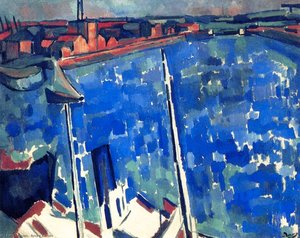
Vibrant blue water scene with boats by André Derain's 1905 work, capturing the colorful spirit of early modern art; discover this masterpiece today.
Biographie de l'artiste
André Derain (1880-1954) : Pionnier du Fauvisme ! Découvrez ses toiles vibrantes, paysages urbains audacieux & son héritage artistique majeur.
À propos de l'œuvre
A Mediterranean Dream in Blue Tones
Gazing upon André Derain's "Boats at Collioure," one is immediately transported to the sun-drenched shores of the French Riviera. This painting captures more than just a seascape; it encapsulates a moment of profound, languid peace. The composition is dominated by the mesmerizing expanse of blue water, a liquid canvas reflecting both the sky and the gentle activity upon its surface. In the foreground, the presence of several vessels anchors the scene, drawing the eye across the rhythmic placement of sails and hulls. There are two principal boats commanding attention—one small craft with its sail catching an unseen breeze, suggesting imminent departure or leisurely drift, and another larger form situated further back, adding depth to the pictorial space. Scattered among them are smaller tenders, dotted like jewels upon the deep blue tapestry.
The Brushwork of Fauvist Light
Derain’s technique here is a masterful display of post-Impressionist vibrancy filtered through the nascent energy of Fauvism. While the subject matter—a simple coastal scene—might suggest quietude, the application of paint speaks of vibrant, almost joyous abandon. The colors are not merely descriptive; they are emotional. Notice how the blues interact with the warmer tones suggested in the distant shore or the figures themselves. Derain uses color as a structural element, allowing light to fracture and refract across the water's surface. This bold use of pigment gives the scene an immediate, palpable luminosity, making the viewer feel the warmth of the Mediterranean sun even from afar.
Context and the Spirit of Place
Painted in 1905, this work places us at a pivotal moment in art history—a time when established academic traditions were being vigorously challenged by revolutionary colorists. Derain, deeply connected to the vibrant artistic circles of early modern Paris, channeled the raw energy of his surroundings into this piece. Collioure itself, with its intense light and deep blue waters, provided the perfect muse for an artist eager to break free from muted palettes. The inclusion of figures—one on the left, another on the right—are not just incidental details; they are witnesses to the scene, grounding the viewer within a shared, observed moment of coastal life.
Symbolism of Passage and Leisure
The boats themselves carry rich symbolism. They represent journeys, both literal passages across the water and metaphorical voyages through life's experiences. The interplay between the stationary elements—the distant shore or the anchored vessels—and the implied movement of the sails suggests a beautiful tension: the comfort of being present versus the irresistible call of adventure. For the collector or decorator, this painting offers more than just decoration; it offers an emotional anchor—a visual escape to a place where time slows down and the only concern is the gentle rocking rhythm of the tide.
Bringing Riviera Vibrancy Home
To reproduce "Boats at Collioure" in your own space is to invite a breath of Mediterranean air into your home. Whether displayed above a sofa, nestled in an entryway, or used as a focal point in a gallery setting, the painting’s inherent vibrancy will elevate any interior design scheme. Its bold yet harmonious color palette ensures it complements both minimalist modern aesthetics and richly decorated traditional rooms alike. It is a piece that speaks of freedom, light, and the enduring allure of the sea.
Questions et réponses
Comment la composition chromatique de «Boats at Collioure» de André Derain est-elle construite ?
La composition chromatique de «Boats at Collioure» de André Derain allie un contraste Bold à une harmonie Balanced Harmony.
Comment les couleurs de "Boats at Collioure" s'harmonisent-elles entre elles ?
Les couleurs de «Boats at Collioure» de André Derain présentent une harmonie Balanced Harmony. L'harmonie décrit la relation entre les couleurs.
Les couleurs de «Boats at Collioure» de André Derain sont-elles vives ou feutrées ?
Les couleurs de «Boats at Collioure» de André Derain présentent une saturation Vivid Color et une intensité Vivid.
Informations clés et quiz sur l'œuvre
À propos de André Derain

André Derain
1880 - 1954, France
Biographie de l'artiste
Premières années et formation
- Naissance et famille : André Derain est né le 10 juin 1880 à Chatou, dans les Yvelines, près de Paris.
- Études indépendantes : Contrairement à certaines affirmations, Derain a commencé à peindre indépendamment en 1895, avant de rencontrer Vlaminck ou Matisse. Il effectuait occasionnellement des sorties artistiques avec le père Jacomin et ses fils.
- Formation académique : En 1898, il étudia l'ingénierie à l'Académie Camillo, où il rencontra Henri Matisse puis suivit des cours de peinture sous la direction d'Eugène Carrière.
- Abandon de l’ingénierie : Après son service militaire (1901-1904), Matisse le persuada d'abandonner sa carrière d'ingénieur pour se consacrer à la peinture. Il fréquenta ensuite l'Académie Julian.
Fauvisme et développement artistique précoce
- Collaboration avec Matisse : Derain collabora étroitement avec Henri Matisse, notamment pendant l’été 1905 à Collioure, ce qui donna naissance à des œuvres telles que "Montagnes à Collioure".
- Salon d'Automne (1905) : Leur exposition au Salon d'Automne marqua un moment décisif, conduisant le critique Louis Vauxcelles à inventer le terme « Fauves » (« bêtes sauvages ») en raison de leur utilisation audacieuse et non conventionnelle des couleurs.
- Peintures de Londres : En 1906, Ambroise Vollard envoya Derain à Londres, où il produisit une série de peintures représentant la ville d'une manière nouvelle et frappante, en se concentrant sur la Tamise et le Tower Bridge. Ces œuvres sont considérées comme faisant partie de ses plus importantes réalisations.
- Influences et style : Le travail fauve précoce est caractérisé par des couleurs intenses et non naturalistes ainsi que par des coups de pinceau expressifs. Derain fut influencé par des artistes tels que Van Gogh et Cézanne.
Évolution du style et œuvres ultérieures
- Virage vers le classicisme : Après 1907, le style de Derain commença à évoluer, s'éloignant de la palette purement fauve vers des tons plus atténués et une plus grande emphase sur la forme. Cette période (1911-1914) est parfois appelée sa « phase gothique ».
- Influence du Cubisme et des Maîtres anciens : Le travail de Derain pendant cette période reflétait son étude des maîtres anciens, intégrant des éléments du cubisme et un regain d'intérêt pour les formes classiques.
- Conception de ballet : En 1919, il conçut le décor et les costumes du ballet "La Boutique Fantasque" pour Diaghilev, démontrant sa polyvalence en tant qu’artiste.
- Œuvres notables : Parmi les œuvres clés de cette période figurent "Arlequin et Pierrot", "Le Retour d'Ulysse" (une grande fresque murale) ainsi que divers paysages et natures mortes qui témoignent de son style en évolution.
Héritage et signification historique
- Co-fondateur du Fauvisme : Derain est reconnu comme une figure clé dans le développement du fauvisme, aux côtés de Matisse, contribuant de manière significative au mouvement artistique moderne du début du XXe siècle.
- Vision unique de Londres : Sa série de peintures représentant Londres a offert une perspective nouvelle et distinctive sur la ville, s'écartant des représentations artistiques antérieures.
- Reconnaissance d’après-guerre : Après la Première Guerre mondiale, Derain regagna en popularité pour ses contributions à un retour au classicisme dans l'art.
- Dernières années et controverse : Malgré le prix Carnegie remporté en 1928, Derain fit face à des controverses pendant la Seconde Guerre mondiale en raison de sa présence en Allemagne et fut par la suite ostracisé par certains de ses anciens partisans.
- Décès et souvenir : André Derain est décédé le 8 septembre 1954. Son œuvre continue d'être célébrée pour ses couleurs audacieuses, ses compositions expressives et sa contribution significative à l’histoire de l’art moderne.
Informations clés sur André Derain
- Artistes Influents:
- Henri Matisse
- Vincent van Gogh
- Paul Cézanne
- Date De Décès: 8 septembre 1954
- Date De Naissance: 10 juin 1880
- Lieu De Naissance: Chatou, France
- Mouvement Artistique: Fauvisme
- Nationalité: Française
- Nom Complet: André Derain
- Oeuvres Notables:
- Arlequin et Pierrot
- Pont Westminster, Londres
- Falaises
- Retour d'Ulysse


Explorez des œuvres d'art classées par thèmes, styles et caractéristiques.




André Derain
Boats at Collioure
() ·
Avec son cadre : · Peint à la main à l'huile sur lin
Total