

Shown: · With its frame:
 Aperçu en situation
 Envoyer
 Partager
 Détails de l'œuvre
 Guide
Guide

 Télécharger l'image
 Articles similaires
 Radiographie
 Diaporama
 Q&A
Q&A Statistiques
 Oil On Canvas
- WallArt
- Australian Impressionism
 1888
1888- 19th Century
 233.0 x 128.0 cm
 Galerie Nationale d'Australie
€ 237
Reproduction à l'huile faite à la main
Huile sur toile peinte à la main, avec cadre et dimensions personnalisés, réalisée sur commande par nos artistes. ( Passer au format impression Passer au format numérique)
Size
·Format standard
sur mesure
CM
INCH
Choisissez parmi nos formats prédéfinis qui respectent les proportions originales de l’œuvre.
Loading sizes...

largeur
hauteur
Saisissez la largeur et la hauteur souhaitées, pour s'adapter à votre cadre ou à votre mur. Cette œuvre est peinte à la main ; ainsi, pour un format de forme différente, l'artiste peut peindre un peu plus autour du tableau ou réduire légèrement les bords — c'est vous qui choisissez. Nous vous envoyons une maquette numérique pour approbation avant que la peinture ne commence. L'image présentée sur cette page ne reflète pas le résultat réel — seule la maquette le fait.
 En savoir plus
Finish
·
White €1

Blurside €1

Extended €1

P118B €10

P118H €10

P118W €10

P438Z €10

P508JH €12

P508YH €12

P805H €10

P805Z €10

P919BZ €10

P919G €10

P919XJ €10

P959ZH €10

P968JZ €12

W106C €8

W218G €10

W218JH €8

W218Y €10

W307PJ €10

W316G €10

W316PJ €8

W316Y €10

W398PJ €8

W4111J €10

W500HY €15

W500JH €15

W692G €12

W849H €8

W940BG €15

W953PJ €8

H24-GOLD €30

H24-SILVER €30

H36-GOLD €45

H36-SILVER €45
Shipped in a protective tube, ready for your own framer.
Above 105 cm the frame is shipped as a kit for a professional framer — read the details.
Extras
optionalWhat do the extras include?
Examples of what can be changed: Replace face with customer photo; Add pet (e.g., replace cat with dog); Include hidden message in background; Change background landscape or elements.
After order, TopImpressionists.com team will email client for instructions and provide a mockup preview
After order, TopImpressionists.com team will email client for instructions and provide a mockup preview
Livraison dans le monde entier () en 3 à 4 semaines au lieu des 5 semaines habituelles. (30 octobre). Aucun compromis sur la qualité.
Vernis de protection
Cartel
Détails de la plaque en bronze gravée
This elegant plaque features the artist's name and the title of the artwork, finely engraved for a timeless presentation.
It is made from bronze with a refined, elegant finish. The text is precisely laser-engraved for a sharp and permanent result. Measuring 9x2 cm, the plaque is compact yet easy to read. It's built to be durable and scratch-resistant, offering a professional, museum-quality look. Mounting is simple thanks to the included adhesive backing.
Détails de la plaque en acrylique transparent
The plaque includes essential engraved details such as the artist's name, the title of the artwork, the date it was created, the type of media used-like oil on canvas or watercolor-a brief description of the piece, and a QR code that links to the complete artwork information.
It is crafted from clear acrylic, offering a sleek, modern appearance. The text is UV-engraved in black to ensure strong visual contrast. With a size of 10x15 cm, it ensures optimal readability. It comes equipped with two metal hooks for secure wall mounting. The plaque is designed to be weather-resistant, making it suitable for various environments, and it includes interactive features that work seamlessly with smartphone scanning.
Détails de la plaque en acrylique noir
This elegant plaque includes engraved information such as the artist's name, the title of the artwork, the date it was created, the type of media used (like oil on canvas or watercolor), a short description of the artwork, and a QR code for quick access to more information.
The plaque itself is made from refined black acrylic with a premium finish. The text is laser-engraved in white for high contrast and readability. Its size is 10x15 cm, designed to be easy to read. It comes with two metal hooks for professional mounting. The design is sleek and fits any interior style. It is also weather-resistant and durable, with built-in digital integration for mobile compatibility.
L'option verre n'est disponible que pour les dimensions inférieures à 110 cm.
 L'option verre n'est disponible que pour les dimensions inférieures à 110 cm.
- Livraison express gratuite dans le monde entier
- Toile de lin de qualité supérieure
- Assurance transport complète
- Garantie de remboursement des droits de douane
- Garantie de fidélité des couleurs
- Politique de retour de 100 jours (uniquement en cas de défaut)
- Garantie de remboursement à 100%
- Offre de tarifs dégressifs


Description de la pièce
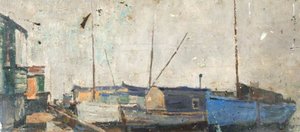
A dramatic harbor scene capturing the chaos of a sinking boat in Arthur Streeton's 1888 masterpiece Sandridge, showcasing Australian Impressionism and inviting you to explore this iconic piece for your collection.
Biographie de l'artiste
Explorez les paysages emblématiques d'Arthur Streeton (1867-1943), peintre impressionniste australien et figure clé de l'École de Heidelberg. Découvrez ses scènes ensoleillées, son style plein air et son rôle essentiel dans l'art australien.
About the painting
A Moment Frozen in Time: The Drama of Sandridge
In the vast expanse of Australian Impressionism, few works capture the raw, unscripted tension of maritime life as poignantly as Arthur Streeton’s Sandridge. Painted in 1888, this monumental oil on canvas serves as a window into a bustling, high-stakes moment within a busy harbor. At first glance, the viewer is drawn into a scene of profound movement and uncertainty; the central focus is a vessel caught in a state of distress, appearing to sink or having just succumbed to the elements. This focal point acts as the emotional anchor of the composition, pulling the eye toward the center of a swirling maritime drama where the calm of the water meets the sudden chaos of an emergency.
Streeton, a pioneer of the Heidelberg School, was a master at capturing what his contemporaries called the "Australian Light." In Sandridge, he utilizes this expertise to paint not just a scene, and not just a location, but an atmosphere. The light dances across the hulls of various boats—ranging from large, dominating vessels to smaller, more agile craft—creating a sense of depth and shimmering heat. Through his brushwork, one can almost feel the humidity of the harbor and the frantic energy of the at least twelve figures scattered throughout the scene. Some onlookers stand in stunned proximity to the sinking boat, while others are mere silhouettes against the horizon, their presence adding to the collective weight of the unfolding tragedy.
Technique and the Impressionist Spirit
The technical execution of Sandridge is a testament to Streeton’s ability to blend large-scale composition with delicate, impressionistic touches. The sheer scale of the work, measuring an impressive 233 x 128 cm, allows the viewer to become immersed in the harbor's geography. Streeton employs a palette that reflects the gritty yet luminous reality of a working port. His use of oil on canvas provides a rich texture that gives weight to the wooden hulls and life to the churning water. The way he manages the interplay between light and shadow is crucial; it is through these subtle shifts in tone that the sense of "chaos" is communicated without relying on overt, messy strokes.
For the discerning collector or interior designer, this piece offers a sophisticated balance of narrative intensity and aesthetic harmony. The painting does not merely depict a disaster; it captures the structural beauty of a maritime landscape. The composition guides the eye through a rhythmic arrangement of masts, sails, and figures, making it a powerful statement piece for any grand space. It possesses that rare quality in fine art: the ability to command attention through its historical gravity while simultaneously complementing a modern or classical interior with its masterful use of color and light.
A Legacy of Australian Identity
To understand Sandridge is to understand the birth of a national artistic identity. During the late 19th century, Streeton and his peers were moving away from European traditions to find a way to paint the unique, harsh, yet beautiful Australian landscape. While much of his work focuses on the golden hues of the bush, Sandridge explores the industrial and social heartbeat of the coast. The painting symbolizes the vulnerability of human endeavor when faced with the unpredictable forces of nature, a theme that resonates deeply across generations.
Owning a high-quality reproduction of this masterpiece allows one to bring a piece of Australian history into the contemporary home. It is more than a decoration; it is an invitation to contemplate the fleeting nature of stability and the enduring strength of human observation. Whether placed in a library, a formal dining room, or a curated gallery space, Sandridge serves as a profound conversation starter, embodying the spirit of an era defined by discovery, struggle, and the breathtaking beauty of the Australian light.
Questions et réponses
Qui a créé « Sandridge » et en quelle année ?
«Sandridge» a été créé par Arthur Streeton en 1888.
Les couleurs de « Sandridge » paraissent-elles vives ou douces ?
«Sandridge» de Arthur Streeton présente une intensité de couleur Monochromatic.
Quel âge avait Arthur Streeton lors de la création de « Sandridge » ?
Lorsque « Sandridge » a été créé en 1888, Arthur Streeton — né(e) en 1867 — était âgé(e) de 21 ans.
Quick facts and art quiz
About Arthur Streeton

Arthur Streeton
1867 - 1943, Australie
Biographie de l'artiste
Premières années et formation
Arthur Streeton, peintre de paysages australien éminent, est né le 8 avril 1867 à Duneed, dans l'État du Victoria. Il a commencé son parcours artistique en 1882 à la National Gallery School sous la direction de George Folingsby. Cette formation précoce a jeté les bases de sa réussite ultérieure en tant que membre de proue de l'école de Heidelberg, également connue sous le nom d'impressionnisme australien.Points saillants de sa carrière
Le travail de Streeton s’est rapidement amélioré au cours de ses premières années et, dès 1888, il était largement considéré comme l'un des jeunes peintres les plus talentueux du Victoria. Son association avec d'autres artistes tels que Tom Roberts et Frederick McCubbin a conduit à la formation d'une période de compagnonnage créatif intense sur deux ans, qui allait devenir connue sous le nom de mouvement de l’école de Heidelberg.Le camp d'Eaglemont et œuvres notables
La période passée par Streeton au camp d'Eaglemont en 1888 a marqué un tournant important dans sa carrière. Durant cette période, il a créé des œuvres remarquables telles que « Golden Summer, Eaglemont » (1889) et « Still glides the stream, and shall for ever glide » (1890). Ces scènes pastorales baignées de soleil mettaient en valeur le style unique de Streeton, qui a ensuite été exposé à la Royal Academy de Londres et a reçu une mention honorable au Salon de Paris de 1892.Évolution artistique et influences
- Influences initiales : L'influence de Girolamo Nerli, un peintre italien qui a enseigné à la National Gallery School, est notable dans les premières œuvres de Streeton, notamment son approche du clair-obscur et de l’utilisation de la lumière.
- Impressionnisme australien : Streeton s'est inscrit dans le mouvement impressionniste australien, cherchant à capturer les effets changeants de la lumière sur le paysage australien. Il a été influencé par l’impressionnisme français, mais il a adapté ce style pour refléter la beauté unique du bush australien.
- Lumière et couleur : Streeton était connu pour son utilisation audacieuse de la couleur et sa capacité à rendre les effets de la lumière naturelle. Ses peintures sont souvent caractérisées par des couleurs vives et une atmosphère lumineuse.
Héritage et vie ultérieure
Au cours de ses dernières années, Streeton a navigué vers Londres sur le « Polynésien » en 1897 et a participé à des expositions à la Royal Academy en 1900. Bien qu'il ait acquis une certaine réputation en Australie, il n'a pas connu le même succès en Angleterre. Streeton est décédé le 1er septembre 1943.- Œuvres de Arthur Streeton : Découvrez les œuvres d’Arthur Streeton sur TopImpressionists : https://TopImpressionists.com/@/arthur_streeton
- Mouvement de l'école de Heidelberg : Explorez le mouvement de l’école de Heidelberg et son influence sur l’art australien : https://en.wikipedia.org/wiki/heidelberg_school
- Musée virtuel TopImpressionists : Découvrez davantage sur la vie et l’œuvre de Streeton au musée virtuel de TopImpressionists : /fr/art/show/art-d3c5zh-fr/
- Histoire de la peinture : Renseignez-vous sur l’histoire de la peinture et son évolution au fil du temps : https://en.wikipedia.org/wiki/history_of_painting
Quick facts about Arthur Streeton
- Artistes Influents: ['Girolamo Nerli']
- Date De Décès: 1er septembre 1943
- Date De Naissance: 8 avril 1867
- Lieu De Naissance: Mount Moriac, Australie
- Mouvement Artistique: Impressionnisme australien
- Mouvements Influencés: ['École de Heidelberg']
- Nationalité: Australien
- Nom Complet: Arthur Ernest Streeton
- Œuvres Notables:
- Golden summer, Eaglemont
- Still glides the stream
- The spirit of the drought



Explorez des œuvres d'art classées par thèmes, styles et caractéristiques.


Arthur Streeton
Sandridge
() ·
With its frame: · Hand-painted in oil on linen
Total