

 Aperçu en situation
 Envoyer
 Partager
 Détails de l'œuvre
 Guide
Guide

 Télécharger l'image
 Articles similaires
 Radiographie
 Diaporama
 Questions et réponses
 Statistiques
Régulo

- 87.0 x 58.0 cm


A striking naturalist portrait of an Australian native painted by Artur José de Sousa Loureiro in 1900 captures a moment of quiet strength, inviting you to bring this piece of history into your private collection.
 Lire la suite
Artur Loureiro (1853-1932), peintre portugais naturaliste, a marqué l'art avec ses paysages et portraits. Il a vécu en France et en Australie, laissant une empreinte significative dans le monde de l'art.
Giclées et impressions d'art
Impressions giclées ou sur toile de qualité musée, avec une production rapide et des finitions au choix. ( Commander la reproduction peinte à la main Passer au format numérique)




P118B €10

P118H €10

P118W €10

P438Z €10

P508JH €12

P508YH €12

P805H €10

P805Z €10

P919BZ €10

P919G €10

P919XJ €10

P959ZH €10

P968JZ €12

W106C €8

W218G €10

W218JH €8

W218Y €10

W307PJ €10

W316G €10

W316PJ €8

W316Y €10

W398PJ €8

W4111J €10

W500HY €15

W500JH €15

W692G €12

W849H €8

W940BG €15

W953PJ €8




Format standard
sur mesure
CM
INCH
Choisissez parmi nos formats prédéfinis qui respectent les proportions originales de l’œuvre.
Loading sizes...

largeur
hauteur
Saisissez la largeur et la hauteur souhaitées pour qu'elles s'adaptent à votre cadre ou à votre mur. Une impression peut être recadrée, mais jamais agrandie au-delà de l'image originale ; ainsi, un format de forme différente entraînera la perte d'une partie de l'image. Nous vous envoyons une maquette numérique pour approbation avant toute impression. L'image présentée sur cette page ne montre pas le recadrage réel — seule la maquette le permet.
Livraison dans le monde entier () en 2 semaines au lieu des 4/5 semaines habituelles. (4 novembre)

Livraison express gratuite dans le monde entier

Toile de lin de qualité supérieure

Assurance transport complète

Garantie de remboursement des droits de douane

Garantie de fidélité des couleurs

Politique de retour de 100 jours (uniquement en cas de défaut)

Garantie de remboursement à 100%

Offre de tarifs dégressifs
 L'option verre n'est disponible que pour les dimensions inférieures à 110 cm.

Régulo
Giclées et impressions d'art
Format de la reproduction
-


Prix total
€ 62
When Artur Loureiro returned to Porto in 1901, after a long period in Australia (where he lived since 1884), he brought with him some works which he was to exhibit in his first show in Oporto in March of 1902, in his recently inaugurated studio in the Palacio de Cristal. This painting was rendered by the painter in Melbourne in 1900 and depicts a native Australian, the work is proof of the artist’s skill in painting outdoors.
Questions et réponses
Où puis-je télécharger «Régulo» de Artur Loureiro ?
L'image de «Régulo» de Artur Loureiro peut être téléchargée sur la page de téléchargement de l'œuvre : Téléchargement (téléchargement d'une image numérique haute résolution).
Dans quelle pièce est-il suggéré d'exposer « Régulo », compte tenu de sa palette ?
Grâce à sa palette de couleurs Earthy, l'œuvre « Régulo » s'intègre parfaitement dans une Living Room.
Quelle taille d'impression est recommandée pour « Régulo » ?
Une reproduction en Medium est suggérée pour «Régulo» de Artur Loureiro. Le format peut être ajusté tout en conservant les proportions.
Biographie de l'artiste
A Portuguese Painter’s Journey Through Time
Artur José de Sousa Loureiro, a prominent figure in the vibrant tapestry of Portuguese art, left an indelible mark on the canvas of history. Born on February 11, 1853, in Porto, and passing away on July 7, 1932, his life was a testament to artistic evolution, embracing diverse influences and culminating in a significant contribution to both the national and international art scenes. His journey spanned continents, reflecting a restless spirit and an unwavering dedication to his craft.Early Beginnings and Formative Years
Loureiro’s initial steps into the world of art were guided by the mentorship of his close friend, António José da Costa. Under Da Costa's tutelage, he honed the fundamental skills of drawing and painting, laying a solid foundation for his future endeavors. This early training led him to the Escola Superior de Belas-Artes do Porto, where he studied under the esteemed guidance of João António Correia. It was during this period that Loureiro began to develop his unique artistic voice, absorbing the principles of academic art while simultaneously seeking inspiration from the burgeoning movements of the time. The influence of Correia, a respected figure in Portuguese art education, undoubtedly shaped Loureiro’s approach to composition and technique.A Journey Across Continents
Loureiro's artistic trajectory took an exciting turn with the support of his patron, Delfim Deodato Guedes. In 1875, he embarked on a transformative journey to Rome, immersing himself in the rich artistic heritage of the Eternal City. This experience broadened his horizons considerably, exposing him to classical art and architectural grandeur. Subsequently, in 1879, he moved to Paris, securing a scholarship to study at the École des Beaux-Arts. Life in the Latin Quarter proved stimulating, allowing him to engage with the vibrant artistic community and refine his skills under the tutelage of renowned instructors. He became part of the Parisian art scene, exhibiting at the Salon de 1880 through 1882 alongside fellow Portuguese artists like João Marques de Oliveira and António Silva Porto. His time in Paris was marked by a growing awareness of contemporary artistic trends and a desire to push the boundaries of his own style. A pivotal moment in Loureiro’s career arrived with his emigration to Australia in 1884, accompanied by his wife, Marie Huybers. This move represented a significant shift, as he settled in Melbourne and began contributing to the burgeoning Australian art community. The decision was driven partly by personal circumstances – Marie's origins – but also by an opportunity to experience a new environment and explore different artistic landscapes. He quickly established himself within the local scene, participating in exhibitions organized by the Australian Art Association and eventually becoming a professor of design at the Presbyterian Ladies’ Academy.Notable Works and Achievements
Loureiro’s artistic output spanned various genres, including landscape paintings, portraits, and depictions of animals. His work often reflected his experiences and observations across different cultures. A particularly poignant piece is *The Death of Burke* (1892), a powerful portrayal capturing the tragic fate of explorer Robert Burke and his party in the Australian outback. The painting, based on sketches provided by Alfred Howitt, demonstrates Loureiro’s ability to convey emotion and narrative through visual imagery. His involvement with the Australian Art Association and his role as an educator further solidified his position within the country's artistic landscape. In 1899, he received the gold medal at the International Exhibition in London, a prestigious recognition of his talent and dedication.Legacy and Remembrance
Loureiro’s return to Porto in 1904 marked a new phase in his life. He established a studio at the “Crystal Palace,” a purpose-built exhibition hall that became a hub for artists and art enthusiasts. His second marriage in 1918 to Elisa Fernanda de Sousa Pires brought further stability and personal fulfillment. Despite passing away in 1932, Loureiro’s legacy endures through numerous exhibitions and the lasting impact he had on the Portuguese art world. His work continues to be appreciated for its technical skill, evocative imagery, and insightful portrayal of human experience and the natural world. Key Links: - artur josé de sousa loureiro | TopImpressionists.com - artur loureiro - wikipedia - palavras cruzadas vii | TopImpressionists.com
Artur Loureiro
1853 - 1932 , Portugal
L'essentiel de l'artiste
- Artistic Movement Or Style: Naturalisme
- Artists Or Movements Influenced By This Artist: ['École des Beaux-Arts']
- Artists Who Influenced This Artist: ['António José da Costa']
- Date Of Birth: 11 févr 1853
- Date Of Death: 7 juil 1932
- Full Name: Artur José de Sousa Loureiro
- Nationality: Portugais
- Notable Artworks:
- Mort de Burke
- R. Douro
- Place Of Birth: Porto, Portugal
Articles connexes

Capturing Ephemeral Light: A Comprehensive Exploration of Plein Air Painting's History & Enduring Legacy
Explore the rich history of plein air painting, from its origins with Constable & Corot to Impressionism's revolution. Discover techniques, key artists, and the enduring legacy of capturing light outdoors. Learn more at TopImpressionists.

Shadow Catcher: Edward S. Curtis & the Ethnographic Portraiture of a Vanishing West
Explore the life & work of Edward S. Curtis, the 'Shadow Catcher,' and his groundbreaking photographic documentation of Native American cultures. Discover iconic images from *The North American Indian* and a critical look at his lasting legacy.

Evocations of Open Air: A Comprehensive Exploration of Outdoor Scenes in Art History
Explore the rich history of outdoor painting! Discover Impressionism, en plein air techniques & renowned landscape artists. Learn about light, color & enduring artistic legacies with TopImpressionists.

The Allure of Open Airs: Exploring Representations of Outdoors in Art History
Explore the rich history of outdoor painting! From Romantic landscapes to Impressionism's revolution, discover key artists, techniques & the enduring legacy of capturing light and nature in art. Learn more at TopImpressionists.
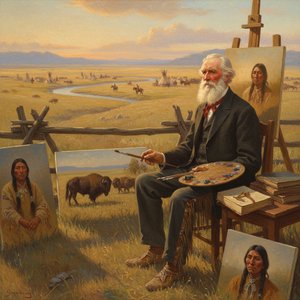
Joseph Henry Sharp: Capturing the Spirit of the Plains – Life, Art & Legacy
Explore the life & art of Joseph Henry Sharp, a founding member of the Taos Society of Artists renowned for his realistic depictions of Native American culture and Western landscapes. Discover his legacy with TopImpressionists.
Explorez des œuvres d'art classées par thèmes, styles et caractéristiques.
