Envoyer
 Partager
 Détails de l'œuvre
 Guide
Guide

 Télécharger l'image
 Articles similaires
 Diaporama
 Statistiques
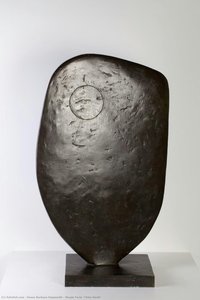
Shaft and Circle


Admire Barbara Hepworth's iconic 'Shaft and Circle' sculpture – a striking abstract form embodying balance & harmony through clean lines and organic shapes, reflecting modernist principles.
 Lire la suite
Découvrez Barbara Hepworth (1903-1975), pionnière de la sculpture britannique moderne ! Explorez ses œuvres abstraites, dont 'Oval Form' et 'Two Forms', au Hepworth Wakefield.
L’œuvre d'art présentée sur cette page est protégée par le droit d'auteur, ce qui signifie que nous ne pouvons légalement créer ou vendre de reproduction identique. Cette protection est appliquée en vertu d'accords internationaux tels que la Convention de Berne et par les lois nationales, notamment celles énoncées par le Loi américaine sur le droit d'auteur - Titre 17.
Cette méthode est pleinement conforme aux réglementations sur le droit d'auteur car elle ne repose pas sur la copie ou la duplication de l'œuvre protégée. Il s'agit plutôt d'une réinterprétation créative — une nouvelle peinture qui s'inspire de l'original sans pour autant lui être identique.
Giclées et impressions d'art
Impressions giclées ou sur toile de qualité musée, avec une production rapide et des finitions au choix. ( Commander la reproduction peinte à la main Passer au format numérique)




































Format standard
sur mesure
CM
INCH
Choisissez parmi nos formats prédéfinis qui respectent les proportions originales de l’œuvre.
Loading sizes...

largeur
hauteur
Saisissez la largeur et la hauteur souhaitées pour qu'elles s'adaptent à votre cadre ou à votre mur. Une impression peut être recadrée, mais jamais agrandie au-delà de l'image originale ; ainsi, un format de forme différente entraînera la perte d'une partie de l'image. Nous vous envoyons une maquette numérique pour approbation avant toute impression. L'image présentée sur cette page ne montre pas le recadrage réel — seule la maquette le permet.
Livraison dans le monde entier () en 2 semaines au lieu des 4/5 semaines habituelles. (28 octobre)

Livraison express gratuite dans le monde entier

Toile de lin de qualité supérieure

Assurance transport complète

Garantie de remboursement des droits de douane

Garantie de fidélité des couleurs

Politique de retour de 100 jours (uniquement en cas de défaut)

Garantie de remboursement à 100%

Offre de tarifs dégressifs
 L'option verre n'est disponible que pour les dimensions inférieures à 110 cm.

Shaft and Circle
Giclées et impressions d'art
Format de la reproduction
-


Prix total
€ 61
A Vertical Echo: Barbara Hepworth’s “Shaft and Circle”
Barbara Hepworth's "Shaft and Circle," created in 1972, isn’t merely a sculpture; it’s an invitation to quiet contemplation. Standing before this arresting form – a towering shaft of polished concrete punctuated by a perfectly circular aperture – is akin to entering a sacred space. The piece immediately commands attention with its stark simplicity and the profound sense of upward movement it evokes. Hepworth, a pivotal figure in 20th-century British sculpture, masterfully distilled her signature style into this work: an exploration of form’s inherent qualities, divorced from representational concerns. It's a testament to her belief that sculpture could be experienced not just visually, but through touch and the subtle shifts in light and shadow.
The material itself – likely cast concrete, though Hepworth often worked with stone as well – is treated with an almost reverent attention. The surface is flawlessly smooth, reflecting the surrounding environment while simultaneously maintaining a sense of contained solidity. This deliberate contrast between smoothness and mass speaks to the core of Hepworth’s philosophy: she sought to capture the essence of materials themselves, revealing their inherent textures and geometries. The scale of the sculpture – approximately six feet tall – further amplifies this effect, drawing the viewer upwards into its embrace.
Roots in Epirus and Mycenaean Tradition
To fully appreciate “Shaft and Circle,” it’s crucial to understand Hepworth's artistic lineage. Her early influences stemmed from her travels through Italy and Greece, particularly a deep immersion in the archaeological sites of Mycenae. The shaft tomb tradition prevalent in Bronze Age Greece – elaborate burial chambers dug vertically into the earth, often containing grave goods – provided a foundational inspiration for her work. These tombs, built by elite societies, weren’t simply markers of death; they were statements of power and belief, reflecting a complex cosmology centered around ancestry and the afterlife. Hepworth's sculpture echoes this spirit, suggesting an upward journey towards something beyond the material world.
Interestingly, similar shaft tombs have been found in Bronze Age China, demonstrating a surprisingly widespread cultural practice across Eurasia. This shared heritage underscores the universal human impulse to create enduring monuments and explore questions of mortality and transcendence. Hepworth’s work can be seen as a contemporary reimagining of these ancient traditions, translated into the language of abstract form.
The Language of Form: Circularity and Verticality
The composition of “Shaft and Circle” is meticulously balanced between two fundamental principles: verticality and circularity. The shaft itself rises directly upwards, creating a powerful sense of momentum and aspiration. This upward thrust is counterbalanced by the perfectly formed circle cut into its midsection – an element that introduces ambiguity and invites interpretation. The circle can be seen as representing wholeness, continuity, or perhaps even a portal to another dimension. It’s a subtle yet potent symbol that adds layers of meaning to the sculpture's overall impact.
Hepworth was deeply interested in exploring the relationship between form and space. She believed that sculpture should not simply occupy physical space but also create an emotional resonance within the viewer. “Shaft and Circle” achieves this beautifully, prompting a sense of stillness and introspection. The negative space created by the circular aperture is just as important as the solid mass of the shaft itself, contributing to the sculpture’s dynamic balance.
A Legacy of Minimalism and Emotional Resonance
“Shaft and Circle” exemplifies Hepworth's commitment to minimalism and her profound understanding of materials. It’s a work that rewards careful observation and invites repeated contemplation. Her sculptures, often described as “non-objective,” are nonetheless deeply expressive, communicating complex ideas about form, space, and the human condition. Today, "Shaft and Circle" remains a powerful testament to Hepworth's artistic vision – a timeless exploration of fundamental geometric principles and their capacity to evoke profound emotional responses.
Questions et réponses
Quel âge avait Barbara Hepworth lors de la création de « Shaft and Circle » ?
Barbara Hepworth a réalisé « Shaft and Circle » à l'âge de 69. L'artiste est né en 1903 et l'œuvre date de 1972.
D'où viennent les visiteurs de «Shaft and Circle» de Barbara Hepworth ?
Une page Statistiques est disponible pour « Shaft and Circle ». Elle présente l'évolution mensuelle des visites de l'œuvre ainsi que des autres créations de l'artiste, avec une répartition par pays et par langue.
« Shaft and Circle » est-il représentatif de l'œuvre habituelle de Barbara Hepworth ?
Les thèmes récurrents de Barbara Hepworth incluent abstraction, modernism, geometry, surrealist, exploration, balance, harmony, sculptural form ; « Shaft and Circle » se concentre sur sculpture, abstraction, form, circle, geometric, modernism, balance.
Biographie de l'artiste
Premières années et formation
Dame Barbara Hepworth, une artiste et sculptrice anglaise de renom, est née le 10 janvier 1903 à Wakefield, dans le Yorkshire. Elle a fréquenté la Leeds School of Art à partir de 1920 puis a remporté une bourse du comté pour étudier à la Royal College of Art (RCA) à Londres de 1921 jusqu'à ce qu'elle obtienne le diplôme en 1924.Carrière artistique
- L’œuvre de Dame Barbara Hepworth exemplifie le modernisme, en particulier la sculpture moderne. Elle était l'une des rares artistes féminines à atteindre une reconnaissance internationale.
- En 1933, elle a cofondé le mouvement artistique Unit One avec Ben Nicholson, Paul Nash et d'autres, cherchant à unir le surréalisme et l'abstraction dans l'art britannique.
- Le travail précoce de Hepworth était caractérisé par l'abstraction et son implication avec le mouvement artistique parisien, Abstraction-Création.
Œuvres notables et expositions
- Oval Form (Trezion), une sculpture en bronze, fait partie de la collection du Kimball Art Museum à Fort Worth, aux États-Unis. (voir sur TopImpressionists)
- Two Forms, une sculpture, est exposée au Hepworth Wakefield à Wakefield, dans le Yorkshire. (voir sur TopImpressionists)
- Totem, une sculpture en marbre, fait également partie de la collection du Hepworth Wakefield. (voir sur TopImpressionists)
Évolution artistique et influences
L'œuvre de Hepworth a évolué au fil des ans, passant d'abstractions influencées par le cubisme et le surréalisme à des formes plus organiques et abstraites. Son séjour en France dans les années 1930, où elle a rencontré des artistes comme Brancusi et Arp, a été déterminant pour son développement artistique. Elle s’est intéressée aux formes naturelles, notamment celles trouvées dans la mer et le paysage de Cornouailles, où elle a vécu pendant une grande partie de sa carrière.
Héritage et collections muséales
L'œuvre de Barbara Hepworth est largement reconnue, ses sculptures et peintures faisant partie de diverses collections de musées dans le monde. Le Hepworth Wakefield, du nom de l'artiste, abrite de nombreux chefs-d'œuvre d'artistes renommés, dont les propres œuvres de Hepworth. (découvrez davantage sur le Hepworth Wakefield sur TopImpressionists)Conclusion
Dame Barbara Hepworth’s pioneering work in modern British sculpture has left an indelible mark on the art world. Her legacy continues to inspire artists and art enthusiasts alike, with her works remaining a testament to her innovative spirit and artistic genius. more about barbara hepworth on wikipedia
Barbara Hepworth
1903 - 1975 , Royaume-Uni
L'essentiel de l'artiste
- Artistes Influents:
- Brancusi
- Henry Moore
- Ben Nicholson
- Date De Naissance: 10 janvier 1903
- Lieu De Naissance: Wakefield, Royaume-Uni
- Mouvement Artistique: Modernisme, Sculpture abstraite
- Nationalité: Britannique
- Nom Complet: Barbara Hepworth
- Oeuvres Notables:
- Oval Form (Trezion)
- Two Forms
- Totem
Articles connexes

The Beauty of Less: A Sophisticated Guide to the Soul of Minimalist Art and Geometric Harmony
Discover the profound elegance of minimalist art. Explore how geometric abstraction and the beauty of reduction create serene, sophisticated spaces through our expert guide to finding soul and harmony in every line and shape.
Explorez des œuvres d'art classées par thèmes, styles et caractéristiques.