


 Aperçu en situation
 Partager
 Partager
 Détails
 Guide imprimable

 Télécharger
 Articles similaires
 Radiographie
 Voir le diaporama
 Statistiques
Psyche
 Acrylique sur toile
- Art mural
- French Impressionism
 1876
1876 64.0 x 54.0 cm
 Musée Thyssen-Bornemisza
Berthe Morisot’s ‘Psyche,’ painted in 1876, exemplifies Impressionism’s focus on domestic scenes and fleeting light. This masterpiece portrays a woman contemplating her reflection before a mirror, bathed in soft illumination and adorned with subtle details—a testament to Morisot's pioneering spirit and enduring influence within the art world.
 Afficher la suite
Découvrez Berthe Morisot (1841-1895), peintre impressionniste française ! Ses scènes intimes, portraits & paysages captivent par leur délicatesse et modernité.
Giclées et impressions d'art
Impressions giclées ou sur toile de qualité musée, avec une production rapide et des finitions au choix. ( Acheter la peinture faite à la main Passer au format image numérique)




P118B €10

P118H €10

P118W €10

P438Z €10

P508JH €12

P508YH €12

P805H €10

P805Z €10

P919BZ €10

P919G €10

P919XJ €10

P959ZH €10

P968JZ €12

W106C €8

W218G €10

W218JH €8

W218Y €10

W307PJ €10

W316G €10

W316PJ €8

W316Y €10

W398PJ €8

W4111J €10

W500HY €15

W500JH €15

W692G €12

W849H €8

W940BG €15

W953PJ €8




Format standard
personnalisé
CM
INCH
Choisissez parmi nos formats prédéfinis qui respectent les proportions originales de l’œuvre.
Loading sizes...

largeur
hauteur
Vous pouvez saisir vos propres dimensions pour vous adapter à un cadre ou à un espace spécifique. Si la taille sélectionnée ne correspond pas aux proportions de l'image originale, nous recadrerons l'œuvre ou étendrons l'image avec une bordure en miroir ou une couleur unie. Une maquette numérique vous sera envoyée pour approbation avant le début de la production.
Veuillez noter que l'aperçu à l'écran ne reflète pas le recadrage ou l'extension réelle. Seule la maquette montrera avec précision la composition finale.
Bien que des tailles personnalisées soient disponibles, nous vous recommandons de choisir une dimension dans la liste prédéfinie afin de préserver les proportions originales.
Livraison dans le monde entier () en 2 semaines au lieu des 4/5 semaines habituelles. (11 octobre)

Livraison express gratuite dans le monde entier

Toile de lin de haute qualité

Assurance transport complète

Garantie de remboursement des droits de douane

Garantie de fidélité des couleurs

Garantie de retour de 100 jours (uniquement en cas de défaut)

Garantie de remboursement à 100%

Tarifs dégressifs sur quantité
 L'option verre n'est disponible que pour les dimensions inférieures à 110 cm.

Psyche
Giclées et impressions d'art
Format de la reproduction
-


Prix total final
€ 59
Psyche by Berthe Morisot: An Intimate Reflection of Impressionist Vision
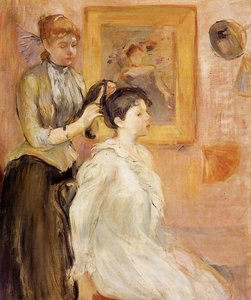
Berthe Morisot’s *Psyche*, painted in 1876, stands as a cornerstone of Impressionism—a movement that revolutionized artistic expression and captured the fleeting beauty of everyday life. Currently housed within the Museo Nacional Thyssen-Bornemisza in Madrid, Spain, this deceptively simple portrait transcends mere representation; it delves into themes of introspection, femininity, and the subtle interplay between light and perception. Morisot’s masterful technique—characterized by loose brushstrokes and a delicate tonal palette—perfectly embodies the Impressionist ethos, prioritizing atmosphere over meticulous detail.Composition and Setting: A Dialogue Between Woman and Mirror
The painting depicts a young woman standing before a dressing mirror, her gaze fixed upon her reflection. Morisot skillfully employs compositional devices to heighten the sense of intimacy and contemplation. The room itself is sparsely furnished—two chairs and a dining table—creating a backdrop that emphasizes the subject’s solitude. However, crucially, two windows flank the mirror, flooding the space with diffused daylight – a hallmark of Impressionist painting. This light isn't merely decorative; it actively shapes the tonal range of the canvas, contributing to the overall mood of quiet serenity and inner reflection. The woman wears a white dress that contrasts sharply with the deep red carpet beneath her feet, drawing the viewer’s eye towards the central figure and reinforcing the symbolic significance of purity against opulent surroundings.Symbolism: Beyond Appearance – Exploring Inner Consciousness
The title *Psyche*, referencing Greek mythology—the soul—immediately establishes a profound connection between the painting's subject and universal themes of psychological exploration. Psyche, in myth, undertakes a perilous journey to retrieve Eros (Cupid), symbolizing love and desire. Morisot’s portrayal captures this essence through her woman’s posture – absorbed in her gaze at her reflection – suggesting an internal preoccupation with self-awareness and emotional experience. The mirror serves as a powerful visual metaphor for confronting one's inner self, mirroring not just physical appearance but also psychological state. Furthermore, the inclusion of the dining table hints at domestic life and perhaps represents the woman’s role within the home—a theme frequently explored by Morisot in her oeuvre.Technique: Delicate Brushstrokes and Luminosity – The Impressionist Legacy
Morisot's brushwork is remarkably fluid and loose, prioritizing tonal variation over precise delineation. She achieves this effect through layering thin washes of paint—a technique known as glazing—allowing light to penetrate deeply into the canvas and creating a luminous quality that captures the ephemeral effects of natural illumination. The artist’s meticulous attention to detail—particularly in rendering the folds of the dress and the texture of the carpet—is balanced by an overall impression of spontaneity and immediacy, reflecting the Impressionist commitment to capturing fleeting moments of experience. Like many Impressionists, Morisot sought to convey not just what she saw but how she felt—a feat accomplished with remarkable grace and sensitivity.Historical Context: Challenging Conventions – A Woman’s Voice in Art
Berthe Morisot's participation in the Impressionist movement was itself a groundbreaking achievement for women artists at the time. Facing considerable societal prejudice, Morisot persevered in pursuing her artistic ambitions alongside Édouard Manet—whom she married—demonstrating unwavering determination and securing exposure to the Parisian art scene. Her work aligns with broader trends of the era – a shift away from academic formalism towards subjective observation and emotional expression—solidifying her place as one of the “tres grandes dames” (the three great ladies) of Impressionism, alongside Marie Bracquemond and Mary Cassatt. *Psyche* remains an enduring testament to Morisot’s artistic vision and her contribution to redefining the boundaries of art history.Questions et réponses
Est-ce que «Psyche» de Berthe Morisot est une œuvre bien connue ?
«Psyche» de Berthe Morisot possède un niveau de popularité Reconnue. Cette classification reflète l'étendue de la reconnaissance de l'œuvre.
À quel artiste est attribuée l'œuvre "Psyche" ?
L'artiste à l'origine de « Psyche » est Berthe Morisot. L'œuvre est répertoriée sous le nom de Berthe Morisot.
À quel âge Berthe Morisot a-t-il créé « Psyche » ?
Lorsque « Psyche » a été créé en 1876, Berthe Morisot — né(e) en 1841 — était âgé(e) de 35 ans.
Comment les couleurs de «Psyche» de Berthe Morisot se rapportent-elles à l'émotion qui s'en dégage ?
La palette Sombre et profond de «Psyche» de Berthe Morisot s'harmonise avec son ton émotionnel Réflexif. La couleur est l'un des moyens par lesquels une œuvre transmet une émotion.
À quelle période de la carrière de Berthe Morisot se situe « Psyche » ?
Au cours de la carrière de Berthe Morisot, « Psyche » s'inscrit dans la période Mature Period. Cette phase permet de le comparer aux autres œuvres de l'artiste.
Où puis-je voir l'original de «Psyche» de Berthe Morisot ?
«Psyche» de Berthe Morisot est exposé au Musée Thyssen-Bornemisza, Madrid, Espagne. La mention du musée se rapporte à l'œuvre originale et non à des reproductions.
En quelle année "Psyche" a-t-il été réalisé ?
«Psyche» date de 1876. Cette date inscrit l'œuvre dans la carrière de Berthe Morisot ainsi que dans son époque.
Œuvres similaires




Biographie de l'artiste
Premières années et débuts artistiques
Berthe Marie Pauline Morisot, peintre française, est née le 14 janvier 1841 à Bourges. Issue d'une famille bourgeoise aisée, son père, Edmé Tiburce Morisot, était préfet du département du Cher. Sa mère, Marie-Joséphine-Cornélie Thomas, était apparentée à Jean-Honoré Fragonard, un peintre rococo renommé.Formation artistique et influences
Berthe, ainsi que ses sœurs Yves et Edma, reçurent des leçons d'art privées de Geoffroy-Alphonse Chocarne et Joseph Guichard. Cela marqua le début de son parcours artistique. En 1857, Guichard les initia aux galeries du Louvre, où elles apprirent en observant et en copiant des tableaux. Elle étudia également avec Corot, ce qui influença sa technique picturale.Évolution artistique et œuvres majeures
Morisot fit ses débuts au Salon de Paris en 1864 avec deux peintures de paysages. Elle continua à exposer régulièrement jusqu'en 1873. En 1874, elle rejoignit les impressionnistes lors de leur première exposition, aux côtés d’artistes tels que Paul Cézanne, Edgar Degas et Claude Monet. Parmi ses œuvres notables figurent :- La Berceuse, un chef-d'œuvre impressionniste capturant l'intimité maternelle.
- Un coin du jardin de roses, une œuvre sereine illustrant la beauté de la nature.
- Des portraits saisissants, comme Femme à la robe verte.
Vie personnelle et héritage
Berthe épousa Eugène Manet, frère de son ami et collègue Édouard Manet. Sa carrière mûrit en 1872 lorsque Durand-Ruel acheta vingt-deux de ses tableaux. Berthe choisit d'exposer sous son nom de jeune fille, témoignant de son indépendance. Elle fut décrite par le critique Gustave Geffroy comme l’une des « trois grandes dames » de l’impressionnisme, aux côtés de Marie Bracquemond et Mary Cassatt. Son œuvre a contribué à la reconnaissance du rôle des femmes dans le mouvement impressionniste et continue d'être célébrée pour sa sensibilité et son observation attentive de la vie quotidienne.Signification historique
Morisot est aujourd’hui reconnue comme une figure essentielle de l’impressionnisme, apportant une perspective féminine unique au mouvement. Ses peintures, souvent centrées sur des scènes domestiques et des portraits intimes, offrent un aperçu précieux de la vie bourgeoise du XIXe siècle. Son travail a influencé les générations suivantes d'artistes femmes et continue d’inspirer par sa délicatesse et son authenticité.
Berthe Morisot
1841 - 1895 , France
En bref
- Artistes Influents:
- Jean-Honoré Fragonard
- Camille Corot
- Édouard Manet
- Date De Décès: 2 mars 1895
- Date De Naissance: 14 janvier 1841
- Lieu De Naissance: Bourges, France
- Mouvement Artistique: Impressionnisme
- Nationalité: Française
- Nom Complet: Berthe Marie Pauline Morisot
- Oeuvres Notables:
- Le Berceau
- Un Coin du Jardin de Roses
- Femme à la toilette
Articles similaires

Les 10 Chefs-d'œuvre Impressionnistes qui ont Révolutionné le Paysage
Plongez dans l'univers vibrant de l'impressionnisme ! Découvrez les 10 chefs-d'œuvre de Monet, Renoir et autres maîtres qui ont révolutionné le paysage. Inspirez votre décoration intérieure avec TopImpressionists.com : reproductions tableaux de qualité muséale.

Les 10 Chefs-d'œuvre Impressionnistes qui ont Révolutionné le Paysage
Plongez au cœur de l'Impressionnisme avec les 10 chefs-d'œuvre qui ont révolutionné le paysage. Découvrez Monet, Renoir et plus encore sur TopImpressionists.com – reproductions d'art de qualité muséale pour sublimer votre intérieur.

Impressionnisme : Top 10 des Œuvres Incontournables pour une Décoration Raffinée
Plongez dans l'univers vibrant de l'impressionnisme avec notre sélection des 10 œuvres les plus emblématiques : Monet, Renoir, Degas… Découvrez l'histoire et la magie de ces chefs-d'œuvre. Reproductions d'art de qualité muséale sur TopImpressionists.com

Impressionnisme : Les 10 Chefs-d'œuvre Incontournables pour une Déco Élégante
Plongez au cœur de l'Impressionnisme avec les 10 chefs-d'œuvre incontournables de Monet, Renoir & Degas. Découvrez l'histoire et la lumière unique de ces peintures célèbres. Reproductions d'art de qualité muséale sur .

Beyond the Shadows: The Powerful Legacies of Artemisia Gentileschi and Berthe Morisot
Explore the profound legacies of Artemisia Gentileschi and Berthe Morisot. Discover how these female masters redefined the Baroque and Impressionist eras through dramatic chiaroscuro and luminous light in this expert art-history guide for collectors and enthusiasts.
Explorez des œuvres d'art classées par thèmes, styles et caractéristiques.


