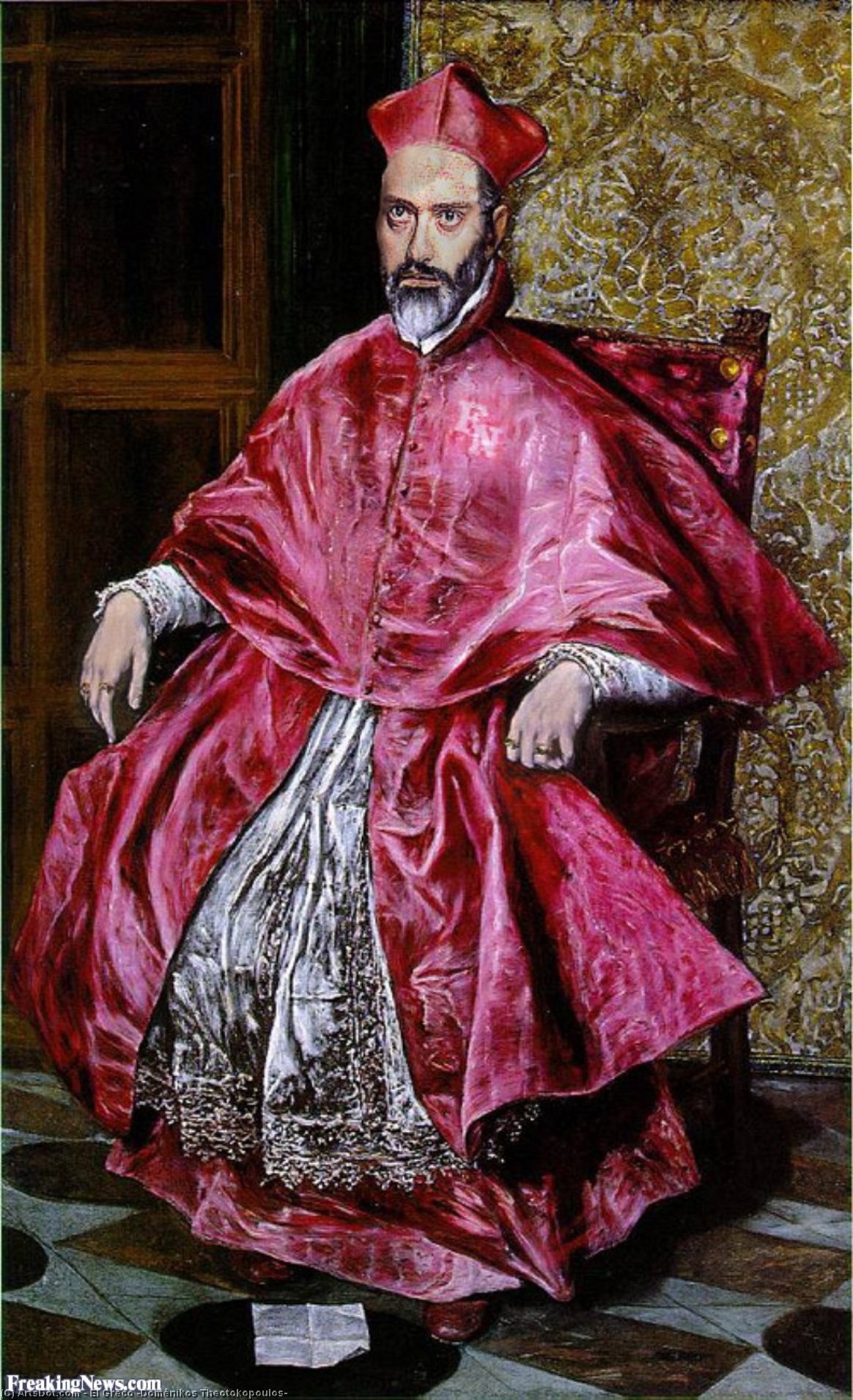
Portrait of Cardinal Tavera: A Masterpiece of Mannerism
El Greco’s “Portrait of Cardinal Tavera,” completed around 1608, stands as one of the artist’s most celebrated achievements and a quintessential example of Mannerist art. This monumental oil painting resides in Toledo’s Museo de El Greco, offering visitors an unparalleled glimpse into the artistic sensibilities of the Spanish Renaissance.
Style and Technique: Doménikos Theotokopoulos—better known as El Greco—revolutionized painting with his distinctive style, characterized by elongated figures, distorted perspectives, and dramatic lighting. In “Portrait of Cardinal Tavera,” he employs a masterful blend of observation and imagination, capturing the cardinal’s likeness while simultaneously elevating it to an almost ethereal realm. The artist utilizes thick impasto – applying paint in textured layers—to imbue the canvas with palpable energy and depth.
Historical Context: Mannerism emerged as a reaction against the harmonious ideals of High Renaissance art, rejecting balance and proportion for expressive distortion and psychological intensity. Toledo during El Greco’s lifetime was a vibrant cultural center under Habsburg rule, attracting artists and intellectuals from across Europe. The painting reflects this intellectual ferment, embodying the artist's preoccupation with spiritual contemplation and conveying a profound sense of solemn dignity.
Symbolism: The cardinal’s attire—a scarlet robe adorned with ermine fur—symbolizes his ecclesiastical authority and prestige. El Greco’s meticulous rendering of the drapery emphasizes movement and dynamism, mirroring the cardinal's inner turmoil and conveying a powerful emotional resonance. The gaze of the cardinal directs upward, suggesting an aspiration towards divine transcendence.
Emotional Impact: “Portrait of Cardinal Tavera” transcends mere representation; it invites contemplation on themes of faith, power, and mortality. El Greco’s masterful use of color—particularly crimson—creates a visual spectacle that captivates the viewer's senses. The painting’s enduring appeal lies in its ability to evoke feelings of awe and reverence, cementing its place as an icon of Mannerist art.
El Greco: A Life Dedicated to Art
Doménikos Theotokópoulos, known universally as El Greco (1541 – 1614), was born in Crete—then under Venetian dominion—and quickly distinguished himself as a prodigious talent within the Byzantine tradition. His formative years instilled in him a rigorous discipline focused on icon painting, where precision and symbolic representation reigned supreme.
Before relocating to Venice and Rome around 1567, El Greco honed his skills in Crete, absorbing influences from Venetian artists like Tintoretto and Titian. These encounters broadened his artistic horizons and fueled his experimentation with innovative techniques—a hallmark of his distinctive style.
Rome became El Greco’s crucible for artistic development; he established a workshop there and produced numerous commissions, integrating Renaissance ideals alongside Mannerist distortions. His unwavering commitment to artistic excellence cemented his legacy as one of the most influential painters of his era.
The Portrait's Significance
“Portrait of Cardinal Tavera” exemplifies El Greco’s profound understanding of human psychology and his ability to convey complex emotions through visual imagery. Unlike many portraits of his time, which prioritized idealized beauty, El Greco sought to capture the cardinal’s inner life—his anxieties, his convictions, and his spiritual yearning.
The painting's dramatic lighting—characteristic of Mannerist aesthetics—creates a theatrical effect that draws the viewer into the scene. The elongated figure—a signature element of El Greco’s style—emphasizes the cardinal’s solemn dignity and underscores the artist’s rejection of Renaissance conventions.
Moreover, “Portrait of Cardinal Tavera” serves as a testament to El Greco's mastery of color and texture. The vibrant crimson robe commands attention, symbolizing papal authority while simultaneously conveying an aura of grandeur. The textured impasto technique—applied with deliberate precision—adds palpable physicality to the canvas.
Exploring El Greco’s Oeuvre
To delve deeper into El Greco's artistic vision and appreciate the breadth of his oeuvre, visit Museo de El Greco in Toledo (Spain). Admire masterpieces like “View of Toledo” and “The Burial of Columbus,” alongside numerous portraits—including “Portrait of Cardinal Tavera”—that showcase the artist’s unparalleled talent.
Discover more about El Greco's life and artistic journey on our website: /art/list/?Filter=85FR9U-El-Greco-(Domenikos-Theotokopoulos)-Portrait-of-Cardinal-Tavera.
We offer hand-made oil paintings reproductions of “Portrait of Cardinal Tavera” on our website: https://TopImpressionists.com/.


 Aperçu en situation
 Passer à la peinture faite à la main
 Envoyer
 Partager
 Détails de l'œuvre

 Télécharger
 Articles similaires
 Radiographie
 Diaporama

 Lire la suite






































 L'option verre n'est disponible que pour les dimensions inférieures à 110 cm.