Aperçu en situation
 Envoyer
 Partager
 Détails de l'œuvre
 Guide
Guide

 Télécharger l'image
 Articles similaires
 Radiographie
 Diaporama
 Questions et réponses
 Statistiques
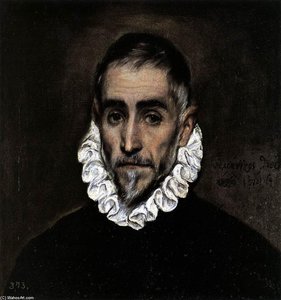
Portrait du Cardinal (Probablement Cardinal Don Fernando Niño de Guevara)

- 171.0 x 108.0 cm


Portrait du Cardinal (Probablement Cardinal Don Fernando Niño de Guevara) peint par El Greco en 1598 : une œuvre emblématique du mélange baroque et byzantin, symbole espagnol et religieux. Découvrez cette magnifique reproduction !
 Lire la suite
Explorez l'art dramatique et expressif d'Él Greco (Doménikos Theotokopoulos). Découvrez ses peintures maniéristes emblématiques, ses thèmes religieux, ses figures allongées et son influence durable sur l'Expressionnisme et le Cubisme. Admirez des chefs-d’œuvre comme 'Vue de Tolède'!
Giclées et impressions d'art
Impressions giclées ou sur toile de qualité musée, avec une production rapide et des finitions au choix. ( Commander la reproduction peinte à la main Passer au format numérique)




P118B €10

P118H €10

P118W €10

P438Z €10

P508JH €12

P508YH €12

P805H €10

P805Z €10

P919BZ €10

P919G €10

P919XJ €10

P959ZH €10

P968JZ €12

W106C €8

W218G €10

W218JH €8

W218Y €10

W307PJ €10

W316G €10

W316PJ €8

W316Y €10

W398PJ €8

W4111J €10

W500HY €15

W500JH €15

W692G €12

W849H €8

W940BG €15

W953PJ €8




Format standard
sur mesure
CM
INCH
Choisissez parmi nos formats prédéfinis qui respectent les proportions originales de l’œuvre.
Loading sizes...

largeur
hauteur
Saisissez la largeur et la hauteur souhaitées pour qu'elles s'adaptent à votre cadre ou à votre mur. Une impression peut être recadrée, mais jamais agrandie au-delà de l'image originale ; ainsi, un format de forme différente entraînera la perte d'une partie de l'image. Nous vous envoyons une maquette numérique pour approbation avant toute impression. L'image présentée sur cette page ne montre pas le recadrage réel — seule la maquette le permet.
Livraison dans le monde entier () en 2 semaines au lieu des 4/5 semaines habituelles. (7 novembre)

Livraison express gratuite dans le monde entier

Toile de lin de qualité supérieure

Assurance transport complète

Garantie de remboursement des droits de douane

Garantie de fidélité des couleurs

Politique de retour de 100 jours (uniquement en cas de défaut)

Garantie de remboursement à 100%

Offre de tarifs dégressifs
 L'option verre n'est disponible que pour les dimensions inférieures à 110 cm.

Portrait du Cardinal (Probablement Cardinal Don Fernando Niño de Guevara)
Giclées et impressions d'art
Format de la reproduction
-


Prix total
€ 62
Portrait of a Cardinal (Probably Cardinal Don Fernando Niño de Guevara)
El Greco’s *Portrait of a Cardinal*, painted in 1598, stands as an emblem of the Spanish Renaissance and a testament to Doménikos Theotokopoulos's singular artistic vision. More than just a depiction of a prominent religious figure—likely Cardinal Don Fernando Niño de Guevara—this oil on canvas masterpiece embodies a fusion of Byzantine spirituality and Florentine humanist ideals, resulting in an image that transcends mere representation. Housed at The Metropolitan Museum of Art in New York City, the painting continues to captivate viewers with its dramatic composition and profound psychological depth.Artistic Style and Technique
The artist’s distinctive style is immediately recognizable through elongated figures—a hallmark of El Greco—and a vibrant palette characterized by intense reds, blues, and yellows. These colors aren't merely decorative; they convey emotion and contribute to the overall sense of dynamism. The technique employed reflects meticulous observation combined with imaginative embellishment. Notice the subtle gradations of light and shadow that sculpt the cardinal’s form, creating an illusionistic depth that draws the eye inward. El Greco skillfully utilizes glazing—applying thin layers of translucent paint over previous coats—to achieve luminous effects and heighten textural richness. This technique was particularly favored by Venetian painters during the Renaissance, demonstrating El Greco's engagement with prevailing artistic trends.Historical Context
El Greco’s formative years were spent in Crete, under Ottoman rule, where he absorbed influences from Byzantine iconography. However, his relocation to Venice around 1567 marked a pivotal moment, exposing him to the burgeoning humanist spirit of the Italian Renaissance and fostering collaborations with artists like Titian and Tintoretto. Subsequently, he settled in Toledo, Spain—a city grappling with religious upheaval during Philip II’s reign—where he produced some of his most celebrated works. The painting reflects this complex historical landscape, capturing a moment of solemn contemplation amidst the grandeur of the Spanish monarchy. Cardinal Niño de Guevara served as Inquisitor General for much of Philip II's reign and was appointed Archbishop of Seville in 1602.Symbolism and Emotional Impact
The cardinal’s attire—a scarlet robe adorned with a hood—symbolizes his ecclesiastical authority and piety. The stern expression on his face conveys seriousness and introspection, inviting viewers to contemplate themes of faith and moral responsibility. Furthermore, the inclusion of two chairs and a book establishes a setting of formality and erudition, reinforcing the cardinal's status as a learned scholar. El Greco’s masterful use of color and gesture communicates an emotional intensity that transcends the literal depiction of the subject. The painting evokes a feeling of solemn grandeur—a visual embodiment of spiritual contemplation—that resonates with audiences centuries later.Relevance in Modern Times
El Greco's influence extends far beyond his own time, inspiring artists across disciplines who sought to express profound emotion and explore psychological complexities. His innovative style foreshadowed movements like Expressionism and Cubism, demonstrating the enduring power of artistic experimentation. The *Portrait of a Cardinal* serves as a reminder that art can communicate universal truths—beliefs, emotions, and aspirations—that transcend cultural boundaries. Its continued presence in The Metropolitan Museum’s collection ensures its legacy as one of the most significant achievements of Renaissance painting.Questions et réponses
Quelle émotion «Portrait du Cardinal (Probablement Cardinal Don Fernando Niño de Guevara)» de Él Greco dégage-t-il ?
«Portrait du Cardinal (Probablement Cardinal Don Fernando Niño de Guevara)» de Él Greco dégage une tonalité émotionnelle Mystérieux.
Quel format choisir pour l'impression de "Portrait du Cardinal (Probablement Cardinal Don Fernando Niño de Guevara)" afin qu'il s'adapte à ma pièce ?
L'association recommandée pour «Portrait du Cardinal (Probablement Cardinal Don Fernando Niño de Guevara)» de Él Greco : une impression de Grand format dans un(e) Salon.
Quelle est la place de «Portrait du Cardinal (Probablement Cardinal Don Fernando Niño de Guevara)» de Él Greco dans l'histoire de l'art ?
«Portrait du Cardinal (Probablement Cardinal Don Fernando Niño de Guevara)» de Él Greco appartient au mouvement Mannerism, durant la période Renaissance. Ensemble, ils confèrent à l'œuvre sa place dans l'histoire de l'art.
Biographie de l'artiste
**Jeunesse et formation**
El Greco (Domenikos Theotokopoulos), un peintre, sculpteur et architecte grec renommé, est né en 1541 à Crète, alors sous domination vénitienne. Son nom de naissance était Domenikos Theotokopoulos. La formation précoce d'El Greco en tant que peintre d'icônes de l'école crétoise, un centre majeur de l'art byzantin post-byzantin, a jeté les bases de ses futurs efforts artistiques.**Évolution artistique et influences**
Le style artistique d'El Greco s'est façonné par ses voyages à Venise et Rome, où il a absorbé les styles maniéristes et du Renouveau, influencé notamment par Tintoret et Titien. Son déménagement à Tolède, en Espagne, en 1577 a marqué une période de création prolifique, donnant naissance à des chefs-d'œuvre tels que La Vue de Tolède et L'ouverture du cinquième sceau.**Œuvres notables et style**
* L'allégorie de l'ordre des Camalodites (méroristique, huile) - témoignant du mélange unique d'El Greco entre les traditions byzantines et les éléments stylistiques occidentaux. * Fable (méroristique, huile) – démontrant son utilisation de choix de couleurs vibrantes et inhabituels. * Giacomo Bosio (méroristique, huile) – mettant en valeur la maîtrise d'El Greco du style méroptique.**Héritage et influence**
Le style dramatique et expressionniste d'El Greco, caractérisé par des figures allongées et une pigmentation fantastique, a été une source d'inspiration pour les poètes et les écrivains. Il est considéré comme un précurseur de l'expressionnisme et du cubisme. Pour en savoir plus sur la vie et les œuvres d'El Greco, visitez [https://TopImpressionists.com/@/el-greco-(domenikos-theotokopoulos)](https://TopImpressionists.com/@/el-greco-(domenikos-theotokopoulos)).- **Consultez les peintures d'El Greco** sur [https://TopImpressionists.com/@@/85fr95-el-greco-(domenikos-theotokopoulos)-allegory-of-the-camaldolite-order](https://TopImpressionists.com/@@/85fr95-el-greco-(domenikos-theotokopoulos)-allegory-of-the-camaldolite-order)
- **Apprenez-en davantage sur la vie et les œuvres d'El Greco** sur [https://en.wikipedia.org/wiki/el_greco](https://en.wikipedia.org/wiki/el_greco)
- **Explorez l'Institut hellénique des études byzantines et post-byzantines**, qui présente une large gamme d'artefacts reflétant le riche patrimoine artistique de Byzance, sur /fr/art/show/art-d3b8bv-fr/

Él Greco
1541 - 1614 , Grèce
L'essentiel de l'artiste
- Artistes Influents:
- Titian
- Tintoretto
- Date De Décès: 1614
- Date De Naissance: 1541
- Influences Artistiques:
- Expressionnisme
- Cubisme
- Lieu De Naissance: Crète, Grèce
- Mouvement Artistique: Manierisme, Renaissance espagnole
- Nationalité: Grecque-Espagnole
- Nom Complet: Él Greco (Doménikos Theotokópoulos)
- Oeuvres Notables:
- Vue de Tolède
- Entombs du Comte d'Orgaz
- Allégorie des Camaldoulins
Articles connexes

Les 25 chefs-d'œuvre incontournables du Musée du Prado à Madrid
Explorez 25 chefs-d'œuvre du Prado, de Velázquez à Goya. Trouvez l'inspiration et des reproductions d'exception sur TopImpressionists.com.

José Gutiérrez Solana: A Chronicle of Spanish Society Through Expressionist Vision
Explore the captivating world of José Gutiérrez Solana, a pivotal Spanish Expressionist painter. Discover his haunting depictions of early 20th-century Spain, influenced by Goya & El Greco. Learn about his key works and lasting legacy.

Les 25 chefs-d'œuvre les plus emblématiques d'El Greco
Explorez les 25 chefs-d'œuvre d'El Greco et le génie du maniérisme. Découvrez ces trésors sur TopImpressionists.com.

El Greco : Spiritualité, Style et Innovation – L'Héritage d'un Maître de la Renaissance
Explorez l'univers fascinant d'El Greco : spiritualité, style révolutionnaire et héritage artistique exceptionnel. Découvrez son œuvre unique et son influence durable sur l'histoire de l'art.

Mannerism Explained: The Dramatic Evolution of Renaissance Art and the Rise of El Greco
Explore the dramatic evolution of Mannerism from High Renaissance perfection to El Greco's spiritual intensity. Discover the history, techniques, and enduring legacy of this transformative era through an expert art-history lens.
Explorez des œuvres d'art classées par thèmes, styles et caractéristiques.