


 Aperçu en situation
 Partager
 Partager
 Détails
 Guide imprimable

 Télécharger
 Articles similaires
 Radiographie
 Voir le diaporama
 Statistiques
Saint Paul
 Acrylique sur toile
- Art mural
- Proto-Renaissance
 1300
1300- Renaissance
 Trésor du Musée de la Basilique Saint-François d’Assise
Découvrez Saint Paul de Giotto Di Bondone : une œuvre emblématique du Proto Renaissance italienne ! Admirez sa révolution naturelle et son émotion profonde dans cette magnifique reproduction.
 Afficher la suite
Découvrez Giotto di Bondone (1267-1337), le peintre et architecte italien révolutionnaire ! Explorez ses fresques proto-renaissance, son naturalisme, sa profondeur émotionnelle et ses œuvres emblématiques telles que la Chapelle Scrovegni. Une figure fondatrice de l'histoire de l'art européen.
Reproduction à l'huile faite à la main
Huile sur toile peinte à la main, avec cadre et dimensions personnalisés, réalisée sur commande par nos artistes. ( Passer au format impression Passer au format image numérique)




P118B €10

P118H €10

P118W €10

P438Z €10

P508JH €12

P508YH €12

P805H €10

P805Z €10

P919BZ €10

P919G €10

P919XJ €10

P959ZH €10

P968JZ €12

W106C €8

W218G €10

W218JH €8

W218Y €10

W307PJ €10

W316G €10

W316PJ €8

W316Y €10

W398PJ €8

W4111J €10

W500HY €15

W500JH €15

W692G €12

W849H €8

W940BG €15

W953PJ €8




Format standard
personnalisé
CM
INCH
Choisissez parmi nos formats prédéfinis qui respectent les proportions originales de l’œuvre.
Loading sizes...

largeur
hauteur
Saisissez la largeur et la hauteur souhaitées, pour s'adapter à votre cadre ou à votre mur. Cette œuvre est peinte à la main ; ainsi, pour un format de forme différente, l'artiste peut peindre un peu plus autour du tableau ou réduire légèrement les bords — c'est vous qui choisissez. Nous vous envoyons une maquette numérique pour approbation avant que la peinture ne commence. L'image présentée sur cette page ne reflète pas le résultat réel — seule la maquette le fait.
Exemples de personnalisation possibles : remplacer un visage par la photo du client ; ajouter un animal de compagnie (par exemple, remplacer un chat par un chien) ; inclure un message caché en arrière-plan ; modifier le paysage ou les éléments de l'arrière-plan.
Après la commande, l’équipe TopImpressionists.com contactera le client par e-mail pour recueillir ses instructions et lui fournira une maquette d’aperçu
Après la commande, l’équipe TopImpressionists.com contactera le client par e-mail pour recueillir ses instructions et lui fournira une maquette d’aperçu
Livraison dans le monde entier () en 3 à 4 semaines au lieu des 5 semaines habituelles. (22 octobre). Aucun compromis sur la qualité.

Livraison express gratuite dans le monde entier

Toile de lin de haute qualité

Assurance transport complète

Garantie de remboursement des droits de douane

Garantie de fidélité des couleurs

Garantie de retour de 100 jours (uniquement en cas de défaut)

Garantie de remboursement à 100%

Tarifs dégressifs sur quantité
 L'option verre n'est disponible que pour les dimensions inférieures à 110 cm.

Saint Paul
Technique de reproduction
Format de la reproduction
-


Prix total final
€ 235
A Glimpse of Divinity: Giotto’s St. Paul
Giotto di Bondone's “St. Paul,” created around 1300, is not merely a depiction of an Apostle; it’s a profound exploration of faith and the nascent humanism that would come to define the Renaissance. This fresco fragment, originally part of a larger cycle adorning the Basilica of Saint Francis in Assisi, offers a captivating encounter with one of Christianity's most pivotal figures. What immediately strikes the viewer is not simply the representation of St. Paul, but the startlingly direct gaze – an invitation to communion that transcends centuries. Giotto doesn’t present us with a distant saint enshrined in ethereal glory; he presents a man, imbued with spiritual authority yet palpably human.
Breaking from Byzantine Tradition
To fully appreciate “St. Paul,” one must understand the artistic landscape of its time. The 13th century was still largely dominated by the Byzantine style – characterized by flattened figures, gold backgrounds, and a focus on symbolic representation over naturalistic depiction. Giotto, however, was at the vanguard of a revolution. While retaining elements like the iconic halo signifying holiness and the rich blue backdrop hinting at the divine realm, he infused his work with an unprecedented sense of volume and emotional depth. Notice how Giotto uses subtle shading to model St. Paul’s face, giving it weight and presence. The delicate rendering of features—the lines around the eyes, the slight parting of the lips—suggest a thoughtful interior life. This was a radical departure from the stylized rigidity of Byzantine art, marking a crucial step towards the realism that would define Renaissance painting.
Symbolism and Spiritual Resonance
The composition itself is carefully considered. The inclusion of smaller figures flanking St. Paul – often interpreted as angels or attendant saints – emphasizes his importance while simultaneously grounding him within a celestial hierarchy. The gold accents, though reminiscent of Byzantine tradition, are used more sparingly and strategically, drawing attention to key elements like the halo and subtly illuminating St. Paul’s face. The very essence of St. Paul’s story—his dramatic conversion on the road to Damascus and his subsequent tireless evangelism—is captured in this single, arresting image. He embodies both strength and humility, a testament to the transformative power of faith. It is important to remember that St. Paul was not one of the original apostles who knew Jesus during his lifetime; he became a pivotal figure *after* the crucifixion, spreading the message to Gentiles across the Roman world.
A Proto-Renaissance Masterpiece for Modern Spaces
Owning a reproduction of Giotto’s “St. Paul” is not simply acquiring a beautiful image; it’s inviting a piece of art history into your home. The painting’s restrained palette and dignified composition make it surprisingly versatile, lending itself well to both traditional and contemporary interiors. Imagine this work gracing a study, a library, or even a dining room – its presence would undoubtedly spark conversation and inspire contemplation. The emotional resonance of the piece—the sense of quiet strength and unwavering faith—can bring a profound sense of peace and serenity to any space. A TopImpressionists reproduction allows you to experience the power of Giotto’s vision firsthand, connecting with a legacy that continues to shape our understanding of art and spirituality.
- Artist: Giotto di Bondone (1267-1337)
- Birth Year: 1267
- Death Year: 1337
- Birth City: Florence
- Birth Country: Italy
- Biography: Giotto di Bondone (c. 1267 – January 1337) was an Italian painter of the Proto Renaissance period, considered one of the most influential artists of his time. He revolutionized painting by introducing naturalism and emotional depth into Christian art, marking a decisive break from Byzantine conventions. His formative years were spent in Assisi, where he apprenticed under Cimabue, absorbing the stylistic influences of Byzantium before forging his own distinctive artistic path.
- Style: Proto Renaissance
- Technique: Fresco Painting
- Medium: Tempera and Pigments on Plaster
- Dimensions: Unknown (Fragment)
- Location: Basilica of Saint Francis, Assisi
Questions et réponses
De quoi est fait « Saint Paul » ?
Le médium de «Saint Paul» de Giotto di Bondone est Acrylique sur toile. Les reproductions visent à restituer l'aspect de cette technique.
Quelle est la teinte dominante de «Saint Paul» de Giotto di Bondone ?
La teinte dominante de «Saint Paul» de Giotto di Bondone est Nuances d'ocre et de sépia. Cette teinte constitue la tonalité de fond de la palette.
Quelle saturation et quelle intensité «Saint Paul» de Giotto di Bondone présente-t-il ?
La couleur de « Saint Paul » présente une saturation de Couleurs subtiles et une intensité de Équilibré.
Biographie de l'artiste
**Une vie d’innovation et de révolution artistique**
Giotto di Bondone, le peintre et architecte italien renommé, a laissé une marque indélébile sur le monde de l’art grâce à ses contributions novatrices aux périodes du proto-renaissance et gothique. Né en 1267 à Florence, en Italie, la vie de Giotto reste quelque peu enveloppée de mystère, mais son héritage artistique est incontestable.**Contributions et innovations artistiques**
L’œuvre la plus célèbre de Giotto, la Chapelle Scrovegni (ou Chapelle Arena) à Padoue, achevée vers 1305, témoigne de son esprit innovant. Cette fresque représentant la vie de la Vierge et la vie du Christ ne se contente pas de démontrer son génie artistique, mais illustre également une capacité narrative qui constituait une rupture significative avec l’approche stylisée byzantine.- Révolutionnant la peinture : L'accent mis par Giotto sur le naturalisme, l'attention aux émotions humaines et l’exploration des figures spatiales et volumétriques dans la peinture ont jeté les bases du développement de l’art occidental qui a suivi.
- Contributions architecturales : Sa commande en 1334 de la commune florentine pour concevoir le nouveau campanile (clocher) de la cathédrale de Florence affirme son double talent d'artiste et d'architecte.
**Œuvres notables et leur signification**
- L’Annonciation : la Vierge recevant le message (voir sur TopImpressionists.com) : un exemple premier du style proto-renaissance de Giotto, caractérisé par son utilisation du naturalisme et son souci du détail.
- La Nativité. Naissance de Jésus (voir sur TopImpressionists.com) : démontre la capacité de Giotto à transmettre des récits complexes à travers ses fresques, une caractéristique de la période proto-renaissance.
- La Madone d’Ognissanti (Madonne dans le majestue) (voir sur TopImpressionists.com) : cette altierpe, commandée à l'église d'Ognissanti à Florence, est un exemple significatif de la peinture sur panneaux de Giotto et de son utilisation de la tempera.
**Héritage et influence**
L’influence de Giotto sur l’art occidental est profonde, jetant les bases du mouvement artistique de la Renaissance. Son accent sur le naturalisme, les émotions humaines et la conscience spatiale dans la peinture a perduré, assurant sa place en tant que figure fondamentale de l'histoire de l'art européen. Explorez davantage des œuvres et l’héritage de Giotto di Bondone sur TopImpressionists.com.
Giotto di Bondone
1267 - 1337 , Italie
En bref
- Artistes Influents: ['Cimabue']
- Date De Décès: 1337
- Date De Naissance: 1267
- Influence Sur Les Artistes:
- Masaccio
- Léonard de Vinci
- Lieu De Naissance: Florence, Italie
- Mouvement Artistique: Proto-Renaissance, Gothique
- Nationalité: Italienne
- Nom Complet: Giotto di Bondone
- Oeuvres Notables:
- Chapelle Scrovegni
- Madone d'Ognissanti
- Fresques de Saint-François
Articles connexes
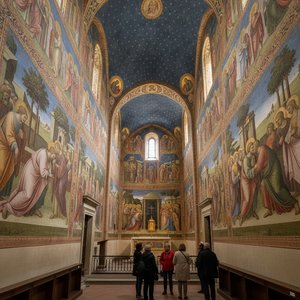
The Proto-Renaissance Revolution: How Giotto Shattered the Mold to Create Modern Visual Impact
Discover how the Proto-Renaissance shattered artistic norms. Explore Giotto’s revolutionary shift from flat Byzantine icons to raw human emotion and naturalism—the true origin of modern visual impact and storytelling in art history.

Giotto di Bondone : Les 25 Chefs-d'œuvre Incontournables pour Embellir Votre Intérieur
Plongez dans l'univers de Giotto di Bondone : découvrez les 25 fresques et chefs-d'œuvre qui ont révolutionné l'art médiéval italien. Explorez son style unique, ses couleurs vibrantes et l'histoire fascinante derrière chaque œuvre. Retrouvez des reproductions d'exception sur TopImpressionists.com.

Paul Klee : Les 25 Œuvres Maîtresses d'un Génie de la Couleur | TopImpressionists
Plongez dans l'univers coloré de Paul Klee ! Découvrez les 25 œuvres maîtresses du peintre suisse, figures clés de l'art abstrait et du Bauhaus. Inspirez votre décoration intérieure avec TopImpressionists.com – reproductions de qualité muséale & collection exclusive.

Proto-Renaissance : 10 Chefs-d'œuvre Révolutionnaires pour une Décoration d'Exception
Plongez au cœur de la Proto-Renaissance avec TopImpressionists.com ! Découvrez 10 chefs-d'œuvre intemporels de Giotto, Cimabue et autres maîtres italiens. Retables gothiques, fresques émouvantes… Trouvez l’inspiration déco & achetez des reproductions d'art exceptionnelles. Explorez la collection sur TopImpressionists

Giotto di Bondone: Revolutionizing Late Medieval Painting through Narrative Innovation
Explore the revolutionary art of Giotto di Bondone! Discover his groundbreaking techniques, iconic frescoes like those in the Arena Chapel, and lasting impact on Renaissance painting. A deep dive for art enthusiasts.
Explorez des œuvres d'art classées par thèmes, styles et caractéristiques.


![Scrovegni - [05] - Le Rêve de Joachim](/media/artworks/images-thumb/8f/67/8f67bb5da87296bd452b3f0b237b528d.jpg)


