Aperçu en situation
 Partager
 Partager
 Détails
 Guide
Guide

 Télécharger
 Articles similaires
 Radiographie
 Voir le diaporama
 Statistiques
Il camoscio morto
 Oil On Canvas
- WallArt
- Divisionist Symbolism Landscape
 19th Century
 101.0 x 75.0 cm
 Galleria d'Arte Moderna
Giovanni Segantini’s ‘Il camoscio morto’ captures a tranquil black and white scene of a dead horse in the hay with birds amidst Divisionist style, evoking serenity and reflecting the artist's alpine landscapes. Discover this poignant artwork or commission a hand-painted reproduction.
 Afficher la suite
Segantini (1858-1899): Maître des paysages alpins! Découvrez ses peintures symbolistes & divisionnistes, capturant la beauté de la nature et la vie rurale.
Giclées et impressions d'art
Impressions giclées ou sur toile de qualité musée, avec une production rapide et des finitions au choix. ( Acheter la peinture faite à la main Passer au format image numérique)




P118B $10

P118H $10

P118W $10

P438Z $10

P508JH $12

P508YH $12

P805H $10

P805Z $10

P919BZ $10

P919G $10

P919XJ $10

P959ZH $10

P968JZ $12

W106C $8

W218G $10

W218JH $8

W218Y $10

W307PJ $10

W316G $10

W316PJ $8

W316Y $10

W398PJ $8

W4111J $10

W500HY $15

W500JH $15

W692G $12

W849H $8

W940BG $15

W953PJ $8




Format standard
personnalisé
CM
INCH
Choisissez parmi nos formats prédéfinis qui respectent les proportions originales de l’œuvre.
Loading sizes...

largeur
hauteur
Vous pouvez saisir vos propres dimensions pour vous adapter à un cadre ou à un espace spécifique. Si la taille sélectionnée ne correspond pas aux proportions de l'image originale, nous recadrerons l'œuvre ou étendrons l'image avec une bordure en miroir ou une couleur unie. Une maquette numérique vous sera envoyée pour approbation avant le début de la production.
Veuillez noter que l'aperçu à l'écran ne reflète pas le recadrage ou l'extension réelle. Seule la maquette montrera avec précision la composition finale.
Bien que des tailles personnalisées soient disponibles, nous vous recommandons de choisir une dimension dans la liste prédéfinie afin de préserver les proportions originales.
Livraison dans le monde entier () en 2 semaines au lieu des 4/5 semaines habituelles. (23 septembre)

Livraison express gratuite dans le monde entier

Toile de lin de haute qualité

Assurance transport complète

Garantie de remboursement des droits de douane

Garantie de fidélité des couleurs

Garantie de retour de 100 jours (uniquement en cas de défaut)

Garantie de remboursement à 100%

Tarifs dégressifs sur quantité
 L'option verre n'est disponible que pour les dimensions inférieures à 110 cm.

Il camoscio morto
Giclées et impressions d'art
Format de la reproduction
-


Prix total final
$ 69
Giovanni Segantini’s ‘Il Camoscio Morto’: A Study in Alpine Melancholy
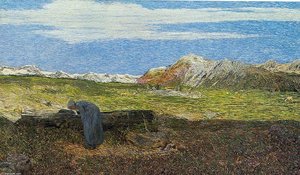
Giovanni Segantini's “Il Camoscio Morto” – "The Dead Chamois" – is a profoundly moving work that transcends the simple depiction of a deceased animal. Painted around 1890, this black and white masterpiece captures a moment of stark beauty within the dramatic landscape of the Italian Alps, revealing Segantini’s unique artistic vision and his deep connection to the natural world. Measuring 101 x 75 cm, the painting immediately draws the viewer into a scene of quiet contemplation, dominated by the slumped form of a chamois – a wild goat native to the region – resting peacefully in a bed of hay.
Divisionism and the Spirit of the Alps
Segantini’s style is inextricably linked to Divisionism, a technique pioneered by artists like Tomás y Bernardez and நிறுவित by William De Morgan. Rather than blending colors on the palette, Divisionists meticulously applied tiny dots or strokes of pure color – achieved through layering multiple glazes – allowing the viewer's eye to optically blend them. This method creates an ethereal luminosity and a remarkable sense of depth and texture, particularly evident in the rendering of the hay, the chamois’s fur, and the distant mountain peaks. Segantini’s approach wasn’t merely about technical skill; it was a deeply spiritual one, reflecting his belief that nature possessed a divine quality. He sought to capture not just what he saw, but how light itself interacted with the landscape – a pursuit central to Divisionist philosophy.
Symbolism of Loss and Resilience
The image of the dead chamois is laden with symbolic weight. The animal’s stillness suggests vulnerability and mortality, yet it's presented within a scene of remarkable serenity. Birds are scattered throughout the composition – some perched on the hay, others taking flight – representing both mourning and renewal. This juxtaposition speaks to the cyclical nature of life and death, a recurring theme in Segantini’s work. The chamois itself, a symbol of strength and agility in its natural habitat, now lies vulnerable, prompting reflection on the fragility of existence. The setting, a remote alpine pasture, further emphasizes this sense of isolation and the raw power of nature.
A Painter's Journey: Segantini’s Biography
Giovanni Segantini’s life story is as compelling as his art. Born in Graz, Austria, in 1858, he spent his formative years battling poverty and hardship, including a period of institutionalization following his mother’s death. This challenging upbringing instilled in him an unwavering determination and a profound respect for the simple beauty of the natural world. His self-taught artistic journey, fueled by a deep passion and a meticulous approach to technique, ultimately led to his recognition as one of Italy's most important landscape painters. “Il Camoscio Morto” stands as a testament to his resilience and his ability to transform personal struggles into enduring works of art.
Biographie de l'artiste
Giovanni Segantini : Une Vie Dédiée aux Alpes
- Né: 15 janvier 1858, Arco, Trentin (alors Autriche-Hongrie)
- Décédé: 10 août 1899, Schiavi di Abbemaggiore, près de Sondrio, Italie
Giovanni Segantini était un peintre italien renommé pour ses paysages pastoraux à grande échelle des Alpes. Son histoire est marquée par les difficultés et le triomphe artistique éventuel, aboutissant à un style unique qui mélangeait le divisionnisme avec l'imagerie symboliste.
Première Vie et Difficultés
- Débuts Difficiles : Les premières années de Segantini ont été marquées par la pauvreté. Son père était un commerçant itinérant, laissant sa mère le faire largement seule.
- Orphelinat et Réformatoire : Après la mort de sa mère, il a fui son domicile et s'est retrouvé dans un réformatoire milanais. C'est là qu'un chapelain a reconnu son talent artistique et l'a encouragé à se développer.
- Auto-formation : Malgré une éducation formelle limitée, Segantini a appris à lire et à écrire plus tard dans la vie, démontrant une détermination remarquable.
- Première Carrière : Il a d’abord travaillé comme assistant photographe avant de se consacrer sérieusement à la peinture.
Développement Artistique et Influences
- Formation à l'Académie de Brera : Segantini a suivi des cours à la prestigieuse Académie de Brera à Milan, où il a rencontré des figures influentes du mouvement Scapigliatura. Ce groupe défendait le rejet des conventions artistiques et l’acceptation des réalités brutes de la vie.
- Influences Clés : Son travail a été considérablement influencé par Anton Mauve et Jean-François Millet, qui lui ont été présentés par Vittorio Grubicy de Dragon, devenu son conseiller et son marchand. Ces artistes mettaient l’accent sur le réalisme et les représentations de la vie rurale.
- Divisionnisme : Segantini a adopté une approche picturale divisionniste, qui consistait à appliquer de petites touches ou des coups de couleur pure côte à côte sur la toile. Cette technique visait à créer un mélange optique dans l'œil du spectateur, produisant des effets vibrants et lumineux.
- Symbolisme : Outre le divisionnisme, Segantini a incorporé des éléments symbolistes dans son travail, imprégnant ses paysages de significations plus profondes et de représentations allégoriques de la vie, de la mort et de la spiritualité.
Œuvres Majeures et Thèmes
- Premier Succès : Sa peinture "Le Chancel de Sant'Antonio" a été reconnue pour sa qualité puissante et a été acquise par la Società per le Belle Arti de Milan.
- Paysages Alpine : Segantini est surtout connu pour ses représentations des Alpes, capturant leur grandeur et leur sérénité. Il cherchait à représenter non seulement la beauté physique, mais aussi l'essence spirituelle de ces paysages.
- Peintures Notables : Parmi ses œuvres les plus célébrées figurent :
- Les Deux Mères (Le due Madri) - Une représentation poignante de la maternité et de la vie rurale.
- La Vie (La Vita) – Capture l'essence de la beauté alpine et de la connexion humaine.
- Donna alla fonte (également connue sous le nom d'Alpenlandschaft mit Frau am Brunnen) – Une scène sereine d’une femme près d’une fontaine dans les Alpes.
- Ragazza che fa la calza - Une magnifique peinture symboliste représentant une femme et des moutons.
- Il castigo delle lussuriose – Une représentation obsédante explorant les thèmes de la moralité et de la nature.
- Dernières Années : Il a passé ses dernières années en Suisse, où il a créé certaines de ses œuvres les plus importantes, notamment "Capriolo morto" (Cerf mort), une représentation profondément émouvante de la mortalité.
Héritage et Importance Historique
- Style Artistique Unique : La fusion du divisionnisme et du symbolisme par Segantini a donné lieu à un style distinctif qui le distinguait de ses contemporains.
- Capturer l'Esprit des Alpes : Il est rappelé comme l’un des peintres les plus importants des paysages alpins, réussissant à transmettre leur beauté et leur signification spirituelle.
- Influence sur les Artistes Ultérieurs : Son utilisation innovante de la couleur et de la lumière a influencé les générations d'artistes suivantes.
- Appréciation Continue : Aujourd’hui, les œuvres de Segantini sont exposées dans des musées du monde entier, et son héritage en tant que maître peintre continue d’inspirer les amateurs d’art.

Giovanni Segantini
1858 - 1899 , Autriche-Hongrie
En bref
- Artistes Influents:
- Anton Mauve
- Jean-François Millet
- Date De Décès: 10 août 1899
- Date De Naissance: 15 janvier 1858
- Lieu De Naissance: Graz, Autriche
- Mouvement Artistique: Symbolisme, Divisionnisme
- Nationalité: Italienne
- Nom Complet: Giovanni Segantini
- Oeuvres Notables:
- Le Chancel de Sant'Antonio
- La Vita (Vie)
- Donna alla fonte
- Ragazza che fa la calza
- Il castigo delle lussuriose
- Capriolo morto
Articles similaires

Shadow & Soul: Why Black & White Photography Remains the Ultimate Power Move in Modern Art
Discover why black & white photography remains a powerful force in contemporary art. Explore the impact of light, shadow, and texture through a visual journey of monochrome mastery and learn how to elevate your space with timeless grayscale aesthetics.

Monochrome Visions: Exploring the Aesthetic & Historical Significance of Black & White Photography
Explore the rich history & artistic power of black and white photography. From early techniques to iconic masters like Ansel Adams, discover why monochrome continues to captivate art lovers today. Expert insights for collectors.

Blancs Sublimes : Les 10 Chefs-d'œuvre de la Peinture Révélés par
Plongez dans l'univers fascinant des 10 plus beaux tableaux blancs de l'histoire de l'art ! Découvrez Monet, Whistler, Kandinsky et d'autres maîtres. Inspirez votre décoration intérieure avec : reproductions de qualité muséale en ligne.

Giovanni Segantini: Capturing Alpine Light & Symbolist Visions
Explore the captivating world of Giovanni Segantini, master of Alpine landscapes & Symbolist art. Discover his innovative techniques, allegorical masterpieces like 'La Vita,' and enduring legacy. Learn about this pivotal 19th-century Italian painter.

Les 10 Chefs-d'œuvre Noirs : Peintures Célèbres et Décoration d'Intérieur
Plongez dans l'univers fascinant des 10 plus beaux tableaux noirs de l'histoire de l'art. Découvrez les secrets de Goya, Manet, Rothko et autres maîtres. Inspirez votre décoration intérieure avec !
Explorez des œuvres d'art classées par thèmes, styles et caractéristiques.