

Présenté : · Avec son cadre :
 Aperçu en situation
 Envoyer
 Partager
 Détails de l'œuvre
 Guide
Guide

 Télécharger l'image
 Articles similaires
 Radiographie
 Diaporama
 Questions et réponses
 Statistiques

€ 240
Reproduction à l'huile faite à la main
Huile sur toile peinte à la main, avec cadre et dimensions personnalisés, réalisée sur commande par nos artistes. ( Passer au format impression Passer au format numérique)
Format
·Format standard
sur mesure
CM
INCH
Choisissez parmi nos formats prédéfinis qui respectent les proportions originales de l’œuvre.
Chargement des formats...

largeur
hauteur
Saisissez la largeur et la hauteur souhaitées, pour s'adapter à votre cadre ou à votre mur. Cette œuvre est peinte à la main ; ainsi, pour un format de forme différente, l'artiste peut peindre un peu plus autour du tableau ou réduire légèrement les bords — c'est vous qui choisissez. Nous vous envoyons une maquette numérique pour approbation avant que la peinture ne commence. L'image présentée sur cette page ne reflète pas le résultat réel — seule la maquette le fait.
 En savoir plus
Finition
·
Bords blancs €1

Bords estompés €1

Bords imprimés €1

P118B €10

P118H €10

P118W €10

P438Z €10

P508JH €12

P508YH €12

P805H €10

P805Z €10

P919BZ €10

P919G €10

P919XJ €10

P959ZH €10

P968JZ €12

W106C €8

W218G €10

W218JH €8

W218Y €10

W307PJ €10

W316G €10

W316PJ €8

W316Y €10

W398PJ €8

W4111J €10

W500HY €15

W500JH €15

W692G €12

W849H €8

W940BG €15

W953PJ €8

H24-GOLD €30

H24-SILVER €30

H36-GOLD €45

H36-SILVER €45
Expédié dans un tube de protection, prêt à être encadré par votre professionnel habituel.
Options supplémentaires
optionnelQue comprennent les extras ?
Exemples de personnalisation possibles : Remplacer le visage par la photo du client ; Ajouter un animal (ex: remplacer le chat par un chien) ; Inclure un message caché en arrière-plan ; Modifier le paysage ou les éléments de l'arrière-plan.
Après la commande, l'équipe de TopImpressionists.com contactera le client par e-mail pour obtenir ses instructions et lui fournir un aperçu de la maquette
Après la commande, l'équipe de TopImpressionists.com contactera le client par e-mail pour obtenir ses instructions et lui fournir un aperçu de la maquette
Livraison dans le monde entier () en 3 à 4 semaines au lieu des 5 semaines habituelles. (6 novembre). Aucun compromis sur la qualité.
Vernis de protection
Cartel
Détails de la plaque en bronze gravée
This elegant plaque features the artist's name and the title of the artwork, finely engraved for a timeless presentation.
It is made from bronze with a refined, elegant finish. The text is precisely laser-engraved for a sharp and permanent result. Measuring 9x2 cm, the plaque is compact yet easy to read. It's built to be durable and scratch-resistant, offering a professional, museum-quality look. Mounting is simple thanks to the included adhesive backing.
Détails de la plaque en acrylique transparent
The plaque includes essential engraved details such as the artist's name, the title of the artwork, the date it was created, the type of media used-like oil on canvas or watercolor-a brief description of the piece, and a QR code that links to the complete artwork information.
It is crafted from clear acrylic, offering a sleek, modern appearance. The text is UV-engraved in black to ensure strong visual contrast. With a size of 10x15 cm, it ensures optimal readability. It comes equipped with two metal hooks for secure wall mounting. The plaque is designed to be weather-resistant, making it suitable for various environments, and it includes interactive features that work seamlessly with smartphone scanning.
Détails de la plaque en acrylique noir
This elegant plaque includes engraved information such as the artist's name, the title of the artwork, the date it was created, the type of media used (like oil on canvas or watercolor), a short description of the artwork, and a QR code for quick access to more information.
The plaque itself is made from refined black acrylic with a premium finish. The text is laser-engraved in white for high contrast and readability. Its size is 10x15 cm, designed to be easy to read. It comes with two metal hooks for professional mounting. The design is sleek and fits any interior style. It is also weather-resistant and durable, with built-in digital integration for mobile compatibility.
L'option verre n'est disponible que pour les dimensions inférieures à 110 cm.
 L'option verre n'est disponible que pour les dimensions inférieures à 110 cm.
- Livraison express gratuite dans le monde entier
- Toile de lin de qualité supérieure
- Assurance transport complète
- Garantie de remboursement des droits de douane
- Garantie de fidélité des couleurs
- Politique de retour de 100 jours (uniquement en cas de défaut)
- Garantie de remboursement à 100%
- Offre de tarifs dégressifs


Description de la pièce
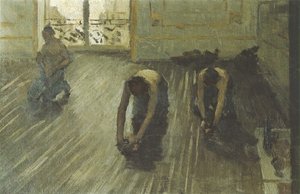
Gustave Caillebotte's 'The Floor Scrapers (study)' captures Parisian laborers with striking realism and light. Explore this iconic Impressionist work depicting urban life, showcasing Caillebotte’s unique perspective.
Biographie de l'artiste
Caillebotte (1848-1894) : Découvrez les peintures réalistes & impressionnistes de cet artiste français, célèbre pour ses scènes parisiennes modernes et perspectives uniques. Admirez 'Les Raboteurs' & son influence!
À propos de l'œuvre
The Floor Scrapers (Study) 02: A Glimpse into Parisian Labor
Gustave Caillebotte’s “The Floor Scrapers (Study) 02,” painted in 1875, isn't merely a depiction of three men diligently working; it’s a meticulously observed and subtly powerful portrait of urban life in late 19th-century Paris. This early work, often considered a pivotal piece in Caillebotte’s artistic development, offers a rare and intimate view into the lives of the city's working class – a subject largely absent from the grand narratives of the era. The painting immediately draws the eye with its stark contrast: the muted tones of the darkened room, punctuated by the bright white of the freshly sanded floorboards, create an almost photographic realism that was revolutionary for its time.
Caillebotte’s artistic journey began with a formal training in law and engineering, but it was his encounter with photography – particularly the work of Nadar – that profoundly shaped his approach to painting. He recognized the power of capturing fleeting moments and precise details, mirroring the photographic process. This influence is evident in the meticulous rendering of the men’s postures, their tools, and the textures of the wood. The composition itself feels deliberately staged, reminiscent of a photograph, with its careful attention to perspective and lighting. The figures are not idealized; they are presented as ordinary laborers, their faces obscured by shadow, emphasizing their anonymity within the bustling city.
Impressionistic Techniques and a Revolutionary Perspective
“The Floor Scrapers” exemplifies Caillebotte’s early embrace of Impressionism, though with a distinct realism that sets him apart from many of his contemporaries. He employed broken brushstrokes to capture the play of light on the wood and the men's clothing, creating a sense of movement and atmosphere. The use of complementary colors – the cool blues and greens of the shadows against the warm browns and yellows of the floor – adds depth and vibrancy to the scene. Notably, Caillebotte’s decision to depict these laborers in a darkened room, bathed in the diffused light of an unseen window, was a bold departure from traditional studio settings. This choice immediately imbued the painting with a sense of immediacy and authenticity.
Furthermore, Caillebotte's innovative perspective—a low-angle shot that emphasizes the scale of the men and their work—was groundbreaking. It forces the viewer to confront the scene directly, fostering a feeling of intimacy and engagement. The composition isn’t about glorifying labor; it’s about presenting it as a fundamental aspect of urban existence. The painting's technical mastery lies in its ability to convey both the physical reality of the work and the emotional weight of the men’s efforts.
Symbolism and Social Commentary
While seemingly straightforward, “The Floor Scrapers” carries subtle layers of symbolism. The act of scraping floors represents a repetitive, demanding task – a symbol of the daily grind endured by countless working-class individuals in Paris at the time. The absence of any discernible hierarchy or leadership among the men suggests a shared experience of labor and resilience. It’s important to note that Caillebotte was one of the first artists to depict urban proletariat, a subject rarely addressed in art during this period. This choice speaks volumes about his desire to challenge conventional artistic norms and offer a more nuanced representation of Parisian society.
The painting's historical context is crucial to understanding its significance. Paris in the 1870s was undergoing rapid industrialization, leading to significant social and economic changes. The working class faced harsh conditions, long hours, and low wages. Caillebotte’s work serves as a poignant reminder of these realities, offering a glimpse into the lives of those often overlooked by history.
A Timeless Reflection on Labor and Urban Life
“The Floor Scrapers (Study) 02” remains a powerful and evocative artwork. It's not just a depiction of three men working; it’s a meditation on labor, poverty, and the human condition. Caillebotte’s meticulous observation, innovative perspective, and subtle symbolism combine to create a work that continues to resonate with viewers today. Reproductions of this painting offer an opportunity to appreciate Caillebotte's artistic vision and gain a deeper understanding of Parisian life in the 19th century – a testament to the enduring power of art to illuminate social realities.
Questions et réponses
Quelle est la technique utilisée pour "The Floor Scrapers (study) 02" et quel en est le style ?
« The Floor Scrapers (study) 02 » est réalisé en Acrylic On Canvas, dans le style Impressionist Painting.
Existe-t-il une fiche informative sur «The Floor Scrapers (study) 02» de Gustave Caillebotte destinée aux étudiants ?
La page Fiche pédagogique de «The Floor Scrapers (study) 02» de Gustave Caillebotte propose une fiche pédagogique imprimable en deux volets : l'œuvre accompagnée de sa fiche d'identité, une frise chronologique la situant dans la vie de l'artiste, d'autres œuvres de l'artiste, la palette de couleurs mesurée, ainsi que des citations prêtes à être copiées en quatre styles différents.
Quelle couleur domine dans « The Floor Scrapers (study) 02 » ?
La couleur qui prédomine dans « The Floor Scrapers (study) 02 » est le Espresso (#504d40). La couleur dominante est un atout précieux pour harmoniser une œuvre d'art avec un intérieur.
Informations clés et quiz sur l'œuvre
À propos de Gustave Caillebotte

Gustave Caillebotte
1848 - 1894, France
Biographie de l'artiste
Premières années et éducation
Gustave Caillebotte, peintre français, est né le 19 août 1848 à Paris au sein d'une famille de la haute bourgeoisie. Son père, Martial Caillebotte, était l’héritier de l’entreprise familiale de textiles militaires et juge au tribunal de commerce du département de la Seine. L'intérêt précoce de Gustave pour la photographie en tant que forme d'art allait plus tard influencer son style pictural.Carrière artistique
Gustave obtint une licence en droit en 1868, puis un certificat pour exercer le droit en 1870, mais sa véritable passion résidait dans les arts. Il commença à fréquenter l'atelier du peintre Léon Bonnat, où il étudia la peinture sérieusement. Son style, caractérisé par son réalisme, fut influencé par ses collègues impressionnistes, dont Edgar Degas et Giuseppe de Nittis.Œuvres notables et style
* Les Raboteurs de parquet (1875) : Ce chef-d'œuvre précoce, aujourd’hui au musée d'Orsay, met en valeur le mélange unique de réalisme et d'influences impressionnistes de Caillebotte. * Vue des toits (effet de neige) (1878) : Démontre son utilisation de points de vue élevés, une technique peut-être influencée par les estampes japonaises et la photographie. * Boulevard vu d'en haut (1880): Cette œuvre illustre sa capacité à combiner réalisme et techniques impressionnistes pour capturer l’atmosphère urbaine parisienne.Influences et développement artistique
Caillebotte a été influencé par le mouvement réaliste, mais il s'est également inspiré des impressionnistes comme Monet, Renoir et Degas. Son approche unique consistait à combiner une observation précise du monde réel avec les techniques de composition et de couleur des impressionnistes. Il était particulièrement fasciné par la représentation de la vie moderne parisienne, notamment les scènes urbaines et les paysages industriels. Sa maîtrise de la perspective et son utilisation innovante de points de vue élevés témoignent de son intérêt pour la photographie et l'art japonais.Héritage et importance historique
Bien que faisant partie de l’école du réalisme, le style de Caillebotte était fortement influencé par ses pairs impressionnistes. Son œuvre a contribué à élargir les frontières de la peinture moderne en explorant des thèmes tels que la vie urbaine, la technologie et la transformation sociale. Après sa mort, sa collection d'œuvres impressionnistes fut léguée à l’État français, devenant le noyau central de la collection impressionniste du musée d'Orsay. Cette donation a joué un rôle crucial dans la reconnaissance et la popularisation de l'impressionnisme en France et dans le monde entier. Son travail est aujourd'hui considéré comme une contribution significative à l'histoire de l'art moderne, témoignant de son talent unique et de sa vision artistique novatrice.Exposition des œuvres de Caillebotte sur TopImpressionists
Informations clés sur Gustave Caillebotte
- Artistic Movement Or Style: Réalisme et Impressionnisme
- Artists Who Influenced This Artist:
- Léon Bonnat
- Edgar Degas
- Giuseppe De Nittis
- Date Of Birth: 19 août 1848
- Date Of Death: 21 février 1894
- Full Name: Gustave Caillebotte
- Nationality: Français
- Notable Artworks:
- Les Raboteurs de parquet
- Vue de toits (effet de neige)
- Boulevard vu d'en haut
- Un balcon à Paris
- Homme au Fenêtre
- Place Of Birth (City And Country): Paris, France
Explorez des œuvres d'art classées par thèmes, styles et caractéristiques.


Gustave Caillebotte
The Floor Scrapers (study) 02
() ·
Avec son cadre : · Peint à la main à l'huile sur lin
Total