

 Aperçu en situation
 Partager
 Partager
 Détails
 Guide imprimable

 Télécharger
 Articles similaires
 Radiographie
 Voir le diaporama
 Statistiques
Avatar
 Oil On Canvas
- WallArt
- Symbolism
 1916
1916- Modern
 102.0 x 128.0 cm
 Académie Royale Écossaise des Beaux-Arts - Architecture
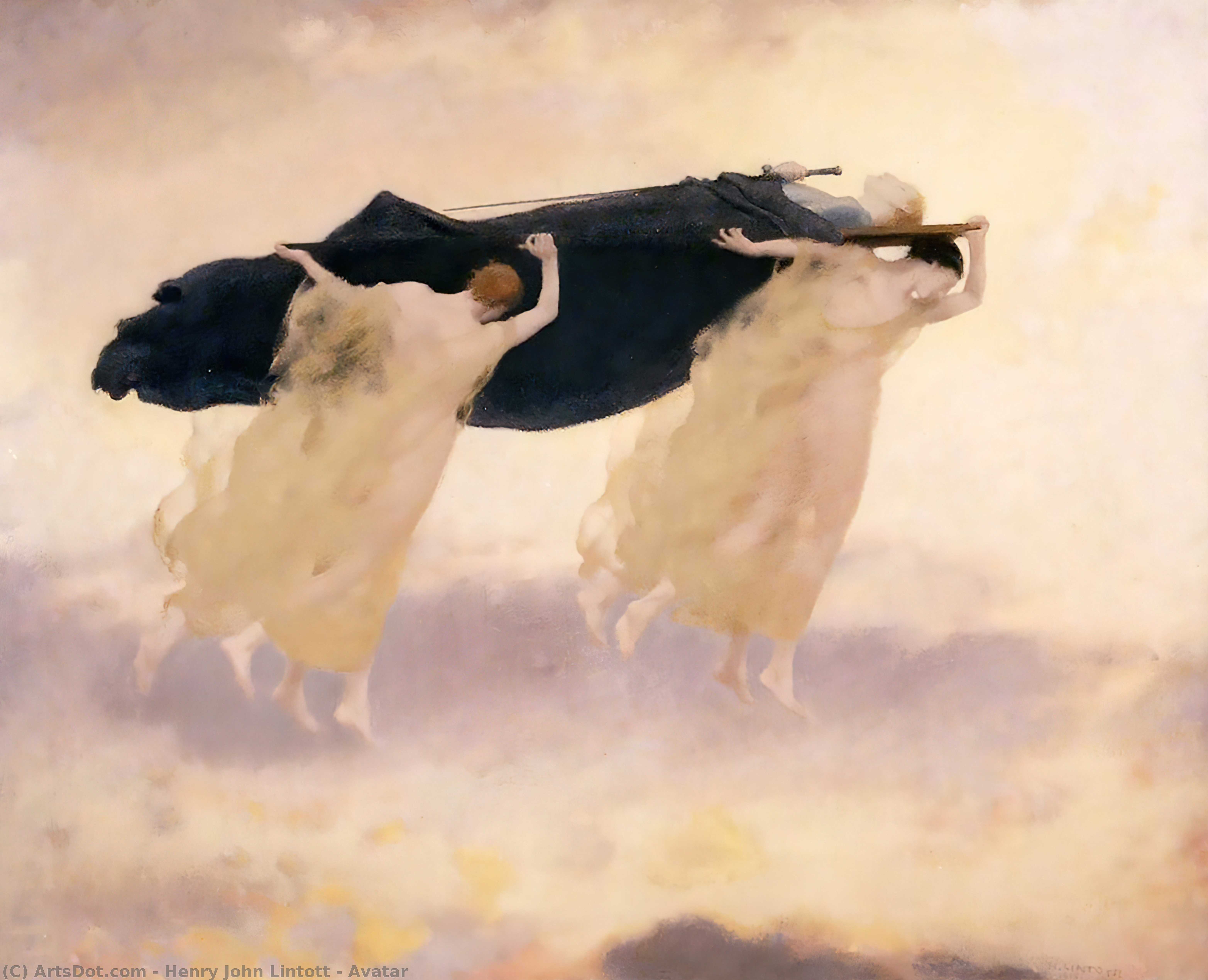
Explore 'Avatar' by Henry John Lintott – a haunting Symbolist painting of three women uniting in strength. Discover its ethereal beauty & British Impressionism at the Royal Scottish Academy.
 Afficher la suite
Découvrez les peintures captivantes de Henry John Lintott ! Explorez ses portraits et paysages reflétant l'impressionnisme britannique. Admirez ses œuvres disponibles et apprenez à connaître cet artiste du XXe siècle.
L’œuvre d'art présentée sur cette page est protégée par le droit d'auteur, ce qui signifie que nous ne pouvons légalement créer ou vendre de reproduction identique. Cette protection est appliquée en vertu d'accords internationaux tels que la Convention de Berne et par les lois nationales, notamment celles énoncées par le Loi américaine sur le droit d'auteur - Titre 17.
Cette méthode est pleinement conforme aux réglementations sur le droit d'auteur car elle ne repose pas sur la copie ou la duplication de l'œuvre protégée. Il s'agit plutôt d'une réinterprétation créative — une nouvelle peinture qui s'inspire de l'original sans pour autant lui être identique.
Giclées et impressions d'art
Impressions giclées ou sur toile de qualité musée, avec une production rapide et des finitions au choix. ( Acheter la peinture faite à la main Passer au format image numérique)




P118B €10

P118H €10

P118W €10

P438Z €10

P508JH €12

P508YH €12

P805H €10

P805Z €10

P919BZ €10

P919G €10

P919XJ €10

P959ZH €10

P968JZ €12

W106C €8

W218G €10

W218JH €8

W218Y €10

W307PJ €10

W316G €10

W316PJ €8

W316Y €10

W398PJ €8

W4111J €10

W500HY €15

W500JH €15

W692G €12

W849H €8

W940BG €15

W953PJ €8




Format standard
personnalisé
CM
INCH
Choisissez parmi nos formats prédéfinis qui respectent les proportions originales de l’œuvre.
Loading sizes...

largeur
hauteur
Saisissez la largeur et la hauteur souhaitées pour qu'elles s'adaptent à votre cadre ou à votre mur. Une impression ne peut être que découpée, elle ne peut jamais être agrandie au-delà de l'image originale ; ainsi, un format de forme différente entraînera la perte d'une partie de l'image. Nous vous envoyons une maquette numérique pour approbation avant toute impression. L'image présentée sur cette page ne montre pas le recadrage réel — seule la maquette le permet.
Livraison dans le monde entier () en 2 semaines au lieu des 4/5 semaines habituelles. (23 octobre)

Livraison express gratuite dans le monde entier

Toile de lin de haute qualité

Assurance transport complète

Garantie de remboursement des droits de douane

Garantie de fidélité des couleurs

Garantie de retour de 100 jours (uniquement en cas de défaut)

Garantie de remboursement à 100%

Tarifs dégressifs sur quantité
 L'option verre n'est disponible que pour les dimensions inférieures à 110 cm.

Avatar
Giclées et impressions d'art
Format de la reproduction
-


Prix total final
€ 61
A Vision of Ethereal Unity
In the vast, misty corridors of art history, few works manage to bridge the gap between the tangible world and the realm of the spirit as gracefully as Henry John Lintott’s 1916 masterpiece, "Avatar." This captivating oil on canvas is not merely a painting; it is a window into a dreamscape where the boundaries of form and shadow dissolve. At its heart, the composition presents three female figures, positioned with a deliberate, rhythmic balance that guides the eye across a landscape of uncertainty. They appear to be engaged in a shared, sacred task, bearing a large, dark, boat-like object that anchors the ethereal scene. There is an undeniable sense of weight and purpose in their movement, yet they seem to glide through a hazy, atmospheric void, as if caught in a moment of suspended animation between heaven and earth.
The style of "Avatar" is a profound dialogue between Symbolism and Romanticism. Lintott eschews the sharp, clinical lines of realism in favor of soft, curvilinear forms and a palette of pale yellows, muted blues, and ghostly whites. The brushwork is loose and evocative, creating a textured surface where light does not strike objects so much as it permeates them. This technique produces a diffused, glowing effect, making the clouds appear to swirl with a life of their own. For the discerning collector or interior designer, this piece offers a sophisticated layer of depth; its lack of rigid boundaries allows it to integrate seamlessly into spaces that value atmosphere and mood, providing a focal point that invites quiet contemplation rather than demanding loud attention.
Symbolism and the Strength of Connection
Beyond its visual beauty, "Avatar" serves as a powerful allegory for human resilience and collective endeavor. The central theme is one of unity. The way the three women work in concert to carry their mysterious burden symbolizes the strength found in solidarity—the idea that even the most daunting journeys through life's shadows are made possible through cooperation. The dark, enigmatic object they carry acts as a profound symbol; it could represent the heavy responsibilities of existence, or perhaps a vessel for the soul navigating the turbulent currents of fate. This tension between the lightness of the angelic figures and the gravity of their task creates an emotional resonance that is both melancholic and deeply inspiring.
Historically, this work reflects Lintott’s position within the Scottish art scene and his exposure to the burgeoning Symbolist movements in London and Paris. As a prominent figure at the Royal Scottish Academy, Lintott was a master of capturing the struggle between light and darkness. In "Avatar," this struggle is not depicted through violent contrast, but through a subtle, atmospheric haze that suggests the ephemeral nature of life itself. To possess a reproduction of this work is to bring a piece of this historical introspection into a modern home—a reminder of the enduring power of connection and the beauty found in the pursuit of common goals.
An Invitation to the Sublime
For those seeking to curate an environment of peace, mystery, or intellectual depth, "Avatar" offers unparalleled inspiration. The painting’s shallow perspective and flattened space create an intimate experience, drawing the viewer into a world where the physical laws of gravity seem secondary to the emotional laws of the spirit. It is a piece that rewards repeated viewing, revealing new nuances in its layered glazes and soft shadows each time the light hits it. Whether placed in a grand gallery-style living room or a quiet study, this reproduction serves as a testament to the timeless allure of the sublime, making it an exquisite choice for anyone looking to infuse their surroundings with a sense of poetic grace and historical significance.
Questions et réponses
À quel sentiment "Avatar" est-il associé ?
Le ton émotionnel relevé pour «Avatar» de Henry John Lintott est Ethereal. Il résume le sentiment exprimé par l'œuvre.
Quel est l'usage recommandé pour une impression de « Avatar » ?
L'utilisation recommandée d'une impression de « Avatar » est Mood.
À quel mouvement artistique appartient «Avatar» de Henry John Lintott ?
« Avatar » est une œuvre de Symbolism. Ce mouvement indique la tradition artistique à laquelle l'œuvre appartient.


Biographie de l'artiste
Henry John Lintott : Un tisserand de rêves écossais
Henry John Lintott (1877-1965) n’était pas un nom qui dominait le monde de l'art de son vivant, pourtant, au sein de la riche tapisserie de la peinture britannique du XXe siècle, particulièrement en Écosse, il demeure une figure d'une importance discrète mais profonde. Bien plus qu'un simple peintre, Lintott fut un éducateur et un mentor, façonnant les trajectoires artistiques de générations entières grâce à son passage au Edinburgh College of Art. Son œuvre — un mélange captivant de portrait, de paysage et de scènes allégoriques — offre un aperçu d'un monde où l'observation est primordiale, où l'émotion est subtilement rendue, et où l'éthéré s'entrelace avec le quotidien.
Né à Brighton, le parcours artistique de Lintott débuta par une formation classique dans l'école locale. Il élargit ensuite ses horizons en étudiant à Londres et à Paris, des expériences qui l'exposèrent sans aucun doute aux courants naissants de l'impressionnisme et du symbolisme. Ce fut son installation au nord, à Édimbourg, en 1902, qui s'avéra décisive, lui permettant d'établir une carrière longue et influente au cœur même du patrimoine artistique écossais. Il accéda rapidement à une position de respect, devenant l'un des membres fondateurs du corps enseignant du Collège, où il passa plus de quatre décennies à cultiver les talents tout en affinant sa propre pratique.
Le langage de l'ombre et de la lumière
Le style de Lintott est immédiatement reconnaissable : un renoncement délibéré aux coups de pinceau audacieux et affirmés au profit d'une technique méticuleusement stratifiée. Il privilégiait une lumière douce et diffuse, employant souvent une palette feutrée dominée par les bleus, les verts et les bruns, créant ainsi une atmosphère de contemplation paisible. Ses paysages ne sont pas de simples représentations de décors ; ils sont imprégnés d'une qualité onirique, comme s'ils étaient perçus à travers un souvenir embrumé ou une vision à moitié oubliée. Cela est particulièrement manifeste dans des œuvres telles que « St Bernard’s Crescent from Studio Window », où la scène urbaine se dissout dans un lavis de couleurs atmosphériques, suggérant à la fois la familiarité et un mystère sous-jacent.
Ses portraits sont tout aussi fascinants. Lintott évitait la formalité conventionnelle souvent associée au portrait pour capturer ses sujets avec une douce intimité. Il semblait rechercher non seulement la ressemblance, mais aussi quelque chose de plus profond — un soupçon de personnalité, d'émotion ou de vie intérieure. Son « Autoportrait », par exemple, révèle un homme mûr réfléchissant sur son propre voyage, le regard empreint d'une dignité tranquille et peut-être d'une touche de mélancolie.
Influences et cercle artistique
Le développement artistique de Lintott fut indéniablement façonné par les mouvements prédominants de son époque : l'impressionnisme et le symbolisme. Cependant, il a su forger sa propre voix distinctive, mêlant ces influences à une sensibilité proprement écossaise. Il fit partie de la « Society of Eight », un groupe d'artistes partageant l'engagement d'explorer l'expérience subjective et de défier les normes artistiques conventionnelles. Ce cercle a favorisé un esprit d'expérimentation et de collaboration, contribuant de manière significative à la scène artistique vibrante d'Édimbourg.
Son influence s'étendit bien au-delà de ses collègues immédiats. Il accompagna une cohorte remarquable de jeunes artistes écossais, notamment Anne Redpath, John Maxwell et William MacTaggart — des artistes qui allaient acquérir une reconnaissance considérable par eux-mêmes. L'accent mis par Lintott sur l'observation, la sensibilité et l'exploration des paysages intérieurs a sans aucun doute joué un rôle crucial dans le façonnement de leurs visions artistiques.
Héritage et résonance éternelle
Si Henry John Lintott n'a peut-être pas connu une célébrité universelle de son vivant, son œuvre continue de résonner auprès des spectateurs d'aujourd'hui. Ses peintures possèdent une beauté sereine et une profondeur émotionnelle qui transcendent le temps. Elles nous invitent à ralentir, à observer attentivement et à contempler les nuances subtiles de la lumière, de la couleur et de la forme. Les National Galleries of Scotland reconnaissent l'importance de Lintott, le décrivant comme « un peintre de portraits, de paysages et de sujets allégoriques », dont la méthode était « lente et méticuleuse » et le style « souvent doux et onirique ».
Son héritage réside non seulement dans les œuvres qu'il a créées, mais aussi dans les artistes qu'il a fait grandir. L'influence de Lintott est visible dans tout le paysage artistique écossais, témoignage de son talent d'éducateur et de sa compréhension profonde du pouvoir du langage visuel. Ses peintures demeurent un rappel poignant que la véritable maîtrise artistique réside souvent dans les moments de silence — les changements subtils de lumière, les émotions indicibles et la beauté durable du monde quotidien.

Henry John Lintott
1877 - 1965 , Royaume-Uni
En bref
- Artistic Movement Or Style: Impressionnisme/Post-impressionnisme britannique
- Artists Or Movements Influenced By This Artist: ['École écossaise']
- Artists Who Influenced This Artist:
- Anne Redpath
- John Maxwell
- William MacTaggart
- Date Of Birth: 1877
- Date Of Death: 1965
- Full Name: Henry John Lintott
- Nationality: Britannique
- Notable Artworks:
- Avatar
- Autoportrait
- St Bernard’s Crescent
- Place Of Birth: Brighton, Royaume-Uni
Articles connexes

Henry Lamb: Reassessing Modern British Primitivism & the Poetics of Discomfort
Explore the compelling work of Henry Lamb, a key figure in British Primitivism. Discover his unsettling portraits, poignant war art & unique artistic vision. A deep dive into his life and legacy.

Henri Matisse : Les 25 Œuvres Maîtresses d'un Génie de la Couleur | TopImpressionists
Plongez dans l'univers vibrant d'Henri Matisse ! Découvrez les 25 œuvres majeures du fauvisme et de la peinture moderne. Explorez La Danse, L'Atelier Rouge & plus encore. Reproductions de qualité musée sur TopImpressionists.com.

John Henry Twachtman: Atmospheric Impressionism & the American Landscape
Explore the captivating landscapes of John Henry Twachtman, a pivotal American Impressionist & Tonalist painter. Discover his artistic evolution, key works, and lasting influence on early 20th-century art.

John Singer Sargent : Les 25 Œuvres Maîtresses d'un Portraitiste Éminent | TopImpressionists
Plongez dans l'univers de John Singer Sargent : découvrez les 25 œuvres qui ont marqué l'histoire de l'art. Portraits impressionnants, réalisme exquis et couleurs vibrantes. Retrouvez ces chefs-d'œuvre en reproduction haute définition sur TopImpressionists.com.

Constable : Les 25 Chefs-d'Œuvre du Maître Anglais | TopImpressionists
Plongez dans l'univers de John Constable avec les 25 œuvres incontournables du maître anglais. Découvrez l'histoire, la technique et l'émotion derrière ses paysages romantiques. Reproductions de qualité muséale sur TopImpressionists.com.